Introduction
Digital Forensics & Incident Response (DFIR) Suites are specialized cybersecurity platforms designed to investigate security incidents, collect and analyze digital evidence, and support rapid response to cyberattacks. These tools help security teams understand how a breach happened, what systems were affected, and how to prevent similar incidents in the future. DFIR suites have become essential due to rising ransomware attacks, cloud-native threats, insider risks, and increasingly complex hybrid IT environments. Modern DFIR platforms combine endpoint forensics, memory analysis, log correlation, and automated incident response workflows into unified systems.
Real-world use cases include:
- Investigating ransomware attacks across enterprise endpoints
- Performing forensic analysis on compromised cloud workloads
- Identifying lateral movement in enterprise networks
- Collecting and preserving digital evidence for compliance audits
- Automating incident containment and response actions
What buyers should evaluate:
- Endpoint and network forensic depth
- Speed of evidence collection and processing
- Cloud and hybrid environment support
- Automation and response orchestration capabilities
- Integration with SIEM, SOAR, and ITSM tools
- Scalability across large enterprise environments
- Chain-of-custody and evidence integrity features
- AI-assisted investigation and anomaly detection
- Security controls like RBAC, encryption, and audit trails
- Usability for both analysts and incident responders
Best for:
Cybersecurity teams, SOC analysts, DFIR specialists, incident response teams, and large enterprises managing sensitive digital infrastructure.
Not ideal for:
Small businesses with minimal security operations, teams without dedicated security staff, or organizations only needing basic antivirus or endpoint protection.
Key Trends in DFIR Suites
- AI-assisted forensic analysis for faster incident reconstruction
- Automation of evidence collection and triage workflows
- Cloud-native DFIR capabilities for hybrid and multi-cloud environments
- Integration with SIEM and SOAR platforms for unified security operations
- Real-time threat hunting with behavioral analytics
- Memory forensics and endpoint detection convergence
- Zero Trust-driven incident response models
- Improved chain-of-custody automation for compliance
- Use of machine learning for attack pattern recognition
- Expansion of cross-platform mobile and IoT forensics
How We Selected These Tools (Methodology)
- Market adoption across enterprise cybersecurity teams
- Depth of forensic analysis and investigation capabilities
- Incident response automation and orchestration features
- Endpoint, network, and cloud coverage completeness
- Integration strength with SIEM, SOAR, and security ecosystems
- Performance in large-scale incident investigations
- Security architecture including encryption and RBAC controls
- AI/ML capabilities for detection and correlation
- Usability for SOC analysts and forensic investigators
- Support maturity and enterprise readiness
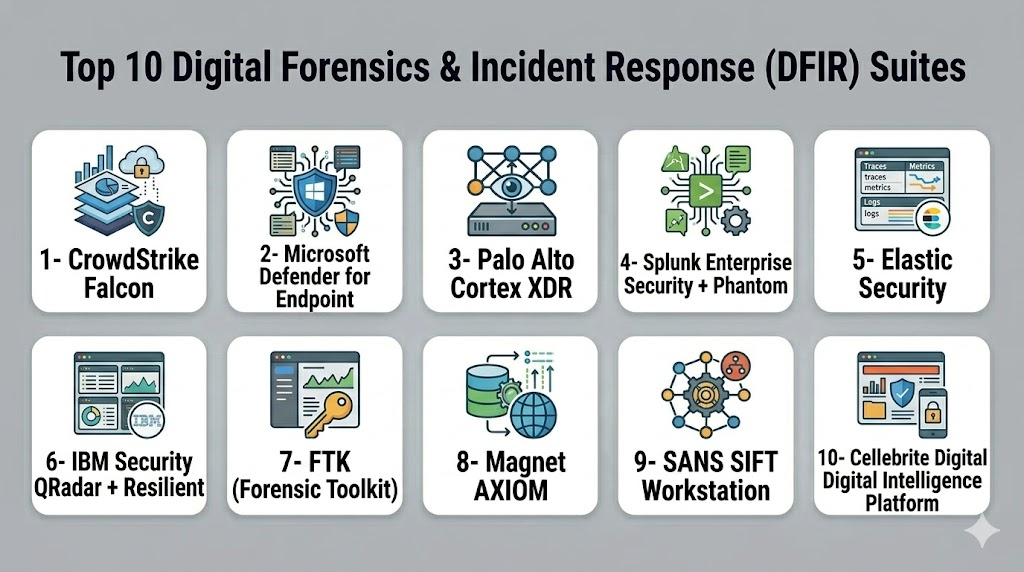
Top 10 Digital Forensics & Incident Response (DFIR) Suites
1- CrowdStrike Falcon Forensics
Short description: Cloud-native endpoint detection and DFIR platform that enables real-time forensic investigation, threat hunting, and incident response across enterprise endpoints.
Key Features
- Endpoint forensic data collection at scale
- Real-time threat detection and response
- Cloud-based investigation console
- Behavioral analytics for attack detection
- File system and memory analysis
- Threat intelligence integration
- Automated containment actions
Pros
- Extremely fast threat detection
- Strong cloud-native architecture
- High scalability for enterprise environments
Cons
- Premium pricing structure
- Requires mature security operations team
Platforms / Deployment
Cloud
Security & Compliance
- RBAC and SSO support
- Encryption in transit and at rest
- Not publicly stated certifications
Integrations & Ecosystem
Deep integration with SIEM, SOAR, and cloud security tools.
- API-based automation
- Threat intelligence feeds
- Security orchestration platforms
Support & Community
Strong enterprise support and global cybersecurity community.
2- Microsoft Defender for Endpoint (DFIR capabilities)
Short description: Enterprise endpoint security and DFIR platform integrated into Microsoft ecosystem for investigation and response.
Key Features
- Endpoint behavioral monitoring
- Automated investigation and remediation
- Threat and vulnerability management
- Advanced hunting queries
- Incident timeline reconstruction
- Cloud-delivered protection
- Integration with Microsoft Sentinel
Pros
- Strong Microsoft ecosystem integration
- Built-in automation capabilities
- Easy deployment in Windows environments
Cons
- Best suited for Microsoft-heavy environments
- Advanced features require configuration expertise
Platforms / Deployment
Cloud
Security & Compliance
- Strong enterprise RBAC
- Encryption and audit logging
- Compliance varies by deployment
Integrations & Ecosystem
- Microsoft 365 security suite
- Azure Sentinel
- API and security tool integrations
Support & Community
Strong enterprise support via Microsoft ecosystem.
3- Palo Alto Cortex XDR
Short description: AI-driven detection and response platform with strong forensic investigation and endpoint analytics capabilities.
Key Features
- Cross-data correlation (endpoint, network, cloud)
- Behavioral analytics engine
- Automated incident investigation
- Root cause reconstruction
- Threat hunting dashboards
- Malware analysis tools
- Endpoint telemetry collection
Pros
- Strong AI-based detection
- Deep cross-layer visibility
- Effective automated investigation
Cons
- Complex configuration for beginners
- Higher cost at scale
Platforms / Deployment
Cloud / Hybrid
Security & Compliance
- RBAC and SSO
- Encryption and secure telemetry
- Not publicly stated certifications
Integrations & Ecosystem
- Palo Alto security ecosystem
- SIEM and SOAR platforms
- API integrations
Support & Community
Strong enterprise cybersecurity support ecosystem.
4- Splunk Enterprise Security + Phantom (SOAR)
Short description: Combined SIEM + SOAR ecosystem enabling advanced DFIR investigations, log correlation, and automated response workflows.
Key Features
- Advanced log correlation engine
- Security incident investigation dashboards
- Automated response workflows
- Threat intelligence integration
- Event reconstruction capabilities
- Behavioral anomaly detection
- Case management system
Pros
- Extremely powerful data analytics
- Strong automation capabilities
- Deep enterprise adoption
Cons
- High complexity
- Expensive infrastructure requirements
Platforms / Deployment
Cloud / Hybrid / Self-hosted
Security & Compliance
- RBAC and audit logs
- Encryption support
- Compliance varies
Integrations & Ecosystem
- Massive SIEM ecosystem
- Security tool integrations
- API-based extensibility
Support & Community
Large enterprise community and strong vendor support.
5- Elastic Security (DFIR Suite)
Short description: Open and flexible DFIR platform built on Elastic Stack for threat detection, forensic analysis, and investigation workflows.
Key Features
- Log-based forensic investigation
- Endpoint security analytics
- Machine learning anomaly detection
- Threat hunting dashboards
- SIEM integration capabilities
- Timeline reconstruction tools
- OpenTelemetry support
Pros
- Highly flexible and customizable
- Strong open-source foundation
- Powerful search capabilities
Cons
- Requires tuning for enterprise scale
- Operational complexity in self-hosting
Platforms / Deployment
Cloud / Self-hosted / Hybrid
Security & Compliance
- RBAC and encryption
- Security modules available
- Compliance varies
Integrations & Ecosystem
- Elastic Stack ecosystem
- Cloud providers
- Security APIs
Support & Community
Strong open-source and enterprise support options.
6- IBM Security QRadar + Resilient
Short description: Enterprise SIEM and incident response platform offering forensic investigation, correlation, and response automation.
Key Features
- Security event correlation
- Incident response automation
- Threat intelligence integration
- Forensic log analysis
- Case management system
- Behavioral analytics
- Compliance reporting
Pros
- Strong enterprise governance
- Powerful correlation engine
- Integrated incident workflows
Cons
- Complex deployment
- Resource-intensive platform
Platforms / Deployment
Cloud / Hybrid
Security & Compliance
- RBAC and audit logging
- Encryption support
- Enterprise compliance frameworks
Integrations & Ecosystem
- IBM security ecosystem
- SIEM/SOAR integrations
- Enterprise APIs
Support & Community
Strong enterprise-grade support from IBM.
7- FTK (Forensic Toolkit) by Exterro
Short description: Dedicated digital forensics platform focused on deep disk, memory, and evidence analysis for investigations.
Key Features
- Disk imaging and analysis
- Email and file recovery
- Memory forensics
- Evidence indexing and search
- Timeline reconstruction
- Data carving tools
- Case management
Pros
- Deep forensic capabilities
- Strong evidence handling
- Widely used in investigations
Cons
- Not a real-time detection tool
- Requires forensic expertise
Platforms / Deployment
Windows / Self-hosted
Security & Compliance
- Chain-of-custody support
- Evidence integrity validation
- Not publicly stated certifications
Integrations & Ecosystem
- Legal and compliance systems
- Forensic workflows
- Export APIs
Support & Community
Strong forensic analyst community and vendor support.
8- Magnet AXIOM
Short description: Advanced DFIR platform for endpoint and mobile forensics with deep evidence analysis capabilities.
Key Features
- Endpoint and mobile device forensics
- Cloud data acquisition
- Timeline reconstruction
- Artifact extraction
- Deep evidence visualization
- Case management tools
- Automated reporting
Pros
- Strong mobile forensics
- User-friendly interface
- Good evidence visualization
Cons
- Expensive licensing
- Resource-heavy processing
Platforms / Deployment
Windows / Hybrid
Security & Compliance
- Chain-of-custody tracking
- Evidence encryption
- Not publicly stated certifications
Integrations & Ecosystem
- Cloud storage systems
- Legal investigation tools
- Export APIs
Support & Community
Strong forensic investigation community and enterprise support.
9- SANS SIFT Workstation
Short description: Open-source digital forensic workstation widely used for investigation, analysis, and incident response.
Key Features
- Pre-configured forensic toolkit
- Disk and memory analysis tools
- Incident response utilities
- Timeline reconstruction tools
- Open-source forensic utilities
- Evidence acquisition support
- Network analysis tools
Pros
- Free and open-source
- Widely adopted in training and labs
- Highly flexible toolkit
Cons
- Requires technical expertise
- Not enterprise-grade automation
Platforms / Deployment
Linux / Self-hosted
Security & Compliance
- Not enterprise-certified
- Depends on configuration
Integrations & Ecosystem
- Open-source forensic tools
- Security research ecosystems
- CLI-based workflows
Support & Community
Strong cybersecurity and academic community.
10- Cellebrite Digital Intelligence Platform
Short description: Specialized DFIR platform focused on mobile device forensics, data extraction, and investigative intelligence.
Key Features
- Mobile device data extraction
- Cloud data acquisition
- Advanced file decoding
- Evidence analysis dashboards
- Cross-device correlation
- Timeline reconstruction
- Investigation reporting
Pros
- Industry-leading mobile forensics
- Strong evidence extraction capabilities
- Trusted in law enforcement
Cons
- Narrower focus (mobile-heavy)
- High specialization required
Platforms / Deployment
Cloud / Hybrid
Security & Compliance
- Chain-of-custody tracking
- Secure evidence handling
- Not publicly stated certifications
Integrations & Ecosystem
- Law enforcement systems
- Digital investigation tools
- API integrations
Support & Community
Strong enterprise and government-focused support.
Comparison Table (Top 10)
| Tool | Best For | Platforms | Deployment | Standout Feature | Public Rating |
|---|---|---|---|---|---|
| CrowdStrike Falcon | Endpoint DFIR | Web | Cloud | Real-time endpoint response | N/A |
| Microsoft Defender | Windows ecosystems | Web | Cloud | Automated investigations | N/A |
| Cortex XDR | AI detection | Web | Cloud/Hybrid | Cross-data correlation | N/A |
| Splunk + Phantom | SIEM + SOAR | Web | Hybrid | Security automation | N/A |
| Elastic Security | Search-based DFIR | Web | Hybrid | Log analytics engine | N/A |
| IBM QRadar | Enterprise SIEM | Web | Hybrid | Event correlation | N/A |
| FTK | Disk forensics | Windows | Self-hosted | Deep forensic imaging | N/A |
| Magnet AXIOM | Digital forensics | Windows | Hybrid | Mobile + cloud forensics | N/A |
| SIFT Workstation | Open-source DFIR | Linux | Self-hosted | Forensic toolkit suite | N/A |
| Cellebrite | Mobile forensics | Web | Hybrid | Mobile extraction | N/A |
Evaluation & Scoring of DFIR Suites
| Tool | Core (25%) | Ease (15%) | Integrations (15%) | Security (10%) | Performance (10%) | Support (10%) | Value (15%) | Total |
|---|---|---|---|---|---|---|---|---|
| CrowdStrike | 9 | 8 | 9 | 9 | 9 | 9 | 7 | 8.6 |
| Microsoft Defender | 8 | 9 | 8 | 9 | 8 | 8 | 8 | 8.3 |
| Cortex XDR | 9 | 7 | 8 | 9 | 9 | 8 | 7 | 8.4 |
| Splunk | 9 | 7 | 9 | 9 | 9 | 8 | 6 | 8.3 |
| Elastic | 8 | 7 | 9 | 8 | 8 | 8 | 8 | 8.1 |
| IBM QRadar | 9 | 6 | 8 | 9 | 8 | 9 | 6 | 8.0 |
| FTK | 8 | 6 | 7 | 9 | 8 | 8 | 7 | 7.7 |
| Magnet AXIOM | 8 | 7 | 7 | 9 | 8 | 8 | 6 | 7.8 |
| SIFT | 7 | 6 | 7 | 7 | 7 | 7 | 10 | 7.4 |
| Cellebrite | 8 | 7 | 7 | 9 | 8 | 8 | 6 | 7.9 |
Which DFIR Tool Is Right for You?
Solo / Freelancer
SIFT Workstation, Elastic Security
Best for learning, research, and lightweight forensic analysis.
SMB
Microsoft Defender, Elastic Security, CrowdStrike (entry tier)
Balanced security visibility and incident response.
Mid-Market
Cortex XDR, Datadog Security modules (ecosystem use), Splunk
Strong automation and correlation capabilities.
Enterprise
CrowdStrike, Splunk, IBM QRadar, Service-driven DFIR stacks
Advanced investigations, governance, and automation.
Budget vs Premium
- Budget: SIFT, Elastic
- Premium: CrowdStrike, Splunk, Cellebrite
Feature Depth vs Ease of Use
- Easy: Microsoft Defender, CrowdStrike
- Deep forensic depth: FTK, Magnet AXIOM, Splunk
Integrations & Scalability
- Strongest ecosystems: Splunk, CrowdStrike, Elastic
Security & Compliance Needs
- Enterprise governance leaders: IBM QRadar, CrowdStrike, Microsoft Defender
Frequently Asked Questions (FAQs)
1. What is DFIR?
DFIR stands for Digital Forensics and Incident Response, focusing on investigating and responding to cyber incidents.
2. How is DFIR different from SIEM?
SIEM collects and correlates logs, while DFIR focuses on deep investigation and evidence analysis after incidents.
3. Do DFIR tools use AI?
Yes, many modern DFIR platforms use AI for anomaly detection and automated investigation.
4. Are DFIR suites cloud-based?
Most modern DFIR tools are cloud or hybrid, though some forensic tools remain on-premise.
5. What data do DFIR tools analyze?
Endpoints, logs, memory dumps, network traffic, and cloud activity.
6. Are DFIR tools expensive?
Enterprise DFIR tools can be costly, especially at large scale.
7. Who uses DFIR tools?
SOC teams, incident responders, forensic investigators, and government agencies.
8. Can DFIR tools prevent attacks?
They help detect, investigate, and respond faster but are not prevention-only tools.
9. What is chain of custody?
It is the process of ensuring digital evidence is preserved and traceable during investigations.
10. What is the biggest challenge in DFIR?
Handling massive data volumes across distributed systems during incidents.
Conclusion
Digital Forensics & Incident Response (DFIR) Suites are essential for modern cybersecurity operations, enabling organizations to investigate breaches, analyze threats, and respond quickly to incidents. As cyber threats become more sophisticated, DFIR tools are increasingly powered by AI, automation, and cloud-native architectures. However, the best DFIR solution depends on your environment, budget, and investigative depth requirements. The most effective approach is to shortlist 2–3 platforms, run controlled incident simulations, and validate integration with your security stack before full deployment.

Find Trusted Cardiac Hospitals
Compare heart hospitals by city and services — all in one place.
Explore Hospitals
DFIR suites are most effective when they streamline both evidence collection and analysis without forcing investigators to jump between too many disconnected tools. In real incident scenarios, the speed of triage and the ability to reconstruct timelines accurately often matter more than having a large set of advanced features.