Introduction
Root Cause Analysis (RCA) Tools are software platforms designed to identify the underlying cause of IT system failures, performance issues, and service disruptions. Instead of only showing alerts, they help teams understand why an issue happened across complex environments. these tools are critical due to distributed cloud systems, microservices, and real-time digital operations. They combine logs, metrics, traces, and events to provide deep diagnostic insights. Many modern RCA tools also use AI and machine learning for faster and more accurate problem detection. This helps reduce downtime, improve system reliability, and speed up incident resolution. Overall, RCA tools are becoming a core part of modern IT operations and AIOps strategies.
Real-world use cases include:
- Diagnosing production outages across microservices environments
- Identifying performance bottlenecks in cloud-native applications
- Correlating logs, metrics, and traces during incident response
- Detecting cascading failures in distributed systems
- Automating post-incident analysis and reporting
What buyers should evaluate:
- Depth of correlation across logs, metrics, and traces
- AI/ML-driven anomaly detection and root cause inference
- Speed of incident resolution and mean-time-to-resolution (MTTR) impact
- Integration with DevOps and ITSM ecosystems
- Scalability for high-volume telemetry data
- Visualization and dependency mapping capabilities
- Automation and remediation support
- Security, RBAC, and compliance readiness
- Ease of deployment and usability
- Cost efficiency at scale
Best for:
IT operations teams, SREs, DevOps engineers, cloud architects, and enterprises managing complex distributed systems where rapid incident resolution is critical.
Not ideal for:
Small static environments, simple single-server applications, or teams that only require basic monitoring dashboards without deep diagnostic capabilities.
Key Trends in Root Cause Analysis Tools
- AI-driven RCA using machine learning for automatic failure identification
- Shift from reactive troubleshooting to predictive incident prevention
- Convergence of observability + RCA + AIOps into unified platforms
- Increased adoption of OpenTelemetry for standardized data ingestion
- Real-time event correlation across logs, metrics, and traces
- Automated incident summarization and postmortem generation
- Self-healing infrastructure triggered by RCA insights
- Cloud-native-first RCA platforms replacing legacy monitoring tools
- Integration of LLMs for natural-language incident investigation
- Cost-aware telemetry processing and intelligent data sampling
How We Selected These Tools (Methodology)
- Market adoption and enterprise usage maturity
- Depth of root cause analysis and correlation capabilities
- AI/ML-based diagnostic intelligence
- Multi-cloud and hybrid infrastructure support
- Integration with DevOps, ITSM, and observability stacks
- Performance under large-scale telemetry ingestion
- Security features including RBAC, encryption, and audit logs
- Visualization quality and dependency mapping accuracy
- Ease of deployment and operational usability
- Fit across SMB, mid-market, and enterprise environments
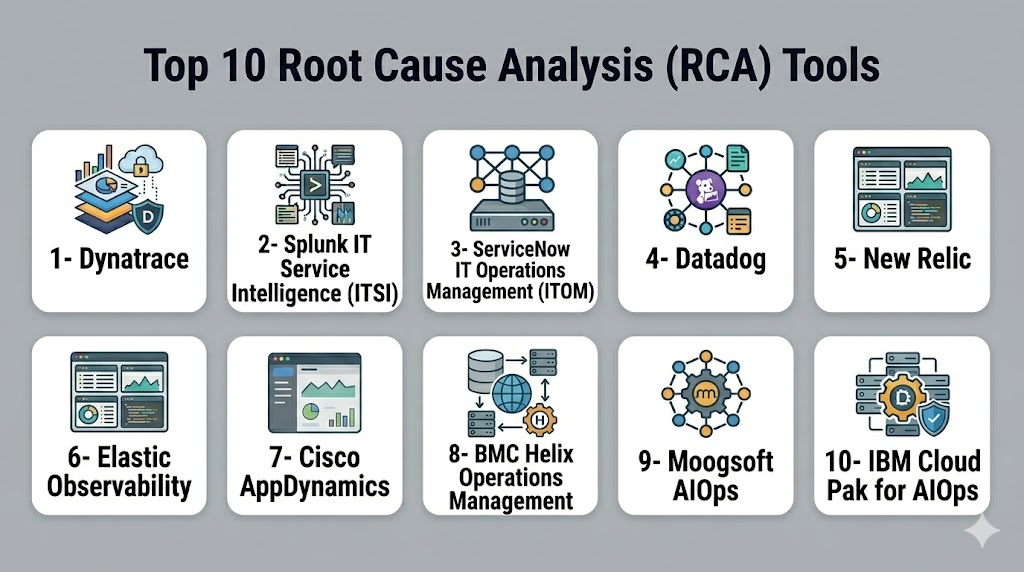
Top 10 Root Cause Analysis (RCA) Tools
1- Dynatrace
Short description: AI-powered observability and RCA platform that automatically identifies root causes of performance issues across full-stack environments. Ideal for large enterprises and cloud-native systems.
Key Features
- Davis AI engine for automated root cause detection
- Full-stack dependency mapping
- Real-time anomaly detection
- Distributed tracing and service flow visualization
- Kubernetes and cloud-native monitoring
- Automatic topology discovery
- Performance bottleneck identification
Pros
- Highly automated RCA capabilities
- Strong AI-driven insights
- Excellent enterprise scalability
Cons
- Complex initial configuration
- Premium pricing model
Platforms / Deployment
Cloud / Hybrid
Security & Compliance
- RBAC and SSO support
- Encryption in transit and at rest
- Not publicly stated compliance certifications
Integrations & Ecosystem
Strong integration ecosystem with AWS, Azure, GCP, Kubernetes, and enterprise ITSM tools.
- API-first architecture
- DevOps pipeline integrations
- Enterprise observability stack compatibility
Support & Community
Strong enterprise support with global documentation and training resources.
2- Splunk IT Service Intelligence (ITSI)
Short description: Enterprise-grade RCA and analytics platform that correlates events, metrics, and logs to identify service-level root causes.
Key Features
- Event correlation and clustering
- KPI-based service monitoring
- Machine learning anomaly detection
- Service health modeling
- Predictive analytics for failures
- Incident intelligence dashboards
- Dependency mapping
Pros
- Powerful log and event correlation
- Strong enterprise adoption
- Flexible data ingestion
Cons
- High operational complexity
- Expensive at scale
Platforms / Deployment
Cloud / Hybrid / Self-hosted
Security & Compliance
- RBAC and audit logs
- Encryption capabilities
- Compliance varies by deployment
Integrations & Ecosystem
- Extensive enterprise integrations
- API-based customization
- Strong SIEM ecosystem alignment
Support & Community
Enterprise support with strong technical community adoption.
3- ServiceNow IT Operations Management (ITOM)
Short description: IT operations and RCA platform combining CMDB-driven dependency mapping with AIOps capabilities for enterprise environments.
Key Features
- CMDB-based service mapping
- AI-driven incident correlation
- Predictive failure detection
- Workflow automation
- Infrastructure dependency analysis
- Event management engine
- Root cause identification workflows
Pros
- Strong ITSM integration
- Excellent enterprise automation
- High governance control
Cons
- Complex implementation
- High cost structure
Platforms / Deployment
Cloud / Hybrid
Security & Compliance
- Enterprise RBAC
- Audit logging and governance controls
- Compliance varies
Integrations & Ecosystem
Deep integration with ServiceNow ecosystem and enterprise IT tools.
- ITSM workflows
- API integrations
- Enterprise application connectivity
Support & Community
Strong enterprise consulting and support ecosystem.
4- Datadog
Short description: Cloud-native observability platform with strong RCA capabilities through unified logs, metrics, and traces correlation.
Key Features
- Unified observability data platform
- Real-time anomaly detection
- Distributed tracing correlation
- Infrastructure and application monitoring
- Log analytics for incident diagnosis
- Service dependency mapping
- AI-based alerting
Pros
- Fast deployment and usability
- Strong cloud-native support
- Excellent integrations
Cons
- Cost increases with scale
- Advanced RCA requires tuning
Platforms / Deployment
Cloud
Security & Compliance
- RBAC and SSO
- Encryption in transit and at rest
- Not fully publicly detailed compliance list
Integrations & Ecosystem
- AWS, Azure, GCP
- Kubernetes ecosystems
- CI/CD tool integrations
Support & Community
Strong enterprise support and active developer community.
5- New Relic
Short description: Full-stack observability platform providing performance monitoring and RCA insights across distributed systems.
Key Features
- Full-stack telemetry collection
- Distributed tracing analysis
- AI-assisted anomaly detection
- Service-level performance monitoring
- Log and metric correlation
- User experience tracking
- Custom dashboards
Pros
- Easy onboarding
- Strong developer experience
- Good visibility across stacks
Cons
- Pricing complexity
- Advanced features require configuration
Platforms / Deployment
Cloud
Security & Compliance
- SSO and RBAC
- Encryption support
- Compliance varies
Integrations & Ecosystem
- Kubernetes and cloud providers
- DevOps tools
- API integrations
Support & Community
Strong documentation and enterprise support options.
6- Elastic Observability
Short description: Search-based observability and RCA platform using Elasticsearch for deep log correlation and troubleshooting.
Key Features
- Log-based RCA analysis
- Distributed tracing support
- Machine learning anomaly detection
- Real-time search and analytics
- Infrastructure monitoring
- Dashboard visualization
- OpenTelemetry support
Pros
- Extremely powerful log search
- Flexible deployment options
- Strong open-source foundation
Cons
- Requires tuning and expertise
- Resource-intensive at scale
Platforms / Deployment
Cloud / Self-hosted / Hybrid
Security & Compliance
- RBAC support
- Encryption capabilities
- Compliance varies
Integrations & Ecosystem
- Elastic Stack ecosystem
- Cloud integrations
- API-first architecture
Support & Community
Strong open-source community and enterprise support.
7- Cisco AppDynamics
Short description: Application performance and RCA platform focused on business transaction analysis and performance diagnostics.
Key Features
- Business transaction tracking
- Application flow mapping
- Performance anomaly detection
- Infrastructure correlation
- End-user monitoring
- Dependency visualization
- Root cause diagnostics
Pros
- Strong application insights
- Business-focused monitoring
- Enterprise-ready
Cons
- Complex deployment
- Cost considerations
Platforms / Deployment
Cloud / Hybrid
Security & Compliance
- RBAC and encryption
- Enterprise security controls
- Compliance varies
Integrations & Ecosystem
- Cisco ecosystem tools
- Cloud providers
- DevOps integrations
Support & Community
Strong enterprise support via Cisco.
8- BMC Helix Operations Management
Short description: AI-driven operations platform focused on predictive RCA and enterprise incident management.
Key Features
- AI-based event correlation
- Predictive failure detection
- Service impact analysis
- Incident automation
- Hybrid monitoring support
- Root cause workflows
- Performance analytics
Pros
- Strong enterprise automation
- Good predictive capabilities
- Hybrid IT support
Cons
- Complex implementation
- Enterprise pricing model
Platforms / Deployment
Cloud / Hybrid
Security & Compliance
- RBAC and audit logging
- Enterprise governance
- Compliance varies
Integrations & Ecosystem
- ITSM systems
- Cloud platforms
- Enterprise monitoring tools
Support & Community
Enterprise-level support and consulting ecosystem.
9- Moogsoft AIOps
Short description: AI-driven RCA platform focused on event correlation, noise reduction, and incident intelligence.
Key Features
- Event deduplication and clustering
- AI correlation engine
- Incident noise reduction
- Service impact analysis
- Root cause detection workflows
- Real-time alerting
- Automation support
Pros
- Reduces alert fatigue
- Strong event intelligence
- Fast incident correlation
Cons
- Narrower than full observability suites
- Requires integration effort
Platforms / Deployment
Cloud / Hybrid
Security & Compliance
- RBAC support
- Encryption standards
- Compliance varies
Integrations & Ecosystem
- ITSM tools
- Monitoring platforms
- Cloud integrations
Support & Community
Good enterprise support and AIOps-focused community.
10- IBM Cloud Pak for AIOps
Short description: Enterprise AIOps platform delivering AI-powered RCA, automation, and hybrid IT visibility.
Key Features
- AI-driven root cause analysis
- Event correlation engine
- Predictive insights
- Incident automation workflows
- Hybrid infrastructure monitoring
- Service dependency mapping
- ChatOps integration
Pros
- Strong enterprise AI capabilities
- Excellent hybrid support
- Deep IBM ecosystem integration
Cons
- Complex deployment
- Enterprise-focused pricing
Platforms / Deployment
Hybrid
Security & Compliance
- Enterprise RBAC
- Encryption standards
- Compliance varies
Integrations & Ecosystem
- IBM Cloud ecosystem
- Kubernetes and hybrid systems
- ITSM integrations
Support & Community
Strong enterprise support via IBM ecosystem.
Comparison Table (Top 10)
| Tool | Best For | Platforms | Deployment | Standout Feature | Public Rating |
|---|---|---|---|---|---|
| Dynatrace | AI-driven RCA | Web | Cloud/Hybrid | Davis AI engine | N/A |
| Splunk ITSI | Event correlation | Web | Hybrid | KPI-based RCA | N/A |
| ServiceNow ITOM | Enterprise ITSM | Web | Cloud/Hybrid | CMDB correlation | N/A |
| Datadog | Cloud observability | Web | Cloud | Unified telemetry | N/A |
| New Relic | Full-stack monitoring | Web | Cloud | APM insights | N/A |
| Elastic | Log-based RCA | Web | Hybrid | Search analytics | N/A |
| AppDynamics | App performance | Web | Cloud/Hybrid | Transaction mapping | N/A |
| BMC Helix | AIOps RCA | Web | Hybrid | Predictive analytics | N/A |
| Moogsoft | Event intelligence | Web | Cloud/Hybrid | Noise reduction | N/A |
| IBM Cloud Pak | Enterprise AIOps | Web | Hybrid | AI automation | N/A |
Evaluation & Scoring of Root Cause Analysis Tools
| Tool | Core (25%) | Ease (15%) | Integrations (15%) | Security (10%) | Performance (10%) | Support (10%) | Value (15%) | Total |
|---|---|---|---|---|---|---|---|---|
| Dynatrace | 9 | 7 | 8 | 9 | 9 | 9 | 7 | 8.5 |
| Splunk ITSI | 9 | 7 | 9 | 9 | 9 | 8 | 6 | 8.3 |
| ServiceNow ITOM | 9 | 6 | 8 | 9 | 8 | 9 | 6 | 8.0 |
| Datadog | 9 | 8 | 9 | 8 | 9 | 8 | 7 | 8.4 |
| New Relic | 8 | 9 | 8 | 8 | 8 | 8 | 8 | 8.2 |
| Elastic Observability | 8 | 7 | 9 | 8 | 8 | 8 | 8 | 8.1 |
| AppDynamics | 8 | 7 | 8 | 8 | 8 | 8 | 7 | 8.0 |
| BMC Helix | 8 | 6 | 8 | 9 | 8 | 8 | 6 | 7.9 |
| Moogsoft | 8 | 7 | 8 | 8 | 8 | 8 | 8 | 8.0 |
| IBM Cloud Pak | 9 | 6 | 8 | 9 | 8 | 9 | 6 | 8.1 |
Which Root Cause Analysis Tool Is Right for You?
Solo / Freelancer
Elastic Observability, New Relic
Simple setup and cost-efficient RCA capabilities.
SMB
Datadog, New Relic, Elastic
Balanced observability and troubleshooting capabilities.
Mid-Market
Datadog, Dynatrace, AppDynamics
Strong automation and real-time diagnostics.
Enterprise
ServiceNow ITOM, Splunk ITSI, IBM Cloud Pak, BMC Helix
Advanced AI-driven RCA and enterprise governance.
Budget vs Premium
- Budget: Elastic, Moogsoft
- Premium: Dynatrace, Splunk, ServiceNow
Feature Depth vs Ease of Use
- Easy: New Relic, Datadog
- Deep RCA intelligence: Dynatrace, Splunk, IBM
Integrations & Scalability
- Strongest ecosystems: Datadog, Splunk, Elastic
Security & Compliance Needs
- Enterprise-grade governance: ServiceNow, IBM, Dynatrace, BMC
Frequently Asked Questions (FAQs)
1. What is Root Cause Analysis in IT?
It is the process of identifying the underlying reason behind system failures or performance issues.
2. How do RCA tools work?
They correlate logs, metrics, and traces using AI and analytics to find failure patterns.
3. Are RCA tools AI-based?
Most modern RCA tools use AI/ML for anomaly detection and root cause prediction.
4. Do they work in cloud environments?
Yes, they are designed for multi-cloud and hybrid infrastructures.
5. What data do they analyze?
Logs, metrics, traces, events, and dependency graphs.
6. Can they prevent outages?
They help predict issues before they escalate into outages.
7. Are they expensive?
Pricing varies based on scale and data volume.
8. Is implementation difficult?
It depends on system complexity and integration requirements.
9. What is the biggest challenge?
Integrating data from multiple distributed systems.
10. What are alternatives?
Basic monitoring tools, though they lack deep correlation and AI-based diagnosis.
Conclusion
Root Cause Analysis tools are essential for modern IT operations, helping teams move beyond alerting into deep diagnostic and predictive intelligence. They reduce downtime, speed up resolution, and improve system reliability. However, no single tool fits every organization. The best choice depends on infrastructure complexity, budget, and required depth of analytics. A practical approach is to shortlist a few tools, run pilot testing, and validate integration with your existing ecosystem before full adoption.

Find Trusted Cardiac Hospitals
Compare heart hospitals by city and services — all in one place.
Explore Hospitals
RCA tools often look useful for identifying “what failed,” but in real production incidents the harder part is connecting multiple small signals into a single meaningful timeline. If event data is incomplete or scattered across different systems, even the best RCA workflow can lead to conclusions that feel correct but miss the true trigger path.