Introduction
Email Deliverability Tools are software solutions designed to help organizations ensure their marketing, transactional, and operational emails reach recipients’ inboxes reliably. They monitor, analyze, and optimize email sending practices to prevent spam classification, improve inbox placement, and maintain sender reputation. These tools are crucial for marketing teams, customer success teams, and IT departments aiming to maintain consistent email performance.with growing regulations, spam filters, and complex email ecosystems, email deliverability is more critical than ever. Poor deliverability can lead to lost revenue, decreased engagement, and brand reputation issues. Tools that provide insights into sender score, authentication, bounce management, and analytics are vital for modern organizations.
Real-world use cases include:
- Monitoring email campaigns for marketing, newsletters, and promotional content.
- Ensuring transactional emails reach customers, such as confirmations, receipts, and notifications.
- Maintaining corporate email reputation and reducing bounce rates.
- Integrating with CRM and automation platforms to enhance customer engagement.
- Providing analytics and recommendations for improving sender reputation and inbox placement.
Evaluation Criteria for Buyers:
- Accuracy and depth of deliverability analytics.
- Real-time monitoring of inbox placement and spam scoring.
- Integration with email service providers, CRMs, and marketing platforms.
- Authentication checks (SPF, DKIM, DMARC) and domain reputation tools.
- Bounce, complaint, and engagement tracking.
- Ease of setup and reporting dashboards.
- Automation capabilities for alerts and remediation.
- Support for multi-domain or enterprise email environments.
- Security and compliance with email data standards.
- Scalability for high-volume sending.
Best for: Marketing teams, customer success teams, IT administrators, SMBs, mid-market companies, and enterprises with significant email traffic who want to maximize inbox placement and engagement.
Not ideal for: Small businesses or occasional email senders who have minimal email traffic and do not require advanced monitoring or analytics.
Key Trends in Email Deliverability Tools
- AI-driven insights to predict email deliverability issues before they occur.
- Real-time inbox placement and reputation monitoring.
- Automation of authentication checks and alerts for SPF, DKIM, and DMARC failures.
- Increased integration with CRMs, marketing automation, and ESPs for streamlined workflows.
- Detailed analytics on engagement, open rates, and click-through performance.
- Multi-domain and enterprise-level email monitoring for large organizations.
- Cloud-native and API-driven deliverability tools for faster automation.
- Compliance monitoring with GDPR, CAN-SPAM, and other regional regulations.
- Predictive recommendations to improve sender score and engagement.
- Consolidation of spam filter analysis, blacklists, and reputation scoring in a single dashboard.
How We Selected These Tools
- Evaluated market adoption and popularity across SMBs, mid-market, and enterprises.
- Assessed feature completeness including monitoring, analytics, automation, and reporting.
- Reviewed performance signals such as reliability, uptime, and alert accuracy.
- Verified security posture including data handling, encryption, and compliance standards.
- Checked integrations and ecosystem compatibility with ESPs, CRMs, and marketing tools.
- Considered scalability and support for multiple domains or brands.
- Reviewed ease of setup, user interface, and usability for non-technical teams.
- Compared pricing transparency and value for different organizational scales.
- Considered customer support quality, onboarding, and community resources.
- Factored in industry recognition and trust signals for email deliverability reliability.
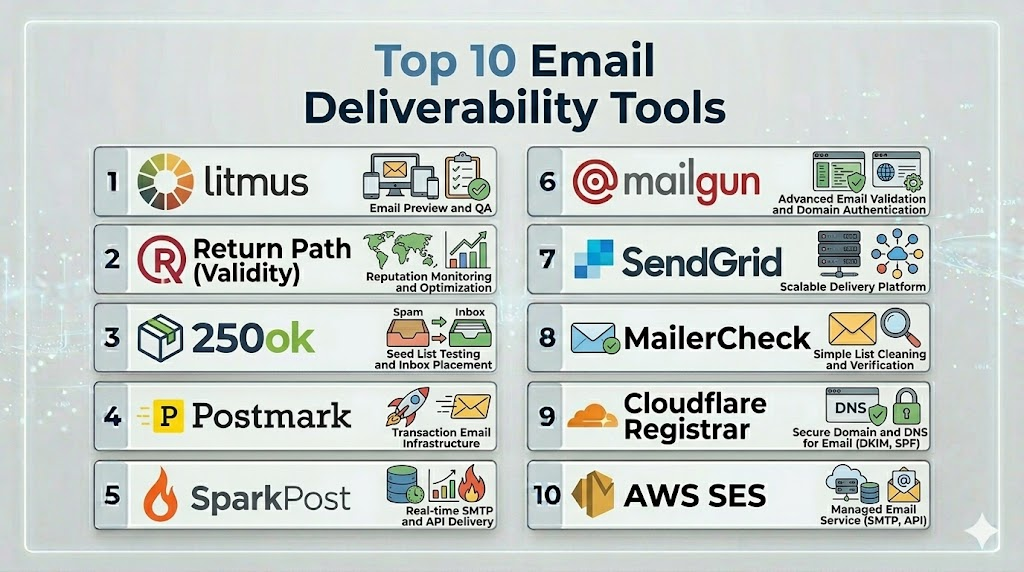
Top 10 Email Deliverability Tools
1- Litmus
Short description:
Litmus is a leading email testing and deliverability platform that helps marketing teams optimize inbox placement and engagement.
Key Features
- Inbox rendering previews across devices and clients.
- Spam filter and deliverability testing.
- Engagement analytics and click tracking.
- Domain reputation insights.
- Automation workflows for pre-send checks.
- Integration with major ESPs and CRMs.
- Email accessibility and compliance checks.
Pros
- Comprehensive pre-send testing.
- Strong analytics and reporting dashboards.
- Enterprise-ready with multi-team support.
Cons
- Pricing may be high for small teams.
- Requires learning for advanced analytics.
- Limited transactional email monitoring.
Platforms / Deployment
Web / Cloud
Security & Compliance
Not publicly stated; provides secure cloud-based dashboard access.
Integrations & Ecosystem
- Major ESPs (Mailchimp, Salesforce Marketing Cloud)
- CRMs (HubSpot, Salesforce)
- Analytics platforms
- Marketing automation tools
Support & Community
Knowledge base, email support, webinars, and active user community.
2- Return Path (Validity)
Short description:
Return Path provides deliverability monitoring and sender reputation management for enterprise email marketers.
Key Features
- Sender score monitoring.
- Inbox placement and spam reporting.
- Blacklist monitoring and remediation.
- Domain and IP reputation tracking.
- Engagement analytics for campaigns.
- Multi-domain monitoring support.
- Integration with ESPs and marketing platforms.
Pros
- Strong reputation management tools.
- Enterprise-grade monitoring.
- Insightful analytics to improve inbox placement.
Cons
- Higher cost for smaller businesses.
- Complex setup for new users.
- Focused primarily on marketing emails.
Platforms / Deployment
Web / Cloud
Security & Compliance
SOC 2 compliant, MFA available for account access.
Integrations & Ecosystem
- ESPs (Marketo, Salesforce Marketing Cloud)
- CRMs and marketing automation platforms
- Analytics dashboards
Support & Community
Enterprise support, documentation, webinars, and training resources.
3- 250ok
Short description:
250ok is an email deliverability and analytics platform designed to monitor sender reputation, inbox placement, and engagement metrics.
Key Features
- Inbox placement monitoring.
- Engagement and performance analytics.
- Domain and IP reputation scoring.
- Feedback loop and spam complaint tracking.
- Automation and alert notifications.
- Integration with ESPs and marketing platforms.
- Customizable reporting dashboards.
Pros
- Detailed analytics and monitoring.
- Alerts for potential deliverability issues.
- Flexible reporting for multiple domains.
Cons
- May require technical setup for full automation.
- Interface can be complex for beginners.
- Some features are enterprise-focused.
Platforms / Deployment
Web / Cloud
Security & Compliance
Supports encryption in transit, not publicly stated for certifications.
Integrations & Ecosystem
- ESPs and CRMs
- Marketing automation
- Analytics tools
- API access for developers
Support & Community
Documentation, email support, and knowledge resources.
4- Postmark
Short description:
Postmark specializes in transactional email deliverability with fast inbox placement and API-driven automation for developers and SaaS platforms.
Key Features
- Real-time transactional email delivery.
- API and SMTP integration.
- Domain reputation monitoring.
- Engagement tracking for sent emails.
- Automation and alert notifications.
- Detailed reporting dashboards.
- DKIM, SPF, DMARC compliance checks.
Pros
- Fast, reliable transactional email delivery.
- Developer-friendly API and integration.
- Detailed engagement insights.
Cons
- Focused mainly on transactional emails.
- Marketing email features are limited.
- Pricing scales with volume.
Platforms / Deployment
Web / Cloud
Security & Compliance
Supports SPF, DKIM, DMARC, TLS; SOC 2 compliant.
Integrations & Ecosystem
- Developer tools (Node.js, Python, PHP)
- SaaS applications
- Analytics dashboards
- API-driven automation
Support & Community
Documentation, email support, community forums, and developer guides.
5- SparkPost
Short description:
SparkPost is a cloud-based email delivery and analytics platform for transactional and marketing emails with strong deliverability tools.
Key Features
- Real-time inbox placement and reputation tracking.
- Analytics for engagement and performance.
- API and SMTP support for developers.
- Bounce and complaint monitoring.
- Multi-domain and IP monitoring.
- Deliverability optimization recommendations.
- Integrates with ESPs and marketing tools.
Pros
- Scalable cloud-based platform.
- Detailed analytics and reporting.
- Strong transactional and marketing email support.
Cons
- Enterprise-focused pricing.
- Requires some technical expertise.
- Learning curve for full analytics usage.
Platforms / Deployment
Web / Cloud
Security & Compliance
SOC 2 compliant; supports TLS, DKIM, SPF, DMARC.
Integrations & Ecosystem
- Marketing platforms
- CRMs and ESPs
- APIs for automation
- Analytics dashboards
Support & Community
Documentation, email support, developer forums, and training webinars.
6- Mailgun
Short description:
Mailgun provides email delivery and deliverability monitoring for developers, SaaS platforms, and enterprises focused on transactional and automated campaigns.
Key Features
- API-driven email sending.
- Deliverability and inbox placement monitoring.
- Domain and IP reputation tracking.
- DKIM, SPF, DMARC support.
- Bounce and spam complaint tracking.
- Webhooks and reporting dashboards.
- Multi-domain support.
Pros
- Developer-friendly with full API support.
- Real-time delivery monitoring.
- Scales for large volumes of transactional emails.
Cons
- Marketing email features limited.
- Interface can be technical for non-developers.
- Pricing based on volume can grow quickly.
Platforms / Deployment
Web / Cloud
Security & Compliance
Supports encryption, DKIM, SPF, DMARC; SOC 2 not publicly stated.
Integrations & Ecosystem
- ESPs and CRMs
- Webhooks and APIs
- Cloud platforms
- Analytics dashboards
Support & Community
Documentation, developer forums, and email support.
7- SendGrid
Short description:
SendGrid, now part of Twilio, is a cloud-based platform offering email API delivery, marketing email tools, and deliverability monitoring for businesses and developers.
Key Features
- Transactional and marketing email support.
- Inbox placement and reputation tracking.
- API, SMTP, and automation tools.
- Bounce, complaint, and engagement monitoring.
- DKIM, SPF, DMARC compliance.
- Analytics dashboards for performance insights.
- Multi-domain and IP monitoring.
Pros
- Scalable email delivery platform.
- Developer-friendly API and tools.
- Strong analytics for marketing and transactional emails.
Cons
- Enterprise pricing for large volumes.
- Advanced marketing features require higher plans.
- Learning curve for full analytics utilization.
Platforms / Deployment
Web / Cloud
Security & Compliance
SOC 2 certified; supports TLS, DKIM, SPF, DMARC.
Integrations & Ecosystem
- Twilio products
- Marketing automation tools
- ESPs and CRMs
- Developer APIs
Support & Community
Documentation, email support, webinars, and developer forums.
8- 250ok (Validity)
Short description:
250ok provides email analytics and deliverability monitoring for marketing teams and enterprises managing high-volume campaigns.
Key Features
- Reputation scoring and inbox placement monitoring.
- Engagement analytics and click tracking.
- Domain and IP reputation management.
- Spam filter and complaint monitoring.
- Reporting dashboards and automation alerts.
- API and ESP integration.
- Multi-domain support.
Pros
- Deep analytics and monitoring.
- Alerts for potential deliverability issues.
- Supports multi-domain portfolios.
Cons
- Technical setup may be required.
- Enterprise-focused features.
- Pricing may be high for smaller teams.
Platforms / Deployment
Web / Cloud
Security & Compliance
Supports encrypted communication; SOC 2 and formal certifications vary.
Integrations & Ecosystem
- ESPs
- CRMs
- Analytics and reporting tools
- API automation
Support & Community
Documentation, email support, and enterprise training.
9- Postmark
Short description:
Postmark specializes in high-deliverability transactional emails, ensuring rapid inbox placement for SaaS, eCommerce, and customer notifications.
Key Features
- Real-time transactional email delivery.
- Domain and IP reputation tracking.
- Bounce and complaint handling.
- API integration and automation.
- DKIM, SPF, DMARC compliance.
- Analytics and reporting dashboards.
- Multi-domain support.
Pros
- Fast and reliable delivery.
- Developer-friendly API.
- Excellent monitoring for transactional emails.
Cons
- Focused on transactional, not marketing emails.
- Pricing scales with volume.
- Fewer bulk marketing tools.
Platforms / Deployment
Web / Cloud
Security & Compliance
TLS 1.3, DKIM, SPF, DMARC, SOC 2 compliance.
Integrations & Ecosystem
- API for developers
- SaaS applications
- Cloud platform integrations
- Analytics dashboards
Support & Community
Documentation, developer guides, and email support.
10- MailerCheck
Short description:
MailerCheck is an email validation and deliverability tool that improves inbox placement and reduces bounce rates for marketing and transactional campaigns.
Key Features
- Email address validation and hygiene.
- Deliverability scoring and reporting.
- Spam trap and blacklist monitoring.
- Domain reputation insights.
- Integration with ESPs and CRMs.
- Bulk list checking and automation.
- Analytics dashboards.
Pros
- Helps maintain clean email lists.
- Improves deliverability rates.
- Integrates with popular email platforms.
Cons
- Not a full email sending platform.
- Limited transactional automation.
- Enterprise reporting may require higher-tier plans.
Platforms / Deployment
Web / Cloud
Security & Compliance
Supports secure data handling and encrypted communication. SOC 2 or ISO certifications not publicly stated.
Integrations & Ecosystem
- ESPs (Mailchimp, SendGrid)
- CRMs (HubSpot, Salesforce)
- Marketing automation tools
- API support for validation and reporting
Support & Community
Documentation, email support, and knowledge base.
Comparison Table
| Tool Name | Best For | Platform(s) Supported | Deployment | Standout Feature | Public Rating |
|---|---|---|---|---|---|
| Litmus | Marketing teams | Web | Cloud | Inbox previews + deliverability testing | N/A |
| Return Path (Validity) | Enterprises | Web | Cloud | Reputation and inbox placement analytics | N/A |
| 250ok | Marketing + multi-domain | Web | Cloud | Deliverability monitoring + analytics | N/A |
| Postmark | Transactional emails | Web | Cloud | Rapid inbox placement | N/A |
| SparkPost | Transactional + marketing | Web | Cloud | Real-time deliverability monitoring | N/A |
| Mailgun | Developers, SaaS | Web | Cloud | API-driven email + analytics | N/A |
| SendGrid | Marketing + transactional | Web | Cloud | Scalable cloud email platform | N/A |
| MailerCheck | List hygiene & validation | Web | Cloud | Email validation & deliverability | N/A |
| Cloudflare Registrar | Developers + technical teams | Web | Cloud | Domain + email security integration | N/A |
| AWS SES | Developers & cloud | Web | Cloud | Scalable email sending + monitoring | N/A |
Evaluation & Scoring of Email Deliverability Tools
| Tool Name | Core 25% | Ease 15% | Integrations 15% | Security 10% | Performance 10% | Support 10% | Value 15% | Weighted Total |
|---|---|---|---|---|---|---|---|---|
| Litmus | 9 | 8 | 8 | 8 | 9 | 8 | 7 | 8.2 |
| Return Path | 9 | 7 | 8 | 9 | 9 | 8 | 7 | 8.2 |
| 250ok | 8 | 7 | 8 | 8 | 8 | 7 | 7 | 7.7 |
| Postmark | 8 | 8 | 7 | 8 | 9 | 7 | 8 | 7.9 |
| SparkPost | 9 | 7 | 8 | 8 | 9 | 7 | 7 | 7.9 |
| Mailgun | 8 | 7 | 8 | 8 | 8 | 7 | 7 | 7.6 |
| SendGrid | 9 | 7 | 8 | 8 | 8 | 7 | 7 | 7.8 |
| MailerCheck | 7 | 8 | 7 | 7 | 8 | 7 | 7 | 7.3 |
| Cloudflare Registrar | 8 | 7 | 7 | 8 | 8 | 7 | 7 | 7.5 |
| AWS SES | 8 | 7 | 8 | 8 | 9 | 7 | 8 | 7.8 |
Which Email Deliverability Tool Is Right for You?
Solo / Freelancer
Tools like MailerCheck, Postmark, and Mailgun are ideal for individual developers or small businesses managing transactional or marketing campaigns.
SMB
Small businesses benefit from SendGrid, SparkPost, or Litmus for a balance of marketing analytics, deliverability monitoring, and integration with ESPs and CRMs.
Mid-Market
Mid-market organizations should use Return Path, 250ok, or SparkPost for multi-domain monitoring, reputation management, and analytics across multiple campaigns.
Enterprise
Enterprises require Return Path, Litmus, or 250ok for advanced analytics, multi-domain monitoring, automated alerts, and compliance reporting.
Budget vs Premium
Budget-conscious users can leverage Postmark, Mailgun, or MailerCheck, while premium plans provide advanced monitoring, multi-domain analytics, and enterprise dashboards.
Feature Depth vs Ease of Use
Developers may prefer Mailgun or Postmark for APIs and automation, while marketing teams benefit from Litmus or Return Path dashboards for campaign insights.
Integrations & Scalability
Organizations with multiple ESPs, CRMs, or marketing platforms benefit from 250ok, SparkPost, or SendGrid for seamless integration and high-volume email deliverability.
Security & Compliance Needs
Enterprises must ensure TLS encryption, SPF/DKIM/DMARC authentication, monitoring, and compliance reporting. Tools like Return Path, Litmus, and Postmark support these requirements.
1- What is an email deliverability tool?
Email deliverability tools help businesses ensure their emails reach recipients’ inboxes instead of spam folders. They monitor sending practices, check authentication (SPF, DKIM, DMARC), and track inbox placement. These tools provide actionable insights to maintain sender reputation, optimize campaigns, and improve engagement. They are essential for marketing teams, developers, and enterprises that rely on email communications.
2- How do these tools improve email performance?
They improve performance by analyzing bounce rates, spam complaints, and engagement metrics like opens and clicks. The tools also monitor domain and IP reputation, providing alerts and recommendations to optimize sending patterns. Automation helps prevent misconfigurations and expired certificates, ensuring that emails consistently reach inboxes across campaigns and domains.
3- Can small businesses benefit from these tools?
Yes, small businesses gain value by monitoring deliverability, cleaning email lists, and ensuring marketing emails reach customers. Even lower-volume campaigns benefit from actionable insights that improve engagement. Tools like Postmark, MailerCheck, or Mailgun offer easy-to-use dashboards for small teams without requiring extensive technical expertise.
4- Do these tools support transactional emails?
Most deliverability tools, including Postmark, Mailgun, and SendGrid, support transactional email monitoring. They ensure confirmations, receipts, and notifications reach recipients reliably. Real-time monitoring and automated alerts help maintain high inbox placement and reduce the risk of critical emails being blocked or marked as spam.
5- How do these tools integrate with CRMs and ESPs?
They offer APIs, plugins, and prebuilt integrations to work seamlessly with CRMs like HubSpot or Salesforce and ESPs like Mailchimp or SendGrid. Integration allows automated monitoring, reporting, and optimization without manual intervention. It also helps synchronize engagement metrics and improve email campaign efficiency.
6- Can they detect spam issues?
Yes, these tools track spam complaints, blacklists, and email filtering issues. They provide alerts and suggestions to correct misconfigurations or improve sender reputation. By monitoring engagement and reputation, businesses can proactively prevent emails from being flagged as spam and maintain inbox placement.
7- What analytics are offered?
Analytics typically include open rates, click-through rates, bounce rates, complaint rates, inbox placement statistics, and domain/IP reputation scoring. Some tools also provide historical trends, segment performance, and predictive insights for campaign optimization. These metrics guide strategic improvements to improve overall email engagement.
8- Do these tools handle multi-domain campaigns?
Yes, enterprise-level tools like 250ok, Return Path, and Litmus support monitoring multiple domains, subdomains, and IP addresses. This is essential for businesses running campaigns across several brands or regions. Multi-domain support helps maintain consistent deliverability and ensures unified reporting across all campaigns.
9- Are they compliant with regulations?
Many enterprise tools comply with SOC 2, GDPR, and other email security standards. They handle data securely and provide audit logs, which is critical for regulated industries. Proper implementation ensures that email campaigns meet privacy requirements and that recipient data is safely managed.
10- What common mistakes do these tools prevent?
They prevent errors such as expired or misconfigured certificates, sending from unverified domains, low sender reputation, and spam classification. By automating monitoring, reporting, and alerting, these tools help avoid downtime and ensure campaigns reach intended recipients. This reduces bounce rates and increases campaign ROI.
Conclusion
Email deliverability tools are essential for ensuring emails reliably reach inboxes while maintaining sender reputation and engagement. Small businesses and freelancers can leverage tools like Postmark or MailerCheck for simple, automated deliverability monitoring. SMBs benefit from platforms such as SendGrid and SparkPost, combining analytics, automation, and integration with CRMs. Mid-market and enterprise organizations should prioritize Return Path, 250ok, and Litmus for advanced monitoring, multi-domain support, and compliance reporting. Choosing the right tool depends on campaign volume, domain complexity, and integration needs. The next step is to shortlist 2–3 tools, test automation workflows, and validate inbox placement and reporting metrics.

Find Trusted Cardiac Hospitals
Compare heart hospitals by city and services — all in one place.
Explore Hospitals
I am learning about email deliverability, and this content helped me understand how different tools can improve inbox placement and email campaign performance.