Introduction
Enterprise Search Platforms allow organizations to index, search, and retrieve information from multiple internal and external data sources efficiently. They are designed to enhance knowledge discovery, improve productivity, and provide relevant search results across structured and unstructured content. enterprises face increasing data complexity, making advanced search platforms critical for decision-making and operational efficiency.
Real-world use cases include:
- Corporations indexing internal documentation, emails, and intranet content for quick retrieval.
- Healthcare organizations searching patient records and clinical data.
- E-commerce platforms enabling product search with AI-based relevance.
- Legal firms accessing case histories and research documents efficiently.
- Technology companies analyzing large datasets for internal analytics.
Evaluation criteria for buyers:
- AI-powered relevance and semantic search
- Scalability across large datasets
- Multi-source indexing
- Security and access controls
- Integration with existing tools and applications
- Real-time search and analytics
- Ease of deployment and administration
- Customization and flexibility
- Cost and total value
- Support and community resources
Best for: enterprises with large, distributed datasets requiring secure, scalable, and AI-driven search solutions.
Not ideal for: small organizations with minimal data or those needing only basic search functionality within a single system.
Key Trends in Enterprise Search
- AI-driven semantic search and natural language understanding.
- Unified indexing across cloud, on-prem, and hybrid environments.
- Real-time search with streaming data ingestion.
- Personalization and recommendation engines integrated with search.
- Advanced analytics and reporting for search insights.
- Voice and conversational search capabilities.
- Integration with knowledge graphs and RAG frameworks.
- Cloud-first platforms with hybrid deployment options.
- Security and compliance features including encryption, SSO, RBAC.
- Low-code customization and plug-and-play connectors.
How We Selected These Tools (Methodology)
- Market adoption and reputation among enterprise clients.
- Feature completeness covering indexing, AI relevance, analytics, and connectors.
- Performance and reliability benchmarks.
- Security posture including compliance certifications.
- Ecosystem and integration capabilities with analytics, CRM, and collaboration tools.
- Scalability for large volumes of structured and unstructured data.
- AI and NLP capabilities for semantic search and insights.
- Usability for administrators and end-users.
- Vendor support quality, documentation, and training resources.
- Pricing models and overall value proposition.
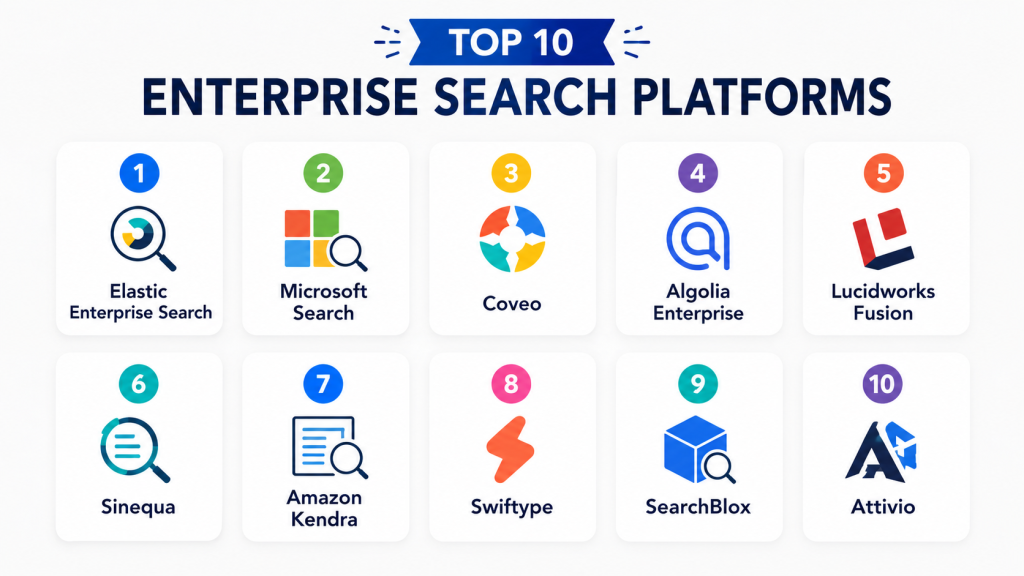
Top 10 Enterprise Search Platforms
1 — Elastic Enterprise Search
Short description: Scalable search platform providing unified search across applications, websites, and internal data sources.
Key Features
- AI-powered relevance and recommendations
- Multi-source indexing
- Full-text search with advanced query DSL
- Analytics dashboards
- Connector library for enterprise apps
Pros
- Scalable and flexible architecture
- Strong community and open-source roots
- Powerful search analytics
Cons
- Setup complexity for large-scale deployments
- Requires skilled operators for tuning
- Some advanced features require commercial subscription
Platforms / Deployment
Web, Cloud, Self-hosted
Security & Compliance
SOC 2, GDPR, SSO/SAML
Integrations & Ecosystem
CRM, analytics platforms, enterprise apps
- REST API for custom integration
- Connector library
- Developer-friendly SDKs
Support & Community
Enterprise support, active open-source community, documentation
2 — Microsoft Search
Short description: Enterprise search integrated into Microsoft 365 for content across Office apps, SharePoint, and Teams.
Key Features
- AI-based relevance ranking
- Microsoft 365 integration
- Role-based access control
- Analytics and insights
- Natural language queries
Pros
- Seamless integration with Microsoft ecosystem
- Easy to deploy for M365 users
- Familiar interface
Cons
- Limited outside Microsoft ecosystem
- Advanced customization requires additional tools
- Cost scales with M365 licensing
Platforms / Deployment
Web, Cloud
Security & Compliance
SOC 2, ISO 27001, GDPR, SSO
Integrations & Ecosystem
SharePoint, Teams, Outlook
- Power Platform integration
- APIs for custom apps
Support & Community
Microsoft support, community forums, training resources
3 — Coveo
Short description: AI-powered search platform delivering relevant results across enterprise apps, CRM, and websites.
Key Features
- Machine learning-based ranking
- Multi-source connectors
- Personalization for users
- Analytics and insights
- API-first architecture
Pros
- Strong AI relevance and recommendations
- Integrates with CRM and digital workplace apps
- Scalable for global enterprises
Cons
- Premium pricing
- Complexity for small teams
- Advanced features require configuration
Platforms / Deployment
Web, Cloud
Security & Compliance
SOC 2, ISO 27001, GDPR
Integrations & Ecosystem
Salesforce, ServiceNow, SharePoint
- API and connector support
- Analytics integration
Support & Community
Enterprise support, professional services, community portal
4 — Algolia Enterprise
Short description: Fast, hosted search platform with real-time indexing and AI-powered relevance.
Key Features
- Instant search and autocomplete
- Multi-language support
- Personalization and recommendation
- Analytics dashboards
- API and SDK support
Pros
- Extremely fast search performance
- Easy API integration
- Flexible relevance tuning
Cons
- Can be expensive at scale
- Limited internal knowledge management features
- Requires developer effort for complex indexing
Platforms / Deployment
Web, Cloud
Security & Compliance
SOC 2, GDPR, SSO
Integrations & Ecosystem
E-commerce, CRM, analytics
- SDKs for web and mobile
- API-first extensibility
Support & Community
Enterprise support, developer forums, documentation
5 — Lucidworks Fusion
Short description: Enterprise search and AI platform combining machine learning, connectors, and analytics for scalable search applications.
Key Features
- Machine learning for query relevance
- NLP capabilities
- Analytics and dashboards
- Multi-source connectors
- Security and access control
Pros
- Strong AI and NLP features
- Scalable architecture
- Integrates with large enterprise systems
Cons
- Complex deployment
- Requires technical expertise
- Higher cost for SMBs
Platforms / Deployment
Web, Cloud, Hybrid
Security & Compliance
SOC 2, ISO 27001, GDPR
Integrations & Ecosystem
CRM, ERP, collaboration tools
- REST API
- Connector library
- Analytics platforms
Support & Community
Enterprise support, training, community portal
6 — Sinequa
Short description: Cognitive search platform combining AI, NLP, and analytics for enterprise knowledge discovery.
Key Features
- AI-based relevance and recommendations
- NLP for semantic understanding
- Multi-source content indexing
- Advanced analytics
- Security and compliance controls
Pros
- Enterprise-grade scalability
- Strong NLP capabilities
- Comprehensive analytics
Cons
- Requires skilled operators
- Pricing may be high for SMBs
- Deployment complexity
Platforms / Deployment
Web, Cloud, Hybrid
Security & Compliance
SOC 2, ISO 27001, GDPR
Integrations & Ecosystem
CRM, SharePoint, ServiceNow
- API and connector support
- Developer SDKs
Support & Community
Enterprise support, documentation, professional services
7 — Amazon Kendra
Short description: AWS-managed search service delivering AI-powered enterprise search with natural language queries.
Key Features
- Natural language search
- Multi-source connectors
- Relevance tuning
- Real-time indexing
- Analytics and usage insights
Pros
- Fully managed, scalable
- AI-powered relevance
- Strong AWS ecosystem integration
Cons
- Limited non-AWS integrations
- Pricing can scale quickly
- Customization requires AWS expertise
Platforms / Deployment
Web, Cloud
Security & Compliance
SOC 2, ISO 27001, GDPR, AWS security
Integrations & Ecosystem
AWS services, CRM, analytics
- API access
- Connector support
Support & Community
AWS support tiers, documentation, community forums
8 — Swiftype
Short description: Elastic-backed enterprise search platform offering easy deployment for websites and internal applications.
Key Features
- Real-time indexing
- Custom relevance tuning
- Multi-platform search
- Analytics dashboards
- API and SDK support
Pros
- Easy setup
- Scalable search
- Custom relevance control
Cons
- Limited AI capabilities compared to larger platforms
- Fewer enterprise connectors
- Requires developer integration for advanced features
Platforms / Deployment
Web, Cloud
Security & Compliance
SOC 2, GDPR, SSO
Integrations & Ecosystem
CRM, CMS, analytics
- API and SDK
- Analytics integration
Support & Community
Documentation, support tiers, community forums
9 — SearchBlox
Short description: Enterprise search platform built on open-source search engines with AI and analytics features.
Key Features
- Semantic and faceted search
- Multi-source connectors
- AI-powered ranking
- Analytics dashboards
- Security and access controls
Pros
- Flexible deployment
- Cost-effective
- Scalable indexing
Cons
- UI less modern
- Advanced AI features require configuration
- Smaller global support network
Platforms / Deployment
Web, Cloud, Self-hosted
Security & Compliance
SOC 2, GDPR, SSO
Integrations & Ecosystem
CRM, SharePoint, databases
- API support
- Connector library
Support & Community
Documentation, email support, developer forums
10 — Attivio
Short description: Cognitive search platform for enterprise knowledge discovery with NLP and analytics capabilities.
Key Features
- NLP and AI relevance
- Multi-source indexing
- Analytics dashboards
- Security and role-based access
- Real-time data updates
Pros
- Strong cognitive search capabilities
- Integrates with large enterprise apps
- Scalable and secure
Cons
- Requires technical expertise
- Higher cost
- Implementation complexity
Platforms / Deployment
Web, Cloud, Hybrid
Security & Compliance
SOC 2, ISO 27001, GDPR
Integrations & Ecosystem
CRM, ERP, collaboration tools
- APIs and SDKs
- Connector support
Support & Community
Enterprise support, professional services, documentation
Comparison Table (Top 10)
| Tool Name | Best For | Platform(s) Supported | Deployment | Standout Feature | Public Rating |
|---|---|---|---|---|---|
| Elastic Enterprise Search | Multi-source enterprise search | Web | Cloud / Self-hosted | AI-powered relevance | N/A |
| Microsoft Search | Microsoft 365 integration | Web | Cloud | Seamless M365 integration | N/A |
| Coveo | CRM and website search | Web | Cloud | AI recommendations | N/A |
| Algolia Enterprise | Fast product and website search | Web | Cloud | Instant search & autocomplete | N/A |
| Lucidworks Fusion | Enterprise AI search | Web | Cloud / Hybrid | Machine learning ranking | N/A |
| Sinequa | Cognitive enterprise search | Web | Cloud / Hybrid | NLP & semantic search | N/A |
| Amazon Kendra | AWS-managed search | Web | Cloud | Natural language queries | N/A |
| Swiftype | Website and internal search | Web | Cloud | Custom relevance tuning | N/A |
| SearchBlox | Flexible enterprise search | Web | Cloud / Self-hosted | Semantic & faceted search | N/A |
| Attivio | Cognitive knowledge discovery | Web | Cloud / Hybrid | NLP & AI relevance | N/A |
Evaluation & Scoring of Enterprise Search Platforms
| Tool Name | Core (25%) | Ease (15%) | Integrations (15%) | Security (10%) | Performance (10%) | Support (10%) | Value (15%) | Weighted Total (0–10) |
|---|---|---|---|---|---|---|---|---|
| Elastic Enterprise Search | 10 | 8 | 9 | 9 | 9 | 8 | 7 | 8.8 |
| Microsoft Search | 8 | 9 | 8 | 9 | 8 | 8 | 8 | 8.3 |
| Coveo | 9 | 7 | 9 | 9 | 9 | 8 | 7 | 8.4 |
| Algolia Enterprise | 9 | 8 | 7 | 8 | 9 | 7 | 7 | 8.0 |
| Lucidworks Fusion | 9 | 7 | 8 | 9 | 9 | 8 | 7 | 8.3 |
| Sinequa | 9 | 7 | 8 | 9 | 9 | 8 | 7 | 8.3 |
| Amazon Kendra | 8 | 8 | 7 | 9 | 8 | 7 | 7 | 7.9 |
| Swiftype | 8 | 8 | 7 | 8 | 8 | 7 | 7 | 7.8 |
| SearchBlox | 7 | 7 | 7 | 8 | 7 | 6 | 7 | 7.2 |
| Attivio | 8 | 7 | 8 | 9 | 8 | 7 | 7 | 7.8 |
Which Enterprise Search Tool Is Right for You?
Solo / Freelancer
Algolia or Swiftype for simple, fast search integration on web projects.
SMB
Elastic Enterprise Search or Microsoft Search for multi-source indexing and ease of use.
Mid-Market
Coveo or Lucidworks Fusion for CRM integration and AI-driven relevance.
Enterprise
Sinequa, Amazon Kendra, and Attivio provide cognitive search, NLP, and enterprise scalability.
Budget vs Premium
Open-source or cloud-first tools (Elastic) for cost efficiency; premium platforms (Lucidworks, Sinequa) deliver advanced AI and analytics.
Feature Depth vs Ease of Use
Algolia offers speed and simplicity; Lucidworks and Sinequa excel in AI, NLP, and custom enterprise workflows.
Integrations & Scalability
Enterprise teams require robust API and connector support to integrate with CRM, ERP, analytics, and productivity tools.
Security & Compliance Needs
Prioritize SOC 2, ISO 27001, GDPR compliance, SSO/MFA, and role-based access for regulated industries.
Frequently Asked Questions (FAQs)
- What is an enterprise search platform?
A tool that indexes multiple internal and external data sources to provide fast, relevant, and secure search results across the organization. - How do AI features enhance search platforms?
AI improves relevance, semantic understanding, personalization, and predictive search, making retrieval more accurate and actionable. - Are enterprise search tools suitable for SMBs?
Yes, cloud-based or open-source options like Elastic or Microsoft Search offer scalability without heavy investment. - Can these platforms integrate with existing software?
Most enterprise search platforms provide APIs, connectors, and plugins for CRM, analytics, collaboration, and ERP systems. - What is the difference between keyword and semantic search?
Keyword search matches literal text; semantic search interprets meaning, context, and intent for more relevant results. - Do enterprise search tools support real-time indexing?
Yes, platforms like Algolia, Elastic, and Amazon Kendra provide near real-time indexing for dynamic content updates. - Are these search platforms secure?
Enterprise-grade platforms offer encryption, SSO, MFA, role-based access, SOC 2, ISO 27001, and GDPR compliance. - Can they handle multi-language content?
Yes, most modern platforms provide multilingual indexing, search, and relevance features for global teams. - How long does deployment take?
Deployment ranges from days for cloud solutions to weeks for large-scale on-prem implementations with complex integrations. - What should I consider when choosing a platform?
Consider dataset size, AI/NLP features, scalability, integrations, security, and cost relative to your organizational needs.
Conclusion
Enterprise search platforms are essential for modern organizations managing complex and distributed data. SMBs can leverage Elastic or Microsoft Search for fast deployment and cost efficiency, while enterprises may require Coveo, Sinequa, or Lucidworks for AI-driven, cognitive search capabilities. Evaluating scalability, integrations, relevance, and compliance ensures a platform aligns with business needs. Organizations should shortlist 2–3 tools, run pilots, and validate AI, search quality, and security. Monitoring analytics ensures search remains effective and improves knowledge discovery. The right platform increases productivity, enhances decision-making, and enables actionable insights across the enterprise.

Find Trusted Cardiac Hospitals
Compare heart hospitals by city and services — all in one place.
Explore Hospitals
Nice article 👍 I now understand how enterprise search platforms help businesses find and manage data more easily. I’d like to learn more about their real-world use.