Introduction
Logistics Visibility Platforms are software systems that help businesses track shipments, freight movement, carrier performance, delivery status, exceptions, and estimated arrival times across road, ocean, air, rail, parcel, and last-mile networks. In simple terms, they give logistics teams a live view of where goods are, what is delayed, what needs attention, and how supply chain partners are performing. These platforms matter because logistics networks are becoming more complex, customer expectations are higher, and businesses cannot rely only on emails, spreadsheets, carrier portals, or manual status calls. Modern visibility platforms help companies reduce delays, improve delivery promises, manage exceptions faster, and make smarter transportation decisions.
Real-world use cases include:
- Tracking inbound and outbound shipments
- Monitoring carrier performance and service levels
- Managing delayed, damaged, or high-risk shipments
- Sharing delivery visibility with customers and partners
- Improving transportation planning with real-time data
What buyers should evaluate:
- Shipment tracking accuracy
- Multimodal visibility coverage
- Carrier network strength
- Predictive ETA quality
- Exception management workflows
- TMS and ERP integrations
- Customer communication tools
- Analytics and reporting depth
- Security and access controls
- Ease of onboarding carriers and partners
Best for: Logistics teams, supply chain leaders, manufacturers, retailers, freight forwarders, 3PLs, shippers, distributors, and enterprise transportation teams that need real-time shipment visibility across multiple carriers and modes.
Not ideal for: Very small businesses with only a few local deliveries, teams using a single carrier portal successfully, or companies that need only basic GPS tracking without analytics, exception management, or partner collaboration.
Key Trends in Logistics Visibility Platforms
- Predictive ETA is becoming standard: Buyers now expect platforms to move beyond simple tracking and provide estimated arrival times based on traffic, carrier behavior, weather, dwell time, and route data.
- AI-based exception detection is growing: Platforms are increasingly using AI to flag likely delays, missed pickups, detention risks, and service failures before they become serious disruptions.
- Multimodal visibility is a core requirement: Companies want one platform for truckload, less-than-truckload, ocean, air, rail, parcel, and last-mile visibility instead of disconnected tools.
- Customer-facing visibility is becoming important: Logistics teams want branded tracking pages, automated alerts, and proactive customer updates to reduce manual support requests.
- IoT and sensor data are expanding: Temperature, humidity, shock, location, and security sensor data are becoming more relevant for pharma, food, electronics, and high-value goods.
- Sustainability reporting is gaining attention: Buyers increasingly want shipment emissions estimates, route efficiency data, and carrier performance insights to support sustainability programs.
- Integration-first buying is common: TMS, ERP, WMS, order management, carrier APIs, EDI, and data warehouse integrations are now major selection criteria.
- Security expectations are higher: Enterprises expect SSO, role-based access, encryption, audit logs, data governance, and clear vendor security documentation.
- Control tower models are expanding: Logistics visibility is becoming part of broader supply chain control towers that combine planning, execution, risk, and analytics.
- Carrier onboarding speed matters: A visibility platform is only useful if carriers, forwarders, brokers, and partners can be connected quickly and reliably.
How We Selected These Tools
The Top 10 Logistics Visibility Platforms were selected using a practical buyer-focused methodology. The goal is not to declare one universal winner, but to compare strong options across different logistics environments.
Selection criteria included:
- Market recognition in logistics, supply chain, freight visibility, and transportation visibility
- Ability to support real-time tracking and shipment status monitoring
- Strength across road, ocean, air, rail, parcel, or last-mile visibility
- Predictive ETA, exception management, and analytics capabilities
- Integration ecosystem with TMS, ERP, WMS, carrier networks, APIs, EDI, and partner systems
- Suitability for shippers, 3PLs, retailers, manufacturers, and enterprise logistics teams
- Support for customer communication, partner collaboration, and control tower workflows
- Publicly visible product maturity and relevance to modern logistics teams
- Security posture signals where publicly available
- Practical fit across enterprise, mid-market, and fast-growing logistics operations
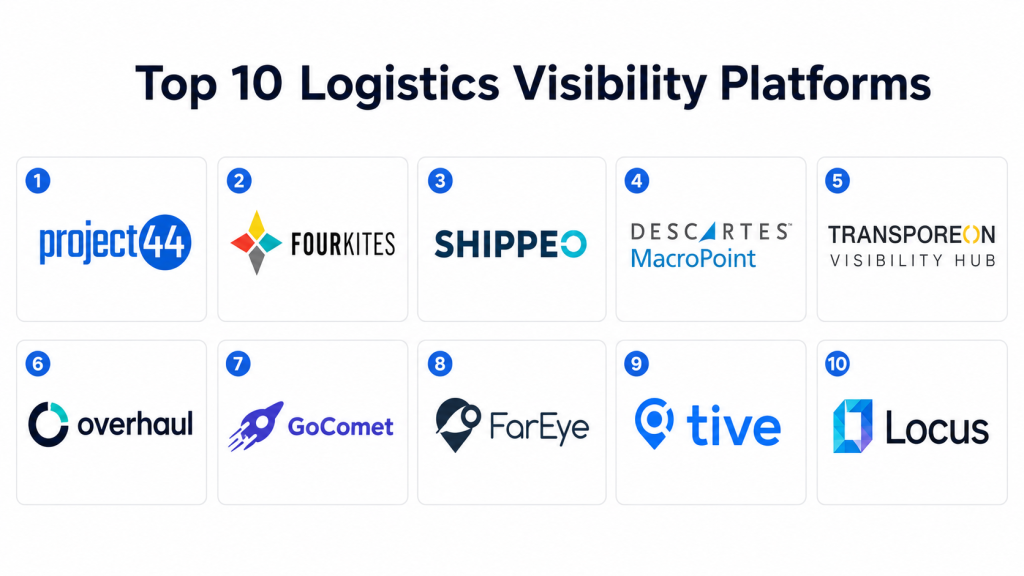
Top 10 Logistics Visibility Platforms
1- project44
Short description: project44 is a major logistics visibility platform focused on real-time transportation visibility, predictive ETAs, multimodal shipment tracking, and supply chain intelligence. It is best suited for large shippers, logistics providers, retailers, and enterprises with complex transportation networks.
Key Features
- Real-time shipment visibility across multiple transportation modes
- Predictive ETA and exception monitoring
- Ocean, truckload, LTL, parcel, rail, and air visibility support
- Carrier and logistics partner connectivity
- Analytics for service performance and transportation execution
- Customer and partner visibility workflows
- Supply chain intelligence and control tower use cases
Pros
- Strong enterprise fit for complex global logistics networks
- Broad multimodal visibility coverage
- Useful for proactive exception management and customer communication
Cons
- May be more advanced than smaller logistics teams need
- Implementation depends on data quality and partner connectivity
- Pricing is typically quote-based and may not suit very small businesses
Platforms / Deployment
Web / Cloud
Mobile access: Varies / N/A
Security & Compliance
Not publicly stated in full detail for all requirements. Buyers should validate SSO, MFA, RBAC, encryption, audit logs, SOC 2, ISO 27001, GDPR, and data residency needs during procurement.
Integrations & Ecosystem
project44 is designed to connect with enterprise transportation systems, carriers, forwarders, brokers, and customer-facing platforms. It works best when logistics teams need visibility data to flow into planning, execution, analytics, and customer service workflows.
- TMS integrations
- ERP and order management integrations
- Carrier and broker connectivity
- APIs and data feeds
- Ocean, road, air, rail, and parcel data sources
- Analytics and control tower ecosystems
Support & Community
project44 generally supports enterprise customers with onboarding, implementation assistance, and customer success resources. Buyers should confirm support tiers, implementation timelines, carrier onboarding assistance, and service-level commitments.
2- FourKites
Short description: FourKites is a real-time supply chain visibility platform used by shippers, carriers, brokers, and logistics teams to track freight, manage exceptions, and improve transportation performance. It is strong for enterprise visibility, predictive insights, and supply chain collaboration.
Key Features
- Real-time freight tracking and shipment monitoring
- Predictive ETA and delay alerts
- Multimodal visibility support
- Yard, facility, and appointment visibility capabilities
- Carrier and partner collaboration tools
- Customer-facing shipment visibility
- Analytics for network performance and exceptions
Pros
- Strong visibility and exception management capabilities
- Useful for large logistics teams managing many carriers
- Good fit for supply chain control tower initiatives
Cons
- Smaller teams may find the platform broader than required
- Value depends on carrier participation and integration quality
- Pricing details are generally not simple or public
Platforms / Deployment
Web / Cloud
Mobile access: Varies / N/A
Security & Compliance
Not publicly stated in full detail for all buyer requirements. Validate SSO, MFA, RBAC, encryption, audit logs, SOC 2, ISO 27001, GDPR, and enterprise security controls before purchase.
Integrations & Ecosystem
FourKites connects shipment data across transportation partners, enterprise systems, facilities, and customer-facing workflows. It is useful when visibility must support both operational teams and executive supply chain reporting.
- TMS and ERP integrations
- Carrier and broker systems
- Yard and facility systems
- APIs and partner data feeds
- Customer communication workflows
- Analytics and control tower reporting
Support & Community
FourKites typically offers enterprise onboarding and customer support. Buyers should evaluate training, carrier onboarding services, documentation, account management, and support response times.
3- Shippeo
Short description: Shippeo is a transportation visibility platform focused on real-time tracking, predictive ETAs, and multimodal logistics visibility. It is especially relevant for shippers and logistics teams that need visibility across road, ocean, rail, air, and parcel operations.
Key Features
- Real-time multimodal shipment tracking
- Predictive ETA calculations
- Exception alerts and delay monitoring
- Carrier connectivity and data collection
- Visibility dashboards for logistics teams
- Customer and partner collaboration features
- Analytics for transport performance
Pros
- Strong fit for European and global logistics visibility needs
- Useful for multimodal tracking and ETA improvement
- Supports proactive exception workflows
Cons
- Implementation quality depends on carrier data access
- May require integration planning for complex ecosystems
- Some security and pricing details may need direct vendor validation
Platforms / Deployment
Web / Cloud
Mobile access: Varies / N/A
Security & Compliance
Not publicly stated in full detail. Buyers should confirm SSO, MFA, RBAC, encryption, audit logs, GDPR readiness, data hosting, and enterprise security documentation.
Integrations & Ecosystem
Shippeo is commonly used in environments where transportation visibility must connect with shippers, carriers, logistics service providers, and internal business systems.
- TMS integrations
- ERP integrations
- Carrier telematics and tracking data
- APIs and data exchange workflows
- Customer visibility portals
- Analytics and reporting tools
Support & Community
Shippeo offers support and onboarding for logistics organizations. Buyers should confirm implementation assistance, carrier onboarding support, documentation quality, and regional service coverage.
4- Descartes MacroPoint
Short description: Descartes MacroPoint is a freight visibility platform designed to help logistics teams track loads, manage carrier visibility, and improve transportation execution. It is often used by brokers, carriers, shippers, and 3PLs.
Key Features
- Real-time freight visibility
- Carrier tracking and load monitoring
- Predictive status updates and exception alerts
- Transportation network connectivity
- Shipment status sharing
- Analytics for freight operations
- Integration with broader Descartes logistics solutions
Pros
- Strong fit for freight brokers, 3PLs, and transportation teams
- Useful carrier network and freight visibility capabilities
- Works well in logistics environments that already use Descartes products
Cons
- May be more freight-focused than full supply chain control tower platforms
- User experience may vary based on implementation setup
- Advanced capabilities may depend on selected modules
Platforms / Deployment
Web / Cloud
Mobile access: Varies / N/A
Security & Compliance
Not publicly stated in full detail for all buyer requirements. Buyers should validate SSO, MFA, RBAC, encryption, audit logs, compliance documentation, and data protection controls.
Integrations & Ecosystem
Descartes MacroPoint benefits from the broader Descartes logistics ecosystem. It is suitable for teams that need freight visibility connected with transportation management, customs, compliance, routing, and logistics execution workflows.
- TMS integrations
- Carrier connectivity
- Freight brokerage systems
- Descartes logistics ecosystem
- APIs and data exchange
- Reporting and analytics tools
Support & Community
Descartes typically provides enterprise and logistics-focused support. Buyers should confirm onboarding support, training, carrier enablement, and support tiers based on contract scope.
5- Transporeon Visibility Hub
Short description: Transporeon Visibility Hub is part of the Transporeon transportation management ecosystem and helps companies track shipments, monitor carrier performance, and improve transport execution visibility. It is especially useful for companies already using Transporeon for freight procurement, execution, or collaboration.
Key Features
- Real-time shipment tracking
- Predictive ETA and delay visibility
- Carrier collaboration tools
- Transport execution visibility
- Integration with freight procurement and transport workflows
- Performance dashboards
- Exception monitoring
Pros
- Strong fit for companies using Transporeon’s transportation ecosystem
- Useful for connecting visibility with freight execution
- Supports carrier collaboration and performance monitoring
Cons
- Best value may depend on broader Transporeon adoption
- May not be the simplest standalone option for small teams
- Security and pricing details should be verified directly
Platforms / Deployment
Web / Cloud
Mobile access: Varies / N/A
Security & Compliance
Not publicly stated in full detail. Buyers should validate SSO, MFA, RBAC, encryption, audit logs, GDPR readiness, and enterprise security documentation.
Integrations & Ecosystem
Transporeon Visibility Hub is valuable when shipment visibility must connect directly with freight procurement, tendering, appointment scheduling, and transport execution workflows.
- TMS and ERP integrations
- Carrier and logistics partner connectivity
- Freight procurement workflows
- Appointment and dock scheduling workflows
- APIs and platform data exchange
- Analytics and performance reporting
Support & Community
Transporeon supports logistics and transportation customers with onboarding and platform support. Buyers should confirm regional support availability, training, carrier onboarding, and implementation timelines.
6- Overhaul
Short description: Overhaul is a supply chain visibility, risk management, and security-focused platform used for high-value, temperature-sensitive, regulated, and risk-prone shipments. It is a strong choice for industries where shipment integrity and risk monitoring are critical.
Key Features
- Real-time shipment tracking
- Risk monitoring and exception management
- IoT and sensor-based visibility
- Temperature, location, and condition monitoring
- High-value cargo protection workflows
- Chain-of-custody visibility
- Logistics security and compliance support
Pros
- Strong fit for high-value, pharma, food, and sensitive shipments
- Good combination of visibility and risk management
- Useful for exception response and shipment integrity monitoring
Cons
- May be more specialized than general logistics visibility platforms
- Sensor and operational setup can add complexity
- Best suited for risk-sensitive supply chains rather than basic freight tracking
Platforms / Deployment
Web / Cloud
Mobile access: Varies / N/A
IoT device support: Varies by shipment program
Security & Compliance
Not publicly stated in full detail. Buyers should confirm SSO, MFA, RBAC, encryption, audit logs, chain-of-custody controls, data retention, and industry-specific compliance requirements.
Integrations & Ecosystem
Overhaul is designed for logistics teams that need shipment visibility combined with security, risk, and condition monitoring. It often fits regulated or sensitive supply chain environments.
- IoT and sensor integrations
- Carrier and logistics partner data
- TMS and ERP integrations
- Security response workflows
- Compliance reporting tools
- Analytics and exception management systems
Support & Community
Overhaul generally supports customers through implementation, monitoring, and operational support services. Buyers should validate response workflows, control tower support, escalation processes, and training.
7- GoComet
Short description: GoComet is a logistics technology platform offering shipment tracking, freight visibility, rate management, invoice reconciliation, and transportation process automation. It is useful for mid-market and enterprise shippers that want visibility plus logistics workflow automation.
Key Features
- Real-time shipment tracking
- Ocean and multimodal visibility support
- Freight procurement and rate management tools
- Automated document and invoice workflows
- Predictive tracking and exception alerts
- Analytics and performance dashboards
- Collaboration tools for logistics teams
Pros
- Combines visibility with broader logistics automation
- Good fit for companies managing freight costs and shipment tracking together
- Useful for mid-market logistics teams seeking practical workflow improvement
Cons
- May not match the largest enterprise visibility networks in all regions
- Some advanced requirements may need custom setup
- Buyers should validate mode coverage for their lanes and carriers
Platforms / Deployment
Web / Cloud
Mobile access: Varies / N/A
Security & Compliance
Not publicly stated in full detail. Buyers should validate SSO, MFA, RBAC, encryption, audit logs, SOC 2, ISO 27001, GDPR, and regional data handling requirements.
Integrations & Ecosystem
GoComet works well for teams that want visibility linked to freight procurement, documents, analytics, and logistics cost controls.
- ERP integrations
- TMS and logistics system integrations
- Carrier and forwarder data
- Freight rate and procurement workflows
- Invoice and document workflows
- APIs and reporting exports
Support & Community
GoComet provides onboarding and customer support for logistics teams. Buyers should confirm implementation services, training resources, support channels, and integration assistance.
8- FarEye
Short description: FarEye is a logistics and delivery management platform focused on visibility, last-mile delivery, carrier orchestration, customer experience, and delivery performance. It is especially relevant for retail, e-commerce, parcel, and last-mile operations.
Key Features
- Last-mile and delivery visibility
- Carrier orchestration and delivery tracking
- Customer notification workflows
- Route and delivery performance insights
- Exception management
- Proof-of-delivery workflows
- Analytics for delivery operations
Pros
- Strong fit for last-mile and customer-facing delivery visibility
- Useful for retailers and e-commerce logistics teams
- Helps improve delivery communication and exception handling
Cons
- Less focused on deep ocean or long-haul freight visibility than some competitors
- Best value depends on last-mile delivery complexity
- May require integration with order, carrier, and customer systems
Platforms / Deployment
Web / Cloud
Mobile support: iOS / Android availability may vary by module
Security & Compliance
Not publicly stated in full detail. Buyers should verify SSO, MFA, RBAC, encryption, audit logs, data privacy, and compliance documentation.
Integrations & Ecosystem
FarEye connects delivery operations with carriers, order systems, customer communication tools, and analytics. It is useful when delivery visibility must directly improve customer experience.
- Order management systems
- Carrier and delivery partner integrations
- Customer notification systems
- APIs and webhooks
- Proof-of-delivery workflows
- Analytics and delivery performance dashboards
Support & Community
FarEye offers implementation and support for delivery operations teams. Buyers should confirm onboarding scope, regional support, training, integration assistance, and customer success resources.
9- Tive
Short description: Tive is a shipment visibility platform focused on real-time tracking and condition monitoring using sensors and connected devices. It is best for companies shipping temperature-sensitive, high-value, fragile, or regulated goods.
Key Features
- Real-time shipment location tracking
- Temperature and condition monitoring
- Sensor-based shipment visibility
- Shock, light, humidity, and security monitoring options
- Alerts for shipment exceptions
- Dashboard for shipment condition data
- Useful for pharma, food, electronics, and high-value cargo
Pros
- Strong for condition-sensitive and high-risk shipments
- Provides visibility beyond location alone
- Useful for compliance, claims support, and quality assurance
Cons
- Hardware and device management may add operational work
- Not a full TMS or broad transportation execution suite
- Best value is for sensitive shipments, not basic freight loads
Platforms / Deployment
Web / Cloud
IoT device-based tracking
Mobile access: Varies / N/A
Security & Compliance
Not publicly stated in full detail. Buyers should validate device security, encryption, RBAC, audit logs, data retention, and compliance documentation for regulated goods.
Integrations & Ecosystem
Tive is useful when shipment condition data must connect with logistics operations, quality teams, compliance processes, and customer reporting.
- IoT sensor devices
- TMS and logistics platform integrations
- APIs and data exports
- Temperature and condition monitoring workflows
- Exception alerting systems
- Compliance and quality reporting workflows
Support & Community
Tive supports customers with device setup, tracking workflows, and visibility platform usage. Buyers should confirm device support, replacement processes, training, and technical assistance.
10- Locus
Short description: Locus is a logistics optimization and visibility platform focused on route planning, dispatch, last-mile delivery, fleet visibility, and delivery execution. It is a strong option for companies managing high-volume delivery operations.
Key Features
- Route optimization and delivery planning
- Real-time fleet and delivery visibility
- Last-mile dispatch workflows
- Customer notifications and tracking
- Delivery performance analytics
- Proof-of-delivery support
- Automation for delivery execution
Pros
- Strong for last-mile logistics and delivery-heavy operations
- Combines optimization with visibility
- Useful for retail, e-commerce, distribution, and field delivery teams
Cons
- Less focused on global ocean or multimodal freight visibility
- Best suited for delivery execution rather than broad control tower visibility
- Implementation depends on route, driver, and order data quality
Platforms / Deployment
Web / Cloud
Mobile support: iOS / Android availability may vary by module
Security & Compliance
Not publicly stated in full detail. Buyers should verify SSO, MFA, RBAC, encryption, audit logs, data privacy, and enterprise security controls.
Integrations & Ecosystem
Locus fits well into delivery operations where route optimization, dispatch, tracking, proof-of-delivery, and customer updates need to work together.
- Order management systems
- ERP and WMS integrations
- Carrier and fleet systems
- Mobile driver workflows
- Customer notification tools
- APIs and analytics exports
Support & Community
Locus offers onboarding and customer support for logistics and delivery teams. Buyers should confirm implementation support, driver training resources, technical documentation, and support response levels.
Comparison Table
| Tool Name | Best For | Platform Supported | Deployment | Standout Feature | Public Rating |
|---|---|---|---|---|---|
| project44 | Enterprise multimodal shipment visibility | Web | Cloud | Global transportation visibility and predictive ETA | N/A |
| FourKites | Supply chain control tower visibility | Web | Cloud | Real-time freight tracking and exception management | N/A |
| Shippeo | Multimodal transportation visibility | Web | Cloud | Predictive ETA and carrier visibility | N/A |
| Descartes MacroPoint | Freight brokers, 3PLs, and transportation teams | Web | Cloud | Freight tracking and carrier network visibility | N/A |
| Transporeon Visibility Hub | Transport execution visibility | Web | Cloud | Visibility connected with freight procurement and execution | N/A |
| Overhaul | High-value and risk-sensitive shipments | Web | Cloud | Shipment risk and condition monitoring | N/A |
| GoComet | Freight visibility plus logistics automation | Web | Cloud | Shipment tracking with procurement and invoice workflows | N/A |
| FarEye | Last-mile and delivery visibility | Web / Mobile varies | Cloud | Customer-facing delivery visibility | N/A |
| Tive | Sensor-based shipment condition visibility | Web / IoT devices | Cloud | Real-time location and condition monitoring | N/A |
| Locus | Last-mile route and delivery visibility | Web / Mobile varies | Cloud | Route optimization with delivery tracking | N/A |
Evaluation & Scoring of Logistics Visibility Platforms
| Tool Name | Core 25% | Ease 15% | Integrations 15% | Security 10% | Performance 10% | Support 10% | Value 15% | Weighted Total |
|---|---|---|---|---|---|---|---|---|
| project44 | 9 | 8 | 9 | 8 | 9 | 8 | 8 | 8.50 |
| FourKites | 9 | 8 | 9 | 8 | 9 | 8 | 8 | 8.50 |
| Shippeo | 8 | 8 | 8 | 7 | 8 | 8 | 8 | 7.95 |
| Descartes MacroPoint | 8 | 7 | 8 | 7 | 8 | 8 | 8 | 7.75 |
| Transporeon Visibility Hub | 8 | 7 | 8 | 7 | 8 | 8 | 7 | 7.55 |
| Overhaul | 8 | 7 | 7 | 8 | 8 | 8 | 7 | 7.65 |
| GoComet | 8 | 8 | 7 | 7 | 8 | 8 | 8 | 7.75 |
| FarEye | 7 | 8 | 8 | 7 | 8 | 8 | 8 | 7.65 |
| Tive | 7 | 8 | 7 | 7 | 8 | 8 | 8 | 7.50 |
| Locus | 8 | 8 | 8 | 7 | 8 | 8 | 8 | 7.90 |
Which Logistics Visibility Platform Tool Is Right for You?
Solo / Freelancer
Solo consultants and independent logistics advisors usually do not need a heavy enterprise visibility platform unless they manage client implementations. For consulting, tools like GoComet, Locus, FarEye, or Tive may be easier to evaluate depending on the use case. If the work involves strategy or network visibility assessments, project44, FourKites, and Shippeo may be relevant for enterprise client recommendations.
SMB
Small and mid-sized businesses should focus on ease of onboarding, carrier coverage, price/value, and practical reporting. GoComet, FarEye, Locus, Tive, and Descartes MacroPoint can be strong candidates depending on shipment type. SMBs should avoid buying a large platform only because it is popular; they should first confirm mode coverage, implementation effort, and required integrations.
Mid-Market
Mid-market logistics teams usually need a balance of visibility, automation, analytics, and integration. Shippeo, GoComet, Descartes MacroPoint, FarEye, Locus, and Overhaul may fit different operational needs. If the business ships across multiple regions and modes, project44 or FourKites may also be suitable, especially when visibility is becoming a board-level supply chain priority.
Enterprise
Large enterprises need scalability, multimodal support, strong integrations, global carrier networks, data governance, analytics, and customer-facing visibility. project44, FourKites, Shippeo, Transporeon Visibility Hub, and Descartes MacroPoint are strong enterprise candidates. Overhaul should be considered when cargo risk, security, or shipment condition monitoring is critical.
Budget vs Premium
Budget-focused buyers should prioritize the most painful visibility gap. If the issue is last-mile delivery communication, FarEye or Locus-style platforms may be better than a broad global visibility tool. If the issue is freight tracking across many carriers, Descartes MacroPoint, GoComet, Shippeo, FourKites, or project44 may be more relevant. Premium platforms make sense when delays, manual tracking, customer escalations, and poor data quality are creating measurable cost.
Feature Depth vs Ease of Use
Feature-rich platforms often provide deeper analytics, global networks, predictive ETAs, and control tower capabilities, but they may require more implementation planning. Easier tools can deliver faster value for focused use cases such as delivery tracking, shipment condition monitoring, or freight status visibility. Buyers should match feature depth with team maturity and operational complexity.
Integrations & Scalability
Integrations are one of the most important selection factors. A visibility platform should connect with TMS, ERP, WMS, OMS, carrier portals, telematics systems, EDI networks, APIs, data warehouses, and customer communication systems. Scalability also matters because shipment volume, carrier count, regions, modes, and customer expectations can grow quickly.
Security & Compliance Needs
Logistics visibility platforms handle shipment data, customer data, location data, carrier information, commercial records, and operational workflows. Buyers should validate SSO, MFA, RBAC, encryption, audit logs, data retention, data residency, incident response, and compliance documentation. For pharma, food, electronics, defense, or high-value shipments, security and chain-of-custody workflows become even more important.
Frequently Asked Questions
1- What is a logistics visibility platform?
A logistics visibility platform helps companies track shipments, monitor freight status, predict delivery times, and manage exceptions. It gives teams a clearer view of transportation activity across carriers, modes, and locations.
2- How is logistics visibility software different from a TMS?
A TMS usually manages transportation planning, tendering, execution, and freight processes. A visibility platform focuses on real-time tracking, shipment status, predictive ETA, exception alerts, and logistics performance visibility.
3- Which logistics visibility platform is best for enterprises?
project44, FourKites, Shippeo, Transporeon Visibility Hub, and Descartes MacroPoint are strong enterprise options. The best choice depends on modes, regions, carrier network, integrations, security, and analytics needs.
4- Which tool is best for last-mile delivery visibility?
FarEye and Locus are strong options for last-mile visibility, delivery tracking, route optimization, and customer notifications. They are especially useful for retail, e-commerce, distribution, and high-volume delivery operations.
5- Which tool is best for cold-chain or high-value shipments?
Overhaul and Tive are strong choices for risk-sensitive, temperature-sensitive, and high-value shipments. They support location visibility, condition monitoring, and exception alerts that go beyond basic freight tracking.
6- How much do logistics visibility platforms cost?
Most pricing is quote-based and depends on shipment volume, modes, users, integrations, carrier network, regions, and modules. Buyers should request a full pricing breakdown, including implementation and support costs.
7- How long does implementation usually take?
Implementation can range from a few weeks to several months depending on integrations, data quality, carrier onboarding, and workflow complexity. Enterprise rollouts usually take longer than focused last-mile or sensor-based deployments.
8- What are common mistakes when choosing a visibility platform?
Common mistakes include ignoring carrier onboarding, underestimating integration work, buying too many features too early, not testing real shipment lanes, and failing to define exception management workflows before implementation.
9- Are logistics visibility platforms secure?
Most enterprise platforms offer security controls, but details vary by vendor and contract. Buyers should validate SSO, MFA, encryption, RBAC, audit logs, compliance documentation, and data handling policies before selection.
10- Can logistics visibility platforms improve customer experience?
Yes, they can improve customer experience by providing proactive shipment updates, accurate ETAs, branded tracking, delay alerts, and faster issue resolution. This reduces manual status calls and improves delivery trust.
Conclusion
Logistics Visibility Platforms have become essential for companies that need better control over transportation, delivery performance, customer communication, and supply chain exceptions. The best platform depends on the shipment profile, transportation modes, carrier network, regions, integration needs, and operational maturity. project44 and FourKites are strong enterprise visibility platforms, while Shippeo, Descartes MacroPoint, and Transporeon Visibility Hub fit many multimodal and freight visibility needs. Overhaul and Tive are better for high-value, sensitive, or condition-monitored shipments, while FarEye and Locus are strong for delivery and last-mile visibility. GoComet is useful for teams that want visibility combined with broader freight process automation. The smartest next step is to shortlist 2–3 platforms, test them with real shipment data, validate carrier coverage and integrations, review security documentation, and run a pilot before making a long-term commitment.

Find Trusted Cardiac Hospitals
Compare heart hospitals by city and services — all in one place.
Explore Hospitals
Logistics visibility platforms are most valuable when they provide real-time tracking and end-to-end visibility of shipments, inventory, and transportation activities across the supply chain. By offering live shipment monitoring, estimated arrival predictions, exception alerts, carrier integration, route tracking, inventory visibility, analytics, collaboration tools, and integration with transportation management (TMS), warehouse management (WMS), and ERP systems, these platforms enable organizations to improve delivery performance, proactively manage disruptions, reduce transportation costs, enhance customer satisfaction, and optimize overall logistics operations.