Introduction
Manufacturing Execution Systems MES are software platforms designed to monitor, manage, optimize, and control manufacturing operations on the factory floor in real time. MES platforms bridge the gap between enterprise planning systems and industrial production equipment by providing operational visibility, production tracking, quality management, scheduling, traceability, and performance analytics. MES platforms are becoming critical for Industry 4.0 transformation, smart manufacturing initiatives, AI-driven operational optimization, and Industrial IoT integration. Manufacturers across automotive, pharmaceuticals, electronics, food processing, aerospace, and industrial equipment sectors increasingly rely on MES software to improve efficiency, reduce downtime, ensure compliance, and enable predictive manufacturing operations.
Common Real-world use cases include:
- Production monitoring and scheduling
- Quality management and traceability
- Real-time factory floor analytics
- Inventory and workflow optimization
- Smart factory automation
When Evaluating MES platforms, buyers should consider:
- Real-time operational visibility
- Integration with ERP and SCADA systems
- Scalability across multiple plants
- Traceability and compliance capabilities
- AI and analytics features
- Industrial IoT support
- Ease of deployment and usability
- Security and access controls
- Workflow automation capabilities
- Vendor ecosystem and long-term support
Best for: Manufacturing enterprises, smart factories, industrial automation teams, pharmaceutical manufacturers, automotive companies, electronics manufacturers, and process industries.
Not ideal for: Small workshops with limited production complexity or businesses that only require basic inventory or production tracking.
Key Trends in Manufacturing Execution Systems MES
- AI-powered production optimization is becoming standard in modern MES platforms.
- Cloud-native MES deployments are rapidly increasing across global manufacturing environments.
- Digital twin integration is improving manufacturing simulation and operational planning.
- Industrial IoT connectivity is enabling real-time machine-level analytics.
- Predictive maintenance workflows are becoming tightly integrated with MES operations.
- Low-code manufacturing workflow automation is gaining popularity.
- Cybersecurity and zero-trust architectures are becoming critical for factory environments.
- Edge computing is improving low-latency manufacturing operations.
- Sustainability tracking and energy analytics are increasingly integrated into MES platforms.
- Unified manufacturing data platforms are replacing fragmented operational systems.
How We Selected These Tools Methodology
The MES platforms in this list were selected using practical operational and technical evaluation criteria:
- Global manufacturing adoption and market reputation
- Real-time manufacturing execution capabilities
- Industrial integration ecosystem strength
- Scalability across manufacturing environments
- Compliance and traceability support
- AI and analytics functionality
- Cloud and hybrid deployment flexibility
- Security and operational reliability
- Vendor support and industrial expertise
- Smart manufacturing and Industry 4.0 readiness
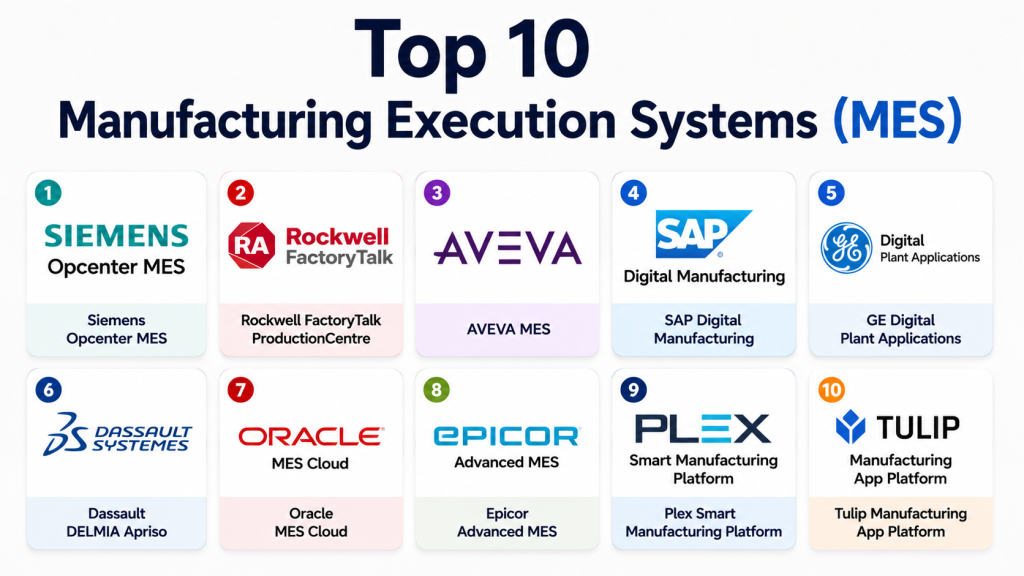
Top 10 Manufacturing Execution Systems MES Tools
1- Siemens Opcenter MES
Short description: Siemens Opcenter MES is an enterprise-grade manufacturing execution platform designed for smart manufacturing, operational visibility, and industrial automation environments.
Key Features
- Real-time production monitoring
- Manufacturing analytics
- Quality management
- Production scheduling
- Traceability support
- Digital twin integration
- Industrial IoT connectivity
Pros
- Strong Industry 4.0 capabilities
- Excellent scalability
- Deep industrial integration ecosystem
Cons
- Enterprise deployment complexity
- High implementation costs
- Advanced training requirements
Platforms / Deployment
- Web / Windows
- Cloud / Hybrid / Self-hosted
Security & Compliance
- RBAC
- Encryption
- Audit logging
- Enterprise authentication support
Integrations & Ecosystem
Opcenter integrates deeply with Siemens industrial automation and enterprise manufacturing systems.
- ERP systems
- SCADA platforms
- Industrial IoT systems
- Digital twin platforms
- PLC integrations
Support & Community
Strong global manufacturing support ecosystem and enterprise consulting services.
2- Rockwell FactoryTalk ProductionCentre
Short description: FactoryTalk ProductionCentre is Rockwell Automation’s MES platform designed for manufacturing operations management and production optimization.
Key Features
- Manufacturing workflow management
- Real-time production tracking
- Batch management
- Quality monitoring
- Industrial reporting
- Performance analytics
- Compliance management
Pros
- Strong manufacturing ecosystem
- Reliable operational visibility
- Deep Rockwell integration
Cons
- Best optimized for Rockwell environments
- Enterprise-oriented pricing
- Complex deployment planning
Platforms / Deployment
- Windows / Web
- Hybrid / Self-hosted
Security & Compliance
- RBAC
- Encryption
- Audit logging
Integrations & Ecosystem
FactoryTalk integrates closely with manufacturing automation systems and operational technologies.
- Allen-Bradley PLCs
- ERP systems
- SCADA systems
- Industrial analytics tools
Support & Community
Large manufacturing customer ecosystem with enterprise automation support.
3- AVEVA MES
Short description: AVEVA MES is a manufacturing operations platform focused on operational intelligence, production efficiency, and industrial analytics.
Key Features
- Manufacturing operations management
- Production analytics
- Workflow automation
- Traceability management
- Quality control
- Industrial dashboards
- Predictive operational insights
Pros
- Strong analytics capabilities
- Enterprise scalability
- Good process manufacturing support
Cons
- Enterprise deployment complexity
- Higher implementation costs
- Advanced customization may require expertise
Platforms / Deployment
- Web / Windows
- Cloud / Hybrid
Security & Compliance
- RBAC
- Encryption
- SSO support
- Audit logging
Integrations & Ecosystem
AVEVA supports broad manufacturing and industrial interoperability.
- ERP systems
- Industrial historians
- SCADA platforms
- Industrial IoT systems
Support & Community
Strong industrial automation expertise and enterprise support services.
4- SAP Digital Manufacturing
Short description: SAP Digital Manufacturing combines MES functionality with cloud manufacturing operations and enterprise process integration.
Key Features
- Cloud manufacturing execution
- Production orchestration
- Real-time analytics
- Quality management
- Resource monitoring
- ERP integration
- Manufacturing insights
Pros
- Strong SAP ecosystem integration
- Modern cloud architecture
- Enterprise scalability
Cons
- SAP ecosystem dependency
- Complex enterprise deployments
- Licensing costs may be significant
Platforms / Deployment
- Web
- Cloud / Hybrid
Security & Compliance
- Encryption
- RBAC
- Audit logging
- Enterprise authentication controls
Integrations & Ecosystem
SAP Digital Manufacturing integrates tightly with SAP enterprise systems and smart manufacturing infrastructure.
- SAP ERP
- Industrial IoT systems
- Supply chain platforms
- Manufacturing analytics tools
Support & Community
Extensive enterprise support ecosystem and global manufacturing expertise.
5- GE Digital Plant Applications
Short description: GE Digital Plant Applications is an MES solution focused on manufacturing optimization, operational visibility, and production efficiency.
Key Features
- Real-time production monitoring
- Manufacturing KPIs
- Quality management
- Workflow automation
- Operational analytics
- Downtime analysis
- Traceability management
Pros
- Strong manufacturing analytics
- Reliable industrial operations support
- Good scalability
Cons
- Legacy interface elements remain
- Advanced customization may require consulting
- Enterprise deployment complexity
Platforms / Deployment
- Windows / Web
- Hybrid / Self-hosted
Security & Compliance
- RBAC
- Encryption
- Enterprise authentication support
Integrations & Ecosystem
Plant Applications supports industrial manufacturing and enterprise integrations.
- ERP systems
- SCADA platforms
- Industrial databases
- Manufacturing analytics tools
Support & Community
Long-standing industrial customer base with enterprise support capabilities.
6- Dassault DELMIA Apriso
Short description: DELMIA Apriso is a manufacturing operations management platform focused on global manufacturing coordination and operational intelligence.
Key Features
- Global manufacturing visibility
- Production orchestration
- Workforce management
- Traceability and compliance
- Real-time analytics
- Manufacturing intelligence
- Quality control workflows
Pros
- Strong global manufacturing support
- Advanced operational visibility
- Good compliance capabilities
Cons
- Enterprise implementation complexity
- Advanced training requirements
- Premium enterprise positioning
Platforms / Deployment
- Web / Windows
- Cloud / Hybrid
Security & Compliance
- RBAC
- Encryption
- Audit logging
- Enterprise identity management
Integrations & Ecosystem
DELMIA Apriso integrates with manufacturing, ERP, and supply chain ecosystems.
- ERP systems
- PLM platforms
- Supply chain tools
- Industrial automation systems
Support & Community
Strong enterprise manufacturing consulting and operational expertise.
7- Oracle MES Cloud
Short description: Oracle MES Cloud provides cloud-based manufacturing execution and production operations management for enterprise manufacturing environments.
Key Features
- Cloud manufacturing execution
- Production scheduling
- Work order management
- Quality tracking
- Real-time dashboards
- Operational analytics
- ERP integration
Pros
- Strong cloud architecture
- Good enterprise integrations
- Scalable operational management
Cons
- Oracle ecosystem dependency
- Enterprise implementation requirements
- Complex licensing structures
Platforms / Deployment
- Web
- Cloud
Security & Compliance
- Encryption
- RBAC
- Enterprise authentication controls
- Audit logging
Integrations & Ecosystem
Oracle MES Cloud supports enterprise manufacturing and operational integration workflows.
- Oracle ERP
- Supply chain systems
- Manufacturing analytics tools
- Industrial IoT integrations
Support & Community
Strong enterprise support ecosystem and cloud infrastructure expertise.
8- Epicor Advanced MES
Short description: Epicor Advanced MES is designed for manufacturing performance monitoring, operational efficiency, and production analytics.
Key Features
- Production monitoring
- Machine performance analytics
- OEE tracking
- Downtime management
- Quality management
- Manufacturing dashboards
- Workflow optimization
Pros
- Strong operational monitoring
- Good usability
- Suitable for mid-sized manufacturers
Cons
- Less extensive enterprise ecosystem
- Advanced scalability may vary
- Complex manufacturing environments may require customization
Platforms / Deployment
- Web / Windows
- Cloud / Hybrid
Security & Compliance
- RBAC
- Encryption
- Enterprise access management
Integrations & Ecosystem
Epicor MES integrates with manufacturing operations and ERP systems.
- Epicor ERP
- Manufacturing equipment
- Production analytics tools
- Industrial automation systems
Support & Community
Good manufacturing support and mid-market operational expertise.
9- Plex Smart Manufacturing Platform
Short description: Plex is a cloud-native smart manufacturing platform combining MES, ERP, and industrial analytics capabilities.
Key Features
- Cloud-native MES
- Production tracking
- Quality management
- Inventory visibility
- Manufacturing analytics
- Supply chain visibility
- Compliance management
Pros
- Modern cloud architecture
- Unified operational visibility
- Strong automotive manufacturing adoption
Cons
- Cloud dependency
- Enterprise migration complexity
- Advanced customization may require consulting
Platforms / Deployment
- Web
- Cloud
Security & Compliance
- Encryption
- RBAC
- Audit logging
- Enterprise authentication support
Integrations & Ecosystem
Plex integrates with manufacturing operations, ERP, and industrial infrastructure.
- ERP systems
- Industrial IoT
- Supply chain systems
- Manufacturing analytics tools
Support & Community
Strong cloud manufacturing support and operational consulting capabilities.
10- Tulip Manufacturing App Platform
Short description: Tulip is a low-code manufacturing operations platform focused on frontline manufacturing applications and operational visibility.
Key Features
- Low-code workflow automation
- Real-time production tracking
- Digital work instructions
- Manufacturing analytics
- IoT connectivity
- Quality monitoring
- Operator guidance tools
Pros
- Easy workflow customization
- Strong usability
- Good flexibility for smaller teams
Cons
- Less traditional enterprise MES depth
- Complex enterprise manufacturing needs may require additional platforms
- Advanced industrial integrations may vary
Platforms / Deployment
- Web / Mobile
- Cloud / Hybrid
Security & Compliance
- RBAC
- Encryption
- Audit logging
- Enterprise authentication support
Integrations & Ecosystem
Tulip supports flexible integrations across smart manufacturing environments.
- Industrial IoT devices
- ERP systems
- APIs
- Manufacturing equipment
Support & Community
Active modern manufacturing community and strong onboarding experience.
Comparison Table
| Tool Name | Best For | Platform(s) Supported | Deployment | Standout Feature | Public Rating |
|---|---|---|---|---|---|
| Siemens Opcenter MES | Enterprise manufacturing | Windows, Web | Hybrid | Smart factory integration | N/A |
| FactoryTalk ProductionCentre | Manufacturing automation | Windows, Web | Hybrid | Rockwell ecosystem integration | N/A |
| AVEVA MES | Industrial analytics | Windows, Web | Hybrid | Operational intelligence | N/A |
| SAP Digital Manufacturing | Enterprise cloud manufacturing | Web | Cloud | SAP integration | N/A |
| GE Digital Plant Applications | Manufacturing monitoring | Windows, Web | Hybrid | Production analytics | N/A |
| DELMIA Apriso | Global manufacturing | Windows, Web | Hybrid | Manufacturing orchestration | N/A |
| Oracle MES Cloud | Cloud manufacturing operations | Web | Cloud | Oracle ecosystem integration | N/A |
| Epicor Advanced MES | Mid-market manufacturing | Windows, Web | Hybrid | OEE monitoring | N/A |
| Plex Smart Manufacturing Platform | Cloud smart factories | Web | Cloud | Unified manufacturing visibility | N/A |
| Tulip Manufacturing App Platform | Low-code manufacturing workflows | Web, Mobile | Hybrid | Workflow customization | N/A |
Evaluation & Scoring of Manufacturing Execution Systems MES
| Tool Name | Core | Ease | Integrations | Security | Performance | Support | Value | Weighted Total |
|---|---|---|---|---|---|---|---|---|
| Siemens Opcenter MES | 9.5 | 7.6 | 9.4 | 8.9 | 9.4 | 9.0 | 7.0 | 8.9 |
| FactoryTalk ProductionCentre | 9.0 | 7.4 | 8.8 | 8.5 | 9.0 | 8.7 | 7.1 | 8.5 |
| AVEVA MES | 9.1 | 7.5 | 9.0 | 8.6 | 9.1 | 8.8 | 7.2 | 8.6 |
| SAP Digital Manufacturing | 9.2 | 7.3 | 9.3 | 8.8 | 9.1 | 8.7 | 6.9 | 8.6 |
| GE Digital Plant Applications | 8.7 | 7.6 | 8.4 | 8.2 | 8.8 | 8.3 | 7.5 | 8.2 |
| DELMIA Apriso | 9.0 | 7.1 | 8.9 | 8.5 | 8.9 | 8.6 | 7.0 | 8.4 |
| Oracle MES Cloud | 8.9 | 7.4 | 9.0 | 8.7 | 8.8 | 8.5 | 7.0 | 8.4 |
| Epicor Advanced MES | 8.4 | 8.2 | 8.0 | 7.9 | 8.4 | 8.0 | 8.3 | 8.2 |
| Plex Smart Manufacturing Platform | 8.8 | 8.1 | 8.6 | 8.4 | 8.7 | 8.3 | 8.0 | 8.4 |
| Tulip Manufacturing App Platform | 8.0 | 8.9 | 7.8 | 7.8 | 8.1 | 8.2 | 8.7 | 8.2 |
These scores are comparative and intended to help manufacturers evaluate MES platforms based on operational capabilities, integrations, scalability, and overall value. Enterprise-focused systems generally score higher in advanced manufacturing orchestration and ecosystem depth, while cloud-native and low-code platforms often provide stronger usability and deployment flexibility. Organizations should prioritize the criteria most aligned with their manufacturing operations and digital transformation goals.
Which Manufacturing Execution System MES Is Right for You?
Solo / Freelancer
Smaller manufacturing consultants and independent operations teams may benefit from Tulip or Epicor Advanced MES because of easier implementation and lower operational complexity.
SMB
Small and medium-sized manufacturers often prefer Epicor Advanced MES, Plex, or Tulip for balanced functionality, usability, and operational visibility.
Mid-Market
Mid-market manufacturers may find AVEVA MES, GE Digital Plant Applications, or FactoryTalk ProductionCentre suitable for scalable operations management.
Enterprise
Large global manufacturers often prioritize Siemens Opcenter MES, SAP Digital Manufacturing, or DELMIA Apriso for enterprise scalability and operational intelligence.
Budget vs Premium
Cloud-native and low-code MES platforms may reduce infrastructure costs, while enterprise MES ecosystems typically involve higher implementation investments but provide deeper operational capabilities.
Feature Depth vs Ease of Use
Enterprise MES systems deliver advanced manufacturing orchestration but often require specialized expertise and longer deployment timelines.
Integrations & Scalability
Manufacturers should carefully evaluate compatibility with ERP systems, industrial automation infrastructure, Industrial IoT devices, and analytics platforms before selecting an MES solution.
Security & Compliance Needs
Manufacturing environments should prioritize RBAC, encryption, audit logging, secure operational access, and compliance traceability when evaluating MES platforms.
Frequently Asked Questions FAQs
1- What are Manufacturing Execution Systems MES?
Manufacturing Execution Systems MES are software platforms used to monitor, control, and optimize manufacturing operations in real time. These systems connect factory-floor equipment, operators, production workflows, and enterprise systems to improve operational visibility and efficiency. MES platforms help manufacturers track production, manage quality, and ensure traceability across manufacturing processes. They play a critical role in smart factory environments.
2- Why are MES platforms important in modern manufacturing?
Modern manufacturing environments require real-time operational visibility, production optimization, and quality control to remain competitive. MES platforms help reduce downtime, improve production efficiency, and support predictive manufacturing strategies. They also enable better coordination between ERP systems and factory-floor operations. Industry 4.0 transformation initiatives increasingly depend on MES technologies.
3- Which industries commonly use MES software?
MES platforms are widely used in automotive, pharmaceuticals, food processing, electronics, aerospace, industrial equipment, and process manufacturing industries. Manufacturers use MES systems to improve production efficiency, ensure compliance, and optimize factory workflows. Highly regulated industries particularly benefit from traceability and quality management capabilities.
4- What should buyers evaluate before selecting an MES platform?
Organizations should evaluate scalability, integrations, industrial IoT support, analytics capabilities, deployment flexibility, compliance features, and usability. Compatibility with ERP, SCADA, and automation systems is also extremely important. Businesses should assess future manufacturing expansion and digital transformation goals before making long-term decisions. Operational support and vendor ecosystem maturity also matter significantly.
5- Are cloud-based MES platforms secure?
Modern cloud MES platforms often include encryption, RBAC, audit logging, enterprise authentication, and secure operational controls. However, manufacturers should still evaluate cybersecurity requirements carefully before deployment. Many organizations use hybrid architectures to balance operational reliability and cloud flexibility. Security planning is especially important in critical manufacturing environments.
6- What role does Industrial IoT play in MES systems?
Industrial IoT enables MES platforms to collect real-time data from machines, sensors, robotics systems, and manufacturing equipment. This improves operational visibility, predictive maintenance, and production analytics significantly. Industrial IoT connectivity also supports automation and smart factory workflows. Modern MES environments increasingly depend on connected manufacturing infrastructure.
7- Can MES platforms support predictive maintenance?
Yes, many modern MES platforms integrate predictive maintenance capabilities powered by AI and operational analytics. These systems help manufacturers identify equipment issues before failures occur. Predictive maintenance reduces downtime and improves operational efficiency across manufacturing environments. It has become a major Industry 4.0 priority.
8- How difficult is MES implementation?
Implementation complexity depends on manufacturing scale, operational complexity, and the number of integrated systems. Enterprise deployments can require extensive planning, process mapping, and infrastructure integration. Proper change management and employee training are also critical for success. Pilot deployments are commonly recommended before full-scale implementation.
9- Are MES systems compatible with existing manufacturing infrastructure?
Most modern MES platforms support integrations with ERP systems, PLCs, SCADA systems, industrial IoT devices, and manufacturing databases. However, compatibility should always be validated during implementation planning. Many manufacturers modernize MES environments gradually to reduce operational risk. Hybrid modernization strategies are very common.
10- How can manufacturers successfully modernize MES environments?
Successful MES modernization requires careful planning around scalability, interoperability, cybersecurity, and operational continuity. Organizations should evaluate current manufacturing infrastructure before adopting newer MES architectures. Pilot testing and phased deployment strategies help reduce operational disruption significantly. Long-term vendor support and workforce training also play major roles in successful modernization.
Conclusion
Manufacturing Execution Systems MES have become foundational technologies for modern smart manufacturing, enabling organizations to optimize production operations, improve quality control, enhance traceability, and support Industry 4.0 transformation initiatives. As manufacturing environments become increasingly connected and data-driven, MES platforms are evolving into intelligent operational ecosystems powered by AI, Industrial IoT, predictive analytics, cloud-native architectures, and digital twin integrations. Enterprise platforms like Siemens Opcenter MES, SAP Digital Manufacturing, and DELMIA Apriso continue to dominate large-scale global manufacturing operations, while cloud-native and low-code platforms such as Plex and Tulip provide flexibility and usability for evolving smart factory environments. Mid-sized manufacturers may prioritize operational visibility and ease of deployment, while enterprise organizations often focus on scalability, compliance, integrations, and long-term operational intelligence. Ultimately, the best MES platform depends on manufacturing complexity, infrastructure maturity, integration requirements, operational goals, and digital transformation priorities. Manufacturers should shortlist multiple platforms, validate integrations with existing factory systems, run pilot deployments, and carefully assess scalability, cybersecurity, analytics, and long-term vendor support before making a strategic MES investment.

Find Trusted Cardiac Hospitals
Compare heart hospitals by city and services — all in one place.
Explore Hospitals
Manufacturing Execution Systems (MES) are most valuable when they help manufacturers monitor, control, and optimize production activities from the shop floor through a centralized digital platform. By providing production scheduling, work-in-process tracking, quality management, machine monitoring, labor tracking, traceability, performance analytics, downtime monitoring, electronic work instructions, and integration with ERP and industrial automation systems, these platforms enable manufacturers to improve production visibility, reduce downtime and waste, maintain consistent quality, optimize resource utilization, and make faster, data-driven manufacturing decisions.