Introduction
Meeting management software helps teams plan, schedule, and run meetings efficiently while tracking agendas, notes, and follow-ups. hybrid work and distributed teams make these tools essential for productivity and accountability. They reduce wasted time, improve decision-making, and centralize meeting information in one place. Real-world use cases include project updates, sales calls, HR interviews, executive board meetings, and cross-functional team collaboration. Key buyer criteria include ease of scheduling, task tracking, AI-powered summaries, platform integrations, and security controls. Choosing the right tool ensures smoother workflows, better engagement, and measurable meeting outcomes.
Real-world use cases include:
- Project updates: Keeping teams aligned with clear agendas and minutes.
- Sales and client meetings: Documenting key discussion points and follow-ups.
- HR and recruitment: Coordinating interviews and tracking candidate progress.
- Board and executive meetings: Ensuring compliance and accountability.
- Cross-functional collaboration: Centralizing action items and task assignments.
Evaluation criteria for buyers:
- Ease of scheduling and calendar integration
- Agenda creation and management
- Task and follow-up tracking
- Collaboration and attendee management
- Reporting and analytics
- Security and compliance
- Multi-platform support
- AI-driven summaries or insights
- Scalability for team size
- Integration with productivity and CRM tools
Best for: Teams of all sizes, project managers, HR professionals, sales teams, and enterprises that run frequent, structured meetings.
Not ideal for: Individuals or teams with minimal meetings, informal communication channels, or those using lightweight calendar and collaboration tools only.
Key Trends in Meeting Management Software
- AI-assisted meeting agendas, summaries, and action items.
- Integration with calendar apps, CRMs, and productivity platforms.
- Increased focus on hybrid and remote meeting management.
- Automation of recurring meetings and follow-up notifications.
- Enhanced reporting and analytics for meeting efficiency.
- Security, compliance, and audit-ready meeting documentation.
- Cross-platform support and mobile-first design.
- Voice recognition and transcription integration.
- Adaptive scheduling with intelligent conflict resolution.
How We Selected These Tools
- Market adoption and user base
- Feature completeness including scheduling, collaboration, and analytics
- Reliability and performance across multiple platforms
- Security and compliance capabilities
- Integration with CRM, productivity, and calendar systems
- Scalability for different team sizes and segments
- AI-driven functionality for summaries and recommendations
- Ease of use and user onboarding experience
- Support and community engagement
- Practical relevance for diverse organizational needs
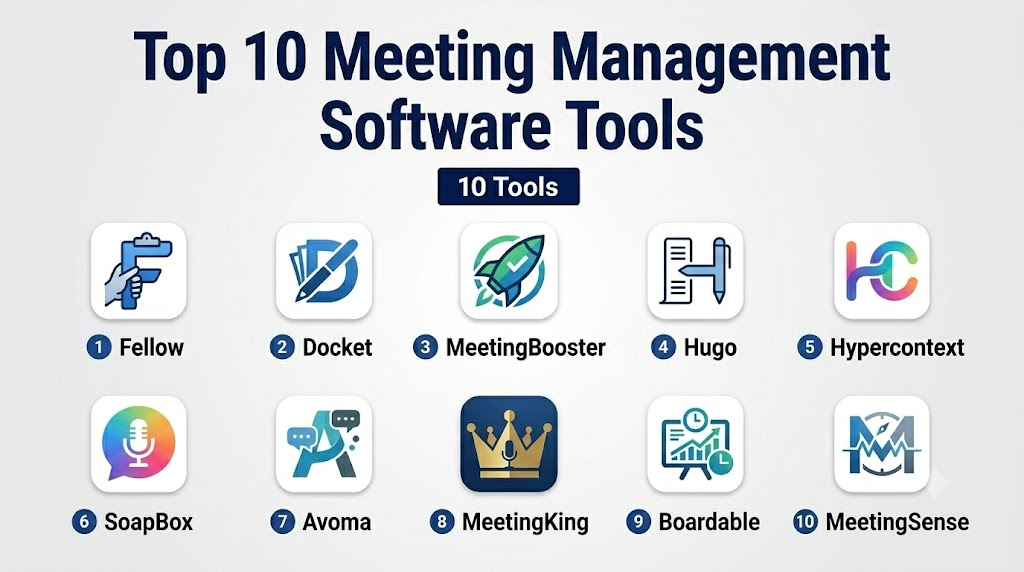
Top 10 Meeting Management Software Tools
1 — Fellow
Short description: Fellow streamlines meeting agendas, notes, and action items for teams and managers, enabling structured discussions and improved follow-up.
Key Features
- Shared agendas and templates
- Action item tracking
- Real-time note-taking
- Feedback and recognition integration
- Analytics and reporting on meeting effectiveness
- Calendar synchronization
Pros
- Intuitive interface for team collaboration
- Strong support for recurring meetings
- Helps improve accountability and follow-up
Cons
- Limited offline functionality
- Advanced analytics may require higher-tier plans
Platforms / Deployment
Web / iOS / Android
Cloud
Security & Compliance
Not publicly stated
Integrations & Ecosystem
Integrates well with productivity tools for smoother workflows:
- Google Workspace
- Microsoft 365
- Slack
- Zoom
Support & Community
Documentation, tutorials, and responsive support team. Strong community for best practices.
2 — Docket
Short description: Docket provides centralized meeting management with agendas, notes, and follow-ups, focusing on operational efficiency for distributed teams.
Key Features
- Collaborative agendas
- Meeting notes and minutes
- Task assignment and tracking
- Pre- and post-meeting engagement
- Document sharing within meetings
Pros
- Simplifies meeting preparation and follow-up
- Supports structured collaboration
- Useful for distributed teams
Cons
- Some features limited in free plan
- Less AI functionality than competitors
Platforms / Deployment
Web / iOS / Android
Cloud
Security & Compliance
Not publicly stated
Integrations & Ecosystem
- Google Calendar
- Outlook
- Zoom
- Slack
Support & Community
Knowledge base and responsive support, active user forum.
3 — MeetingBooster
Short description: MeetingBooster is designed for enterprises to manage agendas, minutes, tasks, and reporting in a centralized platform.
Key Features
- Agenda creation and distribution
- Meeting minutes automation
- Task management
- Reporting and analytics
- Workflow approval
Pros
- Enterprise-ready
- Robust reporting for accountability
- Reduces administrative overhead
Cons
- Complex setup for small teams
- Older UI may require training
Platforms / Deployment
Web / Windows
Cloud / On-premise
Security & Compliance
Not publicly stated
Integrations & Ecosystem
- Microsoft Outlook
- Google Workspace
- SharePoint
- CRM systems
Support & Community
Dedicated enterprise support with documentation and onboarding.
4 — Hugo
Short description: Hugo helps teams capture meeting notes, share insights, and integrate them with workflows and CRMs.
Key Features
- Note templates and smart snippets
- Shared agendas and notes
- CRM integrations
- Searchable meeting history
- Analytics dashboards
Pros
- Strong integration with Salesforce and other CRMs
- Collaborative agenda and note-taking
- Easy to organize historical meetings
Cons
- Some advanced analytics require paid plan
- Limited offline support
Platforms / Deployment
Web / iOS / Android
Cloud
Security & Compliance
Not publicly stated
Integrations & Ecosystem
- Salesforce
- Slack
- Zoom
- Microsoft Teams
Support & Community
Documentation, support team, and active community forum.
5 — Fellow.app
Short description: Fellow.app focuses on one-on-one and team meetings with actionable agendas and feedback.
Key Features
- Collaborative agendas
- Feedback and recognition
- Action items tracking
- Meeting insights
- Templates and analytics
Pros
- Improves employee engagement
- Helps managers track follow-ups
- Intuitive user interface
Cons
- Limited offline access
- Some analytics features require higher-tier subscription
Platforms / Deployment
Web / iOS / Android
Cloud
Security & Compliance
Not publicly stated
Integrations & Ecosystem
- Google Workspace
- Microsoft Teams
- Slack
- Zoom
Support & Community
Comprehensive knowledge base and responsive support.
6 — Hypercontext
Short description: Hypercontext provides structured agendas, meeting notes, and goal alignment tools for team meetings.
Key Features
- Meeting agendas and notes
- Action item tracking
- OKR alignment
- Analytics and insights
- Recurring meeting templates
Pros
- Goal alignment integration
- Real-time collaboration
- Simple to use
Cons
- Smaller feature set for complex workflows
- Limited AI functionality
Platforms / Deployment
Web / iOS / Android
Cloud
Security & Compliance
Not publicly stated
Integrations & Ecosystem
- Slack
- Zoom
- Google Workspace
Support & Community
Documentation and responsive support team.
7 — SoapBox
Short description: SoapBox focuses on one-on-one and team meeting agendas, notes, and feedback.
Key Features
- Agenda templates
- Notes and follow-ups
- Feedback collection
- Action items tracking
- Integrations with calendars
Pros
- Easy one-on-one management
- Encourages feedback culture
- Simple interface
Cons
- Less advanced analytics
- Smaller integration ecosystem
Platforms / Deployment
Web / iOS / Android
Cloud
Security & Compliance
Not publicly stated
Integrations & Ecosystem
- Google Workspace
- Microsoft Teams
- Slack
Support & Community
Documentation and community support.
8 — Avoma
Short description: Avoma provides meeting management with AI-generated agendas, transcription, notes, and analytics, tailored for sales and customer success teams.
Key Features
- AI-driven agendas
- Transcriptions and summaries
- Action items tracking
- CRM integration
- Analytics dashboard
Pros
- Strong for sales teams
- Automated notes reduce administrative load
- AI insights improve follow-ups
Cons
- Enterprise features may be expensive
- Learning curve for new users
Platforms / Deployment
Web / iOS / Android
Cloud
Security & Compliance
Not publicly stated
Integrations & Ecosystem
- Salesforce
- HubSpot
- Zoom
- Slack
Support & Community
Documentation, support tiers, and onboarding guides.
9 — MeetingKing
Short description: MeetingKing offers meeting management with agenda planning, minutes, and task tracking, aimed at mid-size businesses.
Key Features
- Agenda creation
- Notes and minutes
- Task assignment
- Follow-up reminders
- Document attachments
Pros
- Simple for structured meetings
- Easy task tracking
- Cost-effective
Cons
- Limited integrations
- UI may feel dated
Platforms / Deployment
Web
Cloud
Security & Compliance
Not publicly stated
Integrations & Ecosystem
- Google Workspace
- Outlook
Support & Community
Email support and knowledge base.
10 — Boardable
Short description: Boardable is tailored for board and nonprofit meetings, offering agendas, minutes, tasks, and collaboration.
Key Features
- Board meeting management
- Agenda and minutes
- Task and voting tools
- Document management
- Meeting reminders
Pros
- Tailored for boards and nonprofits
- Easy task and document management
- Simple interface for governance
Cons
- Less suitable for corporate team meetings
- Limited AI functionality
Platforms / Deployment
Web
Cloud
Security & Compliance
Not publicly stated
Integrations & Ecosystem
- Google Workspace
- Outlook
- Slack
Support & Community
Documentation and dedicated support.
Comparison Table
| Tool Name | Best For | Platform(s) Supported | Deployment | Standout Feature | Public Rating |
|---|---|---|---|---|---|
| Fellow | Team meetings & action items | Web, iOS, Android | Cloud | Collaborative agendas | N/A |
| Docket | Distributed teams | Web, iOS, Android | Cloud | Pre- and post-meeting engagement | N/A |
| MeetingBooster | Enterprise | Web, Windows | Cloud/On-premise | Automated minutes & reporting | N/A |
| Hugo | CRM-integrated meetings | Web, iOS, Android | Cloud | CRM integration & searchable notes | N/A |
| Fellow.app | One-on-one meetings | Web, iOS, Android | Cloud | Feedback & recognition | N/A |
| Hypercontext | Goal-aligned meetings | Web, iOS, Android | Cloud | OKR integration | N/A |
| SoapBox | One-on-one meetings | Web, iOS, Android | Cloud | Feedback culture support | N/A |
| Avoma | Sales & CS teams | Web, iOS, Android | Cloud | AI-driven agendas & summaries | N/A |
| MeetingKing | Mid-size business | Web | Cloud | Task assignment & reminders | N/A |
| Boardable | Boards & nonprofits | Web | Cloud | Board governance tools | N/A |
Evaluation & Scoring of Meeting Management Software
| Tool Name | Core (25%) | Ease (15%) | Integrations (15%) | Security (10%) | Performance (10%) | Support (10%) | Value (15%) | Weighted Total |
|---|---|---|---|---|---|---|---|---|
| Fellow | 9 | 9 | 8 | 7 | 8 | 8 | 8 | 8.25 |
| Docket | 8 | 8 | 8 | 7 | 8 | 7 | 8 | 7.85 |
| MeetingBooster | 9 | 7 | 8 | 8 | 9 | 8 | 7 | 8.20 |
| Hugo | 8 | 8 | 8 | 7 | 8 | 8 | 8 | 7.85 |
| Fellow.app | 8 | 9 | 7 | 7 | 8 | 8 | 8 | 7.90 |
| Hypercontext | 7 | 8 | 7 | 7 | 7 | 8 | 8 | 7.55 |
| SoapBox | 7 | 8 | 7 | 6 | 7 | 7 | 8 | 7.35 |
| Avoma | 9 | 8 | 9 | 8 | 8 | 8 | 7 | 8.25 |
| MeetingKing | 7 | 7 | 6 | 7 | 7 | 7 | 8 | 7.15 |
| Boardable | 7 | 7 | 6 | 7 | 7 | 7 | 8 | 7.15 |
Which Meeting Management Tool Is Right for You?
Solo / Freelancer
Use Fellow, Hypercontext, or SoapBox for simple, individual or one-on-one meetings with actionable notes.
SMB
Docket, Fellow, and Hugo suit small teams needing collaboration, agenda sharing, and CRM integration.
Mid-Market
Avoma, MeetingBooster, and Hugo provide robust task tracking, analytics, and workflow automation for multiple departments.
Enterprise
Avoma, MeetingBooster, Fellow, and Boardable offer governance, compliance, reporting, and admin controls for large teams.
Budget vs Premium
Lightweight plans: Fellow, SoapBox, Hypercontext. Premium plans: Avoma, MeetingBooster, Hugo for enterprise or feature-rich requirements.
Feature Depth vs Ease of Use
If ease-of-use is priority: Fellow, Hypercontext, SoapBox. If feature depth matters: Avoma, MeetingBooster, Hugo.
Integrations & Scalability
High integration and scaling needs: Avoma, Hugo, Docket, MeetingBooster. Ensure CRM, calendar, and task support.
Security & Compliance Needs
Enterprises must verify SSO, MFA, audit logs, retention policies, and encryption. Confirm compliance documentation for critical industries.
Frequently Asked Questions
1- What is meeting management software?
Tools that organize scheduling, agendas, notes, tasks, and follow-ups for efficient team meetings.
2- Do these tools support hybrid work?
Yes, most platforms support remote, in-person, and hybrid meetings, integrating with calendars and video conferencing apps.
3- Can I track tasks and follow-ups?
Yes, most tools allow assigning tasks, tracking action items, and sending reminders post-meeting.
4- Are there free versions available?
Many platforms offer free or limited plans for small teams; feature access increases with paid plans.
5- How secure is meeting data?
Security varies; enterprise-grade plans often provide encryption, SSO, role-based access, and audit logs.
6- Can I integrate with CRMs?
Yes, tools like Hugo, Avoma, and Docket offer integrations with Salesforce, HubSpot, and other CRMs.
7- Do they support AI-generated summaries?
Yes, AI-powered agendas, summaries, and meeting insights are becoming standard in 2026.
8- Can I schedule recurring meetings?
Most tools allow recurring scheduling with templates and agenda pre-population.
9- Are these tools suitable for boards and nonprofits?
Yes, Boardable and MeetingBooster cater specifically to governance and nonprofit boards.
10- How do I choose the right tool?
Consider team size, workflow complexity, integration needs, budget, and desired level of automation.
Conclusion
Meeting management software helps teams streamline scheduling, agendas, notes, follow-ups, and analytics. The best tool depends on team size, workflow needs, integrations, security, and budget. Solo users may prefer Fellow, SMBs can leverage Docket or Hugo, mid-market teams benefit from Avoma or MeetingBooster, and enterprises require governance-focused tools like Boardable or MeetingBooster. Shortlist 2–3 options, pilot real meetings, evaluate ease of use, integration capabilities, and security compliance to select the right solution for your organization.

Find Trusted Cardiac Hospitals
Compare heart hospitals by city and services — all in one place.
Explore Hospitals
Meeting management software is most effective when it keeps every stage of a meeting—from planning to follow-up—in one organized workflow. Features such as agenda creation, task tracking, collaborative notes, and action item management help teams run more productive meetings, improve accountability, and ensure decisions are translated into measurable outcomes.