Introduction
PEP Screening Tools help organizations identify Politically Exposed Persons, their associates, relatives, and high-risk individuals during onboarding, transaction monitoring, and ongoing compliance reviews. These tools are widely used by banks, fintech companies, insurers, payment providers, crypto exchanges, and multinational enterprises to reduce money laundering, bribery, corruption, and reputational risks. As global regulations around AML, KYC, sanctions, and financial crime continue expanding, organizations can no longer rely on manual screening processes. Modern PEP screening platforms now combine AI-driven matching, sanctions monitoring, adverse media analysis, behavioral analytics, and continuous monitoring workflows to improve compliance efficiency and reduce false positives. Real-time screening and automated monitoring have become especially important for organizations operating across multiple jurisdictions and high-volume customer environments.
Real-World Use Cases Include:
- Screening customers during onboarding
- Monitoring politically exposed persons and close associates
- Detecting corruption and bribery risks
- Supporting AML and KYC compliance workflows
- Monitoring high-risk transactions and customer activity
Evaluation Criteria for Buyers:
- Global PEP database coverage
- Real-time monitoring capabilities
- AI-assisted matching accuracy
- False-positive reduction workflows
- Adverse media and sanctions integration
- API and integration flexibility
- Audit and reporting support
- Scalability for high-volume screening
- Security and access management
- Vendor regulatory expertise
Best for: banks, fintech firms, payment processors, insurance providers, crypto exchanges, multinational corporations, and compliance teams handling high-volume customer onboarding and AML workflows.
Not ideal for: organizations with minimal regulatory obligations or businesses that only require occasional manual customer verification without continuous monitoring requirements.
Key Trends in PEP Screening Tools
- AI-assisted identity matching is reducing false positives and improving investigation speed.
- Continuous customer monitoring is replacing one-time onboarding-only checks.
- Integrated sanctions and adverse media screening is becoming standard.
- Cloud-native compliance infrastructure is replacing legacy screening systems.
- Behavioral analytics and relationship mapping are improving hidden-risk detection.
- Crypto-related PEP monitoring is expanding due to digital asset regulation growth.
- Real-time transaction-linked screening is becoming more common.
- API-first screening workflows are improving fintech and banking integrations.
- Automated compliance reporting is helping organizations prepare for audits faster.
- Explainable AI compliance workflows are gaining importance in regulated industries.
How We Selected These Tools
The tools below were selected using a practical AML and compliance evaluation framework:
- Market adoption across regulated industries
- Breadth of PEP and sanctions data coverage
- Monitoring and transaction screening capabilities
- AI-assisted screening accuracy
- Integration ecosystem strength
- Scalability for enterprise compliance environments
- Security posture and auditability
- Vendor reputation in financial crime compliance
- Deployment flexibility across cloud and enterprise models
- Long-term relevance for evolving AML regulations
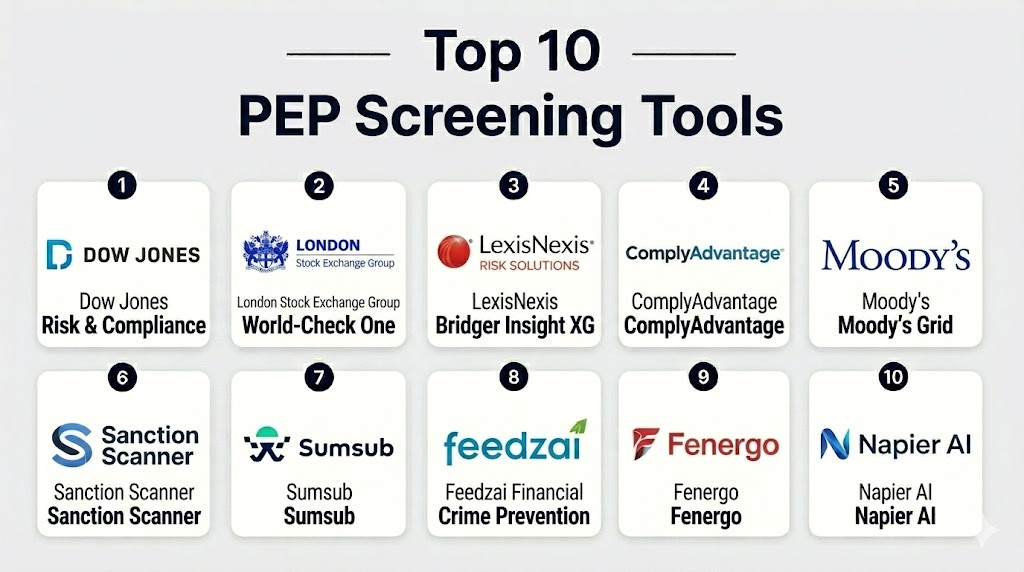
Top 10 PEP Screening Tools
1- Dow Jones Risk & Compliance
Short description: Dow Jones Risk & Compliance provides PEP screening, sanctions monitoring, and adverse media intelligence for banks, financial institutions, and multinational enterprises.
Key Features
- Global PEP screening databases
- Adverse media intelligence
- Real-time sanctions monitoring
- AI-assisted name matching
- Risk scoring analytics
- Ongoing customer monitoring
- Audit and reporting workflows
Pros
- Strong global risk intelligence coverage
- Broad compliance workflow support
- Good adverse media analytics capabilities
Cons
- Enterprise-focused pricing
- Advanced deployments may require specialist support
- Complex onboarding for large institutions
Platforms / Deployment
Cloud / Hybrid
Security & Compliance
Enterprise-grade security controls available.
Integrations & Ecosystem
Dow Jones integrates with AML, onboarding, KYC, and transaction monitoring systems across regulated industries.
- Banking systems
- KYC workflows
- AML monitoring
- Payment systems
- Compliance reporting tools
Support & Community
Strong institutional support with compliance-focused onboarding services.
2- Refinitiv World-Check One
Short description: Refinitiv World-Check One provides PEP screening, sanctions intelligence, and risk monitoring for global financial institutions and regulated organizations.
Key Features
- Global PEP monitoring
- Real-time sanctions screening
- Adverse media analysis
- Ongoing customer monitoring
- Risk intelligence workflows
- Automated compliance reporting
- Watchlist management
Pros
- Extensive global data coverage
- Strong institutional adoption
- Broad compliance functionality
Cons
- Enterprise-oriented deployment
- Higher pricing for advanced workflows
- Large-scale implementations can be complex
Platforms / Deployment
Cloud / Hybrid
Security & Compliance
Enterprise-grade controls available.
Integrations & Ecosystem
World-Check One integrates with onboarding, transaction monitoring, AML, and enterprise compliance environments.
- AML systems
- KYC platforms
- Banking infrastructure
- Payment gateways
- Compliance analytics
Support & Community
Strong global enterprise support ecosystem.
3- LexisNexis Bridger Insight XG
Short description: Bridger Insight XG helps organizations automate PEP screening, sanctions monitoring, and identity intelligence workflows.
Key Features
- PEP and sanctions screening
- Identity verification workflows
- Fuzzy matching capabilities
- AML monitoring support
- Risk scoring analytics
- Transaction monitoring
- Audit and reporting workflows
Pros
- Strong identity intelligence integration
- Broad financial crime compliance coverage
- Useful real-time monitoring capabilities
Cons
- Enterprise deployment complexity
- Advanced configurations may require tuning
- Public pricing details limited
Platforms / Deployment
Cloud / Hybrid
Security & Compliance
Enterprise security controls available.
Integrations & Ecosystem
LexisNexis integrates with financial crime, onboarding, and compliance monitoring environments.
- Banking systems
- KYC workflows
- AML monitoring tools
- Payment systems
- Fraud detection platforms
Support & Community
Strong institutional compliance support ecosystem.
4- ComplyAdvantage PEP Screening
Short description: ComplyAdvantage provides cloud-native PEP screening and AML monitoring tools for fintech companies, banks, and payment organizations.
Key Features
- Real-time PEP screening
- AI-driven name matching
- API-first integrations
- Ongoing monitoring workflows
- Adverse media intelligence
- AML support tools
- Automated compliance alerts
Pros
- Fast deployment workflows
- Strong fintech usability
- Flexible API infrastructure
Cons
- Smaller ecosystem than legacy enterprise vendors
- Enterprise customization may vary
- Public pricing transparency limited
Platforms / Deployment
Cloud
Security & Compliance
Security controls available.
Integrations & Ecosystem
ComplyAdvantage integrates with fintech, digital banking, and AML compliance environments.
- Banking APIs
- Payment systems
- KYC platforms
- AML workflows
- Compliance dashboards
Support & Community
Strong fintech-focused onboarding and implementation support.
5- Moody’s Grid
Short description: Moody’s Grid provides PEP screening, sanctions monitoring, and financial crime risk intelligence for regulated financial institutions.
Key Features
- Global PEP datasets
- Risk intelligence analytics
- Adverse media monitoring
- AML workflow integration
- Ongoing customer screening
- Compliance reporting
- Entity resolution capabilities
Pros
- Strong financial risk intelligence
- Broad compliance workflow support
- Good enterprise scalability
Cons
- Enterprise-oriented deployment
- Complex onboarding for large organizations
- Public pricing not widely available
Platforms / Deployment
Cloud / Hybrid
Security & Compliance
Enterprise-grade security controls available.
Integrations & Ecosystem
Moody’s Grid integrates risk intelligence with onboarding, AML, and transaction monitoring workflows.
- AML systems
- Banking infrastructure
- Risk analytics tools
- Compliance reporting
- KYC platforms
Support & Community
Enterprise compliance and risk intelligence support services available.
6- Sanction Scanner
Short description: Sanction Scanner provides PEP screening, sanctions monitoring, and AML compliance tools for fintech firms and financial organizations.
Key Features
- PEP screening workflows
- Real-time sanctions monitoring
- API integration support
- Customer onboarding checks
- AML monitoring
- Risk scoring tools
- Compliance reporting workflows
Pros
- API-friendly deployment model
- Good fintech usability
- Fast onboarding workflows
Cons
- Smaller enterprise footprint
- Advanced customization options vary
- Limited large-scale deployment visibility
Platforms / Deployment
Cloud
Security & Compliance
Security controls available.
Integrations & Ecosystem
Sanction Scanner integrates with fintech, onboarding, and payment ecosystems for streamlined compliance workflows.
- Banking APIs
- Payment systems
- KYC workflows
- AML monitoring
- Compliance dashboards
Support & Community
Growing fintech-focused support ecosystem.
7- Sumsub
Short description: Sumsub provides identity verification, PEP screening, AML monitoring, and fraud prevention workflows for fintech and crypto organizations.
Key Features
- PEP and sanctions screening
- Identity verification workflows
- AML transaction monitoring
- Fraud prevention support
- Crypto compliance workflows
- Ongoing customer monitoring
- API-driven integrations
Pros
- Strong digital onboarding workflows
- Good fintech and crypto support
- Modern API-first architecture
Cons
- Enterprise customization may vary
- Smaller legacy banking footprint
- Public pricing details limited
Platforms / Deployment
Cloud
Security & Compliance
Security controls available.
Integrations & Ecosystem
Sumsub integrates onboarding, AML, identity verification, and fraud prevention workflows.
- KYC systems
- Crypto exchanges
- Banking APIs
- Payment platforms
- AML monitoring tools
Support & Community
Strong onboarding support for fintech and crypto organizations.
8- Feedzai Financial Crime Prevention
Short description: Feedzai combines AI-driven fraud detection, AML monitoring, and PEP screening workflows for banks and payment organizations.
Key Features
- AI-assisted PEP screening
- Behavioral analytics
- Fraud detection workflows
- Transaction monitoring
- Risk scoring capabilities
- Real-time alerting
- Compliance reporting support
Pros
- Strong AI and behavioral analytics
- Real-time monitoring capabilities
- Good fraud and AML integration support
Cons
- Enterprise deployment complexity
- Advanced analytics require tuning
- Pricing not publicly transparent
Platforms / Deployment
Cloud
Security & Compliance
Enterprise-grade controls available.
Integrations & Ecosystem
Feedzai integrates financial crime prevention with PEP screening and fraud analytics environments.
- Banking systems
- Payment gateways
- AML workflows
- Fraud monitoring
- Risk analytics
Support & Community
Strong banking and fintech implementation support.
9- Fenergo
Short description: Fenergo provides client lifecycle management with integrated PEP screening, KYC automation, and compliance workflows.
Key Features
- PEP monitoring workflows
- Client onboarding automation
- KYC process management
- Regulatory reporting
- Continuous customer monitoring
- Risk scoring support
- Audit tracking workflows
Pros
- Strong onboarding automation capabilities
- Good enterprise workflow visibility
- Useful compliance process integration
Cons
- Larger implementation timelines
- Primarily financial-services focused
- Enterprise complexity
Platforms / Deployment
Cloud / Hybrid
Security & Compliance
Enterprise-grade security controls available.
Integrations & Ecosystem
Fenergo integrates onboarding, KYC, AML, and compliance operations across financial institutions.
- CRM systems
- Banking infrastructure
- KYC workflows
- AML systems
- Compliance reporting tools
Support & Community
Professional onboarding and regulatory compliance support.
10- Napier AI
Short description: Napier AI provides AI-driven AML and PEP monitoring workflows for financial institutions and fintech organizations.
Key Features
- AI-powered PEP screening
- AML transaction monitoring
- Behavioral analytics
- Risk scoring workflows
- Automated alert prioritization
- Compliance reporting
- Ongoing customer monitoring
Pros
- Modern AI-focused monitoring workflows
- Good scalability for digital finance environments
- Strong transaction monitoring support
Cons
- Smaller enterprise footprint than legacy vendors
- Enterprise customization may require tuning
- Public pricing details limited
Platforms / Deployment
Cloud / Hybrid
Security & Compliance
Security controls available.
Integrations & Ecosystem
Napier AI integrates PEP monitoring with AML, banking, and financial crime workflows.
- Banking systems
- Payment infrastructure
- AML monitoring
- Compliance reporting
- Risk analytics tools
Support & Community
Professional support for AML and financial crime operations.
Comparison Table
| Tool Name | Best For | Platform Supported | Deployment | Standout Feature | Public Rating |
|---|---|---|---|---|---|
| Dow Jones Risk & Compliance | Enterprise compliance monitoring | Web / Cloud | Cloud / Hybrid | Global risk intelligence | N/A |
| Refinitiv World-Check One | Large financial institutions | Web / Cloud | Cloud / Hybrid | Extensive global datasets | N/A |
| LexisNexis Bridger Insight XG | Identity intelligence workflows | Web / Cloud | Cloud / Hybrid | Fuzzy matching capabilities | N/A |
| ComplyAdvantage | Fintech and digital banking | Web / Cloud | Cloud | API-first screening | N/A |
| Moody’s Grid | Enterprise risk intelligence | Web / Cloud | Cloud / Hybrid | Financial crime analytics | N/A |
| Sanction Scanner | Fast fintech deployment | Web / Cloud | Cloud | Lightweight API integrations | N/A |
| Sumsub | Crypto and fintech onboarding | Web / Cloud | Cloud | Identity verification workflows | N/A |
| Feedzai | AI-driven fraud and AML monitoring | Web / Cloud | Cloud | Behavioral analytics | N/A |
| Fenergo | KYC and onboarding automation | Web / Cloud | Cloud / Hybrid | Client lifecycle management | N/A |
| Napier AI | AI-powered AML workflows | Web / Cloud | Cloud / Hybrid | Real-time compliance analytics | N/A |
Evaluation & Scoring of PEP Screening Tools
| Tool Name | Core 25% | Ease 15% | Integrations 15% | Security 10% | Performance 10% | Support 10% | Value 15% | Weighted Total |
|---|---|---|---|---|---|---|---|---|
| Dow Jones Risk & Compliance | 10 | 7 | 9 | 9 | 9 | 9 | 6 | 8.50 |
| Refinitiv World-Check One | 10 | 7 | 9 | 9 | 9 | 9 | 6 | 8.50 |
| LexisNexis Bridger Insight XG | 9 | 7 | 9 | 9 | 9 | 8 | 7 | 8.25 |
| ComplyAdvantage | 8 | 8 | 8 | 8 | 8 | 8 | 8 | 8.00 |
| Moody’s Grid | 9 | 7 | 8 | 9 | 8 | 8 | 7 | 8.00 |
| Sanction Scanner | 7 | 8 | 7 | 7 | 7 | 7 | 8 | 7.25 |
| Sumsub | 8 | 8 | 8 | 7 | 8 | 8 | 8 | 7.90 |
| Feedzai | 8 | 8 | 8 | 8 | 8 | 8 | 8 | 8.00 |
| Fenergo | 8 | 7 | 8 | 8 | 8 | 8 | 7 | 7.70 |
| Napier AI | 8 | 7 | 8 | 7 | 8 | 7 | 8 | 7.60 |
Which PEP Screening Tool Is Right for You?
Solo / Freelancer
Independent professionals and very small businesses usually do not require enterprise PEP monitoring platforms unless operating within heavily regulated international sectors. Lightweight compliance workflows or manual screening may be sufficient for low-volume onboarding environments.
SMB
Fintech startups, payment providers, and growing digital financial services firms should prioritize API flexibility, onboarding speed, and usability. ComplyAdvantage, Sanction Scanner, and Sumsub are often practical choices for smaller operational teams.
Mid-Market
Mid-sized regulated organizations frequently need stronger onboarding automation, AML workflows, and reporting support. Feedzai, Napier AI, and Fenergo can provide balanced functionality across compliance operations.
Enterprise
Large banks, multinational corporations, insurers, and enterprise financial institutions should evaluate Dow Jones Risk & Compliance, Refinitiv World-Check One, LexisNexis Bridger Insight XG, and Moody’s Grid for scalability and global compliance coverage.
Budget vs Premium
Premium enterprise screening platforms provide broader global datasets, advanced analytics, and stronger regulatory support. Smaller organizations should focus on practical onboarding workflows and operational efficiency before adopting large enterprise suites.
Feature Depth vs Ease of Use
Enterprise-grade systems deliver extensive customization and compliance depth but often require experienced AML and compliance teams. Cloud-native fintech-oriented platforms generally simplify deployment and reduce operational complexity.
Integrations & Scalability
Integration quality is critical because PEP screening tools commonly connect with onboarding systems, banking infrastructure, payment gateways, CRM platforms, and AML monitoring environments.
Security & Compliance Needs
Strong auditability, encryption, role-based access controls, reporting transparency, and investigation traceability are essential because PEP monitoring systems process highly sensitive customer and financial data.
Frequently Asked Questions FAQs
1. What are PEP Screening Tools?
PEP Screening Tools help organizations identify Politically Exposed Persons and related high-risk individuals during onboarding and ongoing compliance monitoring. These systems automate screening workflows and reduce manual investigation effort. Modern tools also integrate sanctions monitoring and adverse media analysis. They are essential for AML and financial crime compliance environments.
2. Who typically uses PEP screening platforms?
Banks, fintech companies, payment providers, insurers, brokerages, crypto exchanges, and multinational enterprises commonly use these platforms. Compliance officers, AML analysts, onboarding teams, and financial crime investigators rely on them regularly. Organizations handling international customers or financial transactions often require continuous monitoring workflows. Regulatory exposure strongly influences deployment scale.
3. Why are PEP screening tools important today?
Global AML and anti-corruption regulations are becoming stricter across banking, payments, trade, and digital finance ecosystems. Manual screening processes can no longer scale efficiently in high-volume environments. PEP screening tools improve compliance accuracy, reduce false positives, automate monitoring, and strengthen financial crime prevention programs. They also support audit readiness and regulatory reporting.
4. What types of monitoring do these tools support?
Most PEP screening platforms support politically exposed persons monitoring, sanctions checks, adverse media analysis, AML transaction monitoring, customer due diligence, and ongoing compliance screening. Some advanced systems also support crypto monitoring and relationship mapping. Enterprise-grade tools may combine fraud analytics and financial crime detection together. Coverage varies depending on vendor specialization.
5. Are AI and machine learning important for PEP screening?
AI and machine learning improve name matching accuracy and help reduce operational false positives. Traditional rule-based systems often create investigation overload in large financial environments. AI-driven workflows can improve alert prioritization, relationship analysis, and suspicious activity detection significantly. However, organizations still need transparent audit workflows and human oversight.
6. Can PEP screening tools support crypto compliance?
Yes, many modern PEP screening platforms now support crypto onboarding, blockchain monitoring, and digital asset transaction screening workflows. This capability has become increasingly important as regulators expand oversight of digital finance environments. Buyers should confirm blockchain and exchange integration support before deployment. Crypto compliance coverage varies by vendor.
7. What integrations matter most for PEP screening platforms?
Important integrations include banking systems, onboarding platforms, KYC workflows, payment gateways, AML monitoring tools, CRM systems, and compliance reporting environments. API flexibility is especially important for fintech organizations and payment providers. Poor integrations can create compliance blind spots and operational delays. Integration testing should be part of implementation planning.
8. Are cloud-based PEP screening platforms secure?
Most enterprise PEP screening vendors provide encryption, access controls, audit logging, and role-based security workflows. However, organizations should independently validate vendor security documentation and operational controls. Security requirements vary depending on regulations and industry exposure. Highly regulated organizations should involve security and compliance teams during procurement.
9. What mistakes should organizations avoid during implementation?
Common mistakes include underestimating integration complexity, focusing only on screening data instead of workflow usability, and failing to involve compliance analysts early. Some firms also ignore false-positive management and ongoing monitoring requirements. Poor implementation planning can overwhelm investigation teams with unnecessary alerts. Pilot testing before production deployment is strongly recommended.
10. How long does PEP screening implementation usually take?
Implementation timelines vary based on organizational size, transaction volume, workflow customization, and integration complexity. Smaller cloud-native deployments may move relatively quickly, while enterprise banking implementations can take several months. Screening rules, onboarding processes, and reporting workflows often require careful tuning. Organizations should use phased rollout and validation testing strategies.
Conclusion
PEP Screening Tools have become essential infrastructure for organizations operating in regulated financial and international business environments. As AML regulations, anti-corruption enforcement, sanctions requirements, and financial crime risks continue expanding globally, organizations need scalable systems capable of delivering accurate monitoring, real-time screening, and operational efficiency. The best platform depends on your organization’s size, regulatory exposure, transaction volume, onboarding complexity, and integration requirements. Enterprise institutions may prioritize platforms like Dow Jones Risk & Compliance, Refinitiv World-Check One, and LexisNexis Bridger Insight XG for global data coverage and enterprise scalability, while fintech companies may prefer API-first solutions such as ComplyAdvantage, Sumsub, or Sanction Scanner for faster deployment and operational agility. Before selecting a platform, organizations should shortlist a few vendors, validate integrations carefully, test monitoring accuracy, review false-positive workflows, and run pilot compliance scenarios using real onboarding and transaction data.

Find Trusted Cardiac Hospitals
Compare heart hospitals by city and services — all in one place.
Explore Hospitals
PEP (Politically Exposed Person) screening tools are most valuable when they help organizations identify and monitor individuals who may present elevated financial crime or corruption risks due to their public positions or close associations. By providing automated PEP database screening, sanctions checks, adverse media monitoring, risk scoring, ongoing monitoring, and compliance reporting, these platforms enable financial institutions and regulated businesses to strengthen Know Your Customer (KYC) and Anti-Money Laundering (AML) compliance while reducing regulatory and reputational risks.