Introduction
Procurement Software is a business platform that helps organizations manage purchasing, suppliers, approvals, contracts, purchase orders, invoices, and spend control from one centralized system. In simple terms, it helps companies buy the right goods and services from the right suppliers at the right cost while keeping every approval, budget, and compliance step properly tracked. Modern procurement tools are no longer limited to purchase order creation. They now support strategic sourcing, supplier risk management, AI-assisted spend analysis, contract visibility, invoice matching, and deep integrations with ERP, accounting, finance, and supply chain systems. Procurement Software has become important because businesses are dealing with rising supplier complexity, cost pressure, compliance requirements, and the need for faster purchasing decisions. Without a structured procurement system, teams often depend on emails, spreadsheets, manual approvals, and disconnected vendor records, which can lead to delays, duplicate purchases, budget leakage, and poor supplier visibility.
Real World Use Cases
- Managing purchase requests and approval workflows across departments
- Creating and tracking purchase orders
- Comparing supplier quotes and running sourcing events
- Managing supplier onboarding, documents, and performance
- Controlling budgets and reducing maverick spending
- Matching invoices with purchase orders and receipts
- Tracking contract terms, renewals, and compliance
- Analyzing company-wide spend to identify savings opportunities
Evaluation Criteria for Buyers
- Ease of creating purchase requests and approvals
- Supplier management and onboarding capabilities
- ERP, accounting, and finance integrations
- Spend analytics and reporting quality
- Contract and sourcing workflow depth
- Budget control and policy compliance features
- Invoice matching and procurement automation
- Security controls, audit logs, and user permissions
- Scalability for multiple departments, regions, and entities
- Total cost of ownership, implementation effort, and support quality
Best for: Procurement teams, finance departments, operations leaders, supply chain managers, mid-market companies, large enterprises, and growing businesses that need better control over spend, suppliers, approvals, contracts, and purchasing compliance.
Not ideal for: Very small businesses with simple purchasing needs, teams that only buy occasionally, or companies that can manage purchases using basic accounting software without complex approval, supplier, or spend control requirements.
Key Trends in Procurement Software
- AI-assisted spend analytics is helping procurement teams detect savings opportunities, supplier risks, duplicate vendors, and unusual purchase patterns.
- Source-to-pay consolidation is becoming more popular as companies prefer one platform for sourcing, contracts, purchasing, suppliers, invoices, and analytics.
- Supplier risk management is becoming a major priority because businesses need visibility into supplier reliability, compliance, financial health, and operational risk.
- Guided buying experiences are improving employee purchasing by directing users to approved suppliers, catalogs, contracts, and budget-compliant choices.
- No-code workflow configuration is becoming important for procurement teams that want to adjust approvals without heavy IT dependency.
- ERP and finance integration remains a critical requirement because procurement data must connect with budgets, accounting, payments, and financial reporting.
- Contract compliance automation is helping teams ensure purchases follow negotiated terms, preferred supplier agreements, and renewal rules.
- Supplier collaboration portals are making it easier to exchange documents, quotes, purchase orders, invoices, and performance updates.
- ESG and responsible sourcing are becoming stronger buying considerations for organizations tracking sustainability, supplier diversity, and ethical sourcing.
- Real-time procurement dashboards are replacing static reports with live visibility into spend, suppliers, approvals, savings, and invoice status.
How We Selected These Tools
The tools in this list were selected using a practical procurement software evaluation approach focused on business usability, procurement depth, and long-term scalability.
- Market recognition across enterprise, mid-market, and growing business segments
- Strength of procurement workflows such as requisitions, approvals, purchase orders, and supplier management
- Source-to-pay coverage, including sourcing, contracts, purchasing, invoicing, and spend analytics
- Integration capabilities with ERP, accounting, finance, supplier, and contract systems
- Suitability for different organization sizes and procurement maturity levels
- Reporting and analytics strength for spend visibility, savings tracking, and supplier performance
- Security and governance features such as roles, permissions, audit logs, and approval controls
- Ease of adoption for procurement teams, finance users, business requesters, and suppliers
- Support ecosystem, onboarding resources, documentation, and implementation partner availability
- Practical value based on automation, compliance, cost control, and process efficiency
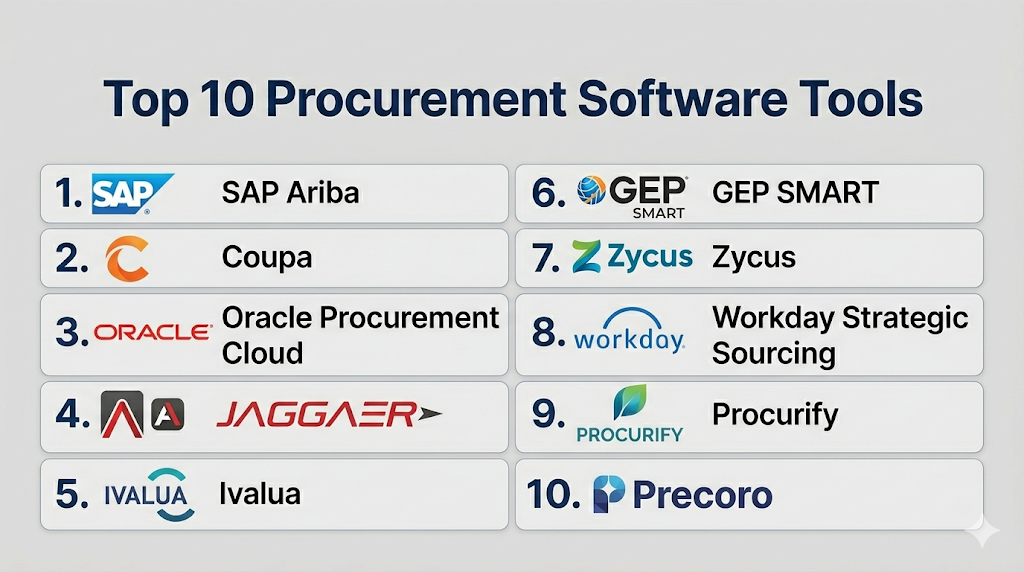
Top 10 Procurement Software Tools
1 — SAP Ariba
Short description: SAP Ariba is an enterprise procurement and supplier collaboration platform designed for global source-to-pay operations. It is best suited for large organizations that need advanced sourcing, supplier management, procurement, contracts, and spend visibility.
Key Features
- End-to-end source-to-pay capabilities for enterprise procurement
- Supplier discovery, onboarding, qualification, and collaboration
- Strategic sourcing events, RFx workflows, and supplier negotiations
- Contract management and purchasing policy compliance
- Guided buying experience for approved purchasing
- Deep alignment with SAP ERP and SAP business applications
- Spend visibility, supplier performance, and procurement reporting
Pros
- Strong fit for global enterprises with complex procurement operations
- Mature supplier network and source-to-pay functionality
- Works well for organizations already using SAP systems
Cons
- Implementation can be complex and resource-intensive
- May be too advanced for smaller procurement teams
- Requires strong process planning and change management
Platforms / Deployment
Cloud / Hybrid / Web / Enterprise deployment options vary by SAP environment.
Security & Compliance
Supports enterprise-grade security expectations such as role-based access, auditability, identity management, workflow governance, and secure integrations. Specific certifications should be verified based on deployment and contract.
Integrations & Ecosystem
SAP Ariba has a strong enterprise procurement ecosystem and is especially useful for organizations using SAP finance, ERP, supply chain, and supplier network capabilities.
- SAP S/4HANA
- SAP ERP
- Supplier network integrations
- Finance and invoice workflows
- Contract management systems
- Enterprise reporting and analytics tools
Support & Community
SAP provides enterprise support, documentation, training resources, implementation partners, and a large consulting ecosystem. Successful adoption usually depends on expert configuration, stakeholder alignment, and strong internal governance.
2 — Coupa
Short description: Coupa is a business spend management platform that combines procurement, sourcing, invoicing, expenses, contracts, supplier management, and spend analytics. It is best for organizations that want broad control over business spending in one cloud-based system.
Key Features
- Procurement, invoicing, expenses, sourcing, and supplier management
- Guided buying workflows for policy-compliant purchasing
- Spend analytics for savings and supplier visibility
- Supplier onboarding and supplier information management
- Budget controls and approval workflow automation
- Contract and sourcing capabilities
- ERP and finance system integrations
Pros
- Strong all-in-one spend management approach
- Good user experience compared with many legacy systems
- Useful for procurement and finance collaboration
Cons
- May be more than needed for small teams
- Advanced modules can increase cost and implementation scope
- Success depends on clean procurement data and workflow design
Platforms / Deployment
Cloud / Web / Mobile access available depending on configuration.
Security & Compliance
Supports enterprise security expectations such as role-based permissions, approval controls, audit trails, and secure access management. Specific certifications should be verified during evaluation.
Integrations & Ecosystem
Coupa connects procurement with finance, supplier, expense, ERP, and analytics workflows. It is often used as a central spend management layer across departments.
- ERP systems
- Finance and accounting platforms
- Supplier management tools
- Invoice and payment workflows
- Contract and sourcing modules
- APIs and implementation partner ecosystem
Support & Community
Coupa offers vendor support, customer success resources, training, implementation services, and a strong partner network. It is commonly adopted by mid-market and enterprise organizations.
3 — Oracle Procurement Cloud
Short description: Oracle Procurement Cloud is part of Oracle Fusion Cloud applications and supports enterprise purchasing, sourcing, supplier management, contracts, and procurement analytics. It is best for organizations already using Oracle ERP or finance systems.
Key Features
- Purchase requisitions, purchase orders, and approval workflows
- Supplier onboarding, qualification, and lifecycle management
- Strategic sourcing and negotiation support
- Contract and purchasing policy controls
- Procurement analytics and performance dashboards
- Integration with Oracle Financials and Oracle ERP Cloud
- Enterprise-grade workflow and reporting capabilities
Pros
- Strong fit for Oracle-based enterprises
- Broad procurement functionality across operational and strategic buying
- Good alignment with finance, ERP, and supply chain processes
Cons
- Best value usually comes within the Oracle ecosystem
- Implementation can be complex for companies with fragmented processes
- Smaller teams may find it too enterprise-focused
Platforms / Deployment
Cloud / Web / Enterprise application suite.
Security & Compliance
Supports enterprise identity, role-based access, audit trails, workflow governance, and administrative controls. Specific certifications should be validated based on region, deployment, and contract.
Integrations & Ecosystem
Oracle Procurement Cloud works closely with Oracle enterprise applications and can connect with third-party systems through integration tools and APIs.
- Oracle ERP Cloud
- Oracle Financials
- Oracle Supply Chain applications
- Supplier and invoice workflows
- Enterprise integration tools
- Reporting and analytics platforms
Support & Community
Oracle provides enterprise support, documentation, certified implementation partners, consulting resources, and training. It is best suited for organizations with Oracle technology investments.
4 — JAGGAER
Short description: JAGGAER is a source-to-pay procurement platform focused on sourcing, supplier management, contracts, spend analytics, and procurement automation. It is often used by large organizations and industry-specific procurement teams.
Key Features
- Source-to-pay suite for sourcing, contracts, procurement, and suppliers
- Supplier lifecycle and performance management
- Strategic sourcing events and negotiation tools
- Spend analytics and category management support
- Contract management and compliance tracking
- ERP and finance system integrations
- Industry-focused procurement capabilities
Pros
- Strong sourcing and supplier management depth
- Good fit for complex procurement environments
- Useful for both strategic sourcing and operational procurement
Cons
- Can require careful configuration and implementation planning
- May be too advanced for basic purchasing needs
- User experience can vary by module and setup
Platforms / Deployment
Cloud / Web / Deployment options may vary by product and contract.
Security & Compliance
Supports enterprise procurement governance features such as user roles, permissions, approval controls, and audit logs. Specific certifications should be verified during procurement.
Integrations & Ecosystem
JAGGAER integrates procurement workflows with ERP, supplier, contract, finance, and analytics systems. It is useful where supplier governance and sourcing depth are important.
- ERP integrations
- Supplier information systems
- Contract management workflows
- Finance and invoice systems
- Spend analytics platforms
- APIs and implementation partner support
Support & Community
JAGGAER provides vendor support, onboarding services, documentation, and implementation assistance. Enterprise buyers should plan for process mapping and stakeholder training.
5 — Ivalua
Short description: Ivalua is a flexible source-to-pay platform covering sourcing, suppliers, contracts, purchasing, invoicing, and spend analytics. It is best for organizations that need configurable procurement workflows and broad process coverage.
Key Features
- End-to-end source-to-pay process support
- Supplier onboarding, risk, performance, and lifecycle management
- Strategic sourcing and contract lifecycle management
- Purchase requisition and purchase order workflows
- Invoice management and spend visibility
- Configurable approval and procurement workflows
- Analytics for suppliers, savings, contracts, and compliance
Pros
- Highly flexible for complex procurement workflows
- Broad coverage across direct and indirect procurement
- Good fit for organizations needing customization
Cons
- Flexibility can increase implementation effort
- Advanced configuration requires strong planning
- Smaller teams may not need the full suite
Platforms / Deployment
Cloud / Web / Enterprise procurement suite.
Security & Compliance
Supports enterprise governance features such as role-based access, approval workflows, auditability, and secure access controls. Specific certifications should be verified directly with the vendor.
Integrations & Ecosystem
Ivalua is designed to integrate with ERP, finance, supplier, invoice, contract, and analytics systems. It is useful for procurement teams that want configurable workflows across the full procurement lifecycle.
- ERP and finance integrations
- Supplier data integrations
- Contract lifecycle systems
- Invoice and payment workflows
- Analytics and reporting tools
- API and partner implementation options
Support & Community
Ivalua offers enterprise support, onboarding, training, and partner-led implementation resources. The platform is best adopted with clear process ownership and structured rollout planning.
6 — GEP SMART
Short description: GEP SMART is a unified procurement platform that supports spend analysis, sourcing, contract management, supplier management, procurement, and invoicing. It is best for organizations looking for technology combined with procurement transformation expertise.
Key Features
- Unified source-to-pay platform
- Spend analysis and savings opportunity identification
- Strategic sourcing and supplier negotiation workflows
- Supplier management and performance tracking
- Contract management and compliance support
- Purchase order and procurement automation
- Invoice processing and finance workflow alignment
Pros
- Broad procurement functionality in one platform
- Useful for procurement transformation initiatives
- Strong fit for sourcing, spend visibility, and supplier control
Cons
- May be more suitable for mature procurement teams
- Implementation scope should be clearly defined
- Advanced capabilities may depend on selected modules and services
Platforms / Deployment
Cloud / Web / Enterprise procurement suite.
Security & Compliance
Supports enterprise security expectations such as access controls, workflow governance, audit trails, and secure data exchange. Specific compliance claims should be verified during vendor evaluation.
Integrations & Ecosystem
GEP SMART connects procurement workflows with ERP, supplier, finance, sourcing, contract, and analytics environments. It is often used by companies modernizing procurement operations.
- ERP systems
- Supplier and sourcing workflows
- Contract management processes
- Invoice and finance systems
- Spend analytics tools
- APIs and service-led implementation options
Support & Community
GEP provides platform support, onboarding, procurement consulting, managed services, training, and customer success resources. Its advisory strength is useful for large procurement transformation projects.
7 — Zycus
Short description: Zycus is a procurement automation and source-to-pay platform focused on spend analytics, sourcing, supplier management, contracts, purchasing, and invoicing. It is suitable for mid-market and enterprise procurement teams.
Key Features
- Spend analysis and procurement analytics
- Strategic sourcing and supplier selection workflows
- Supplier information and performance management
- Contract lifecycle management support
- Procurement automation for requisitions and purchase orders
- Invoice processing and matching capabilities
- AI-supported procurement insights in applicable modules
Pros
- Strong spend analytics orientation
- Covers a broad range of procurement lifecycle needs
- Useful for automation and supplier visibility
Cons
- Full-suite implementation may require detailed planning
- User experience can vary by module
- Smaller teams may find advanced features unnecessary
Platforms / Deployment
Cloud / Web / Deployment options may vary by module.
Security & Compliance
Supports procurement governance features such as roles, approval workflows, and audit controls. Specific certifications should be verified during vendor evaluation.
Integrations & Ecosystem
Zycus integrates with ERP, finance, supplier, contract, and analytics systems. It is often used to improve spend visibility and automate source-to-pay processes.
- ERP integrations
- Finance and invoice systems
- Supplier management workflows
- Contract lifecycle systems
- Analytics and reporting tools
- APIs and integration services
Support & Community
Zycus provides vendor support, documentation, implementation assistance, and customer success resources. Buyers should validate onboarding scope and support tiers before committing.
8 — Workday Strategic Sourcing
Short description: Workday Strategic Sourcing focuses on sourcing intake, supplier collaboration, pipeline management, sourcing events, and team-based procurement workflows. It is especially relevant for organizations using Workday or teams that need better sourcing visibility.
Key Features
- Sourcing intake and project pipeline management
- Supplier collaboration and sourcing events
- RFx workflows and bid comparison
- Team-based sourcing collaboration
- Spend and sourcing visibility
- Integration alignment with Workday applications
- Workflow tracking for procurement and sourcing teams
Pros
- Strong for sourcing pipeline visibility
- Good fit for Workday customers
- Helps standardize sourcing intake and execution
Cons
- More focused on sourcing than full procure-to-pay
- May need other systems for complete procurement operations
- Best suited when sourcing management is a top priority
Platforms / Deployment
Cloud / Web.
Security & Compliance
Supports enterprise access controls and workflow governance as part of the Workday ecosystem. Specific compliance details should be verified based on deployment and contract.
Integrations & Ecosystem
Workday Strategic Sourcing fits naturally with Workday applications and can connect sourcing workflows with finance, supplier, and procurement processes.
- Workday ecosystem
- Supplier collaboration workflows
- Finance and procurement data flows
- Sourcing event tools
- Reporting and analytics
- Integration and API options
Support & Community
Workday provides enterprise support, documentation, training, customer resources, and partner services. The ecosystem is strongest among organizations already using Workday applications.
9 — Procurify
Short description: Procurify is a purchasing and spend management platform designed for growing businesses that need better purchase requests, approvals, budgets, and spend visibility. It is a practical option for SMB and mid-market teams moving away from spreadsheets.
Key Features
- Purchase request and approval workflows
- Purchase order management
- Budget tracking and spend visibility
- Vendor and item management
- Mobile-friendly purchasing approvals
- Integrations with accounting and finance tools
- Reporting dashboards for procurement and finance teams
Pros
- Easier to adopt than large enterprise procurement suites
- Good fit for SMB and mid-market purchasing control
- Helps reduce email and spreadsheet-based approvals
Cons
- May not provide the same depth as enterprise source-to-pay platforms
- Advanced sourcing and contract management may be limited
- Large enterprises may need deeper supplier governance capabilities
Platforms / Deployment
Cloud / Web / Mobile access available depending on configuration.
Security & Compliance
Supports role-based workflows, approval controls, and procurement governance features. Specific certifications and advanced compliance details should be verified with the vendor.
Integrations & Ecosystem
Procurify integrates purchasing workflows with finance and accounting systems. It is useful for teams that want spend control without replacing the entire finance stack.
- Accounting platforms
- ERP or finance systems
- Purchase order workflows
- Vendor management tools
- Reporting dashboards
- API and integration options may vary
Support & Community
Procurify provides onboarding, documentation, customer support, and implementation resources. It is approachable for growing teams that need structured purchasing workflows.
10 — Precoro
Short description: Precoro is a procurement and purchasing management platform for small and mid-sized businesses that need purchase requests, approvals, purchase orders, budgets, suppliers, and invoice matching in a simple cloud system.
Key Features
- Purchase requisition and approval workflows
- Purchase order creation and tracking
- Budget control and spending limits
- Supplier and item catalog management
- Invoice matching and procurement document management
- Multi-level approvals for purchasing governance
- Reporting for spend, suppliers, and procurement activity
Pros
- Practical option for SMB procurement automation
- Easier to implement than large enterprise suites
- Good for teams moving away from manual approvals
Cons
- Not as deep as enterprise-grade source-to-pay platforms
- May be less suitable for complex global procurement
- Advanced sourcing and supplier risk features may be limited
Platforms / Deployment
Cloud / Web.
Security & Compliance
Supports user permissions, approval workflows, and procurement governance features. Specific certifications should be validated directly with the vendor.
Integrations & Ecosystem
Precoro connects procurement workflows with finance, accounting, supplier, and invoice processes. It is designed for practical purchasing automation rather than complex enterprise transformation.
- Accounting tools
- Finance workflows
- Supplier and vendor records
- Purchase order processes
- Invoice matching workflows
- Reporting and export options
Support & Community
Precoro provides documentation, customer support, onboarding resources, and training materials. It is suitable for teams that want a simpler implementation path.
Comparison Table
| Tool Name | Best For | Platform Supported | Deployment | Standout Feature | Public Rating |
|---|---|---|---|---|---|
| SAP Ariba | Global enterprise procurement | Web | Cloud / Hybrid | Supplier network and source-to-pay depth | N/A |
| Coupa | Business spend management | Web / Mobile access varies | Cloud | Unified spend control | N/A |
| Oracle Procurement Cloud | Oracle ERP users | Web | Cloud | Oracle finance and ERP integration | N/A |
| JAGGAER | Complex sourcing and supplier management | Web | Cloud | Supplier and sourcing depth | N/A |
| Ivalua | Configurable procurement workflows | Web | Cloud | Flexible source-to-pay configuration | N/A |
| GEP SMART | Procurement transformation | Web | Cloud | Unified platform with advisory support | N/A |
| Zycus | Spend analytics and automation | Web | Cloud | Procurement analytics strength | N/A |
| Workday Strategic Sourcing | Sourcing teams and Workday users | Web | Cloud | Sourcing intake and collaboration | N/A |
| Procurify | Growing SMB and mid-market teams | Web / Mobile access varies | Cloud | Easy purchase approvals | N/A |
| Precoro | SMB purchasing automation | Web | Cloud | Simple procurement workflow management | N/A |
Evaluation & Scoring of Procurement Software
| Tool Name | Core 25% | Ease 15% | Integrations 15% | Security 10% | Performance 10% | Support 10% | Value 15% | Weighted Total |
|---|---|---|---|---|---|---|---|---|
| SAP Ariba | 9.5 | 7.0 | 9.5 | 9.0 | 9.0 | 9.0 | 7.5 | 8.70 |
| Coupa | 9.3 | 8.5 | 9.0 | 8.8 | 8.8 | 8.7 | 8.0 | 8.78 |
| Oracle Procurement Cloud | 9.0 | 7.5 | 9.2 | 9.0 | 8.8 | 8.8 | 7.8 | 8.57 |
| JAGGAER | 8.8 | 7.5 | 8.5 | 8.5 | 8.5 | 8.2 | 7.8 | 8.25 |
| Ivalua | 9.0 | 7.8 | 8.7 | 8.6 | 8.5 | 8.3 | 8.0 | 8.43 |
| GEP SMART | 8.8 | 8.0 | 8.5 | 8.5 | 8.5 | 8.5 | 8.0 | 8.43 |
| Zycus | 8.5 | 7.8 | 8.3 | 8.3 | 8.2 | 8.0 | 8.0 | 8.17 |
| Workday Strategic Sourcing | 8.0 | 8.3 | 8.2 | 8.5 | 8.3 | 8.3 | 7.8 | 8.18 |
| Procurify | 7.5 | 9.0 | 7.5 | 7.5 | 8.0 | 8.0 | 8.7 | 8.03 |
| Precoro | 7.2 | 8.8 | 7.2 | 7.3 | 7.8 | 7.8 | 8.8 | 7.84 |
The scores are comparative and should be used as a practical decision guide, not as a universal ranking. Enterprise tools score higher for depth, integrations, and scalability, while SMB tools may score better for usability and value. Buyers should adjust priorities based on their procurement maturity, ERP environment, supplier complexity, budget, and implementation capacity.
Which Procurement Software Tool Is Right for You?
Solo / Freelancer
Solo professionals and freelancers usually do not need a full procurement suite. Basic accounting software, expense tools, or simple approval workflows may be enough. A procurement platform becomes useful only when purchase requests, vendor records, and approvals become difficult to manage manually.
SMB
SMBs should prioritize ease of use, budget tracking, simple approvals, purchase orders, and accounting integration. Precoro and Procurify are practical options for teams that want structured purchasing without enterprise-level complexity.
Mid-Market
Mid-market companies need stronger supplier management, spend visibility, sourcing workflows, and finance integration. Coupa, Ivalua, Zycus, GEP SMART, and JAGGAER can be useful depending on whether the team prioritizes analytics, sourcing, automation, or supplier governance.
Enterprise
Enterprises should focus on global scalability, ERP integration, supplier risk, contract compliance, auditability, and complex approval workflows. SAP Ariba, Oracle Procurement Cloud, Coupa, Ivalua, JAGGAER, and GEP SMART are strong enterprise-fit choices.
Budget vs Premium
Budget-conscious teams should avoid buying overly complex software before their procurement processes are mature. Precoro and Procurify are better for simpler procurement control. Premium buyers with global requirements should evaluate SAP Ariba, Coupa, Oracle Procurement Cloud, Ivalua, and GEP SMART.
Feature Depth vs Ease of Use
For maximum feature depth, enterprise platforms such as SAP Ariba, Oracle Procurement Cloud, Coupa, Ivalua, and JAGGAER are stronger. For easier adoption and faster setup, Procurify and Precoro may be more suitable.
Integrations & Scalability
Companies using SAP should strongly evaluate SAP Ariba, while Oracle-centric organizations should evaluate Oracle Procurement Cloud. Workday customers may prefer Workday Strategic Sourcing for sourcing workflows. Buyers with mixed systems should compare API flexibility and ERP integration support carefully.
Security & Compliance Needs
Regulated and enterprise buyers should evaluate SSO, MFA, role-based access, audit logs, encryption, approval history, data residency, and compliance documentation. Supplier risk controls, contract compliance, and procurement auditability should also be part of the security review.
Frequently Asked Questions
1. What is Procurement Software?
Procurement Software is a platform that helps businesses manage purchasing, suppliers, approvals, purchase orders, contracts, invoices, and spend visibility. It replaces manual emails and spreadsheets with structured procurement workflows.
2. How is Procurement Software different from accounting software?
Accounting software mainly manages financial records, bills, payments, and bookkeeping. Procurement Software manages the buying process before payment, including requests, approvals, suppliers, purchase orders, and policy compliance.
3. What pricing model do procurement tools usually follow?
Most procurement tools use subscription pricing based on users, modules, spend volume, supplier count, or company size. Enterprise platforms usually require custom pricing, while SMB tools may offer simpler package-based pricing.
4. How long does procurement software implementation take?
Implementation depends on company size, integrations, supplier data, workflow complexity, and selected modules. SMB tools can be easier to deploy, while enterprise platforms often require planning, testing, training, and phased rollout.
5. What are common mistakes when choosing procurement software?
Common mistakes include ignoring ERP integration, underestimating supplier onboarding, choosing too many modules too early, skipping workflow mapping, and not training business users properly. Poor data quality can also reduce reporting accuracy.
6. Is Procurement Software secure?
Most serious procurement platforms include security features such as user permissions, approval controls, audit logs, and secure access. Buyers should verify SSO, MFA, encryption, compliance documentation, and role-based access before purchasing.
7. Can Procurement Software scale with a growing business?
Yes, but scalability depends on the platform. SMB tools are easier to adopt but may become limited for global procurement, while enterprise suites support complex workflows, multiple entities, more suppliers, and deeper integrations.
8. What integrations should procurement software support?
A good procurement platform should integrate with ERP, accounting, finance, invoice automation, supplier management, contract management, identity provider, and analytics tools. ERP and finance integration is usually the most important.
9. When should a company switch procurement tools?
A company should switch when approvals are slow, spend visibility is poor, supplier data is scattered, purchase orders are inconsistent, or the current system cannot support growth, reporting, compliance, or integration needs.
10. Are there alternatives to Procurement Software?
Alternatives include spreadsheets, accounting software, ERP purchasing modules, expense tools, contract systems, and workflow automation tools. These may work for simple needs, but dedicated procurement software is better for structured purchasing control.
Conclusion
Procurement Software helps organizations improve purchasing control, supplier visibility, approval speed, budget discipline, and spend transparency. The best tool depends on company size, procurement maturity, supplier complexity, ERP environment, compliance needs, and budget. Large enterprises may benefit from platforms such as SAP Ariba, Coupa, Oracle Procurement Cloud, Ivalua, JAGGAER, GEP SMART, and Zycus because they provide deeper source-to-pay capabilities and stronger integration options. Growing companies may prefer Procurify or Precoro because they are easier to adopt and more practical for structured purchasing workflows. Sourcing-focused teams may also consider Workday Strategic Sourcing when intake, supplier collaboration, and sourcing visibility are top priorities. The right next step is to shortlist two or three tools, map your procurement workflows, validate ERP and finance integrations, review security requirements, and run a pilot with real purchase requests before making a final decision.

Find Trusted Cardiac Hospitals
Compare heart hospitals by city and services — all in one place.
Explore Hospitals
Procurement software helps simplify the buying process, improve vendor coordination, and save time by automating routine purchasing tasks.