Introduction
Retail Category Management Tools help retailers and consumer goods teams plan, analyze, optimize, and manage product categories across stores, ecommerce channels, regions, and customer segments. These platforms help teams decide which products belong in each category, how much shelf or digital space they deserve, how pricing and promotions should be managed, and how category performance should be measured. Retail category management matters because retailers must balance customer demand, supplier relationships, margins, inventory availability, promotions, and competitive pressure. A strong category management platform helps teams improve assortment decisions, reduce underperforming SKUs, improve shelf productivity, localize product mixes, and align merchandising with shopper behavior.
Real World Use Cases
- Building category strategies by store, region, customer segment, and sales channel
- Optimizing assortments, shelf space, planograms, pricing, and promotions
- Analyzing category performance, margins, sell-through, and inventory movement
- Collaborating with suppliers and consumer goods partners on category growth
- Connecting category decisions with replenishment, forecasting, ecommerce, and store execution
Evaluation Criteria for Buyers
- Category analytics and performance dashboards
- Assortment planning and SKU rationalization
- Space planning and planogram support
- Demand forecasting and inventory alignment
- Promotion and pricing analysis
- Supplier collaboration workflows
- Integration with POS, ERP, ecommerce, merchandising, and data platforms
- Multi-store, multi-region, and omnichannel scalability
- Security, permissions, and audit controls
- Ease of adoption for category, merchandising, and planning teams
Best for: Retail category managers, merchandising teams, assortment planners, retail analysts, CPG teams, grocery retailers, department stores, specialty retailers, ecommerce merchandisers, and enterprise retailers that need structured category planning and performance optimization.
Not ideal for: Very small retailers with simple product catalogs, single-store shops that only need basic POS reporting, or teams that can manage product categories effectively with lightweight spreadsheets and simple ecommerce dashboards.
Key Trends in Retail Category Management Tools
- AI-assisted category planning: Modern platforms are using AI to support assortment recommendations, demand forecasting, promotion analysis, pricing decisions, and SKU performance insights.
- Localized assortment strategies: Retailers are moving from broad national assortments to store-level, region-level, and customer-segment-level category planning.
- Omnichannel category management: Category teams now need to manage performance across stores, ecommerce, marketplaces, mobile apps, and click-and-collect workflows.
- Shopper behavior analytics: Retailers increasingly use loyalty, basket, transaction, and customer segment data to understand how shoppers interact with categories.
- Shelf and digital shelf optimization: Category management is no longer limited to physical planograms. Ecommerce placement, search ranking, product content, and digital shelf visibility also matter.
- Supplier collaboration: Retailers and brands are using shared category insights to improve joint business planning, assortment decisions, promotions, and category growth strategies.
- Integrated pricing and promotion planning: Category teams need pricing and promotional decisions that align with assortment, inventory, demand, and margin goals.
- Inventory-aware category decisions: Assortment and category strategies are increasingly tied to stock availability, replenishment, warehouse capacity, and supplier reliability.
- Advanced scenario planning: Teams want to model the impact of assortment changes, new product introductions, price changes, and shelf reallocation before execution.
- Cloud-based retail planning: Retailers are modernizing legacy category tools with cloud platforms, APIs, analytics layers, and connected planning workflows.
How We Selected These Tools
- We selected tools that are widely recognized across retail category management, assortment planning, merchandising, shopper analytics, and retail planning.
- We prioritized platforms that support category analysis, assortment optimization, space planning, supplier collaboration, pricing, promotions, and performance tracking.
- We included enterprise retail platforms, analytics-driven category tools, AI planning systems, and merchandising suites.
- We considered fit across grocery, CPG, specialty retail, fashion, general merchandise, ecommerce, and enterprise retail environments.
- We evaluated integration potential with POS, ERP, ecommerce, merchandising, pricing, inventory, loyalty, and analytics systems.
- We considered usability for category managers, merchandisers, retail planners, CPG teams, and executive stakeholders.
- We looked at scalability across store networks, product hierarchies, regions, banners, and sales channels.
- We considered security posture signals such as permissions, auditability, enterprise administration, and role-based access needs.
- We avoided guessing public ratings, exact pricing, certifications, or unsupported compliance claims.
- We focused on practical buyer fit rather than naming one universal best solution.
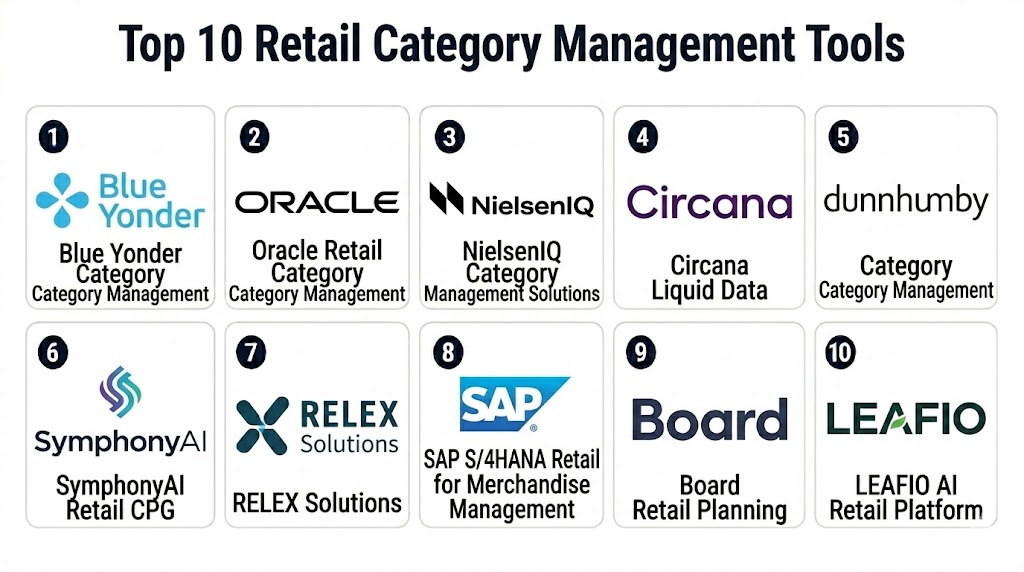
Top 10 Retail Category Management Tools
1- Blue Yonder Category Management
Short description: Blue Yonder Category Management supports retailers with category planning, assortment decisions, space planning, pricing, promotions, and execution workflows. It is well suited for enterprise retailers that need category decisions connected with supply chain, merchandising, and retail planning.
Key Features
- Category planning and retail analytics
- Assortment and space planning support
- Planogram and shelf productivity workflows
- Pricing and promotion alignment
- Demand and inventory-aware planning
- AI-assisted retail decision support
- Integration with broader retail and supply chain systems
Pros
- Strong fit for enterprise retailers with complex planning needs
- Useful for connecting category decisions with supply chain and inventory
- Supports data-driven category and merchandising decisions
Cons
- May require enterprise implementation planning
- Best value depends on data quality and process maturity
- Smaller retailers may find the platform too broad or complex
Platforms / Deployment
Web
Cloud / Hybrid options may vary
Security & Compliance
Security capabilities vary by deployment and contract. Buyers should verify SSO, RBAC, encryption, audit logs, user permissions, and compliance documentation directly with the vendor.
Integrations & Ecosystem
Blue Yonder works well when category management needs to connect with merchandising, inventory, replenishment, pricing, and supply chain systems.
- ERP systems
- POS systems
- Inventory and replenishment tools
- Pricing and promotion systems
- Supply chain planning platforms
- Analytics and data platforms
Support & Community
Blue Yonder provides enterprise implementation support, documentation, customer success resources, and retail planning expertise. Support scope depends on contract and deployment size.
2- Oracle Retail Category Management
Short description: Oracle Retail Category Management helps enterprise retailers manage category strategies, assortments, space, inventory, pricing, and merchandising operations. It is suitable for retailers that already use Oracle retail, finance, supply chain, or enterprise systems.
Key Features
- Category and assortment planning support
- Item, supplier, and merchandise data workflows
- Space and shelf planning alignment
- Pricing and promotion integration
- Inventory and purchasing visibility
- Multi-store and multi-region retail support
- Integration with Oracle Retail ecosystem
Pros
- Strong enterprise retail ecosystem alignment
- Useful for large retailers with complex product hierarchies
- Supports category decisions connected with broader merchandising operations
Cons
- Implementation can be complex
- Not ideal for smaller retailers looking for quick setup
- Best value often depends on broader Oracle retail architecture
Platforms / Deployment
Web
Cloud / Hybrid options may vary
Security & Compliance
Security depends on Oracle environment, deployment model, and configuration. Buyers should verify SSO, RBAC, encryption, audit logs, admin controls, and compliance documentation.
Integrations & Ecosystem
Oracle Retail Category Management is strongest when connected with Oracle Retail, ERP, inventory, financial, and analytics systems.
- Oracle Retail applications
- ERP and finance systems
- POS systems
- Inventory and warehouse systems
- Supplier systems
- Reporting and analytics platforms
Support & Community
Oracle provides enterprise documentation, implementation partners, training resources, and support services. Support model depends on contract and deployment environment.
3- NielsenIQ Category Management Solutions
Short description: NielsenIQ Category Management Solutions support category teams with market data, shopper insights, assortment analysis, shelf planning, and retail performance intelligence. It is especially useful for retailers and CPG companies that need data-backed category decisions.
Key Features
- Category performance analytics
- Shopper and market insights
- Assortment and SKU performance analysis
- Shelf and space planning support
- Retail and CPG collaboration workflows
- Competitive and market-level category intelligence
- Reporting for category growth opportunities
Pros
- Strong category and shopper insight capabilities
- Useful for retailer and CPG collaboration
- Helps category teams make decisions beyond internal sales data
Cons
- Best value depends on data access and analytical maturity
- May need integration with execution systems for operational workflows
- Pricing and packaging may vary by data scope and region
Platforms / Deployment
Web
Cloud
Security & Compliance
Not publicly stated. Buyers should verify SSO, user permissions, data protection, encryption, audit controls, and compliance documentation before enterprise rollout.
Integrations & Ecosystem
NielsenIQ tools are valuable when retailers and brands need category intelligence connected with internal retail data and planning workflows.
- Retail sales data systems
- Category analytics tools
- Data warehouses
- Reporting platforms
- Assortment planning workflows
- Supplier collaboration processes
Support & Community
NielsenIQ provides category expertise, analytics support, documentation, and customer success resources. Support depth depends on subscription and engagement scope.
4- Circana Liquid Data
Short description: Circana Liquid Data helps retail and consumer goods teams analyze market performance, category trends, consumer behavior, and product performance. It is useful for teams that need strong insights to guide category strategies and retail execution.
Key Features
- Retail and CPG market analytics
- Category trend analysis
- Consumer and shopper insights
- Product performance dashboards
- Assortment and promotion analysis
- Competitive benchmarking
- Data-driven category decision support
Pros
- Strong for category intelligence and market analytics
- Useful for CPG and retail collaboration
- Helps teams understand category performance beyond internal systems
Cons
- Not a full merchandising execution suite by itself
- Best value depends on data subscriptions and analytical usage
- Operational execution may require integration with other retail systems
Platforms / Deployment
Web
Cloud
Security & Compliance
Not publicly stated. Buyers should verify SSO, permissions, encryption, audit logs, data governance, and compliance documentation.
Integrations & Ecosystem
Circana Liquid Data fits category teams that need market intelligence, sales trends, and shopper insights connected to planning and decision workflows.
- Retail data systems
- Analytics platforms
- Business intelligence tools
- Category planning workflows
- Supplier collaboration processes
- Data export and reporting workflows
Support & Community
Circana provides customer support, analytics guidance, documentation, and insight services. Support scope depends on contract and data subscription.
5- dunnhumby Category Management
Short description: dunnhumby Category Management supports retailers and brands with customer data science, shopper insights, assortment strategy, price and promotion analysis, and category growth planning. It is especially relevant for grocery, consumer goods, and loyalty-data-driven retail.
Key Features
- Shopper behavior and loyalty analytics
- Category strategy and performance insights
- Assortment optimization support
- Price and promotion effectiveness analysis
- Customer segmentation and basket analysis
- Retailer and supplier collaboration support
- Data science-driven category recommendations
Pros
- Strong shopper-centric category management approach
- Useful for retailers with loyalty and customer behavior data
- Helps link category decisions to customer needs
Cons
- Best value depends on access to quality customer and transaction data
- May be more analytical than execution-focused
- Implementation and insights delivery can vary by engagement model
Platforms / Deployment
Web / Varies
Cloud / Varies
Security & Compliance
Not publicly stated. Buyers should verify access controls, encryption, permissions, audit capabilities, and compliance documentation.
Integrations & Ecosystem
dunnhumby is useful when category management depends heavily on shopper behavior, loyalty analytics, and customer segmentation.
- Loyalty data systems
- POS data platforms
- Retail analytics systems
- Supplier collaboration workflows
- Pricing and promotion analysis tools
- Business intelligence platforms
Support & Community
dunnhumby provides analytics expertise, advisory support, customer success resources, and category management guidance. Support model may vary by engagement.
6- SymphonyAI Retail CPG
Short description: SymphonyAI Retail CPG provides AI-enabled retail planning, merchandising, category, supply chain, and store operations capabilities. It is suitable for retailers and consumer goods organizations that want category decisions supported by AI, analytics, and operational data.
Key Features
- AI-enabled retail and CPG analytics
- Category and merchandising insights
- Demand forecasting and planning support
- Assortment and inventory intelligence
- Promotion and pricing analysis
- Store and supply chain visibility
- Enterprise retail decision support
Pros
- Strong fit for AI-driven retail and CPG decision-making
- Useful for connecting category management with operations and planning
- Supports broader retail intelligence beyond a single category workflow
Cons
- May require strong data integration and implementation planning
- Buyers should validate exact category management module fit
- Smaller retailers may not need the full enterprise platform depth
Platforms / Deployment
Web
Cloud / Hybrid options may vary
Security & Compliance
Security capabilities vary by contract and deployment. Buyers should verify SSO, permissions, encryption, audit controls, data governance, and compliance documentation.
Integrations & Ecosystem
SymphonyAI Retail CPG fits organizations that want category, merchandising, planning, and retail operations data connected.
- POS systems
- ERP platforms
- Inventory and supply chain systems
- Retail analytics platforms
- Pricing and promotion systems
- Data platforms and APIs
Support & Community
SymphonyAI provides enterprise support, implementation resources, customer success services, and retail AI expertise. Support scope depends on contract and deployment.
7- RELEX Solutions
Short description: RELEX Solutions helps retailers optimize forecasting, replenishment, assortment, allocation, space, promotions, and merchandising decisions. It is useful for category teams that need category decisions connected with inventory availability and demand planning.
Key Features
- Demand forecasting and replenishment
- Assortment planning support
- Space and planogram optimization
- Promotion and markdown planning
- Inventory and availability analytics
- AI-supported retail planning
- Multi-location retail optimization
Pros
- Strong connection between category decisions and inventory planning
- Useful for grocery, specialty, and high-volume retail
- Helps reduce stockouts and excess inventory through better planning
Cons
- Requires good sales, inventory, and product hierarchy data
- Implementation can involve process change
- Best value comes when integrated with broader retail planning workflows
Platforms / Deployment
Web
Cloud
Security & Compliance
Security features vary by contract and configuration. Buyers should verify SSO, permissions, encryption, audit logs, data governance, and compliance documentation.
Integrations & Ecosystem
RELEX works well for category teams that need planning connected with store operations, inventory, replenishment, and merchandising execution.
- POS systems
- ERP systems
- WMS and supply chain tools
- Store systems
- Ecommerce systems
- Data and analytics platforms
Support & Community
RELEX provides implementation support, planning expertise, documentation, and customer success resources. Support depth may vary by region and contract.
8- SAP S 4HANA Retail for Merchandise Management
Short description: SAP S 4HANA Retail for Merchandise Management supports enterprise retail merchandising, category, inventory, procurement, pricing, and financial workflows. It is best for large retailers already using SAP for enterprise operations.
Key Features
- Article and merchandise management
- Category and assortment support
- Pricing and promotion workflows
- Inventory and procurement integration
- Supplier and purchasing workflows
- Retail finance and operational visibility
- Integration with SAP enterprise systems
Pros
- Strong fit for SAP-centered enterprise retailers
- Connects category and merchandising decisions with finance and supply chain
- Scales well for complex retail organizations
Cons
- Implementation can be complex
- Requires SAP expertise and process maturity
- Not ideal for small retailers seeking lightweight category tools
Platforms / Deployment
Web
Cloud / Hybrid options may vary
Security & Compliance
Security depends on SAP environment, deployment model, and configuration. Buyers should verify SSO, RBAC, encryption, audit logs, identity management, and compliance documentation.
Integrations & Ecosystem
SAP retail category workflows are strongest when connected with SAP finance, supply chain, procurement, and analytics systems.
- SAP ERP and finance tools
- SAP supply chain platforms
- POS and store systems
- Ecommerce systems
- Supplier and procurement systems
- Reporting and analytics platforms
Support & Community
SAP provides enterprise documentation, implementation partners, support services, and training resources. Support depends on contract and deployment model.
9- Board Retail Planning
Short description: Board Retail Planning provides planning, analytics, and decision support for merchandise financial planning, assortment planning, category performance, and retail analytics. It is useful for retailers that want category management linked with planning and performance management.
Key Features
- Merchandise and category planning support
- Assortment and allocation planning
- Forecasting and scenario analysis
- Retail performance dashboards
- Budgeting and financial planning workflows
- Collaborative planning processes
- Analytics-driven decision support
Pros
- Strong for planning and analytics-driven category decisions
- Useful for finance and merchandising alignment
- Flexible for different planning models and retail structures
Cons
- May require configuration for retail-specific category workflows
- Not a pure planogram or shelf execution tool
- Implementation depends on data model complexity
Platforms / Deployment
Web
Cloud / Hybrid options may vary
Security & Compliance
Security capabilities vary by deployment and configuration. Buyers should verify SSO, permissions, encryption, audit logs, and compliance documentation.
Integrations & Ecosystem
Board fits retailers that need category planning, financial planning, forecasting, and performance analytics connected.
- ERP systems
- POS data platforms
- Data warehouses
- Planning and budgeting systems
- Business intelligence tools
- APIs and connectors
Support & Community
Board provides documentation, implementation services, partner support, and customer success resources. Support depth depends on contract and solution scope.
10- LEAFIO AI Retail Platform
Short description: LEAFIO AI Retail Platform supports retail inventory optimization, assortment management, replenishment, merchandising, and operational decision-making. It is useful for retailers that need practical category and inventory planning support without adopting a very heavy enterprise suite.
Key Features
- Assortment management support
- Inventory and replenishment optimization
- Demand forecasting
- Category performance visibility
- Store and product-level planning
- AI-supported retail recommendations
- Reporting and operational dashboards
Pros
- Practical for retailers focused on assortment and inventory optimization
- Useful for improving category availability and stock movement
- May be easier to adopt than larger enterprise retail suites
Cons
- Enterprise fit should be validated for very large global retailers
- Buyers should confirm integration depth for existing systems
- Advanced category analytics needs may require additional tools
Platforms / Deployment
Web
Cloud
Security & Compliance
Not publicly stated. Buyers should verify SSO, permissions, encryption, audit logs, data retention, and compliance documentation before purchase.
Integrations & Ecosystem
LEAFIO fits retailers that need assortment and replenishment workflows connected with sales, inventory, and store operations.
- POS systems
- ERP systems
- Inventory systems
- Store operations workflows
- Analytics platforms
- APIs and integration options
Support & Community
LEAFIO provides onboarding, documentation, and support resources. Buyers should confirm implementation scope, training, and support terms based on plan and region.
Comparison Table
| Tool Name | Best For | Platform Supported | Deployment | Standout Feature | Public Rating |
|---|---|---|---|---|---|
| Blue Yonder Category Management | Enterprise category and supply chain alignment | Web | Cloud / Hybrid varies | Category decisions connected with retail planning and supply chain | N/A |
| Oracle Retail Category Management | Enterprise retail category operations | Web | Cloud / Hybrid varies | Category management connected with Oracle retail ecosystem | N/A |
| NielsenIQ Category Management Solutions | Retail and CPG category insights | Web | Cloud | Market, shopper, and category performance intelligence | N/A |
| Circana Liquid Data | Retail and CPG market analytics | Web | Cloud | Category trends and shopper insight dashboards | N/A |
| dunnhumby Category Management | Shopper-centric category strategy | Web / Varies | Cloud / Varies | Loyalty and shopper behavior analytics | N/A |
| SymphonyAI Retail CPG | AI-driven retail and CPG decision-making | Web | Cloud / Hybrid varies | AI-enabled category and retail intelligence | N/A |
| RELEX Solutions | Demand-aware category and assortment planning | Web | Cloud | Category decisions connected with forecasting and replenishment | N/A |
| SAP S 4HANA Retail for Merchandise Management | SAP-centered enterprise retailers | Web | Cloud / Hybrid varies | Category and merchandising connected with ERP and finance | N/A |
| Board Retail Planning | Category planning and performance analytics | Web | Cloud / Hybrid varies | Planning, forecasting, and analytics in one environment | N/A |
| LEAFIO AI Retail Platform | Assortment and inventory-focused retailers | Web | Cloud | AI-supported assortment and replenishment optimization | N/A |
Evaluation & Scoring of Retail Category Management Tools
| Tool Name | Core 25% | Ease 15% | Integrations 15% | Security 10% | Performance 10% | Support 10% | Value 15% | Weighted Total |
|---|---|---|---|---|---|---|---|---|
| Blue Yonder Category Management | 9 | 7 | 9 | 8 | 9 | 8 | 8 | 8.35 |
| Oracle Retail Category Management | 10 | 6 | 9 | 9 | 9 | 9 | 7 | 8.50 |
| NielsenIQ Category Management Solutions | 8 | 8 | 7 | 7 | 8 | 8 | 8 | 7.80 |
| Circana Liquid Data | 8 | 8 | 7 | 7 | 8 | 8 | 8 | 7.80 |
| dunnhumby Category Management | 8 | 8 | 7 | 7 | 8 | 8 | 8 | 7.80 |
| SymphonyAI Retail CPG | 8 | 7 | 8 | 8 | 8 | 8 | 8 | 7.85 |
| RELEX Solutions | 9 | 8 | 8 | 8 | 9 | 8 | 8 | 8.40 |
| SAP S 4HANA Retail for Merchandise Management | 9 | 6 | 9 | 9 | 9 | 9 | 7 | 8.35 |
| Board Retail Planning | 8 | 8 | 8 | 8 | 8 | 8 | 8 | 8.00 |
| LEAFIO AI Retail Platform | 7 | 8 | 7 | 7 | 8 | 7 | 8 | 7.45 |
Which Retail Category Management Tool Is Right for You?
Solo / Freelancer
Solo consultants, category advisors, and independent retail analysts usually do not need a full enterprise category platform. NielsenIQ, Circana, dunnhumby, or Board-style analytics workflows may be more relevant if the goal is insights and category recommendations. For consulting with large retailers, familiarity with Oracle, SAP, Blue Yonder, and RELEX can be useful because enterprise clients may already use these systems.
SMB
SMBs should focus on ease of use, clear category reporting, assortment control, and inventory visibility. LEAFIO, Board, or lighter analytics workflows may be practical starting points. If the business only needs basic category sales reporting, a POS, ecommerce, or inventory system may be enough before investing in a dedicated category management platform.
Mid-Market
Mid-market retailers often need stronger assortment planning, forecasting, promotion analysis, supplier collaboration, and category performance dashboards. RELEX, Board, SymphonyAI, Blue Yonder, and LEAFIO are worth evaluating. These teams should test whether the tool can handle product hierarchies, store clusters, supplier data, seasonality, promotions, and integration with existing POS and ERP systems.
Enterprise
Enterprise retailers should prioritize scalability, governance, integration depth, advanced analytics, security, and multi-region support. Oracle Retail Category Management, SAP S 4HANA Retail, Blue Yonder, RELEX, NielsenIQ, Circana, dunnhumby, and SymphonyAI are strong candidates depending on whether the priority is execution, planning, insights, or shopper intelligence. Enterprises should pilot with real category, sales, inventory, and shopper data.
Budget vs Premium
Budget-conscious retailers should avoid heavy enterprise platforms if they only need basic reporting or SKU-level category tracking. Premium buyers may justify Oracle, SAP, Blue Yonder, RELEX, SymphonyAI, NielsenIQ, Circana, or dunnhumby when better category decisions can improve margins, stock productivity, supplier collaboration, and shopper satisfaction. Total cost should include software, data subscriptions, implementation, integrations, training, and ongoing support.
Feature Depth vs Ease of Use
Oracle, SAP, Blue Yonder, RELEX, and SymphonyAI offer strong depth but require more mature processes and implementation planning. NielsenIQ, Circana, and dunnhumby are strong for insight-driven decisions but may need other tools for execution. Board offers planning flexibility, while LEAFIO may be more practical for retailers focused on assortment and replenishment optimization.
Integrations & Scalability
Retail category management tools should connect with POS, ERP, ecommerce, loyalty, inventory, WMS, pricing, promotion, supplier, and analytics systems. Buyers should test product hierarchy mapping, sales data feeds, inventory updates, supplier collaboration workflows, and reporting outputs. Scalability becomes critical when managing many stores, regions, categories, banners, and channels.
Security & Compliance Needs
Retailers should verify SSO, SAML, MFA, RBAC, audit logs, encryption, data governance, user provisioning, data residency, and compliance documentation. Category data may include sensitive sales performance, supplier terms, pricing strategies, margin information, and customer insight data, so permissions and audit controls are important.
Frequently Asked Questions
1. What is a retail category management tool?
A retail category management tool helps retailers analyze, plan, and optimize product categories. It supports decisions around assortment, shelf space, pricing, promotions, inventory, supplier collaboration, and category performance.
2. How is category management different from merchandising?
Merchandising focuses on product presentation, inventory, pricing, promotions, and retail execution. Category management focuses more strategically on category growth, shopper needs, assortment roles, supplier collaboration, and performance optimization.
3. What is the best retail category management tool?
There is no single best tool for every retailer. Oracle, SAP, Blue Yonder, RELEX, NielsenIQ, Circana, dunnhumby, SymphonyAI, Board, and LEAFIO each fit different needs depending on scale, data maturity, and retail format.
4. Do small retailers need category management software?
Small retailers may not need a dedicated category management platform if they have simple products and basic reporting needs. A POS or ecommerce analytics tool may be enough until assortment complexity increases.
5. What data is needed for category management?
Common data includes sales history, product hierarchy, inventory, margins, supplier data, promotions, pricing, customer behavior, loyalty data, store clusters, and competitor or market data when available.
6. Can category management tools help improve margins?
Yes, they can help improve margins by identifying underperforming SKUs, optimizing assortment, improving pricing and promotions, reducing excess inventory, and aligning categories with customer demand.
7. Are shopper insights important in category management?
Shopper insights are very important because category decisions should reflect how customers actually shop. Loyalty data, basket analysis, customer segments, and purchase patterns can improve category strategy.
8. Can category management tools integrate with POS systems?
Yes, many category management tools integrate with POS systems or use POS data feeds. Buyers should validate sales data quality, product hierarchy mapping, store-level reporting, and data refresh frequency.
9. What are common mistakes when choosing category management software?
Common mistakes include ignoring data quality, overbuying complex tools, failing to involve category teams, not testing integrations, and choosing insight tools without a clear execution process.
10. How long does implementation take?
Implementation time depends on retailer size, data readiness, integrations, product hierarchy complexity, user training, and workflow changes. Enterprise rollouts often require phased deployment and governance planning.
Conclusion
Retail Category Management Tools help retailers make better decisions about product assortment, shelf space, pricing, promotions, supplier collaboration, customer demand, and category profitability. The right tool can improve category performance, reduce weak SKUs, strengthen shopper relevance, and connect strategy with execution. Oracle Retail Category Management, SAP S 4HANA Retail, Blue Yonder, RELEX, and SymphonyAI are strong fits for enterprise retailers with complex operations. NielsenIQ, Circana, and dunnhumby are valuable for insight-led category planning and shopper intelligence. Board is useful for planning and analytics flexibility, while LEAFIO supports practical assortment and replenishment optimization. The best choice depends on retail format, category complexity, data maturity, store count, integration needs, and budget. Start by shortlisting two or three tools, test them with real category and sales data, validate integrations, involve category and merchandising users, and choose the platform that supports both strategy and daily execution.

Find Trusted Cardiac Hospitals
Compare heart hospitals by city and services — all in one place.
Explore Hospitals
Retail category management tools help businesses organize products better, improve sales strategies, and understand customer demand more effectively.