Introduction
Marketing Automation Platforms are software solutions that automate repetitive marketing tasks across multiple channels, enabling businesses to deliver personalized campaigns efficiently. They help teams manage emails, SMS, social media, and in-app messaging while tracking engagement and conversions. In 2026, these platforms are essential for improving campaign efficiency, lead nurturing, and data-driven decision-making. Applications include automated email sequences, multi-channel customer journeys, lead scoring, personalized messaging, and analytics reporting. Buyers should evaluate integration capabilities, workflow automation, AI-powered personalization, real-time analytics, scalability, security, ease of use, and reporting features.
Real-world use cases include:
- Automating email campaigns based on user behavior and segmentation
- Nurturing leads through multi-step workflows
- Personalizing website and app experiences
- Managing cross-channel campaigns including SMS, social, and push notifications
- Tracking campaign performance and attribution for marketing analytics
Evaluation Criteria for Buyers
When selecting a Marketing Automation Platform, buyers should focus on several critical factors. Integration capabilities with CRM, e-commerce, CMS, and analytics tools are essential to unify customer data and workflows. Workflow automation and multi-step campaign management ensure marketing teams can execute campaigns efficiently. AI-powered personalization, including predictive lead scoring and segmentation, enhances targeting and engagement. Real-time analytics and reporting provide actionable insights into performance and ROI. Scalability ensures the platform can handle increasing users and multi-channel campaigns. Security and compliance with GDPR, SOC 2, and HIPAA protect sensitive customer data. Ease of use, multi-channel support, and cost-effectiveness should also guide decision-making to align with team capabilities and budget.
Best for: Marketing, sales, and customer success teams in SMBs, mid-market, and enterprise organizations seeking personalized engagement and efficiency.
Not ideal for: Organizations with minimal digital presence or small datasets where simpler email or CRM tools may be sufficient.
Key Trends in Marketing Automation Platforms
- AI-driven personalization and predictive lead scoring
- Cross-channel orchestration integrating email, SMS, social, and web
- GDPR, CCPA, and privacy-first automation features
- Real-time analytics for campaign performance and optimization
- No-code/low-code workflow builders for faster deployment
- Cloud-native platforms with hybrid deployment options
- Integrated CRM and CDP ecosystems for unified data
- Enhanced reporting and attribution modeling
- Automation of ABM (Account-Based Marketing) campaigns
- Cost-efficient and subscription-based pricing models
How We Selected These Tools (Methodology)
- Market adoption and mindshare
- Feature completeness including AI personalization, workflow automation, and analytics
- Performance and reliability signals from customer use cases
- Security posture and compliance with GDPR, SOC 2, HIPAA
- Ecosystem and integration capabilities with CRM, CDP, and analytics tools
- Suitability for SMB, mid-market, and enterprise segments
- Scalability and flexibility for multi-channel campaigns
- User experience, interface design, and onboarding support
- Support availability and community presence
- Cost-effectiveness relative to functionality
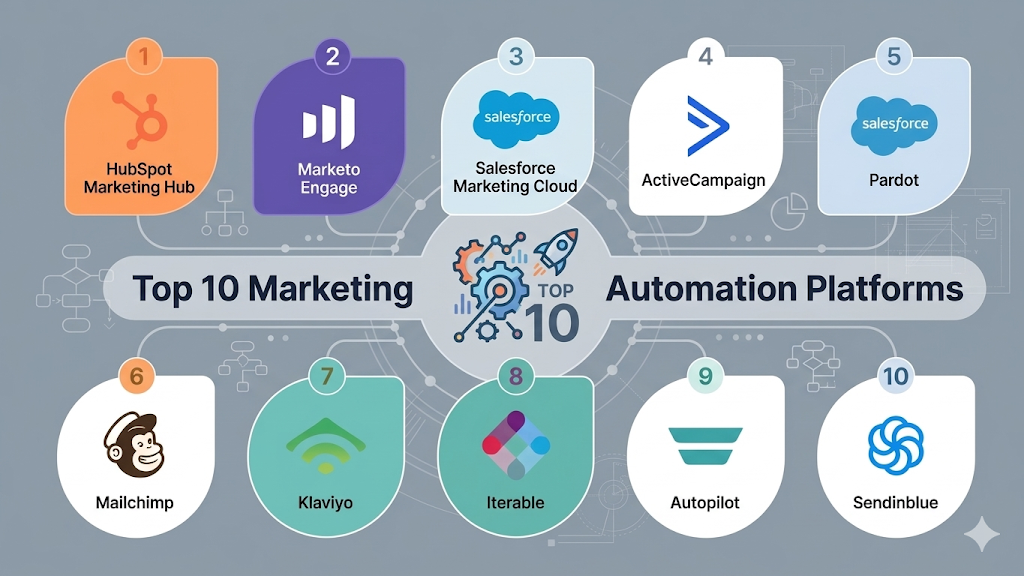
Top 10 Marketing Automation Platforms
1 — HubSpot Marketing Hub
Short description: HubSpot Marketing Hub provides all-in-one marketing automation, CRM integration, and analytics for inbound marketing.
Key Features
- Email automation and workflows
- Lead nurturing and scoring
- Landing pages and forms builder
- Social media scheduling
- Analytics dashboards
Pros
- Unified CRM and marketing platform
- Easy-to-use interface for SMBs
- Strong reporting and analytics
Cons
- Higher cost for enterprise features
- Customization may be limited without dev support
- Some advanced features require premium plans
Platforms / Deployment
- Web / Cloud
Security & Compliance
- SOC 2, GDPR, MFA, encryption
Integrations & Ecosystem
Supports:
- CRM, CMS, social media, e-commerce
- API integrations for custom workflows
- Webhooks and SDKs
Support & Community
- Documentation, HubSpot Academy, community forums, support tiers
2 — Marketo Engage
Short description: Marketo Engage is an enterprise-grade marketing automation platform offering multi-channel campaign management and lead management.
Key Features
- Multi-channel campaign automation
- Lead scoring and nurturing
- Account-based marketing (ABM)
- AI-driven personalization
- Analytics and reporting
Pros
- Enterprise-level features and scalability
- Deep integration with Salesforce CRM
- Advanced segmentation and targeting
Cons
- Steep learning curve
- Higher cost for small teams
- Complexity in workflow setup
Platforms / Deployment
- Web / Cloud
Security & Compliance
- SOC 2, ISO 27001, GDPR
Integrations & Ecosystem
- Salesforce CRM, CDPs, analytics tools
- API access for custom integrations
- Third-party plugin support
Support & Community
- Enterprise support, documentation, professional services
3 — Salesforce Marketing Cloud
Short description: Salesforce Marketing Cloud provides personalized customer journeys, AI insights, and cross-channel marketing automation.
Key Features
- Journey Builder for automated campaigns
- AI-powered recommendations
- Email, SMS, social media automation
- Customer data integration
- Analytics dashboards
Pros
- Strong enterprise ecosystem integration
- Highly scalable for large organizations
- AI-driven insights and analytics
Cons
- Complexity and learning curve
- Pricing can be expensive for SMBs
- Implementation often requires expert support
Platforms / Deployment
- Web / Cloud
Security & Compliance
- SOC 2, GDPR, encryption
Integrations & Ecosystem
- Salesforce CRM, e-commerce platforms, analytics
- API and SDK support
- Web and mobile integration
Support & Community
- Documentation, Salesforce support, community forums
4 — ActiveCampaign
Short description: ActiveCampaign combines marketing automation, email marketing, and CRM for SMBs and mid-market businesses.
Key Features
- Email marketing automation
- Lead scoring and segmentation
- CRM integration
- Messaging automation (SMS, chat)
- Workflow analytics
Pros
- Affordable for SMBs
- Easy-to-use automation workflows
- Multi-channel messaging support
Cons
- Limited advanced analytics
- Fewer enterprise features
- Email deliverability management requires attention
Platforms / Deployment
- Web / Cloud
Security & Compliance
- GDPR, encryption, SSO
Integrations & Ecosystem
- CRM, CMS, e-commerce, analytics
- API and webhooks
- Third-party plugin support
Support & Community
- Documentation, chat/email support, knowledge base
5 — Pardot
Short description: Pardot (by Salesforce) is B2B marketing automation focusing on lead generation, nurturing, and scoring.
Key Features
- Email automation and templates
- Lead scoring and nurturing
- CRM integration with Salesforce
- Reporting and ROI tracking
- Landing page builder
Pros
- Tight Salesforce CRM integration
- Enterprise B2B features
- Robust lead management
Cons
- Best for Salesforce users
- Pricing can be high for smaller teams
- Limited beyond B2B use cases
Platforms / Deployment
- Web / Cloud
Security & Compliance
- SOC 2, GDPR, MFA
Integrations & Ecosystem
- Salesforce CRM, analytics tools, e-commerce
- API support for workflow customization
- Third-party plugins
Support & Community
- Enterprise support, knowledge base, forums
6 — Mailchimp
Short description: Mailchimp is a marketing automation platform for SMBs, offering email campaigns, audience segmentation, and analytics.
Key Features
- Email campaign automation
- Audience segmentation
- Pre-built templates
- Reporting and analytics
- Integrations with e-commerce platforms
Pros
- Easy to use for SMBs
- Affordable pricing
- Good analytics for campaign performance
Cons
- Limited advanced automation
- Fewer enterprise features
- Scaling requires higher-tier plans
Platforms / Deployment
- Web / Cloud
Security & Compliance
- GDPR, encryption
Integrations & Ecosystem
- Shopify, WooCommerce, CMS, CRM
- API access
- Mobile app integration
Support & Community
- Documentation, email support, community forums
7 — Klaviyo
Short description: Klaviyo specializes in email and SMS automation for e-commerce businesses with data-driven targeting.
Key Features
- Email and SMS automation
- Segmentation and personalization
- Predictive analytics
- Pre-built templates
- Integration with e-commerce platforms
Pros
- Excellent for e-commerce campaigns
- Data-driven personalization
- Real-time automation triggers
Cons
- Cost scales with subscriber count
- Limited CRM features
- Enterprise-level customization requires dev support
Platforms / Deployment
- Web / Cloud
Security & Compliance
- GDPR, encryption
Integrations & Ecosystem
- Shopify, Magento, WooCommerce
- APIs for custom workflows
- Analytics tools
Support & Community
- Documentation, email/chat support, knowledge base
8 — Iterable
Short description: Iterable is a cross-channel marketing automation platform for email, SMS, push notifications, and in-app messaging.
Key Features
- Multi-channel campaign orchestration
- Workflow automation
- Segmentation and targeting
- Personalization engine
- Analytics dashboards
Pros
- Strong cross-channel automation
- Real-time customer engagement
- Enterprise scalability
Cons
- Requires technical expertise
- Higher pricing for SMBs
- Advanced features need configuration
Platforms / Deployment
- Web / Cloud
Security & Compliance
- SOC 2, GDPR, encryption
Integrations & Ecosystem
- CRM, CMS, e-commerce, analytics
- API and SDK support
- Third-party integrations
Support & Community
- Documentation, professional services, support tiers
9 — Autopilot
Short description: Autopilot is a visual marketing automation platform focusing on customer journey mapping and multi-channel campaigns.
Key Features
- Visual journey builder
- Email, SMS, and in-app messaging
- Segmentation and personalization
- Analytics and reporting
- CRM integrations
Pros
- Intuitive visual workflow builder
- Multi-channel automation
- Easy onboarding for SMBs
Cons
- Limited enterprise features
- Fewer integrations than competitors
- Customization requires technical support
Platforms / Deployment
- Web / Cloud
Security & Compliance
- GDPR, encryption
Integrations & Ecosystem
- CRM, CMS, analytics tools
- API access
- E-commerce platforms
Support & Community
- Documentation, email/chat support, knowledge base
10 — Sendinblue
Short description: Sendinblue offers email marketing, SMS automation, and marketing workflows for SMBs and mid-market organizations.
Key Features
- Email and SMS campaigns
- Marketing workflows
- Transactional messaging
- Segmentation and personalization
- Analytics dashboards
Pros
- Affordable for SMBs
- Easy to use and implement
- Multi-channel automation
Cons
- Limited advanced features
- Scaling may require higher tiers
- Fewer enterprise-level integrations
Platforms / Deployment
- Web / Cloud
Security & Compliance
- GDPR, encryption
Integrations & Ecosystem
- CRM, e-commerce platforms, CMS
- APIs for custom workflows
- Analytics integration
Support & Community
- Documentation, email support, knowledge base
Comparison Table (Top 10)
| Tool Name | Best For | Platform(s) Supported | Deployment | Standout Feature | Public Rating |
|---|---|---|---|---|---|
| HubSpot Marketing Hub | SMB & mid-market | Web | Cloud | Unified CRM integration | N/A |
| Marketo Engage | Enterprise marketing | Web | Cloud | Multi-channel campaigns | N/A |
| Salesforce Marketing Cloud | Enterprise marketing | Web | Cloud | AI-driven journey builder | N/A |
| ActiveCampaign | SMBs | Web | Cloud | Multi-channel automation | N/A |
| Pardot | B2B Enterprise | Web | Cloud | Salesforce CRM integration | N/A |
| Mailchimp | SMBs | Web | Cloud | Email campaign automation | N/A |
| Klaviyo | E-commerce | Web | Cloud | Data-driven personalization | N/A |
| Iterable | Mid-market | Web | Cloud | Cross-channel orchestration | N/A |
| Autopilot | SMBs | Web | Cloud | Visual journey builder | N/A |
| Sendinblue | SMBs | Web | Cloud | Email & SMS automation | N/A |
Evaluation & Scoring of Marketing Automation Platforms
| Tool Name | Core (25%) | Ease (15%) | Integrations (15%) | Security (10%) | Performance (10%) | Support (10%) | Value (15%) | Weighted Total |
|---|---|---|---|---|---|---|---|---|
| HubSpot Marketing Hub | 9 | 9 | 8 | 9 | 9 | 8 | 8 | 8.7 |
| Marketo Engage | 9 | 7 | 8 | 9 | 8 | 8 | 7 | 8.0 |
| Salesforce Marketing Cloud | 9 | 7 | 8 | 9 | 8 | 8 | 7 | 8.0 |
| ActiveCampaign | 8 | 9 | 7 | 8 | 8 | 8 | 8 | 8.0 |
| Pardot | 8 | 7 | 7 | 8 | 8 | 7 | 7 | 7.5 |
| Mailchimp | 8 | 9 | 7 | 8 | 8 | 8 | 8 | 8.0 |
| Klaviyo | 8 | 8 | 7 | 8 | 8 | 7 | 8 | 7.9 |
| Iterable | 9 | 7 | 8 | 9 | 8 | 8 | 7 | 8.1 |
| Autopilot | 8 | 8 | 7 | 8 | 7 | 7 | 7 | 7.6 |
| Sendinblue | 8 | 9 | 7 | 8 | 8 | 7 | 8 | 7.9 |
Interpretation: Scores reflect core features, usability, integrations, security, performance, support, and value. Higher weighted totals indicate stronger suitability for SMB or enterprise marketing automation use cases.
Which Marketing Automation Platform Is Right for You?
Solo / Freelancer
- Tools like ActiveCampaign, Mailchimp, and Sendinblue provide ease of use and affordability for solo marketers.
SMB
- HubSpot Marketing Hub, Klaviyo, and Autopilot deliver multi-channel capabilities and analytics at reasonable cost.
Mid-Market
- Iterable and ActiveCampaign provide scalable workflows, real-time personalization, and analytics for growing teams.
Enterprise
- Marketo Engage, Salesforce Marketing Cloud, and Pardot excel with cross-channel orchestration, ABM support, and AI-driven personalization.
Budget vs Premium
- Budget: Mailchimp, ActiveCampaign, Sendinblue
- Premium: Salesforce Marketing Cloud, Marketo Engage, HubSpot Marketing Hub
Feature Depth vs Ease of Use
- Feature-rich: Salesforce Marketing Cloud, Marketo Engage
- Easy to implement: Mailchimp, ActiveCampaign
Integrations & Scalability
- Enterprise-level deployments need deep API support, multi-channel integration, and robust workflow orchestration.
Security & Compliance Needs
- SOC 2, GDPR, and ISO-certified platforms are preferred for regulated industries.
Frequently Asked Questions (FAQs)
- What is a Marketing Automation Platform?
It automates repetitive marketing tasks across channels and enables campaign management, lead nurturing, and analytics to improve customer engagement. - Do these platforms support multi-channel campaigns?
Yes, most platforms handle email, SMS, social, push notifications, and in-app messaging, allowing seamless cross-channel orchestration. - Are Marketing Automation Platforms suitable for SMBs?
Yes, tools like ActiveCampaign, Mailchimp, and Sendinblue offer affordable, easy-to-use automation for small and mid-sized businesses. - How do they integrate with CRMs?
Many platforms integrate natively with Salesforce, HubSpot CRM, and other systems via APIs, enabling synchronized customer data and workflows. - Do they provide AI or predictive analytics?
Enterprise platforms like Salesforce Marketing Cloud and Marketo Engage offer AI-driven insights, predictive lead scoring, and personalization recommendations. - How is compliance handled?
Platforms implement encryption, MFA, consent management, and compliance with GDPR, SOC 2, ISO 27001, and HIPAA where applicable. - Can they scale for enterprise use?
Yes, Marketo, Salesforce Marketing Cloud, and HubSpot scale for large customer bases, complex workflows, and multi-channel campaigns. - How is effectiveness measured?
Analytics dashboards, campaign metrics, and AB testing provide insight into performance, engagement, conversions, and ROI. - Can businesses switch platforms easily?
APIs and standardized exports allow migration, but complex workflows and integrations may require additional effort. - What are common mistakes when implementing marketing automation?
Poor segmentation, low-quality data, insufficient tracking, and over-complicated workflows can reduce effectiveness and ROI.
Conclusion
Marketing Automation Platforms streamline and scale marketing efforts, enabling multi-channel campaigns, personalized experiences, and data-driven insights. Enterprise solutions like Salesforce Marketing Cloud, Marketo Engage, and HubSpot provide advanced automation, AI capabilities, and analytics. SMB-focused platforms such as Mailchimp, ActiveCampaign, and Sendinblue deliver cost-effective, easy-to-use automation. Choosing the right tool depends on company size, data strategy, and marketing goals. Buyers should shortlist 2–3 tools, pilot in a controlled environment, and validate integrations, security, and performance before full deployment. Proper implementation can enhance lead generation, engagement, and marketing ROI.

Find Trusted Cardiac Hospitals
Compare heart hospitals by city and services — all in one place.
Explore Hospitals
Marketing automation platforms are most valuable when they help organizations automate, personalize, and measure marketing activities across the customer lifecycle through a centralized platform. By providing lead nurturing, campaign automation, audience segmentation, email and messaging workflows, lead scoring, personalization, customer journey management, analytics, reporting, and integration with CRM, sales, and advertising systems, these platforms enable businesses to reduce repetitive work, improve lead engagement, streamline campaign management, increase marketing efficiency, and make more informed data-driven decisions.