Introduction
Customer Data Platforms (CDPs) centralize and unify customer data from multiple sources into a single platform, providing a complete 360-degree view of each customer. They enable businesses to deliver personalized experiences, targeted marketing campaigns, and data-driven insights. In 2026 and beyond, CDPs are essential for improving customer engagement, retention, and revenue across digital channels. Real-world applications include marketers unifying web, email, and social data, retailers personalizing promotions, SaaS platforms delivering contextual onboarding, and analytics teams tracking multi-channel behavior. Buyers should assess integration capabilities, real-time processing, AI-powered segmentation, scalability, security, ease of use, and analytics
Real-world use cases include:
- Marketing teams unifying email, social, and web data for segmentation and targeted campaigns
- Retailers creating personalized promotions based on purchase history
- SaaS platforms delivering contextual onboarding experiences
- Customer support teams leveraging unified data to resolve issues faster
- Analytics teams tracking behavior across devices and channels
Evaluation Criteria for Buyers:
- Data unification capabilities across systems
- Real-time customer profile updates
- AI/ML-powered segmentation and analytics
- Scalability for enterprise workloads
- Integration with marketing, CRM, and analytics tools
- Security, privacy, and compliance (GDPR, SOC 2, HIPAA)
- Ease of deployment and onboarding
- Customization and flexibility of workflows
- Reporting and insights capabilities
Best for: Marketing, sales, customer success, and analytics teams in SMBs and enterprises that rely on personalized engagement.
Not ideal for: Organizations with minimal digital footprint or limited data infrastructure, where simpler CRM or analytics solutions may suffice.
Key Trends in Customer Data Platforms
- AI-driven segmentation and predictive customer analytics
- Real-time data processing and profile updates across channels
- Privacy-first approaches ensuring GDPR and CCPA compliance
- Cross-channel orchestration for unified marketing campaigns
- Integration with CDP ecosystem including CRM, marketing automation, and analytics
- Increased focus on customer journey analytics
- Self-service configuration with low-code/no-code tools
- Cloud-native and hybrid deployment models
- Automated data quality management
- Flexible pricing models for SMBs and enterprises
How We Selected These Tools (Methodology)
- Evaluated market adoption and industry mindshare
- Reviewed feature completeness including AI analytics and segmentation
- Assessed reliability and real-time processing capabilities
- Checked security posture and compliance certifications
- Verified integrations and ecosystem compatibility
- Evaluated fit across SMB, mid-market, and enterprise segments
- Considered scalability and customization flexibility
- Assessed support and community strength
- Examined data unification and orchestration capabilities
- Balanced cost, performance, and feature depth
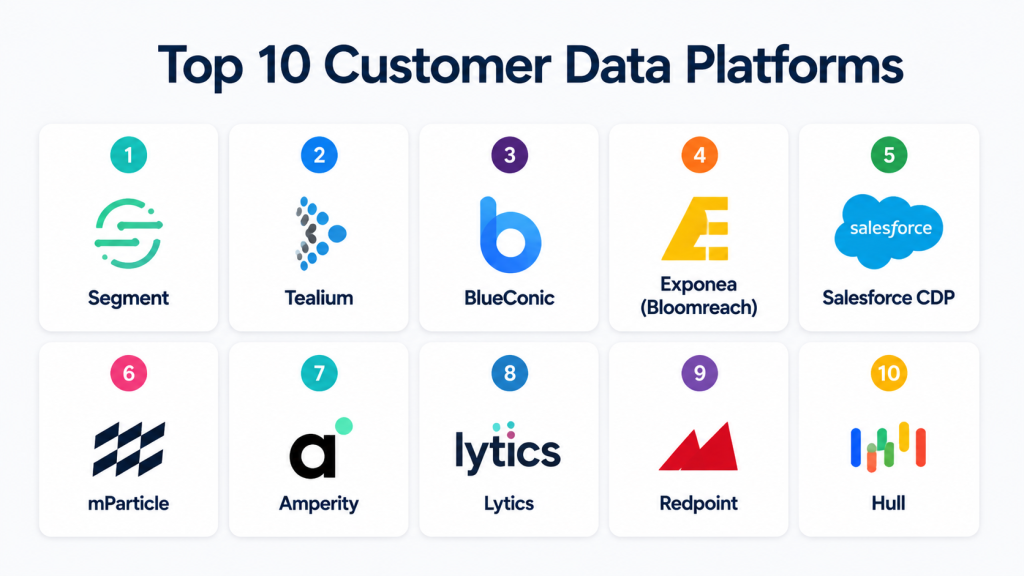
Top 10 Customer Data Platforms
1 — Segment
Short description: Segment centralizes customer data from multiple touchpoints to create unified profiles for personalized marketing and analytics.
Key Features
- Real-time data collection and streaming
- Unified customer profiles
- Integration with hundreds of marketing and analytics tools
- Identity resolution and deduplication
- Event tracking and API access
Pros
- Easy to integrate with multiple systems
- Real-time customer data pipelines
- Strong ecosystem of integrations
Cons
- Pricing can be high for smaller teams
- Complex setup for advanced workflows
- Limited built-in analytics
Platforms / Deployment
- Web / Cloud
Security & Compliance
- SOC 2, GDPR, encryption
Integrations & Ecosystem
- CRM, analytics platforms, marketing automation
- API and SDK access
- Supports web, mobile, and server-side data streams
Support & Community
- Documentation, onboarding support, active community
2 — Tealium
Short description: Tealium provides a comprehensive CDP and tag management solution for data unification and real-time customer engagement.
Key Features
- Data unification across multiple systems
- Real-time event tracking
- Audience segmentation
- Integration hub for marketing and analytics tools
- Consent management and privacy compliance
Pros
- Extensive integration library
- Supports complex enterprise workflows
- Real-time personalization capabilities
Cons
- Enterprise-level pricing
- Requires technical expertise for advanced features
- Steeper learning curve
Platforms / Deployment
- Web / Cloud / Hybrid
Security & Compliance
- SOC 2, ISO 27001, GDPR, HIPAA
Integrations & Ecosystem
- Marketing automation, CRM, analytics, e-commerce platforms
- APIs for custom integrations
- Supports web, mobile, and server-side events
Support & Community
- Enterprise support, documentation, community forums
3 — BlueConic
Short description: BlueConic CDP helps marketers unify customer data and deliver personalized experiences across channels.
Key Features
- Customer profile unification
- Behavioral and engagement tracking
- Segmentation and personalization
- Integration with marketing tools
- Data privacy and consent management
Pros
- Marketing-focused features
- Flexible segmentation and personalization
- Supports multi-channel campaigns
Cons
- Limited analytics compared to larger enterprise CDPs
- Advanced integrations require developer input
- Pricing varies by feature usage
Platforms / Deployment
- Web / Cloud
Security & Compliance
- GDPR, encryption, RBAC
Integrations & Ecosystem
- Marketing automation, CRM, email platforms
- API access and SDKs
- Supports web and mobile platforms
Support & Community
- Documentation, onboarding support, customer success teams
4 — Exponea (Bloomreach)
Short description: Exponea CDP (now part of Bloomreach) provides customer data unification, campaign automation, and AI-powered personalization.
Key Features
- Real-time customer profiles
- AI-powered personalization
- Campaign orchestration across channels
- Behavioral analytics
- Integration with marketing and e-commerce tools
Pros
- Strong analytics and AI personalization
- Multi-channel campaign automation
- Supports enterprise-scale data
Cons
- Pricing geared toward larger organizations
- Steep learning curve for new users
- Requires developer support for custom integrations
Platforms / Deployment
- Web / Cloud
Security & Compliance
- SOC 2, GDPR, ISO 27001
Integrations & Ecosystem
- E-commerce platforms, CRM, email marketing, analytics
- APIs for data ingestion and export
- Supports web, mobile, and email channels
Support & Community
- Professional services, documentation, customer success teams
5 — Salesforce CDP
Short description: Salesforce CDP unifies customer data into a single platform integrated with Salesforce Marketing Cloud and CRM.
Key Features
- Real-time data unification
- Segmentation and personalization
- Integration with Salesforce ecosystem
- AI-driven insights
- Compliance and data governance
Pros
- Tight integration with Salesforce CRM and Marketing Cloud
- Enterprise-grade features
- Scalable for global organizations
Cons
- Best suited for Salesforce users
- Enterprise pricing
- Limited outside Salesforce ecosystem
Platforms / Deployment
- Web / Cloud
Security & Compliance
- SOC 2, ISO 27001, GDPR, encryption
Integrations & Ecosystem
- Salesforce apps, CRM, marketing automation
- API access for custom tools
- Supports web and mobile platforms
Support & Community
- Salesforce support, documentation, Trailhead community
6 — mParticle
Short description: mParticle CDP helps brands collect, unify, and distribute customer data for analytics, marketing, and personalization.
Key Features
- Real-time data ingestion
- Audience segmentation
- Identity resolution
- Data activation across channels
- Integration hub with analytics and marketing tools
Pros
- Robust real-time event processing
- Easy integration with multiple systems
- Scalable for enterprise workloads
Cons
- Pricing may be high for SMBs
- Advanced integrations require technical expertise
- Analytics capabilities limited outside integrations
Platforms / Deployment
- Web / Cloud / Hybrid
Security & Compliance
- SOC 2, GDPR, HIPAA
Integrations & Ecosystem
- CRM, analytics, marketing automation
- SDKs for web and mobile
- APIs for data streaming
Support & Community
- Documentation, onboarding support, professional services
7 — Amperity
Short description: Amperity CDP unifies enterprise customer data with AI-driven insights and analytics.
Key Features
- AI-driven identity resolution
- Real-time customer profiles
- Predictive analytics
- Segmentation and personalization
- Integration with enterprise systems
Pros
- Enterprise-focused AI analytics
- Strong identity resolution capabilities
- Supports large datasets
Cons
- High cost for SMBs
- Requires technical setup
- Limited for small organizations
Platforms / Deployment
- Web / Cloud
Security & Compliance
- SOC 2, GDPR, ISO 27001
Integrations & Ecosystem
- Marketing, CRM, analytics
- APIs for data ingestion and export
- Web and mobile data sources
Support & Community
- Professional services, documentation, customer success
8 — Lytics
Short description: Lytics CDP unifies customer data for AI-driven segmentation, targeting, and personalization.
Key Features
- Real-time profile unification
- Behavioral scoring
- Segmentation and audience targeting
- Integration with marketing automation tools
- AI-driven recommendations
Pros
- AI-powered personalization
- Flexible segmentation
- Real-time insights
Cons
- Limited advanced analytics
- Enterprise features require higher plan
- Custom integrations may need dev resources
Platforms / Deployment
- Web / Cloud
Security & Compliance
- SOC 2, GDPR, encryption
Integrations & Ecosystem
- Marketing automation, email, CRM
- API and SDK support
- Web and mobile channels
Support & Community
- Documentation, customer support, onboarding
9 — Redpoint
Short description: Redpoint CDP provides real-time customer data unification, analytics, and campaign orchestration.
Key Features
- Unified customer profiles
- Event tracking and segmentation
- Campaign management
- Multi-channel orchestration
- Analytics dashboards
Pros
- Enterprise-scale orchestration
- Flexible integration options
- Real-time personalization
Cons
- High pricing
- Complex setup
- Steep learning curve
Platforms / Deployment
- Web / Cloud / Hybrid
Security & Compliance
- SOC 2, GDPR, encryption
Integrations & Ecosystem
- CRM, marketing automation, analytics
- API integrations
- Web, mobile, and email platforms
Support & Community
- Enterprise support, documentation
10 — Hull
Short description: Hull CDP centralizes customer data for segmentation, personalization, and data enrichment across marketing and sales.
Key Features
- Real-time data collection
- Unified profiles and identity resolution
- Segmentation and personalization
- Integration hub
- Data enrichment and cleansing
Pros
- Open-source friendly and flexible
- Real-time unification
- Supports custom workflows
Cons
- Requires developer input for advanced setup
- Limited enterprise-scale analytics
- Smaller community compared to large CDPs
Platforms / Deployment
- Web / Cloud
Security & Compliance
- GDPR, encryption, SOC 2
Integrations & Ecosystem
- CRM, email, marketing automation
- API and SDK access
- Web and mobile data sources
Support & Community
- Documentation, onboarding, developer community
Comparison Table (Top 10)
| Tool Name | Best For | Platform(s) Supported | Deployment | Standout Feature | Public Rating |
|---|---|---|---|---|---|
| Segment | Data unification | Web | Cloud | Real-time pipelines | N/A |
| Tealium | Enterprise workflows | Web | Cloud / Hybrid | Tag management integration | N/A |
| BlueConic | Marketing personalization | Web | Cloud | Behavioral segmentation | N/A |
| Exponea | Multi-channel campaigns | Web | Cloud | AI personalization | N/A |
| Salesforce CDP | Salesforce ecosystem | Web | Cloud | Integration with Marketing Cloud | N/A |
| mParticle | Data distribution | Web | Cloud / Hybrid | Event streaming | N/A |
| Amperity | Enterprise analytics | Web | Cloud | Identity resolution AI | N/A |
| Lytics | AI segmentation | Web | Cloud | Behavioral scoring | N/A |
| Redpoint | Multi-channel orchestration | Web | Cloud / Hybrid | Campaign automation | N/A |
| Hull | Data enrichment | Web | Cloud | Custom workflow flexibility | N/A |
Evaluation & Scoring of CDPs
| Tool Name | Core (25%) | Ease (15%) | Integrations (15%) | Security (10%) | Performance (10%) | Support (10%) | Value (15%) | Weighted Total |
|---|---|---|---|---|---|---|---|---|
| Segment | 9 | 8 | 8 | 9 | 9 | 8 | 7 | 8.5 |
| Tealium | 9 | 7 | 8 | 9 | 8 | 8 | 7 | 8.1 |
| BlueConic | 8 | 8 | 7 | 8 | 8 | 8 | 8 | 8.0 |
| Exponea | 9 | 7 | 8 | 9 | 8 | 8 | 7 | 8.2 |
| Salesforce CDP | 9 | 7 | 8 | 9 | 8 | 8 | 7 | 8.2 |
| mParticle | 8 | 8 | 7 | 8 | 8 | 8 | 8 | 8.0 |
| Amperity | 9 | 7 | 8 | 9 | 8 | 8 | 7 | 8.2 |
| Lytics | 8 | 8 | 7 | 8 | 8 | 7 | 8 | 7.9 |
| Redpoint | 9 | 7 | 8 | 9 | 8 | 8 | 7 | 8.1 |
| Hull | 8 | 8 | 7 | 8 | 8 | 7 | 8 | 7.9 |
Interpretation: Weighted scores provide a comparative view of feature depth, usability, integration, security, performance, support, and value. Higher scores reflect better fit for enterprise or high-scale CDP implementations.
Which CDP Tool Is Right for You?
Solo / Freelancer
- Hull or BlueConic provide flexibility and ease of use for smaller teams with limited budgets.
SMB
- Segment and Lytics offer strong marketing-focused features and easy onboarding.
Mid-Market
- Exponea and mParticle balance personalization, automation, and integrations for growing organizations.
Enterprise
- Salesforce CDP, Tealium, and Amperity excel in scalability, multi-channel orchestration, and advanced analytics.
Budget vs Premium
- Budget: Hull, BlueConic, Lytics
- Premium: Salesforce CDP, Tealium, Amperity
Feature Depth vs Ease of Use
- Feature-rich: Salesforce CDP, Exponea, Amperity
- Ease of use: Hull, BlueConic, Lytics
Integrations & Scalability
- Enterprise adoption requires deep API support, cross-channel orchestration, and robust scalability.
Security & Compliance Needs
- GDPR, SOC 2, ISO 27001 compliant tools are critical for regulated industries.
Frequently Asked Questions (FAQs)
- What is a Customer Data Platform?
A CDP centralizes data from multiple sources to build unified customer profiles, enabling personalized experiences and insights across marketing, sales, and support teams. - How do CDPs differ from CRMs?
While CRMs focus on direct interactions and transactions, CDPs aggregate and unify all customer data for analytics, segmentation, and cross-channel personalization. - Are CDPs suitable for SMBs?
Yes, options like BlueConic, Hull, and Lytics provide affordable, easy-to-deploy solutions suitable for small and mid-sized businesses. - Do CDPs handle real-time data?
Enterprise-grade CDPs, such as Segment and Tealium, support real-time data streaming for up-to-date customer profiles and immediate personalization. - What integrations are common?
CDPs integrate with CRM, marketing automation, analytics, e-commerce platforms, and mobile apps, often via API or SDKs. - How is data privacy ensured?
CDPs implement encryption, access control, consent management, and compliance with GDPR, SOC 2, ISO 27001, and HIPAA as required. - Can I switch CDP vendors easily?
Migration is possible via APIs and standardized data formats, though complex workflows may require additional mapping and testing. - Do CDPs include AI/ML analytics?
Most modern CDPs provide AI-driven segmentation, predictive scoring, and recommendation features for targeted engagement. - How scalable are CDPs?
CDPs like Tealium, Salesforce CDP, and Amperity can handle millions of customer profiles and real-time events, making them suitable for enterprise-level deployment. - What common mistakes should be avoided?
Avoid incomplete data ingestion, poor identity resolution, and insufficient privacy compliance, as these can reduce the accuracy and effectiveness of a CDP.
Conclusion
Customer Data Platforms are essential for unifying disparate customer data, enabling segmentation, personalization, and cross-channel engagement. Enterprise solutions like Salesforce CDP, Tealium, and Amperity offer robust analytics and scalability, while SMB-focused tools such as Hull, BlueConic, and Lytics provide ease of use and affordability. Selection should consider integration needs, company size, data maturity, and AI capabilities. Buyers should shortlist 2–3 tools, pilot in a controlled environment, and validate security, performance, and compliance before full deployment. A well-implemented CDP enhances marketing effectiveness, customer experience, and revenue growth.

Find Trusted Cardiac Hospitals
Compare heart hospitals by city and services — all in one place.
Explore Hospitals
Customer Data Platforms (CDPs) are most valuable when they help organizations collect, unify, organize, and activate customer data from multiple touchpoints through a centralized platform. By providing data ingestion, identity resolution, customer profile unification, audience segmentation, real-time data processing, behavioral analytics, personalization, consent and privacy management, data activation, and integration with marketing, CRM, and analytics systems, these platforms enable businesses to build a more complete view of customers, improve targeting, deliver personalized experiences, strengthen data governance, and make more informed customer-centric decisions.