Introduction
Penetration Testing Tools help cybersecurity professionals simulate real-world attacks against systems, networks, applications, APIs, cloud infrastructure, and endpoints to identify exploitable vulnerabilities before malicious attackers can use them. These tools are essential for validating security controls, testing defenses, and improving overall cyber resilience. As organizations continue adopting cloud-native infrastructure, hybrid work models, SaaS applications, APIs, containers, and distributed environments, the attack surface has expanded dramatically. Modern penetration testing tools now include automation, AI-assisted reconnaissance, exploit validation, cloud assessment capabilities, and integration with DevSecOps workflows to support continuous security testing.
Common Real-world use cases include:
- Web application security testing
- Network penetration testing
- Wireless security assessments
- API security validation
- Cloud infrastructure testing
Buyers should Evaluate:
- Exploit framework maturity
- Automation capabilities
- Web and API testing support
- Cloud and hybrid compatibility
- Reporting quality
- Integration ecosystem
- Ease of use
- Community support
- Scalability
- Compliance testing support
Best for: Security teams, penetration testers, red teams, MSSPs, DevSecOps teams, enterprises, consulting firms, and regulated industries.
Not ideal for: Organizations without security expertise or businesses seeking only basic antivirus or endpoint protection functionality.
Key Trends in Penetration Testing Tools
- AI-assisted reconnaissance and vulnerability discovery are becoming more common.
- Cloud-native penetration testing capabilities continue expanding rapidly.
- API security testing is becoming a core requirement.
- Attack surface management and penetration testing are increasingly converging.
- Continuous penetration testing models are replacing annual testing cycles.
- Automated exploit validation is improving remediation prioritization.
- Red teaming and adversary simulation capabilities are growing.
- DevSecOps integration is becoming a standard enterprise requirement.
- Hybrid infrastructure testing is becoming more complex and important.
- Compliance-driven testing workflows are becoming increasingly automated.
How We Selected These Tools
The following penetration testing tools were selected using practical operational and market-focused criteria:
- Industry adoption and professional usage
- Feature completeness and exploit coverage
- Web, API, cloud, and network testing support
- Automation and workflow capabilities
- Integration ecosystem maturity
- Community and research support
- Scalability for enterprise and consulting use cases
- Reporting and remediation workflows
- Platform flexibility
- Fit across SMB, enterprise, and red team environments
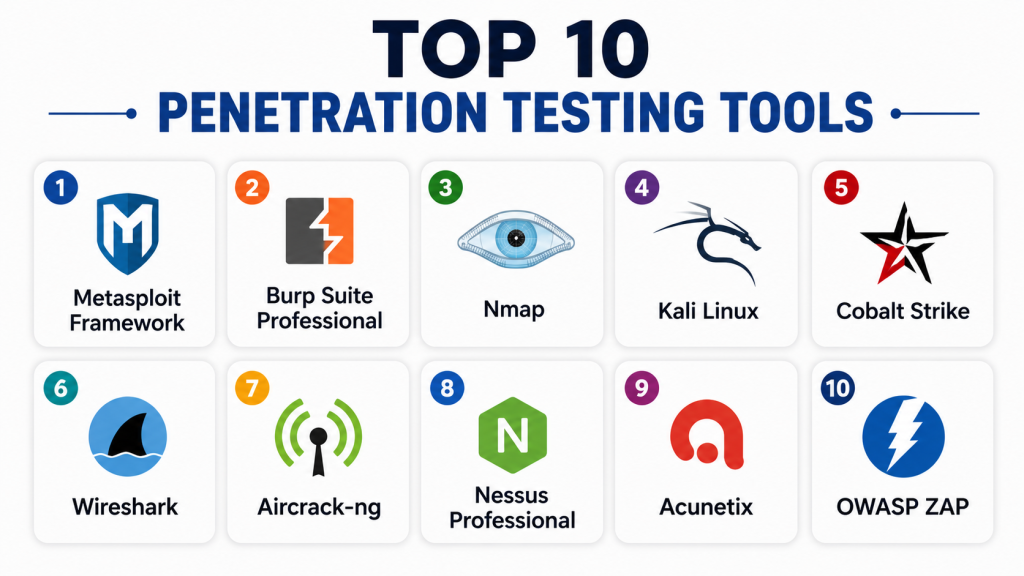
Top 10 Penetration Testing Tools
1- Metasploit Framework
Short description: Metasploit Framework is one of the most widely used penetration testing and exploit development platforms for security professionals and red teams.
Key Features
- Exploit development framework
- Payload generation
- Post-exploitation modules
- Vulnerability validation
- Network testing capabilities
- Extensive exploit database
- Automation scripting support
Pros
- Massive community ecosystem
- Extensive exploit library
- Flexible and powerful framework
Cons
- Requires technical expertise
- Can be complex for beginners
- Advanced enterprise features may require commercial editions
Platforms / Deployment
Windows / Linux / macOS
Self-hosted
Security & Compliance
Varies / Not publicly stated.
Integrations & Ecosystem
Metasploit integrates with vulnerability scanners, reporting tools, and security workflows.
- Nessus
- Nexpose
- Nmap
- SIEM platforms
- Custom APIs
- Reporting tools
Support & Community
Extremely large global cybersecurity community with extensive documentation and tutorials.
2- Burp Suite Professional
Short description: Burp Suite Professional is a leading web application penetration testing platform used by security professionals for web and API security testing.
Key Features
- Web vulnerability scanning
- Proxy interception
- API security testing
- Manual testing tools
- Automated scanning
- Session handling
- Extensibility through plugins
Pros
- Industry-standard web testing platform
- Excellent manual testing capabilities
- Strong extension ecosystem
Cons
- Learning curve for advanced usage
- Resource-intensive scans
- Enterprise automation requires additional editions
Platforms / Deployment
Windows / Linux / macOS
Security & Compliance
SSO and enterprise controls vary by edition.
Integrations & Ecosystem
Burp Suite integrates with developer pipelines and security workflows.
- Jira
- Jenkins
- GitLab
- CI/CD pipelines
- REST APIs
- Security plugins
Support & Community
Large penetration testing community with extensive training content.
3- Nmap
Short description: Nmap is a highly popular open-source network discovery and security auditing tool widely used for reconnaissance and infrastructure mapping.
Key Features
- Network discovery
- Port scanning
- Service detection
- OS fingerprinting
- Scripting engine
- Vulnerability detection
- Network inventory mapping
Pros
- Lightweight and flexible
- Strong open-source ecosystem
- Excellent reconnaissance capabilities
Cons
- Primarily reconnaissance-focused
- Limited exploit functionality
- Requires technical knowledge
Platforms / Deployment
Windows / Linux / macOS
Self-hosted
Security & Compliance
Varies / Not publicly stated.
Integrations & Ecosystem
Nmap integrates with security scanning and automation tools.
- Metasploit
- SIEM tools
- Vulnerability scanners
- Automation scripts
- Linux ecosystems
- Custom workflows
Support & Community
Very active global cybersecurity and networking community.
4- Kali Linux
Short description: Kali Linux is a penetration testing operating system that includes hundreds of security assessment and ethical hacking tools.
Key Features
- Preloaded penetration testing tools
- Wireless testing support
- Exploit development tools
- Forensics capabilities
- Password auditing
- Network testing
- Red team workflows
Pros
- Comprehensive security toolkit
- Widely adopted by professionals
- Strong community ecosystem
Cons
- Requires advanced expertise
- Can overwhelm beginners
- Tool management complexity
Platforms / Deployment
Linux
Self-hosted
Security & Compliance
Varies / Not publicly stated.
Integrations & Ecosystem
Kali Linux supports integration with numerous penetration testing frameworks and tools.
- Metasploit
- Burp Suite
- Wireshark
- Nmap
- Aircrack-ng
- Open-source ecosystems
Support & Community
Massive global security research and ethical hacking community.
5- Cobalt Strike
Short description: Cobalt Strike is a commercial adversary simulation and red teaming platform designed for advanced penetration testing operations.
Key Features
- Adversary simulation
- Beacon payloads
- Post-exploitation workflows
- Team collaboration
- Threat emulation
- Red team automation
- Reporting support
Pros
- Advanced red team capabilities
- Strong collaboration workflows
- Mature adversary simulation features
Cons
- Premium pricing
- Requires skilled operators
- Frequently targeted by misuse concerns
Platforms / Deployment
Windows / Linux
Security & Compliance
Varies / Not publicly stated.
Integrations & Ecosystem
Cobalt Strike integrates with offensive security and testing workflows.
- Metasploit
- Threat emulation tools
- SIEM platforms
- Automation scripts
- Red team tooling
- Security research ecosystems
Support & Community
Strong professional penetration testing adoption and training ecosystem.
6- Wireshark
Short description: Wireshark is a widely used network protocol analyzer that helps penetration testers inspect and analyze network traffic in detail.
Key Features
- Packet capture analysis
- Protocol inspection
- Traffic monitoring
- Deep packet analysis
- Network troubleshooting
- Filtering capabilities
- Visualization support
Pros
- Extremely detailed packet analysis
- Open-source flexibility
- Broad protocol support
Cons
- Requires networking expertise
- Large captures can be overwhelming
- Primarily analysis-focused
Platforms / Deployment
Windows / Linux / macOS
Security & Compliance
Varies / Not publicly stated.
Integrations & Ecosystem
Wireshark integrates with network security and troubleshooting environments.
- Nmap
- SIEM platforms
- Network appliances
- Security analytics
- Linux ecosystems
- Packet capture workflows
Support & Community
Large networking and cybersecurity community with extensive documentation.
7- Aircrack-ng
Short description: Aircrack-ng is an open-source wireless security assessment suite focused on Wi-Fi auditing and wireless penetration testing.
Key Features
- Wireless packet capture
- WPA/WPA2 testing
- Wireless traffic analysis
- Rogue access point testing
- Password auditing
- Network monitoring
- Wireless attack simulation
Pros
- Strong wireless testing capabilities
- Open-source flexibility
- Widely recognized wireless toolkit
Cons
- Specialized for wireless security
- Requires compatible hardware
- Advanced usage complexity
Platforms / Deployment
Windows / Linux / macOS
Security & Compliance
Varies / Not publicly stated.
Integrations & Ecosystem
Aircrack-ng integrates with wireless and penetration testing workflows.
- Kali Linux
- Wireless adapters
- Packet capture tools
- Linux ecosystems
- Custom scripts
- Network testing workflows
Support & Community
Strong open-source wireless security community.
8- Nessus Professional
Short description: Nessus Professional combines vulnerability assessment with penetration testing validation workflows for infrastructure security testing.
Key Features
- Vulnerability scanning
- Configuration auditing
- Patch assessment
- Compliance checks
- Risk prioritization
- Infrastructure scanning
- Reporting dashboards
Pros
- Strong vulnerability coverage
- Easy deployment
- Mature enterprise adoption
Cons
- Primarily vulnerability-focused
- Exploit capabilities more limited
- Advanced workflows may require integrations
Platforms / Deployment
Windows / Linux / macOS
Cloud / Self-hosted
Security & Compliance
RBAC, encryption support, MFA capabilities.
Integrations & Ecosystem
Nessus integrates with broader security operations environments.
- SIEM tools
- ServiceNow
- Metasploit
- Cloud platforms
- Reporting systems
- Security workflows
Support & Community
Strong enterprise documentation and training resources.
9- Acunetix
Short description: Acunetix provides automated web application penetration testing and vulnerability scanning focused on modern web technologies and APIs.
Key Features
- Web application scanning
- API testing
- DAST capabilities
- Authentication testing
- CI/CD integration
- Automated scanning
- Risk prioritization
Pros
- Strong web security coverage
- Good developer integrations
- Easy deployment experience
Cons
- Primarily application-focused
- Enterprise scalability varies
- Limited broader infrastructure testing
Platforms / Deployment
Cloud / Self-hosted
Security & Compliance
SSO, RBAC, encryption support.
Integrations & Ecosystem
Acunetix integrates with developer and enterprise workflows.
- Jira
- GitHub
- Jenkins
- Azure DevOps
- GitLab
- CI/CD pipelines
Support & Community
Strong onboarding and documentation resources.
10- OWASP ZAP
Short description: OWASP ZAP is an open-source web application security testing platform designed for developers, security teams, and DevSecOps workflows.
Key Features
- Web vulnerability scanning
- Proxy interception
- Automated testing
- API security testing
- CI/CD integrations
- Script extensibility
- Passive and active scanning
Pros
- Free and open-source
- Good developer adoption
- Strong automation flexibility
Cons
- Advanced workflows require expertise
- Enterprise support limited
- Large-scale testing may require tuning
Platforms / Deployment
Windows / Linux / macOS
Security & Compliance
Varies / Not publicly stated.
Integrations & Ecosystem
OWASP ZAP integrates well with developer and DevSecOps workflows.
- Jenkins
- GitHub Actions
- GitLab
- CI/CD pipelines
- Docker
- Security automation tools
Support & Community
Very active global open-source security community.
Comparison Table
| Tool Name | Best For | Platform(s) Supported | Deployment | Standout Feature | Public Rating |
|---|---|---|---|---|---|
| Metasploit Framework | Exploit development | Windows / Linux / macOS | Self-hosted | Extensive exploit framework | N/A |
| Burp Suite Professional | Web application testing | Windows / Linux / macOS | Self-hosted | Advanced web testing workflows | N/A |
| Nmap | Network reconnaissance | Windows / Linux / macOS | Self-hosted | Network discovery engine | N/A |
| Kali Linux | Full penetration testing environments | Linux | Self-hosted | Large integrated toolkit | N/A |
| Cobalt Strike | Red team operations | Windows / Linux | Self-hosted | Adversary simulation | N/A |
| Wireshark | Network traffic analysis | Windows / Linux / macOS | Self-hosted | Deep packet inspection | N/A |
| Aircrack-ng | Wireless penetration testing | Windows / Linux / macOS | Self-hosted | Wireless security auditing | N/A |
| Nessus Professional | Vulnerability validation | Windows / Linux / macOS | Hybrid | Enterprise vulnerability scanning | N/A |
| Acunetix | Web and API testing | Web | Cloud / Self-hosted | Automated DAST scanning | N/A |
| OWASP ZAP | Open-source web testing | Windows / Linux / macOS | Self-hosted | Developer-friendly security testing | N/A |
Evaluation & Scoring of Penetration Testing Tools
| Tool Name | Core 25% | Ease 15% | Integrations 15% | Security 10% | Performance 10% | Support 10% | Value 15% | Weighted Total |
|---|---|---|---|---|---|---|---|---|
| Metasploit Framework | 9.5 | 7 | 9 | 8 | 9 | 9 | 9 | 8.8 |
| Burp Suite Professional | 9 | 8 | 8.5 | 8 | 8.5 | 8.5 | 7.5 | 8.3 |
| Nmap | 8 | 8 | 8 | 7 | 8.5 | 8.5 | 9.5 | 8.2 |
| Kali Linux | 9 | 7 | 8.5 | 7 | 8.5 | 9 | 9 | 8.4 |
| Cobalt Strike | 9 | 6.5 | 8 | 8 | 8.5 | 8 | 6 | 7.9 |
| Wireshark | 8 | 7 | 7.5 | 7 | 9 | 8.5 | 9.5 | 8.1 |
| Aircrack-ng | 7.5 | 6.5 | 7 | 7 | 8 | 8 | 9 | 7.7 |
| Nessus Professional | 8.5 | 8 | 8.5 | 8.5 | 8.5 | 8.5 | 8 | 8.3 |
| Acunetix | 8.5 | 8.5 | 8 | 8 | 8 | 8 | 7.5 | 8.1 |
| OWASP ZAP | 8 | 8 | 8 | 7 | 8 | 8 | 9.5 | 8.2 |
These scores are comparative evaluations intended to help buyers understand relative strengths across the penetration testing market. Enterprise-focused tools often provide deeper automation and advanced red team workflows, while open-source platforms typically offer stronger value flexibility and customization. Organizations should prioritize scores based on operational maturity, security expertise, infrastructure complexity, and compliance requirements.
Which Penetration Testing Tool Is Right for You?
Solo / Freelancer
Independent consultants and learners often benefit from open-source tools like Nmap, Kali Linux, OWASP ZAP, and Wireshark because of flexibility and lower costs.
SMB
SMBs should prioritize usability, automation, and deployment simplicity. Nessus Professional and Burp Suite Professional are often strong SMB-friendly options.
Mid-Market
Mid-market organizations typically need broader integrations and scalable testing workflows. Acunetix, Burp Suite Professional, and Nessus Professional provide balanced operational capabilities.
Enterprise
Large enterprises and mature red teams often require advanced adversary simulation, automation, and governance. Metasploit Framework, Cobalt Strike, and enterprise vulnerability platforms are strong candidates.
Budget vs Premium
Open-source tools can provide excellent flexibility and low operational cost, while premium enterprise tools typically offer stronger support, automation, and reporting.
Feature Depth vs Ease of Use
Feature-rich penetration testing frameworks may require experienced operators. Organizations prioritizing rapid onboarding should focus on usability and workflow simplicity.
Integrations & Scalability
Enterprises with large infrastructure footprints should evaluate SIEM, SOAR, DevSecOps, and cloud integration capabilities carefully.
Security & Compliance Needs
Highly regulated industries should prioritize audit logging, reporting workflows, role-based access controls, and compliance-oriented testing support.
Frequently Asked Questions FAQs
1. What is a penetration testing tool?
A penetration testing tool helps security professionals simulate cyberattacks to identify exploitable vulnerabilities in systems, applications, and networks.
2. How is penetration testing different from vulnerability scanning?
Vulnerability scanning identifies weaknesses automatically, while penetration testing actively validates exploitability through simulated attacks.
3. Are open-source penetration testing tools reliable?
Yes. Many open-source tools such as Nmap, Metasploit Framework, OWASP ZAP, and Kali Linux are widely trusted by professionals.
4. Which tool is best for web application testing?
Burp Suite Professional, OWASP ZAP, and Acunetix are among the most widely used web application penetration testing tools.
5. Can penetration testing tools support cloud environments?
Yes. Modern platforms increasingly support AWS, Azure, Kubernetes, containers, APIs, and hybrid cloud infrastructure testing.
6. What integrations are most important?
Common integrations include SIEM, SOAR, CI/CD pipelines, ticketing systems, vulnerability scanners, and cloud platforms.
7. Are these tools beginner-friendly?
Some tools are easier for beginners, while advanced frameworks often require strong networking, operating system, and cybersecurity knowledge.
8. How often should penetration testing occur?
Organizations increasingly perform continuous or quarterly testing depending on compliance requirements and attack surface exposure.
9. What industries benefit most from penetration testing?
Financial services, healthcare, retail, SaaS providers, government agencies, and manufacturing organizations benefit significantly.
10. What should buyers evaluate first?
Organizations should first assess testing scope, automation requirements, integration compatibility, reporting workflows, and operational expertise.
Conclusion
Penetration Testing Tools continue to play a critical role in modern cybersecurity strategies as organizations face expanding attack surfaces, cloud-native environments, API-driven architectures, and increasingly sophisticated cyber threats. The most effective tools now combine vulnerability discovery, exploit validation, automation, cloud assessment, API testing, and DevSecOps integration to support continuous security testing across complex environments. Platforms like Metasploit Framework, Burp Suite Professional, Cobalt Strike, Nessus Professional, and Acunetix each serve different operational needs depending on security maturity, infrastructure complexity, and testing objectives. Open-source tools such as Nmap, Kali Linux, OWASP ZAP, and Wireshark also remain essential components of many professional security workflows. The best tool ultimately depends on organizational goals, budget, technical expertise, and compliance requirements. Before selecting a platform, organizations should shortlist a few tools, validate integration compatibility, run pilot testing scenarios, and ensure the solution aligns with long-term security operations and risk management strategies.

Find Trusted Cardiac Hospitals
Compare heart hospitals by city and services — all in one place.
Explore Hospitals
Penetration testing tools are most valuable when they help authorized security teams identify, validate, and assess vulnerabilities in applications, networks, systems, and infrastructure under controlled testing conditions. By providing vulnerability discovery, security testing, reconnaissance, web application assessment, network analysis, exploitation validation, reporting, evidence collection, and integration with security testing workflows, these tools enable organizations to uncover weaknesses before attackers can exploit them, prioritize remediation efforts, validate security controls, improve defensive readiness, and strengthen overall security posture.