Introduction
Security Information & Event Management SIEM platforms help organizations collect, analyze, correlate, and monitor security events across networks, endpoints, cloud infrastructure, applications, and identity systems. In simple terms, SIEM tools act as a centralized security intelligence hub that helps security teams detect threats, investigate incidents, and respond faster. As cyber threats become more advanced in 2026 and beyond, SIEM platforms are evolving from basic log management systems into AI-driven security analytics platforms with automation, threat intelligence, behavioral analytics, and extended detection capabilities. Organizations now need real-time visibility across hybrid cloud, SaaS, remote work infrastructure, and zero-trust environments.
Common Real-world use cases include:
- Threat detection and incident response
- Compliance monitoring and audit reporting
- Insider threat monitoring
- Cloud security visibility
- Security operations center SOC management
When Evaluating SIEM platforms, buyers should consider:
- Scalability and ingestion performance
- AI and behavioral analytics capabilities
- Detection engineering flexibility
- Cloud and hybrid deployment support
- Integration ecosystem
- Automation and SOAR capabilities
- Compliance reporting
- Ease of investigation workflows
- Pricing predictability
- Analyst usability and learning curve
Best for: Enterprises, MSSPs, regulated industries, financial services, healthcare organizations, government agencies, and mid-sized businesses with dedicated security operations requirements.
Not ideal for: Very small businesses with minimal infrastructure, organizations without security monitoring needs, or teams seeking lightweight endpoint-only security tools.
Key Trends in Security Information & Event Management SIEM
- AI-assisted threat detection and investigation workflows are becoming standard.
- SIEM and XDR convergence is accelerating across major security vendors.
- Cloud-native SIEM adoption continues to grow due to scalability demands.
- Organizations increasingly prioritize automation and SOAR integration.
- Open telemetry and interoperability are becoming critical buying factors.
- UEBA User and Entity Behavior Analytics capabilities are now expected.
- Data retention optimization and tiered storage models are gaining importance.
- Compliance automation is becoming more advanced for regulated sectors.
- Detection-as-code and security engineering workflows are expanding.
- SIEM platforms increasingly support multi-cloud and Kubernetes visibility.
How We Selected These Tools
The tools below were selected based on multiple practical evaluation criteria:
- Enterprise and mid-market adoption
- Industry reputation and analyst visibility
- Breadth of threat detection capabilities
- Cloud-native and hybrid deployment flexibility
- AI and automation maturity
- Integration ecosystem strength
- Incident investigation workflows
- Scalability for modern security operations
- Support for compliance and governance requirements
- Fit across different organizational sizes and industries
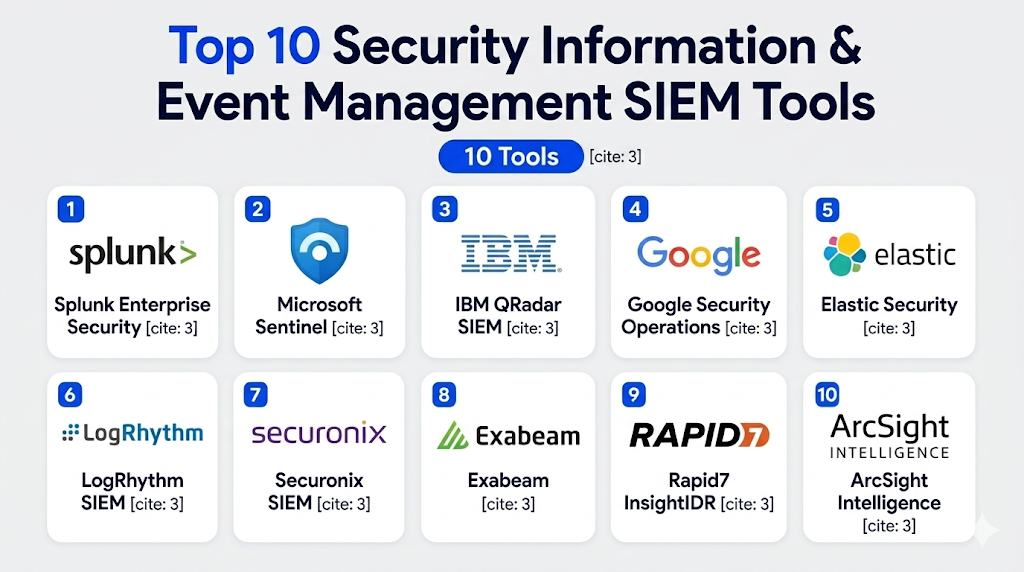
Top 10 Security Information & Event Management SIEM Tools
1 — Splunk Enterprise Security
Short description: Splunk Enterprise Security is one of the most widely adopted enterprise SIEM platforms, known for advanced analytics, scalability, and deep customization capabilities. It is commonly used by large SOC teams and regulated enterprises.
Key Features
- Advanced correlation and detection rules
- AI-assisted threat hunting workflows
- Extensive data ingestion support
- Security orchestration integrations
- Threat intelligence management
- Custom dashboards and reporting
- UEBA capabilities
Pros
- Extremely flexible analytics engine
- Strong ecosystem and integrations
- Mature enterprise-grade capabilities
Cons
- High pricing for large environments
- Steep learning curve
- Complex deployment management
Platforms / Deployment
- Cloud / Self-hosted / Hybrid
Security & Compliance
- RBAC
- MFA
- Audit logging
- SSO/SAML
- Encryption support
- Compliance support varies by deployment
Integrations & Ecosystem
Splunk has one of the largest SIEM integration ecosystems available, supporting cloud providers, endpoint tools, firewalls, IAM systems, DevOps platforms, and SOAR solutions.
- AWS
- Microsoft Azure
- Google Cloud
- CrowdStrike
- Palo Alto Networks
- ServiceNow
Support & Community
Strong enterprise support ecosystem with extensive documentation, certifications, training programs, and large community adoption.
2 — Microsoft Sentinel
Short description: Microsoft Sentinel is a cloud-native SIEM platform built on Azure. It is designed for organizations heavily invested in the Microsoft ecosystem and hybrid cloud security operations.
Key Features
- Native Microsoft integration
- AI-driven analytics
- Automated investigation workflows
- Threat intelligence support
- Built-in SOAR capabilities
- Cloud-native scalability
- Advanced hunting queries
Pros
- Fast cloud deployment
- Strong Microsoft ecosystem integration
- Good automation capabilities
Cons
- Best experience requires Azure adoption
- Complex pricing model
- Limited flexibility outside Microsoft stack
Platforms / Deployment
- Cloud
Security & Compliance
- MFA
- SSO/SAML
- RBAC
- Audit logging
- Encryption
- Microsoft compliance ecosystem support
Integrations & Ecosystem
Sentinel integrates deeply with Microsoft security products while also supporting third-party security telemetry.
- Microsoft Defender
- Entra ID
- AWS
- Cisco
- Palo Alto Networks
- ServiceNow
Support & Community
Strong enterprise documentation and Microsoft partner ecosystem support.
3 — IBM QRadar SIEM
Short description: IBM QRadar is a mature SIEM platform focused on enterprise threat detection, compliance management, and advanced analytics.
Key Features
- Log and flow analytics
- Threat intelligence correlation
- AI-assisted investigations
- Compliance reporting
- Behavioral analytics
- Network visibility
- Custom rule engine
Pros
- Mature enterprise capabilities
- Strong compliance reporting
- Reliable threat correlation
Cons
- Traditional interface feels dated
- Deployment complexity
- Higher operational overhead
Platforms / Deployment
- Cloud / Self-hosted / Hybrid
Security & Compliance
- RBAC
- MFA
- Audit logging
- Encryption support
- SSO/SAML
Integrations & Ecosystem
QRadar supports integrations across network security, endpoint security, IAM, and cloud monitoring environments.
- AWS
- Microsoft Azure
- Cisco
- VMware
- CrowdStrike
- IBM Security tools
Support & Community
Enterprise-focused support with large global consulting ecosystem.
4 — Google Security Operations
Short description: Google Security Operations combines cloud-scale analytics with AI-assisted detection and investigation capabilities for modern SOC teams.
Key Features
- Cloud-native SIEM architecture
- AI-assisted threat analysis
- High-speed search capabilities
- Threat intelligence integration
- Detection engineering workflows
- Security analytics pipelines
- Large-scale telemetry ingestion
Pros
- Excellent scalability
- Fast analytics performance
- Strong cloud-native architecture
Cons
- Complex onboarding for some teams
- Requires cloud security maturity
- Pricing may vary significantly
Platforms / Deployment
- Cloud
Security & Compliance
- RBAC
- SSO/SAML
- MFA
- Audit logging
- Encryption support
Integrations & Ecosystem
Strong integration capabilities for cloud infrastructure, security telemetry, and modern detection pipelines.
- Google Cloud
- AWS
- Microsoft Azure
- Chronicle integrations
- Endpoint security tools
- Threat intelligence platforms
Support & Community
Growing enterprise adoption with strong cloud documentation and support resources.
5 — Elastic Security
Short description: Elastic Security combines SIEM, endpoint security, and search analytics in a flexible platform popular among technical security teams.
Key Features
- Open analytics platform
- SIEM and endpoint integration
- Threat hunting workflows
- Machine learning analytics
- Custom dashboards
- Detection engineering support
- Log analytics flexibility
Pros
- Highly customizable
- Strong search capabilities
- Developer-friendly ecosystem
Cons
- Requires technical expertise
- Management complexity at scale
- Some advanced features require premium licensing
Platforms / Deployment
- Cloud / Self-hosted / Hybrid
Security & Compliance
- RBAC
- MFA
- SSO/SAML
- Audit logging
- Encryption support
Integrations & Ecosystem
Elastic integrates with modern DevOps, observability, and security tooling ecosystems.
- Kubernetes
- AWS
- Microsoft Azure
- Google Cloud
- Endpoint telemetry tools
- Open telemetry pipelines
Support & Community
Large open-source community with strong technical documentation.
6 — LogRhythm SIEM
Short description: LogRhythm focuses on integrated SIEM and SOAR capabilities for organizations seeking operational security visibility and automation.
Key Features
- Threat detection analytics
- Centralized log management
- Automated response workflows
- Compliance reporting
- UEBA capabilities
- Threat intelligence support
- SOC dashboards
Pros
- Strong integrated workflow approach
- Good automation support
- Mature SOC capabilities
Cons
- User interface can feel complex
- Scaling may require tuning
- Cloud-native capabilities evolving
Platforms / Deployment
- Cloud / Self-hosted / Hybrid
Security & Compliance
- RBAC
- MFA
- Audit logging
- Encryption support
Integrations & Ecosystem
Supports integrations across enterprise infrastructure and security environments.
- Active Directory
- AWS
- Microsoft security stack
- Firewalls
- Endpoint platforms
- SOAR tools
Support & Community
Strong enterprise support with security operations focus.
7 — Securonix SIEM
Short description: Securonix is a cloud-native SIEM platform known for UEBA, advanced analytics, and modern threat detection capabilities.
Key Features
- UEBA analytics
- Threat detection automation
- AI-assisted investigations
- Cloud-native architecture
- Risk scoring
- Threat intelligence integration
- Compliance monitoring
Pros
- Strong behavioral analytics
- Cloud-first design
- Good threat prioritization
Cons
- Learning curve for advanced features
- Pricing varies by data volume
- Customization may require expertise
Platforms / Deployment
- Cloud / Hybrid
Security & Compliance
- MFA
- RBAC
- SSO/SAML
- Audit logging
- Encryption support
Integrations & Ecosystem
Supports integrations across cloud platforms, identity systems, and security tools.
- AWS
- Microsoft Azure
- Google Cloud
- Okta
- Endpoint security platforms
- Threat intelligence feeds
Support & Community
Enterprise-focused support with growing cloud security ecosystem adoption.
8 — Exabeam
Short description: Exabeam combines SIEM, UEBA, and automation with a strong focus on incident investigation and behavioral analytics.
Key Features
- Behavioral analytics
- Incident timelines
- AI-assisted investigations
- Automated response workflows
- Threat intelligence support
- Risk-based analytics
- SOC workflow management
Pros
- Strong investigation experience
- Effective risk scoring
- Good automation workflows
Cons
- Advanced deployment complexity
- Premium pricing
- Some integrations require customization
Platforms / Deployment
- Cloud / Hybrid
Security & Compliance
- RBAC
- MFA
- SSO/SAML
- Audit logging
- Encryption support
Integrations & Ecosystem
Supports integrations with security monitoring and response ecosystems.
- CrowdStrike
- Microsoft security stack
- Okta
- AWS
- SOAR platforms
- Threat intelligence tools
Support & Community
Strong enterprise onboarding and professional services availability.
9 — Rapid7 InsightIDR
Short description: Rapid7 InsightIDR is a cloud SIEM and detection platform designed for mid-market and enterprise organizations seeking simpler operations.
Key Features
- Cloud-native SIEM
- UEBA analytics
- Threat detection workflows
- Integrated vulnerability visibility
- Automation support
- Endpoint telemetry integration
- Investigation dashboards
Pros
- Easier deployment experience
- Good analyst usability
- Strong integration with Rapid7 ecosystem
Cons
- Less customization than some enterprise platforms
- Advanced analytics may be limited for large SOCs
- Pricing varies with ingestion scale
Platforms / Deployment
- Cloud
Security & Compliance
- MFA
- SSO/SAML
- RBAC
- Audit logging
- Encryption support
Integrations & Ecosystem
Strong integration support for cloud, identity, and endpoint security tooling.
- AWS
- Okta
- Microsoft 365
- CrowdStrike
- VMware
- Rapid7 products
Support & Community
Good customer support reputation and approachable documentation.
10 — ArcSight Intelligence
Short description: ArcSight is a long-established enterprise SIEM platform known for scalability, compliance monitoring, and complex event correlation.
Key Features
- Large-scale event correlation
- Threat intelligence integration
- Compliance reporting
- Security analytics
- Detection rule customization
- Long-term log retention
- SOC workflows
Pros
- Strong enterprise scalability
- Mature analytics engine
- Good compliance support
Cons
- Complex deployment model
- Requires experienced administrators
- Interface modernization challenges
Platforms / Deployment
- Cloud / Self-hosted / Hybrid
Security & Compliance
- RBAC
- MFA
- SSO/SAML
- Encryption support
- Audit logging
Integrations & Ecosystem
Supports enterprise security infrastructure and legacy environments.
- Firewalls
- IAM systems
- Endpoint security
- Threat intelligence feeds
- Cloud platforms
- Security analytics tools
Support & Community
Enterprise-oriented support ecosystem with long-standing security industry presence.
Comparison Table
| Tool Name | Best For | Platform(s) Supported | Deployment | Standout Feature | Public Rating |
|---|---|---|---|---|---|
| Splunk Enterprise Security | Large enterprises | Web, Linux | Cloud, Hybrid | Advanced analytics flexibility | N/A |
| Microsoft Sentinel | Microsoft-centric organizations | Web | Cloud | Native Microsoft integration | N/A |
| IBM QRadar | Compliance-heavy enterprises | Web, Linux | Hybrid | Flow analytics | N/A |
| Google Security Operations | Cloud-native SOCs | Web | Cloud | Massive-scale analytics | N/A |
| Elastic Security | Technical teams | Web, Linux | Hybrid | Open analytics platform | N/A |
| LogRhythm | SOC automation | Web, Windows | Hybrid | Integrated workflows | N/A |
| Securonix | UEBA-focused environments | Web | Cloud | Behavioral analytics | N/A |
| Exabeam | Investigation-centric SOCs | Web | Hybrid | Incident timelines | N/A |
| Rapid7 InsightIDR | Mid-market teams | Web | Cloud | Ease of deployment | N/A |
| ArcSight Intelligence | Large-scale enterprises | Web, Linux | Hybrid | Event correlation scalability | N/A |
Evaluation & Scoring of Security Information & Event Management SIEM
| Tool Name | Core | Ease | Integrations | Security | Performance | Support | Value | Weighted Total |
|---|---|---|---|---|---|---|---|---|
| Splunk Enterprise Security | 10 | 7 | 10 | 9 | 10 | 9 | 6 | 8.8 |
| Microsoft Sentinel | 9 | 8 | 9 | 9 | 9 | 8 | 8 | 8.6 |
| IBM QRadar | 9 | 6 | 8 | 9 | 8 | 8 | 7 | 7.9 |
| Google Security Operations | 9 | 7 | 8 | 9 | 10 | 8 | 7 | 8.3 |
| Elastic Security | 8 | 6 | 9 | 8 | 8 | 8 | 9 | 8.0 |
| LogRhythm | 8 | 7 | 8 | 8 | 8 | 8 | 7 | 7.8 |
| Securonix | 9 | 7 | 8 | 9 | 8 | 8 | 7 | 8.1 |
| Exabeam | 8 | 8 | 8 | 8 | 8 | 8 | 7 | 7.9 |
| Rapid7 InsightIDR | 8 | 9 | 8 | 8 | 8 | 8 | 8 | 8.1 |
| ArcSight Intelligence | 8 | 5 | 7 | 9 | 8 | 7 | 6 | 7.2 |
These scores are comparative rather than absolute. Organizations should prioritize the categories most relevant to their operational needs. Enterprise-scale environments may prioritize analytics depth and scalability, while smaller teams may value usability and operational simplicity more heavily. Pricing models, ingestion costs, and staffing capabilities can significantly impact real-world value.
Which Security Information & Event Management SIEM Tool Is Right for You?
Solo / Freelancer
Most solo users do not require full enterprise SIEM platforms. Lightweight monitoring, managed detection services, or endpoint-focused tools are usually more practical and affordable.
SMB
Rapid7 InsightIDR and Microsoft Sentinel are often strong options for SMB environments due to simpler deployment models and easier operational management.
Mid-Market
Elastic Security, Securonix, and Exabeam provide balanced capabilities for organizations needing advanced analytics without extremely large enterprise overhead.
Enterprise
Splunk Enterprise Security, IBM QRadar, ArcSight, and Google Security Operations are well suited for large-scale SOC operations with complex detection and compliance requirements.
Budget vs Premium
Elastic Security offers strong flexibility and value for technically skilled teams. Splunk and Google Security Operations typically sit at the premium enterprise end of the market.
Feature Depth vs Ease of Use
Splunk and QRadar offer deep customization and advanced analytics but require experienced teams. Rapid7 InsightIDR prioritizes operational simplicity and analyst usability.
Integrations & Scalability
Organizations with large hybrid environments should prioritize platforms with broad ecosystem support and proven scalability such as Splunk, Sentinel, and Google Security Operations.
Security & Compliance Needs
Highly regulated industries should evaluate audit capabilities, long-term retention support, compliance reporting, and access controls carefully before selecting a platform.
Frequently Asked Questions FAQs
1. What does a SIEM platform actually do?
A SIEM platform centralizes security logs and telemetry from multiple systems, helping organizations detect threats, investigate incidents, and monitor security activity in real time.
2. Is SIEM only for large enterprises?
No. Many cloud-native SIEM tools now support mid-market and smaller organizations with simplified deployment and pricing models.
3. What is the difference between SIEM and XDR?
SIEM focuses on centralized logging and analytics, while XDR emphasizes integrated detection and response across endpoints, networks, and cloud environments.
4. Are cloud-native SIEM platforms replacing traditional SIEM tools?
Cloud-native adoption is growing rapidly because of scalability and operational simplicity, but hybrid and self-hosted SIEM deployments remain common in regulated industries.
5. Why is SIEM pricing often expensive?
Pricing is commonly based on data ingestion volume, retention, analytics complexity, and automation capabilities, which can grow significantly in large environments.
6. What integrations are most important in a SIEM platform?
Critical integrations often include endpoint security tools, identity providers, cloud platforms, firewalls, vulnerability management systems, and ticketing tools.
7. How long does SIEM implementation usually take?
Implementation timelines vary from days for smaller cloud deployments to several months for large enterprise SOC environments with extensive integrations.
8. What are common SIEM deployment mistakes?
Organizations often underestimate log volume growth, detection tuning requirements, staffing needs, and integration complexity during initial deployments.
9. Does every organization need a dedicated SOC team for SIEM?
Not necessarily. Many organizations use managed security service providers MSSPs or outsourced monitoring teams alongside their SIEM platforms.
10. What should buyers prioritize first when evaluating SIEM tools?
Buyers should prioritize visibility requirements, scalability, deployment model preferences, integration needs, analyst workflows, and long-term operational costs.
Conclusion
Security Information & Event Management SIEM platforms remain a foundational component of modern cybersecurity operations. As organizations expand across cloud, SaaS, hybrid infrastructure, and remote environments, centralized visibility and threat detection capabilities become increasingly critical. Modern SIEM platforms now combine analytics, automation, AI-assisted investigations, and behavioral monitoring to support faster and more effective security operations. However, the “best” SIEM platform depends heavily on organizational size, security maturity, compliance requirements, operational complexity, and budget realities. Large enterprises may prioritize scalability and deep analytics, while smaller teams often value ease of deployment and operational simplicity. Before making a final decision, organizations should shortlist two or three platforms, validate integration compatibility, run proof-of-concept deployments, and evaluate long-term operational costs and staffing requirements carefully.

Find Trusted Cardiac Hospitals
Compare heart hospitals by city and services — all in one place.
Explore Hospitals
I liked how each tool is explained with features and pros & cons. It makes comparison very easy for beginners.