Introduction
Data Loss Prevention DLP tools are security platforms designed to detect, monitor, and prevent sensitive data from being exposed, leaked, or transferred outside an organization without authorization. These solutions protect data across endpoints, cloud applications, email systems, networks, and SaaS platforms by enforcing policies and identifying risky user behavior in real time. In today’s enterprise environment, data is constantly moving across cloud services, remote devices, collaboration platforms, and third-party integrations. This creates a larger attack surface where sensitive information such as customer records, financial data, intellectual property, and credentials can be accidentally or maliciously exposed. DLP tools help organizations maintain control over this data by applying context-aware policies and automated enforcement mechanisms.
Common Real-world use cases include:
- Preventing sensitive file sharing outside the organization
- Monitoring email for confidential data leaks
- Protecting intellectual property in cloud storage
- Ensuring regulatory compliance such as GDPR and HIPAA
- Blocking unauthorized data transfers on endpoints
Buyers should Evaluate:
- Data visibility across endpoints, cloud, and SaaS
- Policy customization flexibility
- Integration with security ecosystems
- Cloud and hybrid coverage
- Incident response automation
- User behavior analytics
- Compliance reporting capabilities
- Deployment complexity
- Performance impact on endpoints
- Scalability across enterprise environments
Best for: Enterprises, regulated industries, financial services, healthcare organizations, SaaS companies, and security-conscious mid-market organizations.
Not ideal for: Small organizations with minimal sensitive data exposure or companies without regulatory compliance requirements.
Key Trends in DLP
- Shift from traditional keyword-based DLP to AI-driven content classification
- Integration of DLP with CASB, SSPM, and CNAPP platforms
- Growth of cloud-native DLP across SaaS applications
- Increased focus on insider threat detection and user behavior analytics
- Expansion of endpoint + cloud unified DLP platforms
- Real-time data classification using machine learning
- Automation of incident response workflows
- Stronger encryption-aware inspection capabilities
- API-based integrations replacing legacy agents in some environments
- Privacy-first compliance-driven DLP configurations
How We Selected These Tools
- Market adoption and enterprise presence
- Depth of endpoint, cloud, and network coverage
- Accuracy of data classification engines
- Integration with SIEM, SOAR, and IAM platforms
- Policy customization flexibility
- Performance efficiency and scalability
- Incident response capabilities
- Compliance and regulatory support
- Ease of deployment and management
- Support for hybrid and multi-cloud environments
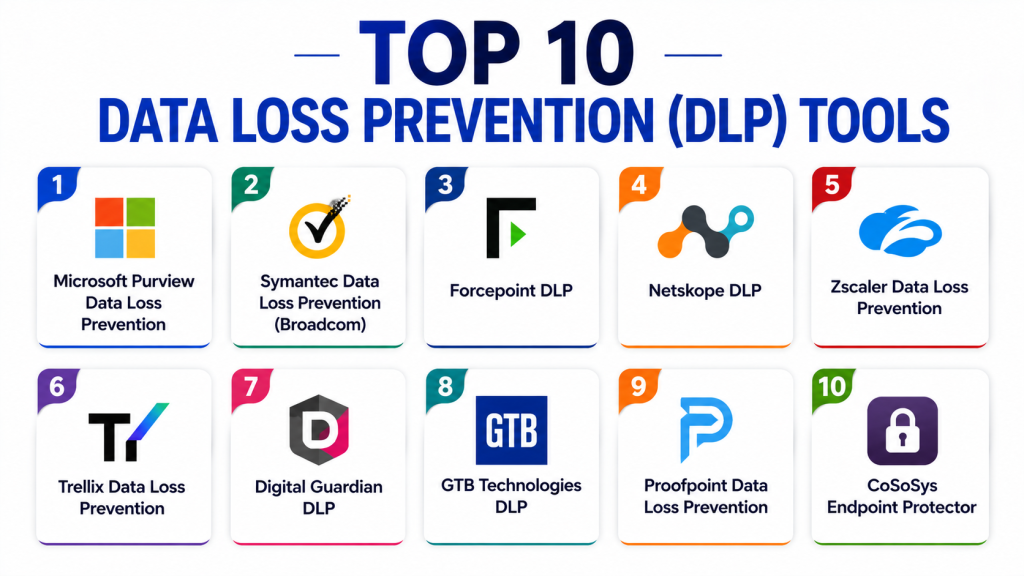
Top 10 Data Loss Prevention DLP Tools
1- Microsoft Purview Data Loss Prevention
Short description: Microsoft Purview DLP provides integrated data protection across Microsoft 365, endpoints, and cloud environments, making it a strong enterprise-native DLP solution.
Key Features
- Sensitive data classification
- Email and document protection
- Endpoint DLP enforcement
- Cloud app monitoring
- Policy-based controls
- Integration with Microsoft 365
- Compliance reporting
Pros
- Deep Microsoft ecosystem integration
- Strong compliance capabilities
- Unified data governance
Cons
- Best suited for Microsoft-centric environments
- Complex configuration for advanced policies
- Licensing complexity
Platforms / Deployment
Cloud / Hybrid
Security & Compliance
SSO, MFA, RBAC, audit logs, encryption support
Integrations & Ecosystem
Integrated deeply with Microsoft security ecosystem:
- Microsoft 365
- Microsoft Defender
- Azure Information Protection
- SIEM tools
- Third-party SaaS apps
Support & Community
Strong enterprise support with extensive documentation
2- Symantec Data Loss Prevention (Broadcom)
Short description: Symantec DLP is a mature enterprise-grade solution offering deep content inspection and policy enforcement across endpoints, network, and cloud.
Key Features
- Endpoint data protection
- Network monitoring
- Email DLP controls
- Cloud storage scanning
- Content inspection engine
- Policy management
- Incident response workflows
Pros
- Highly mature platform
- Strong enterprise scalability
- Deep inspection capabilities
Cons
- Complex deployment
- High operational overhead
- Requires skilled administration
Platforms / Deployment
Cloud / On-prem / Hybrid
Security & Compliance
RBAC, encryption, audit logging, SSO
Integrations & Ecosystem
- SIEM platforms
- Email security systems
- Endpoint security tools
- Cloud storage services
Support & Community
Enterprise-grade support with long-standing customer base
3- Forcepoint DLP
Short description: Forcepoint DLP provides behavior-driven data protection with strong focus on insider threat prevention.
Key Features
- Behavioral analytics
- Endpoint DLP
- Cloud app protection
- Email security
- Risk-based policy enforcement
- Data classification
- Insider threat detection
Pros
- Strong insider threat detection
- Good behavioral intelligence
- Flexible policy engine
Cons
- Complex configuration
- Requires tuning for accuracy
- Enterprise-focused pricing
Platforms / Deployment
Cloud / Hybrid
Security & Compliance
SSO, MFA, RBAC
Integrations & Ecosystem
- SIEM tools
- CASB platforms
- Cloud storage
- Endpoint security systems
Support & Community
Strong enterprise support with global presence
4- Trellix Data Loss Prevention
Short description: Trellix DLP provides endpoint and network data protection with advanced threat intelligence integration.
Key Features
- Endpoint DLP controls
- Network monitoring
- Content inspection
- Policy enforcement
- Threat intelligence integration
- Compliance tracking
- Incident reporting
Pros
- Strong enterprise endpoint coverage
- Good threat intelligence integration
- Scalable architecture
Cons
- Complex interface
- Requires training
- Deployment overhead
Platforms / Deployment
Cloud / On-prem
Security & Compliance
RBAC, encryption, audit logs
Integrations & Ecosystem
- SIEM platforms
- Endpoint protection tools
- Cloud services
- Security orchestration tools
Support & Community
Strong enterprise support ecosystem
5- Netskope DLP
Short description: Netskope DLP focuses on cloud-native data protection across SaaS, IaaS, and web traffic.
Key Features
- Cloud DLP scanning
- SaaS app monitoring
- Real-time data protection
- CASB integration
- Web traffic inspection
- Policy automation
- Data classification
Pros
- Strong cloud-native focus
- Excellent SaaS visibility
- Real-time enforcement
Cons
- Less focused on legacy on-prem systems
- Enterprise pricing
- Requires cloud maturity
Platforms / Deployment
Cloud
Security & Compliance
SSO, MFA, RBAC, encryption
Integrations & Ecosystem
- Microsoft 365
- Google Workspace
- AWS
- Azure
- SIEM tools
Support & Community
Strong cloud security support ecosystem
6- Zscaler Data Loss Prevention
Short description: Zscaler DLP integrates with its zero trust exchange platform to secure data across internet traffic and cloud apps.
Key Features
- Inline data inspection
- Cloud app protection
- Zero trust enforcement
- Email and web DLP
- Policy-based controls
- SSL inspection
- Real-time monitoring
Pros
- Strong zero trust architecture
- Excellent scalability
- Cloud-first design
Cons
- Complex deployment for legacy systems
- Requires Zscaler ecosystem adoption
- Premium pricing
Platforms / Deployment
Cloud
Security & Compliance
SSO, MFA, RBAC, encryption
Integrations & Ecosystem
- Cloud SaaS platforms
- SIEM systems
- Endpoint tools
- Identity providers
Support & Community
Strong enterprise support network
7- Digital Guardian DLP
Short description: Digital Guardian offers endpoint-focused DLP with strong data classification and protection capabilities.
Key Features
- Endpoint data monitoring
- File tracking
- Content classification
- USB and device control
- Application control
- Policy enforcement
- Incident response
Pros
- Strong endpoint protection
- Granular control features
- Good classification engine
Cons
- Less cloud-native focus
- Complex configuration
- Requires tuning
Platforms / Deployment
Cloud / On-prem
Security & Compliance
RBAC, encryption, audit logging
Integrations & Ecosystem
- SIEM tools
- Endpoint security platforms
- CASB solutions
Support & Community
Strong enterprise-level support
8- GTB Technologies DLP
Short description: GTB Technologies provides network and endpoint DLP with strong content inspection capabilities.
Key Features
- Network data monitoring
- Endpoint protection
- Content inspection
- Policy enforcement
- Data classification
- Compliance reporting
- Incident tracking
Pros
- Strong network DLP
- Flexible deployment
- Good detection accuracy
Cons
- Smaller ecosystem
- Limited cloud-native features
- Requires expertise
Platforms / Deployment
Cloud / On-prem
Security & Compliance
SSO, RBAC, encryption
Integrations & Ecosystem
- SIEM systems
- Email security tools
- Endpoint security solutions
Support & Community
Moderate enterprise support
9- Proofpoint Data Loss Prevention
Short description: Proofpoint DLP focuses on email security and insider threat protection with strong content filtering.
Key Features
- Email DLP protection
- Content inspection
- Insider threat detection
- Cloud app monitoring
- Policy enforcement
- Incident reporting
- Data classification
Pros
- Excellent email security
- Strong threat intelligence
- Easy integration with email systems
Cons
- Less endpoint depth
- Cloud-heavy focus
- Premium pricing
Platforms / Deployment
Cloud
Security & Compliance
SSO, MFA, RBAC
Integrations & Ecosystem
- Microsoft 365
- Google Workspace
- SIEM tools
- Email gateways
Support & Community
Strong enterprise support ecosystem
10- CoSoSys Endpoint Protector
Short description: Endpoint Protector provides cross-platform endpoint DLP with strong device control and data protection features.
Key Features
- Endpoint monitoring
- USB/device control
- File tracking
- Content inspection
- Policy enforcement
- Data classification
- Cross-platform support
Pros
- Easy deployment
- Strong endpoint control
- Good cross-platform support
Cons
- Limited enterprise analytics
- Smaller ecosystem
- Less advanced AI features
Platforms / Deployment
Cloud / On-prem
Security & Compliance
SSO, RBAC, encryption
Integrations & Ecosystem
- SIEM platforms
- Endpoint tools
- Cloud storage services
Support & Community
Good SMB and mid-market support
Comparison Table
| Tool | Best For | Platform | Deployment | Standout Feature | Rating |
|---|---|---|---|---|---|
| Microsoft Purview | Enterprise Microsoft environments | Web | Cloud | Native M365 integration | N/A |
| Symantec DLP | Large enterprises | Web | Hybrid | Deep content inspection | N/A |
| Forcepoint DLP | Insider threat prevention | Web | Hybrid | Behavioral analytics | N/A |
| Trellix DLP | Endpoint protection | Web | Hybrid | Threat intelligence | N/A |
| Netskope | Cloud-first security | Web | Cloud | SaaS DLP | N/A |
| Zscaler | Zero trust environments | Web | Cloud | Inline inspection | N/A |
| Digital Guardian | Endpoint security | Web | Hybrid | File tracking | N/A |
| GTB Technologies | Network DLP | Web | Hybrid | Network inspection | N/A |
| Proofpoint | Email security | Web | Cloud | Email DLP strength | N/A |
| Endpoint Protector | SMB/mid-market | Web | Hybrid | Device control | N/A |
Evaluation & Scoring
| Tool | Core | Ease | Integrations | Security | Performance | Support | Value | Total |
|---|---|---|---|---|---|---|---|---|
| Microsoft Purview | 9.5 | 8.5 | 9 | 9 | 9 | 9 | 8 | 8.8 |
| Symantec DLP | 9 | 7.5 | 8.5 | 9 | 8.5 | 9 | 7 | 8.3 |
| Forcepoint | 8.8 | 8 | 8.5 | 8.5 | 8 | 8 | 7.5 | 8.2 |
| Netskope | 9 | 8.5 | 9 | 9 | 9 | 8.5 | 8 | 8.7 |
| Zscaler | 9 | 8 | 9 | 9 | 9 | 8.5 | 7.5 | 8.6 |
| Proofpoint | 8.8 | 8.5 | 8.5 | 9 | 8.5 | 9 | 8 | 8.6 |
| Digital Guardian | 8.5 | 7.5 | 8 | 8.5 | 8 | 8 | 7.5 | 8.0 |
| Trellix | 8.5 | 7.5 | 8 | 8.5 | 8 | 8 | 7.5 | 8.0 |
| GTB | 8 | 7.5 | 7.5 | 8 | 8 | 7.5 | 7.5 | 7.8 |
| Endpoint Protector | 8 | 8.5 | 7.5 | 8 | 8 | 8 | 8 | 8.0 |
Frequently Asked Questions FAQs
1. What is Data Loss Prevention DLP?
DLP is a security approach that prevents sensitive data from being leaked, lost, or accessed by unauthorized users.
It monitors data across endpoints, cloud, email, and networks.
It ensures confidential information stays protected.
2. Why is DLP important?
DLP is important because modern data is constantly moving across cloud apps and devices.
Without protection, sensitive data can be exposed or stolen easily.
DLP reduces risk of data breaches and compliance violations.
3. What types of data does DLP protect?
DLP protects personal data, financial records, customer information, and intellectual property.
It also secures emails, documents, and cloud-stored files.
Any sensitive or regulated data can be monitored by DLP systems.
4. How does DLP work?
DLP works by scanning and classifying data based on rules and policies.
It detects sensitive content and blocks or alerts on risky actions.
It can also enforce automatic security controls.
5. Where is DLP used?
DLP is used across endpoints, cloud services, email systems, and networks.
It protects data in motion, at rest, and in use.
It is widely used in enterprise IT environments.
6. Is DLP only for large companies?
No, DLP is used by both large enterprises and mid-sized organizations.
However, large companies benefit more due to higher data volume.
SMBs use lightweight DLP solutions based on need.
7. What are common DLP challenges?
Common challenges include false positives, complex policies, and performance impact.
Managing large-scale data rules can also be difficult.
Continuous tuning is often required for accuracy.
8. Does DLP support cloud environments?
Yes, modern DLP tools support SaaS, cloud storage, and cloud applications.
They integrate with platforms like Microsoft 365 and Google Workspace.
Cloud DLP is now a standard requirement.
9. Can DLP prevent insider threats?
Yes, DLP helps detect and prevent insider threats by monitoring user behavior.
It can block unauthorized file transfers or suspicious activity.
This improves internal data security.
10. What should buyers look for in a DLP tool?
Buyers should evaluate coverage across cloud, endpoints, and networks.
Policy customization, integration, and scalability are also important.
Strong compliance and reporting features are essential for enterprises.
Conclusion
Data Loss Prevention tools are essential in modern cybersecurity because data now flows across cloud apps, endpoints, SaaS platforms, and remote devices. The rise of hybrid work and cloud adoption has made it critical for organizations to continuously monitor sensitive data movement and enforce strict governance policies. Enterprise leaders like Microsoft Purview, Netskope, and Symantec dominate large-scale environments, while tools like Endpoint Protector and Digital Guardian provide strong endpoint-focused protection. Ultimately, the right DLP solution depends on your cloud maturity, compliance requirements, and security architecture. Organizations should shortlist multiple solutions, run pilot testing, and validate integration with existing IAM, SIEM, and cloud ecosystems before final deployment.

Find Trusted Cardiac Hospitals
Compare heart hospitals by city and services — all in one place.
Explore Hospitals
This article gives a clear overview of how DLP tools help organizations protect sensitive data, prevent accidental leaks, and maintain better control over information security.