Introduction
MLOps Platforms help organizations build, deploy, monitor, govern, and scale machine learning models efficiently across development and production environments. In simple terms, MLOps combines machine learning, DevOps, data engineering, and platform operations into one operational workflow that reduces deployment friction and improves model reliability. As AI adoption accelerates across industries, MLOps has become a critical requirement rather than an optional engineering layer. Organizations are now expected to manage hundreds or even thousands of models while ensuring governance, reproducibility, observability, compliance, and cost control. Modern MLOps platforms simplify this process by automating pipelines, model versioning, deployment, monitoring, retraining, and collaboration.
Common Real-world use cases include:
- Fraud detection systems
- Predictive maintenance
- Recommendation engines
- AI copilots and generative AI applications
- Healthcare diagnostics and forecasting
Key Evaluation criteria for buyers include:
- Model deployment flexibility
- Pipeline orchestration
- Monitoring and observability
- Security and governance
- Multi-cloud support
- Integration ecosystem
- Scalability
- Ease of collaboration
- Experiment tracking
- Cost efficiency
Best for: AI engineering teams, ML engineers, data scientists, platform engineers, enterprises scaling AI initiatives, and regulated industries deploying production-grade machine learning.
Not ideal for: Small teams running only occasional experiments, organizations without dedicated ML workflows, or businesses looking for lightweight no-code analytics tools instead of full machine learning operations platforms.
Key Trends in MLOps Platforms
- Generative AI operations and LLM lifecycle management are becoming standard platform capabilities.
- AI governance and model explainability features are increasingly important due to regulatory pressure.
- Unified data, model, and feature store ecosystems are replacing fragmented ML tooling.
- Multi-cloud and hybrid AI deployments are becoming common for enterprise resilience.
- Automated retraining and drift detection are reducing manual operational overhead.
- GPU orchestration and cost optimization are becoming major differentiators.
- Real-time inference monitoring is evolving into full AI observability platforms.
- Platform engineering teams are consolidating ML workflows into internal developer platforms.
- Open-source interoperability is becoming a buying priority.
- Security-first AI pipelines with RBAC, encryption, and audit trails are expected in enterprise deployments.
How We Selected These Tools
The following MLOps platforms were selected based on a combination of technical maturity, enterprise adoption, ecosystem strength, developer mindshare, and operational capabilities.
Selection criteria included:
- Broad market adoption across industries
- Production-grade ML deployment capabilities
- Reliability and scalability signals
- Security and governance capabilities
- Experiment tracking and model registry maturity
- Integration ecosystem and extensibility
- Multi-cloud and Kubernetes support
- AI observability and monitoring features
- Community adoption and documentation quality
- Suitability across SMB, mid-market, and enterprise environments
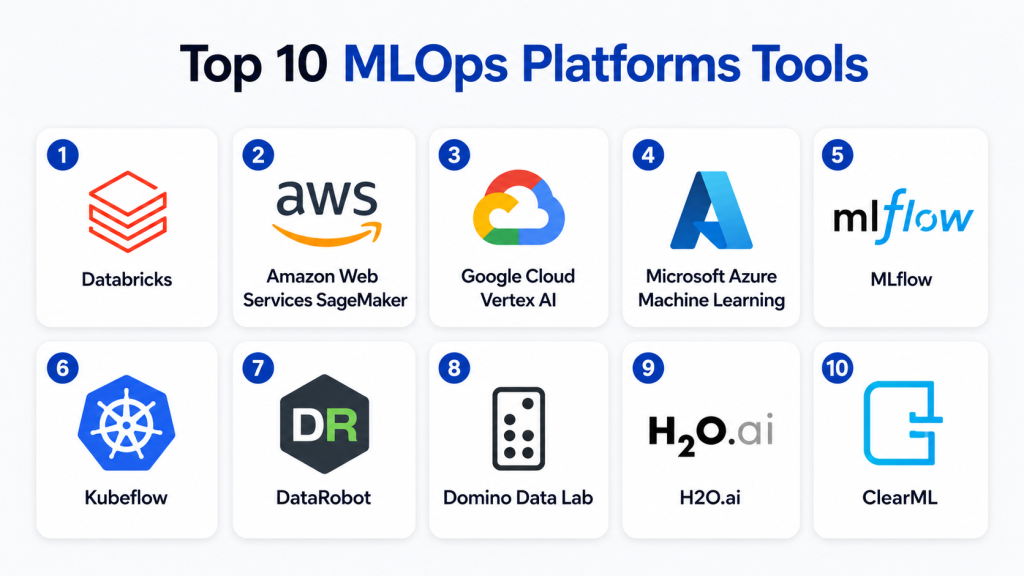
Top 10 MLOps Platforms Tools
1- Databricks ML
Short description: Databricks ML combines machine learning, data engineering, and analytics into a unified lakehouse platform. It is widely used by enterprises building large-scale AI and ML workflows.
Key Features
- Integrated MLflow support
- Collaborative notebooks
- Feature store management
- Automated ML workflows
- GPU-enabled model training
- Model serving and monitoring
- Lakehouse architecture integration
Pros
- Strong unified analytics ecosystem
- Excellent scalability for enterprise AI
- Deep integration with Spark workloads
Cons
- Can become expensive at scale
- Learning curve for smaller teams
- Advanced governance setup may require expertise
Platforms / Deployment
- Cloud / Hybrid
Security & Compliance
Supports RBAC, encryption, audit logging, SSO/SAML, MFA, and compliance frameworks including SOC 2 and GDPR.
Integrations & Ecosystem
Databricks integrates with major cloud providers, orchestration tools, BI platforms, and open-source ML ecosystems.
- MLflow
- Apache Spark
- Kubernetes
- AWS
- Azure
- Google Cloud
Support & Community
Strong enterprise support ecosystem with extensive documentation, certifications, and a large developer community.
2- AWS SageMaker
Short description: AWS SageMaker is a cloud-native MLOps platform designed for building, training, deploying, and monitoring machine learning models at enterprise scale.
Key Features
- Managed model training
- Automated pipelines
- Real-time inference
- Built-in monitoring
- Feature store support
- Generative AI integrations
- Distributed training
Pros
- Deep AWS ecosystem integration
- Strong scalability and automation
- Mature enterprise-grade infrastructure
Cons
- AWS-centric architecture
- Complex pricing structure
- Steeper onboarding for beginners
Platforms / Deployment
- Cloud
Security & Compliance
Supports IAM, encryption, audit logs, SSO, MFA, SOC 2, ISO 27001, HIPAA, and GDPR-related controls.
Integrations & Ecosystem
SageMaker integrates tightly with AWS services and supports common ML frameworks.
- Amazon S3
- Lambda
- EKS
- TensorFlow
- PyTorch
- Hugging Face
Support & Community
Strong enterprise support backed by AWS documentation, training programs, and extensive community adoption.
3- Google Vertex AI
Short description: Vertex AI is Google Cloud’s unified AI platform for building, deploying, monitoring, and scaling machine learning and generative AI applications.
Key Features
- AutoML support
- Generative AI integration
- Feature store
- Experiment tracking
- Managed pipelines
- Real-time prediction
- AI model monitoring
Pros
- Strong AI research ecosystem
- Excellent generative AI capabilities
- Highly scalable cloud infrastructure
Cons
- Primarily optimized for Google Cloud
- Advanced pricing complexity
- Governance setup may require expertise
Platforms / Deployment
- Cloud
Security & Compliance
Supports IAM, encryption, audit logging, SSO/SAML, and compliance programs including SOC 2 and ISO 27001.
Integrations & Ecosystem
Vertex AI integrates well with Google Cloud services and open-source ML tooling.
- BigQuery
- Kubernetes
- TensorFlow
- Kubeflow
- Gemini models
- Dataflow
Support & Community
Comprehensive enterprise support with growing AI developer adoption and strong documentation.
4- Azure Machine Learning
Short description: Azure Machine Learning provides a full MLOps lifecycle platform with strong enterprise governance and Microsoft ecosystem integration.
Key Features
- Automated ML
- Model registry
- Responsible AI tooling
- Pipeline orchestration
- CI/CD support
- Feature engineering
- Endpoint management
Pros
- Strong enterprise governance
- Excellent Microsoft ecosystem integration
- Mature hybrid-cloud capabilities
Cons
- Complex interface for beginners
- Some advanced features require Azure expertise
- Licensing costs may increase rapidly
Platforms / Deployment
- Cloud / Hybrid
Security & Compliance
Supports RBAC, encryption, audit trails, SSO, MFA, HIPAA-related controls, ISO 27001, and SOC 2.
Integrations & Ecosystem
Azure ML integrates tightly with Microsoft and open-source ecosystems.
- GitHub
- Kubernetes
- Power BI
- Azure DevOps
- MLflow
- Synapse
Support & Community
Large enterprise support ecosystem with strong documentation and Microsoft partner network.
5- MLflow
Short description: MLflow is one of the most widely adopted open-source MLOps frameworks for experiment tracking, model packaging, and lifecycle management.
Key Features
- Experiment tracking
- Model registry
- Pipeline management
- Framework interoperability
- Open-source extensibility
- Reproducibility support
- Deployment APIs
Pros
- Strong open-source adoption
- Framework agnostic
- Flexible deployment options
Cons
- Requires operational setup
- Enterprise governance may need additional tooling
- UI simplicity may limit advanced analytics
Platforms / Deployment
- Cloud / Self-hosted / Hybrid
Security & Compliance
Varies depending on deployment configuration and hosting environment.
Integrations & Ecosystem
MLflow integrates with major ML frameworks and orchestration systems.
- TensorFlow
- PyTorch
- Databricks
- Kubernetes
- Docker
- Airflow
Support & Community
Very strong open-source community with broad ecosystem adoption and documentation.
6- Kubeflow
Short description: Kubeflow is an open-source Kubernetes-native MLOps platform focused on scalable ML workflows and pipeline orchestration.
Key Features
- Kubernetes-native pipelines
- Distributed training
- Notebook environments
- Hyperparameter tuning
- Multi-user support
- Workflow orchestration
- Portable deployments
Pros
- Excellent Kubernetes flexibility
- Strong scalability
- Open-source customization
Cons
- Complex operational management
- Requires Kubernetes expertise
- Setup can be resource intensive
Platforms / Deployment
- Self-hosted / Hybrid
Security & Compliance
Varies depending on deployment and Kubernetes security configuration.
Integrations & Ecosystem
Kubeflow integrates with cloud-native and open-source ML ecosystems.
- Kubernetes
- TensorFlow
- Katib
- Istio
- Argo Workflows
- MLflow
Support & Community
Large open-source community with strong engineering adoption but limited centralized support.
7- DataRobot
Short description: DataRobot provides enterprise AI automation and MLOps capabilities focused on accelerating model deployment and governance.
Key Features
- Automated machine learning
- Model monitoring
- AI governance
- Time-series forecasting
- Explainability tooling
- Deployment automation
- Generative AI workflows
Pros
- Strong automation capabilities
- Business-friendly workflows
- Mature governance features
Cons
- Premium enterprise pricing
- Less flexible than open-source stacks
- Advanced customization limitations
Platforms / Deployment
- Cloud / Hybrid
Security & Compliance
Supports RBAC, encryption, audit logs, SSO, and enterprise governance controls.
Integrations & Ecosystem
DataRobot integrates with enterprise data platforms and cloud ecosystems.
- Snowflake
- AWS
- Azure
- Google Cloud
- Tableau
- APIs
Support & Community
Strong enterprise onboarding and customer success support with growing AI operations community.
8- Domino Data Lab
Short description: Domino Data Lab focuses on enterprise-scale collaborative data science and governed MLOps workflows for regulated industries.
Key Features
- Collaborative workspaces
- Experiment management
- Governance controls
- Reproducibility support
- Infrastructure orchestration
- Model deployment
- Centralized AI operations
Pros
- Strong governance features
- Excellent collaboration support
- Good fit for regulated environments
Cons
- Enterprise-focused pricing
- Smaller ecosystem compared to hyperscalers
- Setup complexity for smaller teams
Platforms / Deployment
- Cloud / Hybrid
Security & Compliance
Supports RBAC, audit logging, SSO/SAML, encryption, and enterprise governance controls.
Integrations & Ecosystem
Domino integrates with enterprise AI, infrastructure, and data environments.
- Kubernetes
- Snowflake
- Databricks
- Git
- AWS
- Azure
Support & Community
Strong enterprise support and onboarding services with a specialized customer base.
9- H2O.ai
Short description: H2O.ai offers AI and MLOps capabilities with a strong focus on automated machine learning and explainable AI workflows.
Key Features
- AutoML
- Explainable AI
- Model monitoring
- Driverless AI
- Feature engineering
- Time-series support
- Enterprise AI governance
Pros
- Strong automation workflows
- Explainability capabilities
- Broad industry adoption
Cons
- Advanced features may require enterprise licensing
- UI preferences vary by user
- Some operational workflows require tuning
Platforms / Deployment
- Cloud / Hybrid / Self-hosted
Security & Compliance
Supports enterprise security controls including RBAC and encryption. Additional compliance varies by deployment.
Integrations & Ecosystem
H2O.ai integrates with enterprise and open-source AI stacks.
- Spark
- Kubernetes
- AWS
- Azure
- Python
- R
Support & Community
Large AI community with enterprise support offerings and strong educational resources.
10- ClearML
Short description: ClearML is a developer-focused open-source MLOps platform for experiment tracking, orchestration, model management, and automation.
Key Features
- Experiment tracking
- Pipeline orchestration
- Remote execution
- Model management
- Dataset versioning
- Automation workflows
- Open-source flexibility
Pros
- Strong developer experience
- Cost-effective open-source model
- Flexible orchestration capabilities
Cons
- Smaller enterprise ecosystem
- Advanced governance requires customization
- UI maturity still evolving
Platforms / Deployment
- Cloud / Self-hosted / Hybrid
Security & Compliance
Varies based on deployment architecture and hosting environment.
Integrations & Ecosystem
ClearML integrates with popular ML frameworks and infrastructure platforms.
- PyTorch
- TensorFlow
- Docker
- Kubernetes
- AWS
- GitHub
Support & Community
Growing open-source community with active documentation and developer adoption.
Comparison Table
| Tool Name | Best For | Platform(s) Supported | Deployment | Standout Feature | Public Rating |
|---|---|---|---|---|---|
| Databricks ML | Enterprise AI platforms | Web | Cloud / Hybrid | Unified lakehouse ML workflows | N/A |
| AWS SageMaker | AWS-centric enterprises | Web | Cloud | Managed ML lifecycle | N/A |
| Vertex AI | Generative AI workloads | Web | Cloud | Integrated generative AI tooling | N/A |
| Azure ML | Microsoft enterprises | Web | Cloud / Hybrid | Enterprise governance | N/A |
| MLflow | Open-source ML lifecycle | Web | Cloud / Hybrid / Self-hosted | Experiment tracking | N/A |
| Kubeflow | Kubernetes-native ML | Web | Self-hosted / Hybrid | Cloud-native orchestration | N/A |
| DataRobot | Automated enterprise AI | Web | Cloud / Hybrid | AI automation | N/A |
| Domino Data Lab | Regulated industries | Web | Cloud / Hybrid | Governance and collaboration | N/A |
| H2O.ai | Explainable AI workflows | Web | Cloud / Hybrid / Self-hosted | AutoML and explainability | N/A |
| ClearML | Developer-first MLOps | Web | Cloud / Hybrid / Self-hosted | Open-source orchestration | N/A |
Evaluation & Scoring of MLOps Platforms
| Tool | Core | Ease | Integrations | Security | Performance | Support | Value | Weighted Total |
|---|---|---|---|---|---|---|---|---|
| Databricks ML | 9.5 | 8.0 | 9.5 | 9.0 | 9.5 | 9.0 | 7.5 | 8.96 |
| AWS SageMaker | 9.5 | 7.5 | 9.0 | 9.5 | 9.5 | 9.0 | 7.0 | 8.81 |
| Vertex AI | 9.0 | 8.0 | 8.5 | 9.0 | 9.0 | 8.5 | 7.5 | 8.49 |
| Azure ML | 9.0 | 7.5 | 9.0 | 9.5 | 9.0 | 8.5 | 7.0 | 8.43 |
| MLflow | 8.5 | 8.5 | 9.0 | 7.0 | 8.0 | 8.5 | 9.0 | 8.43 |
| Kubeflow | 8.5 | 6.5 | 9.0 | 7.5 | 9.0 | 8.0 | 8.5 | 8.06 |
| DataRobot | 8.5 | 9.0 | 8.0 | 8.5 | 8.5 | 8.5 | 6.5 | 8.14 |
| Domino Data Lab | 8.5 | 7.5 | 8.0 | 9.0 | 8.5 | 8.5 | 6.5 | 7.99 |
| H2O.ai | 8.5 | 8.0 | 8.0 | 8.0 | 8.0 | 8.0 | 8.5 | 8.13 |
| ClearML | 8.0 | 8.0 | 8.0 | 7.0 | 8.0 | 7.5 | 9.0 | 7.98 |
These scores are comparative rather than absolute. Enterprise cloud-native platforms generally score higher in scalability and governance, while open-source platforms often perform better in flexibility and value. Buyers should prioritize criteria that align with their operational maturity, compliance requirements, infrastructure strategy, and internal engineering capabilities. A platform with the highest score may not necessarily be the best fit for every organization.
Which MLOps Platform Is Right for You?
Solo / Freelancer
Developers and independent AI practitioners often benefit from lightweight and cost-effective platforms.
Recommended:
- MLflow
- ClearML
- H2O.ai
These platforms provide flexibility, open-source extensibility, and manageable operational overhead.
SMB
Small and mid-sized businesses typically need manageable deployment complexity and faster onboarding.
Recommended:
- DataRobot
- Vertex AI
- H2O.ai
These platforms balance automation, usability, and operational scalability.
Mid-Market
Mid-market organizations often require stronger governance and integration capabilities while maintaining operational flexibility.
Recommended:
- Azure Machine Learning
- Databricks ML
- Domino Data Lab
These platforms offer strong governance and collaboration capabilities without the operational burden of fully custom stacks.
Enterprise
Large enterprises require governance, observability, scalability, security, and multi-team collaboration.
Recommended:
- Databricks ML
- AWS SageMaker
- Vertex AI
- Azure Machine Learning
These platforms provide mature enterprise AI infrastructure and operational tooling.
Budget vs Premium
Budget-conscious teams may prefer:
- MLflow
- Kubeflow
- ClearML
Premium enterprise-focused options include:
- Databricks ML
- DataRobot
- Domino Data Lab
Feature Depth vs Ease of Use
For maximum feature depth:
- Kubeflow
- Databricks ML
- SageMaker
For easier onboarding and usability:
- DataRobot
- Vertex AI
- H2O.ai
Integrations & Scalability
Organizations deeply invested in cloud ecosystems should align MLOps platforms with their infrastructure providers.
- AWS-centric organizations: SageMaker
- Microsoft-centric organizations: Azure ML
- Google Cloud organizations: Vertex AI
For infrastructure-neutral strategies:
- MLflow
- Kubeflow
- ClearML
Security & Compliance Needs
Highly regulated industries should prioritize:
- Domino Data Lab
- Azure ML
- Databricks ML
These platforms emphasize governance, auditability, RBAC, and enterprise-grade operational controls.
Frequently Asked Questions
1. What is an MLOps platform?
An MLOps platform helps organizations operationalize machine learning workflows. It manages model training, deployment, monitoring, governance, automation, and lifecycle management across production environments.
2. Why is MLOps important?
MLOps improves model reliability, deployment speed, reproducibility, collaboration, and governance. Without MLOps, production AI systems often become difficult to maintain and scale.
3. Are MLOps platforms only for large enterprises?
No. While enterprises benefit heavily from MLOps, smaller AI teams also use these platforms to automate experimentation, deployment, and monitoring workflows.
4. What is the difference between DevOps and MLOps?
DevOps focuses on software delivery automation, while MLOps specifically handles machine learning lifecycle challenges such as data drift, model retraining, feature management, and experiment tracking.
5. Can open-source tools handle enterprise MLOps workloads?
Yes. Platforms like Kubeflow, MLflow, and ClearML can support enterprise workloads when combined with strong infrastructure engineering and governance processes.
6. How do MLOps platforms help with AI governance?
MLOps platforms provide audit trails, version control, monitoring, explainability tooling, RBAC, and deployment approvals to improve accountability and compliance.
7. What deployment models are common in MLOps?
Most MLOps platforms support cloud, hybrid, and self-hosted deployments. Kubernetes-based deployments are especially common for scalable AI infrastructure.
8. What are common mistakes when adopting MLOps?
Common mistakes include poor monitoring, lack of governance, ignoring cost optimization, overengineering infrastructure, and choosing tools that do not align with team skill levels.
9. How long does MLOps implementation usually take?
Implementation timelines vary based on organizational maturity. Smaller deployments may take weeks, while enterprise-scale implementations can require several months.
10. Can MLOps platforms support generative AI and LLMs?
Yes. Modern MLOps platforms increasingly support LLM orchestration, prompt management, vector workflows, AI observability, and generative AI governance capabilities.
Conclusion
MLOps platforms have become essential infrastructure for organizations scaling AI initiatives in production environments. The right platform depends heavily on operational maturity, engineering expertise, cloud strategy, governance requirements, and workload complexity. Enterprises often prioritize scalability and governance through platforms like Databricks ML, SageMaker, Vertex AI, and Azure ML, while developer-focused and open-source teams may prefer MLflow, Kubeflow, or ClearML for flexibility and cost efficiency. Automated AI-focused platforms such as DataRobot and H2O.ai simplify adoption for teams prioritizing usability and faster time-to-value. Rather than searching for a single universal winner, organizations should shortlist two or three platforms, run pilot deployments, validate integration compatibility, assess governance capabilities, and evaluate long-term operational costs before committing to a broader AI infrastructure strategy.

Find Trusted Cardiac Hospitals
Compare heart hospitals by city and services — all in one place.
Explore Hospitals