Introduction
Robotics simulation tools help engineers, researchers, developers, and manufacturers design, test, validate, and optimize robotic systems in virtual environments before deploying them in the real world. These platforms simulate robot movement, sensors, physics, environments, AI models, and automation workflows, reducing development risks and hardware costs. In the modern robotics landscape, simulation has become essential because robotics systems are increasingly powered by AI, machine learning, autonomous navigation, computer vision, and digital twins. As robotics adoption grows across manufacturing, logistics, healthcare, agriculture, aerospace, and autonomous mobility, simulation environments are now a core part of robotics engineering workflows.
Common Real-world use cases include:
- Autonomous mobile robot testing
- Industrial robotic arm simulation
- Warehouse automation validation
- Drone and UAV environment modeling
- AI and reinforcement learning training
- Digital twin creation for smart factories
When Evaluating robotics simulation tools, buyers should consider:
- Physics engine accuracy
- Real-time performance
- AI and reinforcement learning support
- ROS and middleware compatibility
- Sensor simulation quality
- Scalability and cloud deployment
- Ease of environment creation
- Integration ecosystem
- Visualization quality
- Enterprise collaboration features
Best for: Robotics engineers, AI researchers, industrial automation teams, autonomous vehicle developers, universities, robotics startups, and enterprise R&D organizations.
Not ideal for: Small teams needing only lightweight CAD visualization or organizations with minimal robotics workflows that do not require advanced simulation or digital twin capabilities.
Key Trends in Robotics Simulation Tools
- AI-powered simulation environments are becoming standard for robotics model training and autonomous decision-making.
- Digital twins are increasingly integrated with industrial robotics and smart manufacturing systems.
- Cloud-native simulation platforms are enabling distributed robotics testing at scale.
- GPU acceleration and real-time ray tracing are improving simulation realism.
- Synthetic data generation is becoming critical for robotics vision systems.
- ROS 2 compatibility is now expected across modern robotics ecosystems.
- Multi-robot orchestration and swarm robotics testing are gaining traction.
- Reinforcement learning integration is expanding rapidly across simulation platforms.
- Simulation-to-reality transfer optimization is improving robotic deployment accuracy.
- Open-source robotics simulation ecosystems continue to grow alongside enterprise offerings.
How We Selected These Tools (Methodology)
The tools in this list were selected using a combination of practical market and technical evaluation criteria:
- Strong adoption within robotics engineering and research communities
- Support for industrial and academic robotics workflows
- Physics simulation realism and reliability
- Compatibility with ROS, ROS 2, and robotics middleware
- AI, ML, and reinforcement learning support
- Scalability across enterprise and developer environments
- Ecosystem maturity and third-party integrations
- Active developer communities and documentation quality
- Availability of cloud, hybrid, or local deployment models
- Long-term relevance for robotics innovation beyond 2026
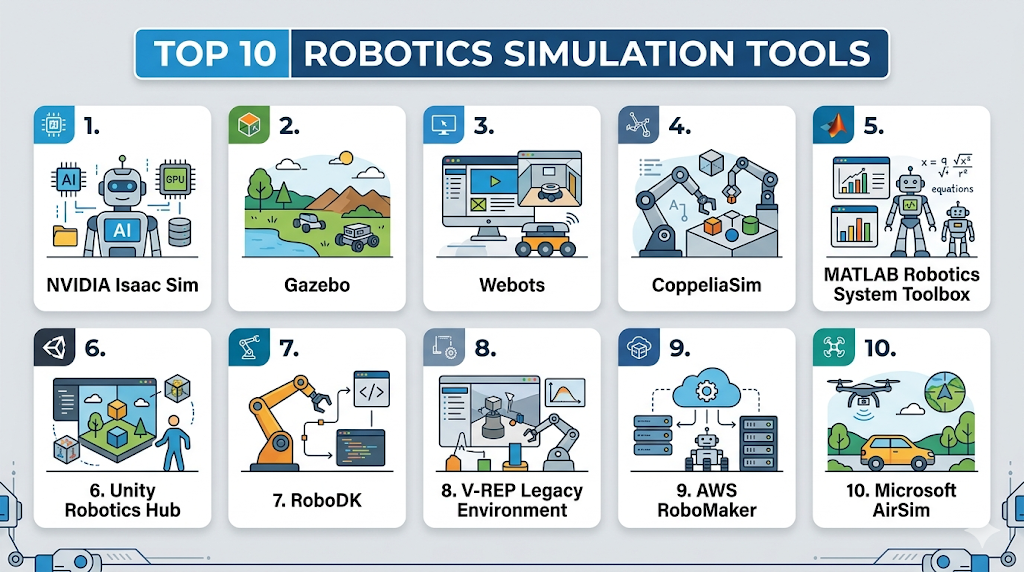
Top 10 Robotics Simulation Tools
1- NVIDIA Isaac Sim
Short description: NVIDIA Isaac Sim is a high-performance robotics simulation platform built on Omniverse technology. It is widely used for AI robotics training, synthetic data generation, autonomous systems development, and digital twin workflows.
Key Features
- GPU-accelerated robotics simulation
- Synthetic data generation
- ROS and ROS 2 integration
- Real-time ray tracing
- Reinforcement learning support
- Omniverse collaboration workflows
- Advanced sensor simulation
Pros
- Exceptional visual realism
- Strong AI and autonomous robotics capabilities
- Excellent for synthetic training datasets
Cons
- High GPU requirements
- Learning curve for new users
- Enterprise infrastructure may be needed for scaling
Platforms / Deployment
- Windows / Linux
- Cloud / Self-hosted / Hybrid
Security & Compliance
- RBAC
- Encryption support
- SSO/SAML support in enterprise environments
- Not publicly stated for some certifications
Integrations & Ecosystem
NVIDIA Isaac Sim integrates deeply with AI, robotics, and digital twin ecosystems. It supports enterprise-scale robotics development and advanced simulation pipelines.
- ROS / ROS 2
- Omniverse ecosystem
- TensorFlow
- PyTorch
- Isaac SDK
- OpenUSD
Support & Community
Strong enterprise documentation, active developer community, and extensive NVIDIA ecosystem support.
2- Gazebo
Short description: Gazebo is one of the most widely adopted open-source robotics simulation environments. It is heavily used in research, education, and ROS-based robotics development.
Key Features
- Open-source robotics simulation
- Multiple physics engines
- ROS integration
- Sensor simulation
- Large robotics plugin ecosystem
- Multi-robot simulation
- Environment customization
Pros
- Strong ROS compatibility
- Large global community
- Cost-effective open-source platform
Cons
- User interface can feel dated
- Advanced rendering may require tuning
- Enterprise support varies
Platforms / Deployment
- Linux / macOS / Windows
- Self-hosted
Security & Compliance
- Varies / N/A
Integrations & Ecosystem
Gazebo is deeply connected to robotics research and ROS development environments.
- ROS
- ROS 2
- Open Robotics tools
- Custom plugins
- Python APIs
Support & Community
Excellent community support and extensive educational resources.
3- Webots
Short description: Webots is a robotics simulator focused on mobile robots, educational robotics, and autonomous systems. It offers accessibility and realistic simulation environments.
Key Features
- Cross-platform robotics simulation
- Multiple robot libraries
- Physics simulation
- Autonomous navigation testing
- ROS integration
- Supervisor APIs
- Sensor modeling
Pros
- Easy to learn
- Strong educational value
- Good balance between realism and usability
Cons
- Limited enterprise-scale tooling
- Smaller ecosystem than Gazebo
- Advanced AI workflows may require customization
Platforms / Deployment
- Windows / macOS / Linux
- Self-hosted
Security & Compliance
- Not publicly stated
Integrations & Ecosystem
Webots supports educational and research-oriented robotics development.
- ROS / ROS 2
- Python
- MATLAB
- C++
- Java APIs
Support & Community
Good academic community and documentation quality.
4- CoppeliaSim
Short description: CoppeliaSim is a flexible robot simulation platform designed for industrial automation, academic robotics, and AI experimentation.
Key Features
- Distributed simulation architecture
- Multiple physics engines
- Remote APIs
- Custom scripting
- Multi-robot coordination
- Sensor simulation
- Path planning tools
Pros
- Highly customizable
- Flexible scripting environment
- Strong robotics experimentation support
Cons
- Interface complexity
- Some workflows require scripting expertise
- Smaller enterprise footprint
Platforms / Deployment
- Windows / macOS / Linux
- Self-hosted
Security & Compliance
- Not publicly stated
Integrations & Ecosystem
CoppeliaSim supports broad robotics integration capabilities.
- ROS
- Python APIs
- MATLAB
- Lua scripting
- Remote APIs
Support & Community
Strong research community and good technical documentation.
5- MATLAB Robotics System Toolbox
Short description: MATLAB Robotics System Toolbox enables robotics algorithm development, control system testing, and simulation for industrial and research applications.
Key Features
- Robotics algorithm design
- ROS connectivity
- Autonomous navigation support
- Kinematics and dynamics modeling
- Path planning
- Sensor fusion
- Simulink integration
Pros
- Excellent engineering workflows
- Strong analytics and visualization
- Enterprise engineering adoption
Cons
- Licensing costs
- Less game-engine realism
- Heavy ecosystem dependency
Platforms / Deployment
- Windows / macOS / Linux
- Cloud / Self-hosted
Security & Compliance
- Enterprise authentication support
- Encryption support
- Not publicly stated for certifications
Integrations & Ecosystem
MATLAB integrates deeply with engineering and simulation ecosystems.
- Simulink
- ROS
- AI toolkits
- Embedded systems
- CAD tools
Support & Community
Excellent enterprise documentation and professional support.
6- Unity Robotics Hub
Short description: Unity Robotics Hub brings robotics simulation capabilities into the Unity ecosystem, supporting AI training, digital twins, and autonomous systems development.
Key Features
- High-quality 3D rendering
- Robotics SDKs
- ROS-TCP integration
- AI training environments
- Digital twin visualization
- Cross-platform simulation
- Real-time environment design
Pros
- Excellent visualization quality
- Strong developer ecosystem
- Good for digital twins
Cons
- Requires game-engine expertise
- Robotics tooling less mature than dedicated simulators
- Performance optimization can be complex
Platforms / Deployment
- Windows / macOS / Linux
- Cloud / Self-hosted / Hybrid
Security & Compliance
- RBAC
- MFA support
- Enterprise security features vary
Integrations & Ecosystem
Unity supports broad extensibility for robotics developers.
- ROS
- AI frameworks
- Cloud services
- Custom SDKs
- Digital twin tools
Support & Community
Massive global developer community and extensive tutorials.
7- RoboDK
Short description: RoboDK focuses on industrial robot programming and offline simulation for manufacturing automation environments.
Key Features
- Industrial robot simulation
- Offline programming
- CAD integration
- Robot calibration
- Path optimization
- Multi-brand robot support
- Manufacturing automation workflows
Pros
- Strong industrial automation focus
- Simplifies robot programming
- Broad robot compatibility
Cons
- Less suitable for AI robotics
- Limited autonomous simulation features
- Advanced workflows may require paid modules
Platforms / Deployment
- Windows / macOS / Linux
- Self-hosted
Security & Compliance
- Not publicly stated
Integrations & Ecosystem
RoboDK integrates with industrial robotics and CAD ecosystems.
- ABB
- FANUC
- KUKA
- UR robots
- SolidWorks
- Fusion 360
Support & Community
Strong industrial user community and practical documentation.
8- V-REP Legacy Environment
Short description: V-REP, the predecessor to CoppeliaSim, remains used in some robotics research and academic projects.
Key Features
- Robot modeling
- Physics simulation
- Sensor support
- Scriptable automation
- Multi-robot simulation
- Remote APIs
- Path planning
Pros
- Flexible research workflows
- Strong scripting support
- Lightweight deployment
Cons
- Legacy platform status
- Smaller active ecosystem
- Modern support limitations
Platforms / Deployment
- Windows / Linux / macOS
- Self-hosted
Security & Compliance
- Varies / N/A
Integrations & Ecosystem
Supports research-oriented robotics experimentation.
- ROS
- Python
- Lua
- MATLAB
Support & Community
Limited compared to newer platforms but still supported in academic circles.
9- AWS RoboMaker
Short description: AWS RoboMaker is a cloud robotics development environment designed for scalable robotics simulation and deployment.
Key Features
- Cloud robotics simulation
- ROS-based development
- Scalable simulation jobs
- CI/CD integration
- Fleet management integration
- Monitoring tools
- Cloud deployment automation
Pros
- Strong cloud scalability
- Enterprise AWS integration
- Simplifies robotics DevOps
Cons
- AWS ecosystem dependency
- Costs can grow quickly
- Less graphical realism than GPU-focused platforms
Platforms / Deployment
- Cloud
- Hybrid
Security & Compliance
- IAM integration
- Encryption
- Audit logging
- Enterprise AWS security controls
Integrations & Ecosystem
AWS RoboMaker integrates naturally with AWS cloud infrastructure.
- ROS
- AWS IoT
- Lambda
- CloudWatch
- S3
- SageMaker
Support & Community
Strong enterprise cloud support and growing robotics ecosystem.
10- Microsoft AirSim
Short description: Microsoft AirSim is an open-source simulator focused on drones, autonomous vehicles, and AI research workflows.
Key Features
- UAV simulation
- Autonomous vehicle simulation
- Unreal Engine integration
- AI training support
- Sensor simulation
- Reinforcement learning environments
- Realistic physics modeling
Pros
- Strong autonomous vehicle focus
- High-quality simulation realism
- Good AI experimentation support
Cons
- Primarily focused on drones and mobility
- Requires Unreal Engine familiarity
- Enterprise tooling limited
Platforms / Deployment
- Windows / Linux
- Self-hosted
Security & Compliance
- Not publicly stated
Integrations & Ecosystem
AirSim supports autonomous mobility and AI research integrations.
- Unreal Engine
- Python APIs
- ROS
- TensorFlow
- Reinforcement learning frameworks
Support & Community
Strong research adoption and active open-source contributors.
Comparison Table
| Tool Name | Best For | Platform(s) Supported | Deployment | Standout Feature | Public Rating |
|---|---|---|---|---|---|
| NVIDIA Isaac Sim | AI robotics | Windows, Linux | Hybrid | GPU-accelerated simulation | N/A |
| Gazebo | ROS robotics | Windows, Linux, macOS | Self-hosted | Open-source ROS ecosystem | N/A |
| Webots | Education & research | Windows, Linux, macOS | Self-hosted | Ease of use | N/A |
| CoppeliaSim | Robotics experimentation | Windows, Linux, macOS | Self-hosted | Flexible scripting | N/A |
| MATLAB Robotics Toolbox | Engineering workflows | Windows, Linux, macOS | Hybrid | Simulink integration | N/A |
| Unity Robotics Hub | Digital twins | Windows, Linux, macOS | Hybrid | Advanced visualization | N/A |
| RoboDK | Industrial automation | Windows, Linux, macOS | Self-hosted | Offline robot programming | N/A |
| V-REP | Academic robotics | Windows, Linux, macOS | Self-hosted | Lightweight experimentation | N/A |
| AWS RoboMaker | Cloud robotics | Cloud | Hybrid | Scalable cloud simulation | N/A |
| Microsoft AirSim | Autonomous mobility | Windows, Linux | Self-hosted | UAV simulation realism | N/A |
Evaluation & Scoring of Robotics Simulation Tools
| Tool Name | Core | Ease | Integrations | Security | Performance | Support | Value | Weighted Total |
|---|---|---|---|---|---|---|---|---|
| NVIDIA Isaac Sim | 9.6 | 7.8 | 9.4 | 8.5 | 9.7 | 8.8 | 7.5 | 8.9 |
| Gazebo | 8.9 | 7.2 | 9.3 | 6.5 | 8.1 | 9.1 | 9.4 | 8.4 |
| Webots | 7.9 | 8.8 | 7.8 | 6.2 | 7.5 | 7.9 | 8.8 | 7.9 |
| CoppeliaSim | 8.5 | 7.1 | 8.4 | 6.3 | 8.3 | 8.0 | 8.5 | 8.0 |
| MATLAB Robotics Toolbox | 9.0 | 8.0 | 9.1 | 8.0 | 8.7 | 9.0 | 6.9 | 8.4 |
| Unity Robotics Hub | 8.6 | 7.4 | 8.8 | 7.5 | 8.9 | 8.8 | 7.6 | 8.3 |
| RoboDK | 8.4 | 8.5 | 8.1 | 6.8 | 8.2 | 8.3 | 8.7 | 8.2 |
| V-REP | 7.5 | 6.9 | 7.2 | 5.8 | 7.4 | 6.9 | 8.2 | 7.2 |
| AWS RoboMaker | 8.7 | 7.5 | 9.2 | 9.0 | 8.8 | 8.7 | 7.1 | 8.5 |
| Microsoft AirSim | 8.3 | 7.0 | 7.8 | 6.2 | 8.7 | 7.6 | 8.3 | 7.9 |
These scores are comparative rather than absolute. Higher scores indicate stronger overall balance across enterprise readiness, usability, integrations, and scalability. Open-source tools often score highly on value, while enterprise-grade platforms may lead in performance and AI capabilities. Buyers should prioritize the criteria most aligned with their robotics goals.
Which Robotics Simulation Tool Is Right for You?
Solo / Freelancer
Individual robotics developers and researchers often benefit most from Gazebo, Webots, or CoppeliaSim because of their accessibility, strong community support, and low entry cost.
SMB
Small and mid-sized robotics companies may prefer RoboDK, Unity Robotics Hub, or MATLAB Robotics Toolbox for faster prototyping and industrial integration capabilities.
Mid-Market
Mid-market organizations needing AI simulation, robotics orchestration, and scalable testing may benefit from NVIDIA Isaac Sim or AWS RoboMaker.
Enterprise
Large enterprises with autonomous robotics initiatives, digital twins, or industrial automation pipelines often choose NVIDIA Isaac Sim, MATLAB Robotics Toolbox, or AWS RoboMaker for scalability and enterprise integrations.
Budget vs Premium
Open-source platforms like Gazebo and Webots are highly cost-effective. Premium enterprise tools provide better AI acceleration, visualization, support, and scalability but may require larger infrastructure investments.
Feature Depth vs Ease of Use
Gazebo and CoppeliaSim offer deep customization, while Webots and RoboDK emphasize usability and accessibility. NVIDIA Isaac Sim provides advanced features but requires more technical expertise.
Integrations & Scalability
Organizations already invested in AWS, NVIDIA, ROS, or Unity ecosystems should prioritize tools aligned with their infrastructure strategy.
Security & Compliance Needs
Enterprise robotics projects involving sensitive operational environments should evaluate identity management, RBAC, encryption, and cloud governance capabilities carefully before adoption.
Frequently Asked Questions FAQs
1- What are Robotics Simulation Tools?
Robotics simulation tools are software platforms used to design, test, and validate robots in virtual environments before real-world deployment. They help developers simulate robot movement, sensors, AI behavior, and automation workflows safely and efficiently. These tools reduce hardware costs, speed up testing cycles, and improve deployment accuracy. They are widely used in manufacturing, research, logistics, healthcare, and autonomous systems development.
2- Why are robotics simulation platforms important in modern robotics?
Modern robotics systems rely heavily on AI, computer vision, and automation, making simulation essential for safe and scalable testing. Simulation platforms allow teams to identify issues before deploying expensive robotic hardware. They also help train machine learning models using synthetic data and virtual environments. This significantly reduces operational risks and accelerates robotics innovation.
3- Which industries commonly use robotics simulation software?
Industries such as manufacturing, automotive, aerospace, logistics, agriculture, healthcare, and defense actively use robotics simulation tools. Warehouse automation companies use them to optimize robot navigation and workflows. Autonomous vehicle developers rely on simulation for AI training and safety validation. Educational institutions and research labs also use these platforms extensively.
4- Are robotics simulation tools suitable for beginners?
Yes, several robotics simulation tools are beginner-friendly and designed for education and research purposes. Platforms like Webots and Gazebo provide accessible interfaces and large learning communities. However, advanced platforms such as NVIDIA Isaac Sim or Unity Robotics Hub may require stronger technical expertise. Choosing the right tool depends on project complexity and technical background.
5- What is the role of ROS in robotics simulation?
ROS, or Robot Operating System, is a middleware framework widely used in robotics development. Many simulation tools integrate with ROS and ROS 2 to support robot communication, control, and sensor management. ROS compatibility helps developers test robotic applications in simulated environments before deploying them physically. It also improves interoperability between robotics components.
6- Can robotics simulators support AI and machine learning projects?
Yes, modern robotics simulators increasingly support AI and machine learning workflows. Platforms like NVIDIA Isaac Sim and Microsoft AirSim provide reinforcement learning environments and synthetic data generation. These tools help train computer vision systems, navigation models, and autonomous robots. AI-powered robotics development is now one of the biggest use cases for simulation platforms.
7- What should businesses evaluate before choosing a robotics simulation tool?
Organizations should evaluate simulation accuracy, AI support, scalability, integrations, ease of use, and deployment flexibility. Compatibility with ROS, cloud infrastructure, and digital twin capabilities are also important. Security features such as RBAC, encryption, and enterprise access control may matter for industrial environments. Long-term ecosystem support and community adoption are equally critical.
8- Are open-source robotics simulation tools reliable for production use?
Open-source platforms like Gazebo and Webots are widely trusted in research and commercial robotics projects. They offer flexibility, strong community support, and extensive plugin ecosystems. However, enterprise organizations may still require commercial support, advanced visualization, or cloud scalability. The right choice depends on operational requirements and support expectations.
9- What are digital twins in robotics simulation?
A digital twin is a virtual representation of a robotic system or operational environment. Robotics simulation platforms use digital twins to monitor, optimize, and predict robot behavior in real time. They help organizations improve operational efficiency and reduce downtime. Digital twins are becoming increasingly important in smart factories and Industry 4.0 environments.
10- How can companies successfully implement robotics simulation tools?
Successful implementation starts with identifying clear robotics objectives and selecting a platform aligned with those goals. Teams should run pilot simulations before large-scale deployment to validate workflows and integrations. Proper training, infrastructure planning, and performance optimization are essential for long-term success. Organizations should also continuously update simulation models as robotic systems evolve.
Conclusion
Robotics simulation tools have become foundational technologies for modern robotics engineering, AI training, industrial automation, and autonomous systems development. As robotics projects become more intelligent, connected, and data-driven, simulation environments are evolving into full digital engineering ecosystems rather than simple testing platforms. Some organizations prioritize open-source flexibility and community innovation, while others need enterprise-grade scalability, cloud integration, or advanced AI acceleration. NVIDIA Isaac Sim stands out for AI and digital twins, Gazebo remains dominant in ROS ecosystems, RoboDK excels in industrial automation, and AWS RoboMaker offers strong cloud-native robotics workflows. The right platform ultimately depends on your technical goals, deployment model, AI requirements, budget, and operational scale. Shortlist two or three tools, validate integration compatibility, run pilot simulations, and evaluate long-term scalability before making a final decision.

Find Trusted Cardiac Hospitals
Compare heart hospitals by city and services — all in one place.
Explore Hospitals