Introduction
Sales Force Automation SFA tools help sales teams automate repetitive selling activities such as lead tracking, contact management, opportunity updates, follow-ups, pipeline movement, task reminders, quote workflows, forecasting, and sales reporting. Instead of depending on scattered spreadsheets, manual notes, email follow-ups, and disconnected sales records, SFA platforms give sales teams a structured system to manage daily selling activities and improve pipeline visibility. SFA matters because modern sales teams need faster follow-up, cleaner CRM data, better forecasting, and more consistent selling processes. Buyers expect quick responses, personalized engagement, and accurate deal handling, while sales leaders need visibility into activities, conversion rates, pipeline health, and team performance.
Real World Use Cases
- Managing leads, contacts, accounts, and opportunities
- Automating follow-ups, reminders, tasks, and sales activities
- Tracking sales pipeline stages and deal progress
- Improving sales forecasting and revenue visibility
- Connecting sales data with marketing, support, finance, and reporting systems
Evaluation Criteria for Buyers
- Lead and contact management
- Opportunity and pipeline tracking
- Sales workflow automation
- Forecasting and reporting
- Email, calendar, and communication integrations
- Mobile sales access
- AI-assisted sales insights
- Customization and scalability
- Security, permissions, and audit controls
- Pricing fit for team size and sales complexity
Best for: Sales Force Automation tools are best for sales teams, sales managers, revenue operations teams, field sales teams, inside sales teams, B2B companies, SaaS businesses, service providers, manufacturers, distributors, and enterprises that need structured sales processes and better pipeline visibility.
Not ideal for: Very small businesses with only one salesperson and simple deal tracking may not need a full SFA platform. A lightweight CRM, spreadsheet, or email-based workflow may be enough until lead volume, sales team size, or pipeline complexity increases.
Key Trends in Sales Force Automation SFA for Modern Businesses
- AI-assisted selling is becoming standard: SFA platforms increasingly include AI features for lead scoring, deal insights, next-best actions, email drafting, call summaries, and pipeline risk detection.
- Sales automation is shifting from task reminders to workflow intelligence: Modern tools do more than remind reps to follow up; they can automate sequences, assign leads, update fields, trigger approvals, and guide next steps.
- Data quality is becoming a major sales operations priority: Poor CRM data can damage forecasting, segmentation, territory planning, and commission calculations, so automation now focuses heavily on clean data capture.
- Mobile-first selling is more important: Field sales teams need mobile access to leads, accounts, notes, route planning, meeting history, documents, and deal updates.
- CRM and SFA are merging into complete revenue platforms: Many SFA tools now connect marketing automation, customer service, CPQ, revenue intelligence, and account management.
- Sales forecasting is becoming more predictive: Leaders want forecasts based on activity patterns, deal health, engagement signals, historical conversion rates, and pipeline movement.
- Integration depth is a buying priority: Sales tools must connect with email, calendar, calling, marketing, support, ERP, billing, CPQ, data warehouse, and analytics systems.
- Sales teams want less admin work: SFA platforms are improving auto-logging, meeting capture, email sync, call notes, task creation, and activity tracking to reduce manual CRM updates.
- Security and access control matter more: Sales platforms store customer, deal, pricing, communication, and revenue data, so role-based access, audit logs, MFA, and data governance are important.
- Industry-specific sales workflows are growing: Companies increasingly want SFA tools that support complex B2B sales, partner sales, distribution sales, field sales, financial services, healthcare, manufacturing, and enterprise account selling.
How We Selected These Tools
The tools below were selected using practical evaluation logic for sales automation, CRM depth, pipeline management, forecasting, integrations, scalability, and sales team usability.
- Market adoption and recognition: Preference was given to platforms widely recognized by sales teams, revenue operations leaders, CRM admins, SMBs, mid-market companies, and enterprises.
- SFA feature completeness: Tools were evaluated for lead management, account management, opportunity tracking, task automation, workflows, forecasting, and reporting.
- Ease of use: Sales adoption matters, so simple data entry, intuitive dashboards, mobile experience, and low-friction workflows were considered.
- Automation depth: Workflow automation, lead routing, reminders, sequence support, activity logging, and AI-assisted sales actions were prioritized.
- Integration ecosystem: Email, calendar, marketing, customer support, CPQ, ERP, finance, data, and communication integrations were evaluated.
- Scalability: Tools were considered for solo sellers, SMB teams, mid-market sales teams, global enterprises, and field sales environments.
- Customization: Sales processes vary, so custom fields, pipelines, dashboards, permissions, and workflow configuration were important.
- Security posture signals: Role-based access, admin controls, audit history, authentication options, and data governance were considered where confidently known.
- Reporting and forecasting: Platforms with stronger pipeline analytics, activity reporting, and forecast visibility were favored.
- No invented ratings: Public ratings are not guessed. Where rating confidence is not strong, “N/A” is used.
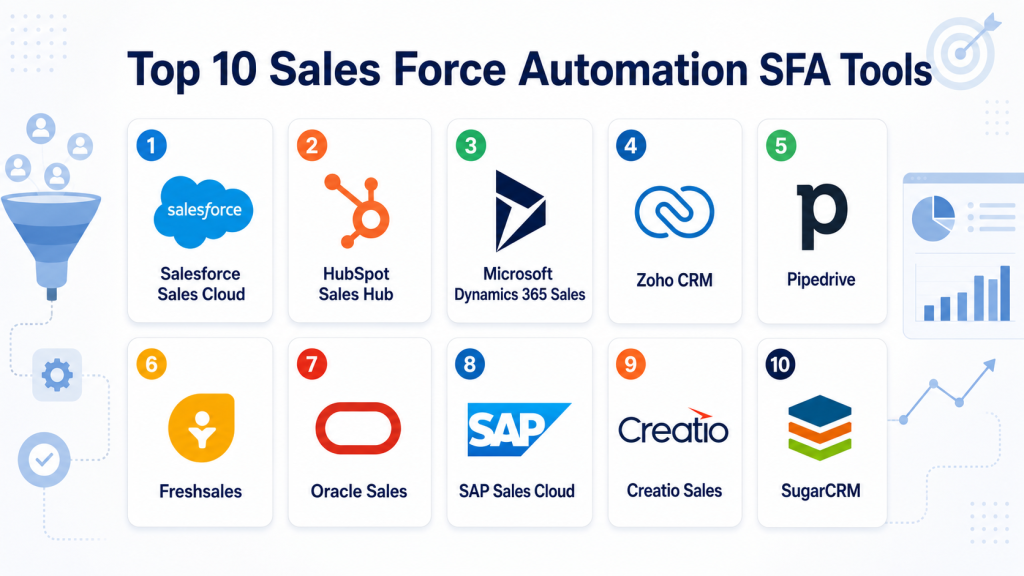
Top 10 Sales Force Automation SFA Tools
1- Salesforce Sales Cloud
Short description: Salesforce Sales Cloud is a widely used sales automation and CRM platform for managing leads, accounts, opportunities, forecasts, sales workflows, and customer relationships. It is best for mid-market and enterprise teams that need deep customization, automation, and ecosystem scale.
Key Features
- Lead, contact, account, and opportunity management
- Sales pipeline and forecasting tools
- Workflow automation and approval rules
- AI-assisted sales insights depending on package
- Custom dashboards and reporting
- Mobile sales access
- Large app and integration ecosystem
Pros
- Highly customizable for complex sales processes
- Strong ecosystem for integrations, apps, and partners
- Suitable for enterprise sales teams and revenue operations
Cons
- Can require administration and implementation expertise
- May feel complex for small teams
- Cost can increase with add-ons, users, and advanced features
Platforms / Deployment
Web / iOS / Android
Cloud
Security & Compliance
Salesforce provides enterprise-grade administration, permissions, authentication options, and data governance capabilities. Specific certifications, SSO, MFA, audit logs, RBAC, and compliance details should be verified directly during vendor review.
Integrations & Ecosystem
Salesforce Sales Cloud has one of the broadest sales technology ecosystems. It connects with marketing, customer support, analytics, finance, CPQ, communication, and data platforms.
- Marketing automation integrations
- Email and calendar sync
- CPQ and quoting workflows
- Customer support connections
- ERP and finance integrations
- Analytics and data warehouse workflows
Support & Community
Salesforce provides documentation, training, partner implementation support, community resources, customer success options, and enterprise support tiers. Support depth depends on selected package and contract.
2- HubSpot Sales Hub
Short description: HubSpot Sales Hub is a sales automation and CRM platform focused on ease of use, pipeline management, email tracking, meetings, sequences, forecasting, and sales productivity. It is best for SMBs and growing teams that want sales automation connected with marketing and customer service.
Key Features
- Contact and deal management
- Sales pipeline tracking
- Email tracking and templates
- Sales sequences and task automation
- Meeting scheduling tools
- Forecasting and reporting
- Integration with HubSpot CRM ecosystem
Pros
- Easy to adopt for SMB and growing sales teams
- Strong connection between sales, marketing, and service workflows
- User-friendly interface for sales reps and managers
Cons
- Advanced customization may be limited compared with enterprise CRM platforms
- Costs can increase as teams add advanced tiers
- Complex enterprise sales processes may need deeper configuration
Platforms / Deployment
Web / iOS / Android
Cloud
Security & Compliance
HubSpot provides account security, permissions, and admin controls. Specific certifications, SSO, MFA, audit logs, RBAC, and compliance documentation should be verified directly.
Integrations & Ecosystem
HubSpot Sales Hub works well for teams that want CRM, marketing, sales, and service data in a connected environment.
- HubSpot CRM ecosystem
- Email and calendar integrations
- Marketing automation workflows
- Calling and meeting tools
- Customer service connections
- App marketplace integrations
Support & Community
HubSpot provides documentation, onboarding resources, academy-style training, customer support, and a large user community. Support depth depends on product tier and package.
3- Microsoft Dynamics 365 Sales
Short description: Microsoft Dynamics 365 Sales is a sales automation and CRM platform for managing leads, opportunities, accounts, forecasting, relationship intelligence, and sales performance. It is best for organizations already using Microsoft business applications and enterprise productivity tools.
Key Features
- Lead and opportunity management
- Account and contact management
- Sales forecasting and pipeline analytics
- AI-assisted seller insights depending on configuration
- Integration with Microsoft productivity tools
- Custom workflows and business process flows
- Reporting and dashboard capabilities
Pros
- Strong fit for Microsoft-centered organizations
- Good enterprise customization and integration options
- Useful for companies needing sales and business data alignment
Cons
- Setup may require Microsoft ecosystem expertise
- Can be complex for small sales teams
- Best value depends on broader Microsoft adoption
Platforms / Deployment
Web / Windows / iOS / Android
Cloud / Hybrid options may vary by configuration
Security & Compliance
Microsoft Dynamics 365 Sales supports enterprise identity, permissions, admin controls, and data governance capabilities. Specific certifications, MFA, SSO, audit logs, RBAC, and compliance documentation should be verified directly.
Integrations & Ecosystem
Dynamics 365 Sales connects closely with Microsoft productivity, analytics, collaboration, and business application workflows.
- Microsoft 365 integrations
- Teams collaboration workflows
- Power BI reporting
- Power Platform automation
- ERP and finance connections
- Email and calendar sync
Support & Community
Microsoft provides documentation, support options, partner implementation services, training resources, and a broad enterprise technology ecosystem.
4- Zoho CRM
Short description: Zoho CRM is a sales automation platform for lead management, pipeline tracking, workflow automation, sales analytics, and omnichannel customer engagement. It is best for SMBs and mid-market companies that want flexible CRM features at practical pricing.
Key Features
- Lead, contact, account, and deal management
- Workflow automation
- Sales forecasting and dashboards
- Email, phone, and communication tracking
- Territory and assignment rules
- AI-assisted sales features depending on plan
- Integration with Zoho business applications
Pros
- Strong value for SMB and mid-market teams
- Broad Zoho ecosystem for sales, marketing, finance, and operations
- Flexible customization for different sales processes
Cons
- Interface and configuration can feel busy for new users
- Advanced features may require higher plans
- Large enterprise complexity should be evaluated carefully
Platforms / Deployment
Web / iOS / Android
Cloud
Security & Compliance
Zoho CRM provides administrative controls, roles, profiles, and security settings. Specific certifications, MFA, SSO, audit logs, RBAC, and compliance documentation should be verified directly.
Integrations & Ecosystem
Zoho CRM connects sales automation with Zoho applications and third-party business tools.
- Zoho ecosystem integrations
- Email and calendar integrations
- Marketing automation connections
- Finance and invoicing workflows
- Help desk integrations
- API and marketplace extensions
Support & Community
Zoho provides documentation, onboarding resources, customer support, community forums, and partner assistance. Support depth may vary by plan and region.
5- Pipedrive
Short description: Pipedrive is a sales-focused CRM and SFA tool built around visual pipeline management, activity tracking, deal progress, and sales productivity. It is best for SMB sales teams that want a simple, pipeline-first selling system.
Key Features
- Visual sales pipeline management
- Lead and deal tracking
- Activity reminders and task automation
- Email integration and communication tracking
- Sales forecasting and reporting
- Workflow automation
- Mobile CRM access
Pros
- Simple and sales-rep-friendly interface
- Strong for pipeline-focused sales teams
- Good fit for SMBs that want fast adoption
Cons
- Less suited to highly complex enterprise CRM environments
- Advanced analytics and automation may require add-ons or higher tiers
- Broader customer lifecycle management may need integrations
Platforms / Deployment
Web / iOS / Android
Cloud
Security & Compliance
Pipedrive provides account security, user permissions, and admin controls. Specific certifications, SSO, MFA, audit logs, RBAC, and compliance documentation should be verified directly.
Integrations & Ecosystem
Pipedrive supports a practical ecosystem for sales teams that need email, calling, marketing, automation, and reporting connections.
- Email and calendar integrations
- Calling and communication tools
- Marketing automation integrations
- Lead generation tools
- Reporting and dashboard connections
- Marketplace app integrations
Support & Community
Pipedrive provides documentation, onboarding resources, support options, and sales-focused learning materials. Support availability depends on plan and region.
6- Freshsales
Short description: Freshsales is a CRM and sales automation platform from Freshworks, designed for lead management, deal tracking, email, phone, workflows, and AI-assisted sales engagement. It is best for SMB and mid-market teams that want sales automation with simple customer engagement workflows.
Key Features
- Contact, account, and deal management
- Sales pipeline tracking
- Built-in phone and email workflows
- Lead scoring depending on package
- Workflow automation
- AI-assisted sales insights depending on plan
- Reporting and dashboards
Pros
- Good fit for SMB and mid-market sales teams
- Combines communication and sales tracking in one platform
- Easier to adopt than many enterprise CRM systems
Cons
- Advanced enterprise customization may be limited
- Complex sales organizations should validate workflow depth
- Some advanced features may depend on selected plan
Platforms / Deployment
Web / iOS / Android
Cloud
Security & Compliance
Freshsales provides role-based permissions, admin controls, and business data management features. Specific certifications, SSO, MFA, audit logs, and compliance documentation should be verified directly.
Integrations & Ecosystem
Freshsales works well for teams using Freshworks products or needing connected sales, support, and engagement workflows.
- Freshworks ecosystem integrations
- Email and phone workflows
- Marketing automation connections
- Customer support integrations
- API and app marketplace options
- Reporting exports
Support & Community
Freshworks provides documentation, onboarding resources, customer support, community resources, and product training options. Support depth depends on selected package.
7- Oracle Sales
Short description: Oracle Sales is an enterprise sales automation platform for managing accounts, opportunities, sales workflows, forecasting, and customer engagement. It is best for large organizations that need sales automation connected with broader Oracle enterprise applications.
Key Features
- Lead, account, and opportunity management
- Sales forecasting and pipeline analytics
- AI-assisted sales recommendations depending on configuration
- Territory and quota support
- Workflow automation
- Enterprise reporting
- Integration with Oracle business applications
Pros
- Strong fit for enterprise sales organizations
- Good alignment with Oracle business technology ecosystems
- Useful for complex account and territory management
Cons
- May be too complex for SMBs
- Implementation can require enterprise CRM expertise
- Best value depends on broader Oracle ecosystem fit
Platforms / Deployment
Web / iOS / Android
Cloud
Security & Compliance
Oracle Sales supports enterprise administration, role-based access, identity controls, and data governance capabilities. Specific certifications, SSO, MFA, audit logs, and compliance documentation should be verified directly.
Integrations & Ecosystem
Oracle Sales connects with broader Oracle applications, finance, service, marketing, analytics, and enterprise data systems.
- Oracle business application integrations
- Marketing and service workflows
- ERP and finance connections
- Analytics and reporting
- Data integration workflows
- Enterprise process automation
Support & Community
Oracle provides documentation, enterprise support, implementation partners, training resources, and customer success programs. Support depth depends on contract and deployment scope.
8- SAP Sales Cloud
Short description: SAP Sales Cloud is a sales automation and CRM solution for lead management, opportunity tracking, forecasting, sales execution, and enterprise customer engagement. It is best for organizations using SAP business systems or needing sales workflows connected with ERP and enterprise operations.
Key Features
- Lead and opportunity management
- Account and contact management
- Forecasting and sales analytics
- Sales workflow automation
- Territory and account planning support
- Mobile sales access
- Integration with SAP ecosystem
Pros
- Strong fit for SAP-centered organizations
- Useful for sales processes connected to ERP and customer operations
- Supports enterprise sales governance and reporting
Cons
- May require implementation and integration expertise
- Smaller teams may find it more complex than needed
- Best value depends on SAP ecosystem alignment
Platforms / Deployment
Web / iOS / Android
Cloud
Security & Compliance
SAP Sales Cloud supports enterprise administration, access controls, and governance capabilities. Specific certifications, MFA, SSO, audit logs, RBAC, and compliance details should be verified directly.
Integrations & Ecosystem
SAP Sales Cloud works best when sales processes need to connect with SAP ERP, commerce, customer service, and enterprise reporting.
- SAP ecosystem integrations
- ERP and finance workflows
- Commerce and service connections
- Sales analytics
- Mobile sales workflows
- Reporting exports
Support & Community
SAP provides documentation, enterprise support, implementation partners, training, and customer success programs. Support depth depends on contract, region, and deployment complexity.
9- Creatio Sales
Short description: Creatio Sales is a no-code CRM and sales automation platform for lead management, opportunity tracking, workflows, process automation, and sales productivity. It is best for teams that want customizable SFA workflows without heavy custom development.
Key Features
- Lead and opportunity management
- No-code workflow automation
- Sales process management
- Forecasting and analytics
- Account and contact management
- Activity tracking
- Custom dashboards and automation rules
Pros
- Strong process automation flexibility
- Useful for companies with custom sales workflows
- No-code approach helps business teams adjust processes faster
Cons
- Requires thoughtful process design for best results
- Smaller teams may not need deep customization
- Integration needs should be validated before rollout
Platforms / Deployment
Web / iOS / Android
Cloud / Self-hosted options may vary
Security & Compliance
Creatio provides platform permissions, access controls, and process governance features. Specific certifications, SSO, MFA, audit logs, RBAC, and compliance documentation should be verified directly.
Integrations & Ecosystem
Creatio Sales connects CRM and sales automation with business process management and no-code workflow design.
- CRM integrations
- Marketing and service workflows
- API-based connections
- Business process automation
- Reporting and analytics exports
- Data import and export workflows
Support & Community
Creatio provides documentation, customer support, partner services, training, and community resources. Support depth depends on product package and deployment type.
10- SugarCRM
Short description: SugarCRM is a CRM and sales automation platform for managing accounts, leads, opportunities, sales workflows, and customer relationships. It is best for organizations that want configurable CRM capabilities with sales, marketing, and service alignment.
Key Features
- Lead, account, and opportunity management
- Sales pipeline tracking
- Forecasting and reporting
- Workflow automation
- Customer relationship history
- Marketing and service alignment
- Custom fields and dashboards
Pros
- Configurable CRM for different sales processes
- Useful for teams that want sales, marketing, and service visibility
- Can support mid-market and enterprise CRM needs
Cons
- Implementation effort depends on customization needs
- User experience may require training for some teams
- Ecosystem size may be smaller than the largest CRM platforms
Platforms / Deployment
Web / iOS / Android
Cloud / Self-hosted options may vary
Security & Compliance
SugarCRM provides administration, access controls, and CRM data governance features. Specific certifications, SSO, MFA, audit logs, RBAC, and compliance documentation should be verified directly.
Integrations & Ecosystem
SugarCRM connects with sales, marketing, customer service, productivity, and reporting systems to support customer lifecycle workflows.
- Email and calendar integrations
- Marketing automation connections
- Customer support workflows
- Reporting and analytics tools
- API integrations
- Data import and export options
Support & Community
SugarCRM provides documentation, support options, implementation partners, training resources, and community support. Support depth depends on deployment and customer agreement.
Comparison Table
| Tool Name | Best For | Platform Supported | Deployment | Standout Feature | Public Rating |
|---|---|---|---|---|---|
| Salesforce Sales Cloud | Mid-market and enterprise sales teams | Web, iOS, Android | Cloud | Deep customization and large sales ecosystem | N/A |
| HubSpot Sales Hub | SMBs and growing revenue teams | Web, iOS, Android | Cloud | Easy sales automation with marketing alignment | N/A |
| Microsoft Dynamics 365 Sales | Microsoft-centered organizations | Web, Windows, iOS, Android | Cloud / Hybrid varies | Sales automation connected with Microsoft ecosystem | N/A |
| Zoho CRM | SMB and mid-market teams | Web, iOS, Android | Cloud | Flexible CRM at practical value | N/A |
| Pipedrive | Pipeline-focused SMB sales teams | Web, iOS, Android | Cloud | Visual pipeline management | N/A |
| Freshsales | SMB and mid-market sales teams | Web, iOS, Android | Cloud | Built-in communication and sales automation | N/A |
| Oracle Sales | Large enterprise sales organizations | Web, iOS, Android | Cloud | Enterprise sales automation with Oracle ecosystem | N/A |
| SAP Sales Cloud | SAP-centered enterprise teams | Web, iOS, Android | Cloud | Sales workflows connected with SAP operations | N/A |
| Creatio Sales | Custom process-driven sales teams | Web, iOS, Android | Cloud / Self-hosted varies | No-code sales workflow automation | N/A |
| SugarCRM | Configurable CRM and sales teams | Web, iOS, Android | Cloud / Self-hosted varies | Flexible sales, marketing, and service CRM workflows | N/A |
Evaluation & Scoring of Sales Force Automation SFA
The scoring below is comparative and designed to help buyers evaluate sales automation depth, ease of use, integrations, security, reliability, support, and value. It is not a universal ranking for every company.
| Tool Name | Core 25% | Ease 15% | Integrations 15% | Security 10% | Performance 10% | Support 10% | Value 15% | Weighted Total |
|---|---|---|---|---|---|---|---|---|
| Salesforce Sales Cloud | 9.5 | 7.7 | 9.6 | 9.0 | 9.0 | 8.6 | 7.6 | 8.74 |
| HubSpot Sales Hub | 8.5 | 9.1 | 8.6 | 8.4 | 8.6 | 8.5 | 8.4 | 8.57 |
| Microsoft Dynamics 365 Sales | 9.0 | 7.9 | 9.1 | 8.9 | 8.8 | 8.5 | 7.8 | 8.59 |
| Zoho CRM | 8.4 | 8.4 | 8.5 | 8.3 | 8.4 | 8.2 | 8.8 | 8.43 |
| Pipedrive | 8.0 | 9.0 | 8.1 | 8.1 | 8.3 | 8.0 | 8.7 | 8.33 |
| Freshsales | 8.2 | 8.6 | 8.2 | 8.2 | 8.3 | 8.1 | 8.5 | 8.32 |
| Oracle Sales | 8.9 | 7.6 | 8.8 | 8.8 | 8.8 | 8.4 | 7.5 | 8.38 |
| SAP Sales Cloud | 8.8 | 7.6 | 8.8 | 8.7 | 8.7 | 8.4 | 7.5 | 8.35 |
| Creatio Sales | 8.4 | 8.1 | 8.3 | 8.3 | 8.4 | 8.2 | 8.1 | 8.26 |
| SugarCRM | 8.1 | 8.0 | 8.0 | 8.2 | 8.2 | 8.0 | 8.2 | 8.10 |
Which Sales Force Automation SFA Tool Is Right for You?
Solo / Freelancer
Solo sellers usually need simple lead tracking, reminders, contact history, email follow-up, and pipeline visibility. Pipedrive, HubSpot Sales Hub, Zoho CRM, or Freshsales can be practical options because they are easier to adopt than large enterprise platforms.
A solo user should avoid overbuilding a complex CRM unless the business has long sales cycles, many accounts, or planned sales hiring.
SMB
SMBs need an SFA tool that is easy for reps to use, simple to configure, affordable, and integrated with email, calendar, marketing, and customer communication tools. HubSpot Sales Hub, Zoho CRM, Pipedrive, Freshsales, and SugarCRM can be strong options.
SMBs should prioritize user adoption, sales workflow simplicity, pipeline visibility, and low admin overhead.
Mid-Market
Mid-market companies need more structured automation, custom fields, sales territories, forecasting, dashboards, integrations, approval workflows, and manager visibility. Salesforce Sales Cloud, Microsoft Dynamics 365 Sales, Zoho CRM, HubSpot Sales Hub, Creatio Sales, and SugarCRM may be relevant.
Mid-market buyers should validate CRM data quality, workflow automation, reporting flexibility, and integration with marketing, support, finance, and CPQ systems.
Enterprise
Enterprises need scalable sales automation, security, role-based permissions, territory management, forecasting, global user support, advanced integrations, governance, and ecosystem depth. Salesforce Sales Cloud, Microsoft Dynamics 365 Sales, Oracle Sales, SAP Sales Cloud, and Creatio Sales are strong candidates.
Enterprise buyers should involve sales leadership, revenue operations, IT, security, finance, marketing, and customer success teams before selecting a platform.
Budget vs Premium
Budget-focused teams should evaluate Zoho CRM, Pipedrive, Freshsales, HubSpot Sales Hub, and SugarCRM depending on required features and user count. These tools can deliver strong sales automation without unnecessary enterprise complexity.
Premium buyers should evaluate Salesforce Sales Cloud, Microsoft Dynamics 365 Sales, Oracle Sales, SAP Sales Cloud, and Creatio Sales when they need advanced workflows, enterprise governance, deep integrations, and scalability.
Feature Depth vs Ease of Use
HubSpot Sales Hub, Pipedrive, Freshsales, and Zoho CRM are strong for ease of use and quicker adoption. Salesforce, Microsoft Dynamics, Oracle, SAP, and Creatio offer deeper customization and enterprise workflows but often require more implementation planning.
The right choice depends on whether the company values simplicity, ecosystem depth, automation power, sales governance, or industry-specific workflow customization.
Integrations & Scalability
SFA tools must connect with email, calendar, marketing automation, customer support, CPQ, ERP, billing, finance, data warehouse, and analytics platforms. Buyers should test integrations before company-wide rollout.
Scalability depends on user count, number of pipelines, custom fields, sales territories, approval flows, reporting needs, and global business units.
Security & Compliance Needs
SFA platforms store sensitive customer, pipeline, deal, pricing, communication, and revenue data. Buyers should review SSO, MFA, encryption, role-based access, audit logs, data retention, admin controls, and vendor security documentation.
Companies with regulated sales processes should also confirm permission models, approval logs, data exports, and record-level access controls.
Frequently Asked Questions
1. What is Sales Force Automation SFA?
Sales Force Automation SFA is software that automates sales activities such as lead tracking, opportunity management, task reminders, follow-ups, forecasting, and reporting. It helps sales teams work more consistently and efficiently.
2. Is SFA the same as CRM?
SFA is often part of CRM, but it focuses specifically on automating sales activities. CRM is broader and may include marketing, service, account management, customer data, and lifecycle workflows.
3. Who needs SFA software?
Sales teams, managers, RevOps teams, field sales teams, and businesses with structured selling processes can benefit from SFA software. It is especially useful when pipeline tracking and follow-up discipline become difficult manually.
4. What are the main benefits of SFA tools?
SFA tools improve follow-up consistency, reduce manual sales admin work, improve pipeline visibility, support forecasting, and help managers track sales activity and deal progress.
5. How much do SFA tools cost?
Pricing varies by vendor, users, features, automation depth, storage, AI features, integrations, and support levels. Buyers should calculate cost based on actual user roles and required modules.
6. Can SFA tools integrate with email and calendars?
Yes, most modern SFA tools integrate with email and calendar systems. This helps sales reps log communication, schedule meetings, track conversations, and create follow-up tasks.
7. What are common mistakes when choosing SFA software?
Common mistakes include choosing based only on brand name, ignoring user adoption, over-customizing too early, skipping data cleanup, and not testing integrations before rollout.
8. Is SFA software secure?
Business-grade SFA tools usually provide user permissions and security controls. Buyers should verify SSO, MFA, encryption, role-based access, audit logs, and data governance documentation.
9. How long does SFA implementation take?
Implementation depends on company size, sales process complexity, integrations, data migration, and customization needs. Small teams can launch quickly, while enterprise rollouts may require phased deployment.
10. Can SFA tools help with sales forecasting?
Yes, many SFA tools include forecasting dashboards, pipeline analytics, deal stage tracking, and sales activity reporting. Forecast accuracy depends heavily on clean data and consistent sales process usage.
Conclusion
Sales Force Automation tools help sales teams reduce manual work, improve pipeline visibility, standardize selling processes, and give leaders better control over forecasting and performance. The best platform depends on company size, sales process complexity, budget, integration needs, security expectations, and team adoption. Salesforce Sales Cloud is strong for enterprise customization, while HubSpot Sales Hub, Zoho CRM, Pipedrive, and Freshsales are strong options for SMB and growing sales teams. Microsoft Dynamics 365 Sales, Oracle Sales, SAP Sales Cloud, Creatio Sales, and SugarCRM are useful for organizations needing deeper customization, enterprise workflows, or ecosystem alignment. The right next step is to shortlist two or three tools, test them with real sales workflows, validate integrations and permissions, train a pilot team, and confirm that the platform improves both rep productivity and sales management visibility before scaling it across the organization.

Find Trusted Cardiac Hospitals
Compare heart hospitals by city and services — all in one place.
Explore Hospitals
Sales Force Automation (SFA) software is most valuable when it helps sales teams automate routine activities, manage customer interactions, and improve visibility across the sales pipeline through a centralized platform. By providing lead and opportunity management, sales activity tracking, contact management, pipeline automation, task scheduling, follow-up reminders, forecasting, performance dashboards, reporting, mobile access, and CRM integration, these platforms enable organizations to increase sales productivity, reduce administrative work, improve follow-up consistency, shorten sales cycles, and make more informed revenue decisions.