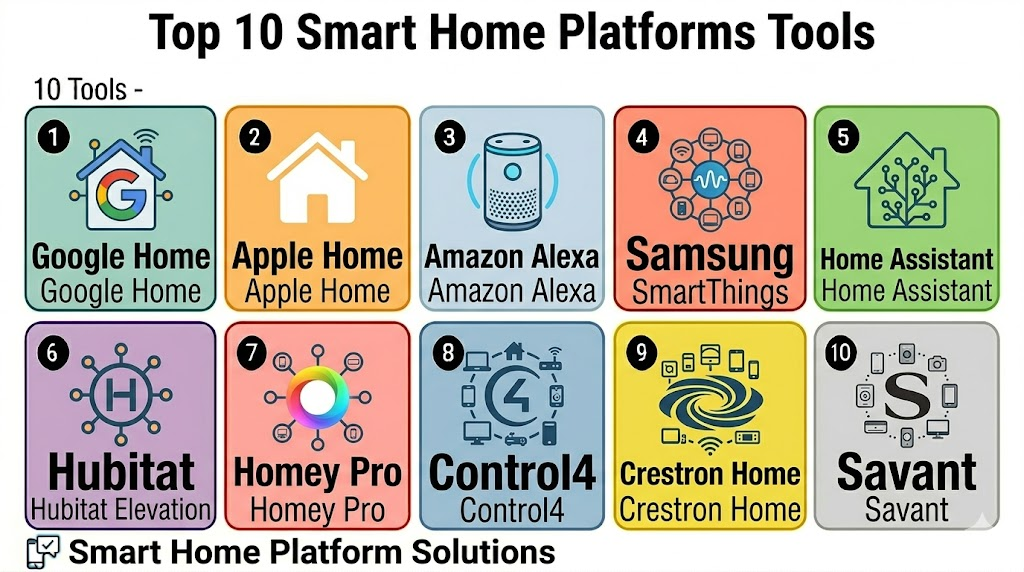
Introduction
Smart Home Platforms help users connect, control, automate, and monitor smart devices such as lights, locks, cameras, speakers, thermostats, sensors, appliances, security systems, curtains, plugs, and energy devices from one ecosystem. Instead of using separate apps for every device brand, these platforms create a centralized control layer for routines, scenes, voice commands, alerts, and device interoperability. This category matters because smart homes are moving from simple device control to more connected, automated, privacy-aware, and energy-conscious living. Modern buyers want platforms that support Matter, Thread, Zigbee, Z-Wave, Wi-Fi, voice assistants, local control, strong security, and easy family access. Matter is especially important because it is designed to improve interoperability across major smart home ecosystems.
Real World Use Cases:
- Controlling lights, plugs, locks, cameras, and thermostats from one app
- Creating routines such as “Good Morning,” “Away Mode,” or “Movie Night”
- Automating security alerts, motion detection, and door lock actions
- Managing energy usage with smart thermostats, plugs, and appliance schedules
- Connecting devices from multiple brands through Matter, Thread, Zigbee, Z-Wave, or Wi-Fi
Evaluation Criteria for Buyers:
- Device compatibility and ecosystem support
- Matter, Thread, Zigbee, Z-Wave, and Wi-Fi compatibility
- Voice assistant and mobile app experience
- Automation depth and rule flexibility
- Local control versus cloud dependency
- Privacy and data protection approach
- Security features and account controls
- Smart speaker, hub, and bridge requirements
- Family sharing and multi-user access
- Long-term ecosystem reliability and device support
Best for: Homeowners, apartment residents, smart home enthusiasts, families, property managers, installers, home automation consultants, builders, and premium home technology integrators who want centralized control, automation, voice control, energy management, and security visibility.
Not ideal for: Users with only one or two simple smart devices may not need a full smart home platform. A brand-specific app, smart speaker app, or basic Wi-Fi device app may be enough until device count, automation complexity, or cross-brand compatibility needs increase.
Key Trends in Smart Home Platforms
- Matter adoption is reshaping compatibility: Major ecosystems are expanding Matter support so users can connect devices across brands with less lock-in. Google describes Matter as an open standard for smart home technology, while Amazon says Matter can allow devices to connect locally to Alexa without a separate skill or hub in supported cases.
- Thread is becoming more important for low-power devices: Thread is designed for smart home devices and can improve mesh reliability for supported sensors, locks, switches, and similar products. Google notes that some Nest devices include Thread border routers for Matter and Thread networks.
- Local control is gaining buyer attention: Platforms such as Home Assistant and Hubitat emphasize local processing and privacy-focused automation, which appeals to users who want less dependence on cloud services.
- AI-assisted home automation is expanding: Smart home platforms are moving toward smarter routines, voice assistant improvements, energy recommendations, occupancy-aware actions, and contextual automation.
- Energy management is becoming a mainstream use case: Smart thermostats, plugs, appliances, solar systems, batteries, and energy dashboards are becoming part of the smart home conversation.
- Security and privacy are buying priorities: Cameras, locks, doorbells, presence sensors, and voice assistants collect sensitive household data, so buyers increasingly evaluate encryption, account protection, permissions, and local processing.
- Multi-protocol hubs remain relevant: Even with Matter, many homes still use Zigbee, Z-Wave, Wi-Fi, Bluetooth, infrared, and legacy bridges, so broad protocol support remains important.
- Professional smart home platforms are still strong: Premium homes, villas, hotels, and luxury apartments often need Control4, Crestron Home, Savant, or Lutron-style systems for deep integration and professional installation.
- Voice control is no longer enough: Users now expect dashboards, routines, scenes, presence automation, device grouping, remote access, and cross-device logic.
- Cloud service continuity matters: Buyers are paying closer attention to whether devices and platforms will continue receiving updates and support over time.
How We Selected These Tools
The tools below were selected using practical smart home platform evaluation logic:
- Market recognition among homeowners, smart home users, integrators, builders, and automation communities
- Compatibility with common smart home device categories such as lights, locks, cameras, sensors, thermostats, speakers, plugs, and appliances
- Ecosystem support across Matter, Thread, Zigbee, Z-Wave, Wi-Fi, Bluetooth, infrared, or cloud integrations where relevant
- Ease of use for beginners, families, and non-technical users
- Automation depth for advanced users and smart home enthusiasts
- Local control, cloud dependency, privacy, and resilience considerations
- Support for voice control, mobile apps, dashboards, scenes, and routines
- Integration potential with third-party devices, hubs, bridges, and professional systems
- Fit across budget homes, apartments, DIY setups, advanced enthusiast homes, and luxury installations
- Long-term ecosystem strength, community support, and platform maturity
Top 10 Smart Home Platforms Tools
1- Google Home
Short description: Google Home is a consumer smart home platform for controlling connected devices through the Google Home app, Nest devices, Google Assistant, and supported Matter products. It is useful for users who want a simple smart home experience connected with Android, Nest, speakers, displays, and voice control.
Key Features
- Smart device control through Google Home app
- Google Assistant voice control
- Matter device support
- Thread support through compatible Google devices
- Routines and household automation
- Nest camera, thermostat, speaker, and display ecosystem
- Remote control and multi-user home sharing
Pros
- Easy for beginners and Android users
- Strong fit for Nest devices and Google Assistant homes
- Matter and Thread support improve ecosystem flexibility
Cons
- Advanced automation depth may be limited for power users
- Some workflows depend on cloud services
- Device behavior can vary by brand, region, and Matter implementation
Platforms / Deployment
Web / Android / iOS
Cloud / Hybrid
Security & Compliance
Varies / N/A. Buyers should validate account security, two-step verification, device permissions, data privacy settings, family access, camera privacy controls, and remote access settings.
Integrations & Ecosystem
Google Home works best for users who want voice-first and app-based control across Nest devices, Matter products, and supported third-party smart home devices.
- Google Assistant
- Nest devices
- Matter-compatible devices
- Thread-enabled devices through supported hubs
- Android ecosystem
- Third-party smart device brands
Support & Community
Google provides product documentation, help resources, community support, and device setup guidance. Support quality can vary by device brand and region.
2- Apple Home
Short description: Apple Home is Apple’s smart home platform for controlling HomeKit and Matter-compatible devices through the Home app, Siri, Apple TV, HomePod, iPhone, iPad, Mac, and Apple Watch. It is useful for users already invested in the Apple ecosystem.
Key Features
- Home app control across Apple devices
- Siri voice control
- HomeKit and Matter accessory support
- Automations and scenes
- HomePod and Apple TV as home hubs
- Family access and room-based device organization
- Privacy-focused Apple ecosystem experience
Pros
- Strong fit for Apple users
- Smooth experience across iPhone, iPad, Mac, Apple Watch, Apple TV, and HomePod
- Good option for users who value privacy and ecosystem consistency
Cons
- Best experience requires Apple devices
- Accessory selection may depend on region and compatibility
- Advanced automation may require Shortcuts or additional tools
Platforms / Deployment
iOS / iPadOS / macOS / watchOS / tvOS
Cloud / Hybrid
Security & Compliance
Apple states that the Home app is designed to be secure and protect personal data, but buyers should still validate device permissions, family sharing, camera settings, remote access, and account security controls.
Integrations & Ecosystem
Apple Home is strongest when the home already uses Apple devices and compatible accessories.
- HomeKit accessories
- Matter-compatible devices
- Siri
- HomePod and Apple TV
- Apple Shortcuts
- Apple device ecosystem
Support & Community
Apple provides official help resources, setup documentation, and device support. Community knowledge is strong because HomeKit users often share automation ideas and accessory recommendations.
3- Amazon Alexa
Short description: Amazon Alexa is a smart home platform built around Echo devices, Alexa voice control, routines, skills, and compatible connected devices. It is useful for households that want voice-first control, smart speakers, entertainment integrations, and broad device compatibility.
Key Features
- Alexa voice assistant control
- Echo smart speaker and display ecosystem
- Smart home routines and scenes
- Matter device support
- Device groups and household control
- Skills and third-party device integrations
- Remote control through Alexa app
Pros
- Strong voice control experience
- Broad ecosystem of compatible devices
- Useful for smart speakers, entertainment, routines, and household control
Cons
- Some integrations depend on cloud services
- Privacy settings should be reviewed carefully
- Advanced local automation is less flexible than enthusiast platforms
Platforms / Deployment
Web / Android / iOS / Echo devices
Cloud / Hybrid
Security & Compliance
Varies / N/A. Buyers should validate Amazon account security, voice recording settings, household permissions, camera privacy, device access controls, and Matter setup security.
Integrations & Ecosystem
Amazon Alexa works well for users who want smart speaker control and simple routines across many compatible brands.
- Echo devices
- Alexa voice assistant
- Matter-compatible devices
- Smart plugs, lights, thermostats, cameras, and locks
- Entertainment and speaker workflows
- Third-party Alexa skills
Support & Community
Amazon provides help resources, device support, and Alexa setup documentation. The platform also has a large consumer user base, making setup guidance and troubleshooting easy to find.
4- Samsung SmartThings
Short description: Samsung SmartThings is a smart home platform that connects, controls, and automates devices across many brands from one app. It supports broad smart home categories and is useful for users who want a flexible ecosystem connected with Samsung devices, appliances, TVs, and compatible hubs.
Key Features
- SmartThings app for device control
- Automations and scenes
- Broad third-party device compatibility
- Samsung appliance and TV ecosystem support
- Matter device support
- Energy and device monitoring features
- Hub-based and hubless device workflows depending on setup
Pros
- Strong cross-brand ecosystem
- Good fit for Samsung appliance and device users
- Useful for smart home automation beyond one device brand
Cons
- Hub and protocol support can vary by device generation
- Some advanced workflows may require careful setup
- Users with legacy Z-Wave setups should validate hardware roadmap carefully
Platforms / Deployment
Web / Android / iOS
Cloud / Hybrid
Security & Compliance
Varies / N/A. Buyers should validate Samsung account security, home sharing permissions, device access rules, privacy settings, and hub-level security controls.
Integrations & Ecosystem
Samsung says SmartThings connects, controls, and automates smart homes from one app and is compatible with hundreds of devices and brands. Its ecosystem is especially relevant for Samsung appliances, TVs, sensors, and Matter devices.
- Samsung appliances and TVs
- Matter-compatible devices
- Zigbee and Thread depending on hub/device setup
- Smart sensors, lights, cameras, locks, and plugs
- Energy management workflows
- Third-party device brands
Support & Community
Samsung provides official SmartThings documentation, product support, and community guidance. SmartThings also has an active user and developer community.
5- Home Assistant
Short description: Home Assistant is an open-source smart home automation platform focused on local control, privacy, and deep customization. It is best suited for DIY users, developers, advanced home automation enthusiasts, and privacy-focused smart homes.
Key Features
- Open-source smart home automation
- Local control and privacy-focused architecture
- Large integration ecosystem
- Advanced automations and dashboards
- Matter integration support
- Works with many device brands and protocols through integrations
- Strong community-driven development
Pros
- Very powerful automation and customization
- Excellent fit for privacy-focused and technical users
- Large community and broad integration ecosystem
Cons
- Requires more setup effort than mainstream platforms
- Beginners may face a learning curve
- Some integrations need maintenance and technical troubleshooting
Platforms / Deployment
Web / iOS / Android / Linux / Docker / Raspberry Pi and similar devices
Self-hosted / Hybrid
Security & Compliance
Not publicly stated as a vendor certification profile. Buyers should manage their own deployment security, user access, remote access, backups, encryption, network segmentation, and update practices.
Integrations & Ecosystem
Home Assistant describes itself as open source home automation that puts local control and privacy first, with a worldwide community and a large integration ecosystem.
- Matter integration
- Zigbee and Z-Wave through supported adapters
- Wi-Fi and local network devices
- MQTT and APIs
- Dashboards and automation scripts
- Large community integrations
Support & Community
Home Assistant has one of the strongest DIY smart home communities, with documentation, forums, community blueprints, open-source contributions, and frequent platform updates.
6- Hubitat Elevation
Short description: Hubitat Elevation is a local-first smart home hub designed for advanced automation, privacy, reliability, and compatibility with Zigbee, Z-Wave, Matter, and other integrations depending on setup. It is useful for users who want local automations without heavy cloud dependency.
Key Features
- Local automation processing
- Zigbee and Z-Wave support
- Matter support depending on device and hub setup
- Rule-based automation engine
- Dashboards and device control
- Voice assistant integrations
- Strong privacy and local reliability focus
Pros
- Strong local automation performance
- Good fit for privacy-conscious smart home users
- Useful for homes with Zigbee and Z-Wave devices
Cons
- Interface may be less beginner-friendly than consumer apps
- Advanced rules require learning
- Device compatibility should be checked before purchase
Platforms / Deployment
Web / iOS / Android / Hub device
Local hub / Hybrid
Security & Compliance
Varies / N/A. Buyers should validate local network security, remote access settings, user access, firmware updates, backup practices, and connected device permissions.
Integrations & Ecosystem
Hubitat emphasizes local processing, privacy, and automations that execute on the hub rather than relying mainly on cloud execution.
- Zigbee devices
- Z-Wave devices
- Matter devices where supported
- LAN integrations
- Voice assistant integrations
- Local dashboards and automation rules
Support & Community
Hubitat has official documentation, support resources, and an active enthusiast community. Community drivers and apps can extend capabilities but should be reviewed carefully.
7- Homey Pro
Short description: Homey Pro is a smart home hub and platform designed to unify many smart home technologies into one system. It is useful for users who want broad protocol coverage, visual automation flows, and device control across multiple brands.
Key Features
- Multi-protocol smart home hub
- Visual automation flows
- Device control across brands
- Zigbee, Z-Wave, Wi-Fi, Bluetooth, infrared, and other protocol support depending on model and setup
- Matter and Thread support depending on implementation
- Mobile and web app control
- Energy and device dashboards
Pros
- Broad protocol support for mixed smart homes
- User-friendly automation flow builder
- Good fit for users with many device types
Cons
- Hardware cost may be higher than app-only ecosystems
- Some integrations may depend on apps or community support
- Regional availability and device support should be checked
Platforms / Deployment
Web / iOS / Android / Hub device
Local hub / Cloud / Hybrid
Security & Compliance
Varies / N/A. Buyers should validate account protection, local and cloud access, permission settings, firmware updates, backup practices, and device privacy controls.
Integrations & Ecosystem
Homey Pro is positioned as a hub that supports multiple smart home technologies, including Zigbee, Z-Wave, infrared, BLE, Wi-Fi, Thread, and Matter in supported contexts.
- Zigbee
- Z-Wave
- Wi-Fi
- Bluetooth
- Infrared
- Matter and Thread where supported
Support & Community
Homey provides official documentation and app ecosystem support. Its community and app-based integrations are useful for users with mixed-brand smart homes.
8- Control4
Short description: Control4 is a professional smart home automation platform for premium homes, luxury apartments, villas, media rooms, lighting control, climate, security, audio, video, and whole-home automation. It is best suited for users who want a professionally installed system.
Key Features
- Professional whole-home automation
- Lighting, climate, security, audio, and video control
- Custom scenes and automation workflows
- Wall keypads, touchscreens, remotes, and mobile apps
- Dealer-installed system design
- Integration with premium AV and home technology
- Multi-room and whole-home control
Pros
- Strong fit for luxury and professionally designed smart homes
- Excellent for AV, lighting, and integrated control
- Suitable for homeowners who want expert setup and support
Cons
- Requires professional installation
- Less DIY-friendly than consumer platforms
- Cost can be high compared with app-based ecosystems
Platforms / Deployment
Web / iOS / Android / Dedicated controllers and interfaces
Hybrid / Professional deployment
Security & Compliance
Varies / N/A. Buyers should validate dealer access, remote management, user permissions, network security, controller updates, and privacy settings directly.
Integrations & Ecosystem
Control4 is most valuable when smart home systems need professional-grade integration across lighting, AV, comfort, security, networking, and whole-home scenes.
- Premium AV systems
- Lighting and shade systems
- Climate control
- Security and access devices
- Touchscreens and remotes
- Professional installer ecosystem
Support & Community
Control4 support is typically delivered through certified dealers, installers, and professional integrators. This is helpful for complex homes but less flexible for DIY users.
9- Crestron Home
Short description: Crestron Home is a premium smart home platform for luxury residences, estates, high-end apartments, and professionally managed properties. It supports lighting, shading, climate, AV, security, scenes, and sophisticated home control experiences.
Key Features
- Premium whole-home control
- Lighting, shading, climate, AV, and security integration
- Professional programming and deployment
- Touchscreens, remotes, and mobile app control
- Room-based scenes and automation
- Enterprise-grade home technology ecosystem
- Strong fit for large and complex properties
Pros
- Excellent for high-end custom installations
- Strong AV, lighting, shading, and climate integration
- Suitable for large homes and luxury environments
Cons
- Requires professional design and installation
- Higher cost and complexity than consumer smart home apps
- Less suitable for casual DIY users
Platforms / Deployment
Web / iOS / Android / Dedicated controllers and touch panels
Hybrid / Professional deployment
Security & Compliance
Varies / N/A. Buyers should validate integrator access, network design, remote support settings, firmware updates, user roles, and device-level security directly.
Integrations & Ecosystem
Crestron Home works best where smart home control is part of a larger luxury technology design across rooms, systems, and building infrastructure.
- Lighting and shading systems
- Premium AV systems
- Climate control
- Security and access control
- Touch panels and remotes
- Professional integrator ecosystem
Support & Community
Crestron Home is supported through professional integrators, dealer networks, documentation, and specialized installation expertise.
10- Savant
Short description: Savant is a premium smart home automation platform for luxury homes, high-end apartments, entertainment spaces, lighting, climate, energy, security, and whole-home control. It is useful for homeowners who want a polished, professionally installed smart home experience.
Key Features
- Whole-home smart control
- Lighting, climate, entertainment, and security automation
- Mobile app and dedicated control interfaces
- Scenes and personalized experiences
- Professional installation and support
- Energy and power-related ecosystem options
- Premium AV and home technology integrations
Pros
- Strong fit for premium smart home experiences
- Polished interface and lifestyle-focused controls
- Useful for homes combining automation, AV, lighting, and energy features
Cons
- Requires professional installation for best results
- Cost may be high for basic smart home users
- Less suitable for DIY experimentation and open-source customization
Platforms / Deployment
Web / iOS / Android / Dedicated controllers and interfaces
Hybrid / Professional deployment
Security & Compliance
Varies / N/A. Buyers should validate user access, remote management, network security, firmware updates, integrator permissions, and privacy controls directly.
Integrations & Ecosystem
Savant is strongest in premium residential automation where lighting, entertainment, climate, security, and energy-related systems need a polished control layer.
- Premium AV systems
- Lighting and shade control
- Climate systems
- Security and access workflows
- Energy and power solutions
- Professional integrator ecosystem
Support & Community
Savant support is typically provided through professional installers and integrator partners. This is useful for complex homes but less DIY-oriented than open platforms.
Comparison Table
| Tool Name | Best For | Platform Supported | Deployment | Standout Feature | Public Rating |
|---|---|---|---|---|---|
| Google Home | Android, Nest, and Google Assistant users | Web, Android, iOS | Cloud / Hybrid | Simple app and voice control with Matter support | N/A |
| Apple Home | Apple ecosystem homes | iOS, iPadOS, macOS, watchOS, tvOS | Cloud / Hybrid | Privacy-focused Apple Home app experience | N/A |
| Amazon Alexa | Voice-first smart homes | Web, Android, iOS, Echo devices | Cloud / Hybrid | Broad voice assistant and Echo ecosystem | N/A |
| Samsung SmartThings | Cross-brand smart homes and Samsung users | Web, Android, iOS | Cloud / Hybrid | Broad device compatibility and automation | N/A |
| Home Assistant | DIY, privacy-focused, advanced automation users | Web, iOS, Android, Linux, Docker | Self-hosted / Hybrid | Open-source local control and deep customization | N/A |
| Hubitat Elevation | Local-first Zigbee and Z-Wave homes | Web, iOS, Android, hub device | Local hub / Hybrid | Local automation with privacy focus | N/A |
| Homey Pro | Multi-protocol smart homes | Web, iOS, Android, hub device | Local hub / Cloud / Hybrid | Broad protocol support and visual flows | N/A |
| Control4 | Professionally installed premium homes | Web, iOS, Android, dedicated controllers | Hybrid / Professional deployment | Whole-home luxury automation | N/A |
| Crestron Home | High-end estates and complex smart homes | Web, iOS, Android, dedicated panels | Hybrid / Professional deployment | Premium custom home control | N/A |
| Savant | Luxury homes and lifestyle automation | Web, iOS, Android, dedicated controllers | Hybrid / Professional deployment | Polished premium home automation experience | N/A |
Evaluation & Scoring of Smart Home Platforms
| Tool Name | Core 25% | Ease 15% | Integrations 15% | Security 10% | Performance 10% | Support 10% | Value 15% | Weighted Total |
|---|---|---|---|---|---|---|---|---|
| Google Home | 8.5 | 9.0 | 8.5 | 8.0 | 8.4 | 8.2 | 8.7 | 8.6 |
| Apple Home | 8.4 | 8.8 | 8.1 | 8.7 | 8.5 | 8.2 | 8.2 | 8.5 |
| Amazon Alexa | 8.6 | 9.0 | 8.6 | 7.8 | 8.4 | 8.2 | 8.6 | 8.5 |
| Samsung SmartThings | 8.8 | 8.4 | 8.8 | 7.9 | 8.4 | 8.1 | 8.3 | 8.5 |
| Home Assistant | 9.3 | 7.0 | 9.5 | 8.4 | 8.8 | 8.7 | 9.0 | 8.7 |
| Hubitat Elevation | 8.7 | 7.5 | 8.5 | 8.3 | 8.8 | 8.0 | 8.4 | 8.4 |
| Homey Pro | 8.8 | 8.2 | 8.9 | 7.9 | 8.4 | 8.0 | 7.8 | 8.4 |
| Control4 | 9.0 | 8.0 | 8.8 | 8.0 | 8.8 | 8.6 | 7.0 | 8.4 |
| Crestron Home | 9.2 | 7.8 | 9.0 | 8.1 | 9.0 | 8.7 | 6.8 | 8.4 |
| Savant | 8.9 | 8.2 | 8.6 | 8.0 | 8.7 | 8.5 | 7.0 | 8.3 |
Which Smart Home Platforms Tool Is Right for You?
Solo / Freelancer
Solo users and apartment residents should focus on simple setup, low cost, easy device pairing, and mobile control. Google Home, Apple Home, Amazon Alexa, and Samsung SmartThings are practical starting points depending on the phone, speaker, and device ecosystem already in use.
For technical users who enjoy customization, Home Assistant or Hubitat can offer more control, but setup effort is higher.
SMB
Small builders, rental operators, small offices, boutique hotels, and property managers should prioritize reliable device control, user access, simple automation, and easy support. Google Home, Apple Home, Samsung SmartThings, and Amazon Alexa can work for simple deployments.
For managed properties or premium rental units, Control4, Savant, or Crestron Home may be better when professional installation and long-term support are required.
Mid-Market
Mid-market property developers, premium apartment projects, serviced residences, villas, and smart community projects need stronger planning around device compatibility, access management, automation reliability, and support. SmartThings, Apple Home, Google Home, Control4, Savant, and Homey Pro can be useful depending on budget and complexity.
This segment should validate device availability, installer support, privacy policies, and support continuity before standardizing a platform.
Enterprise
Enterprise-grade smart home requirements usually apply to luxury real estate developers, hospitality groups, senior living, premium residential campuses, and managed communities. Crestron Home, Control4, Savant, and sometimes Home Assistant-based custom deployments are stronger options for complex control environments.
Enterprise buyers should involve IT, installers, facility teams, security teams, and long-term support partners before deployment.
Budget vs Premium
Budget-conscious users should start with Google Home, Amazon Alexa, Apple Home, or Samsung SmartThings. These platforms can support many common devices without requiring professional installation.
Premium buyers should evaluate Control4, Crestron Home, and Savant when whole-home AV, lighting, shading, climate, security, and polished control interfaces matter more than lowest cost.
Feature Depth vs Ease of Use
If ease of use matters most, Google Home, Apple Home, Amazon Alexa, and Samsung SmartThings are strong choices. If automation depth matters more, Home Assistant, Hubitat Elevation, Homey Pro, Control4, Crestron Home, and Savant should be reviewed more closely.
The best platform is the one that matches the household’s technical comfort level and support expectations.
Integrations & Scalability
Smart home buyers should validate Matter, Thread, Zigbee, Z-Wave, Wi-Fi, Bluetooth, infrared, and brand-specific integrations before purchasing devices. Home Assistant, Homey Pro, Hubitat, and SmartThings are strong choices for mixed-device homes.
For premium homes, Control4, Crestron Home, and Savant offer professional integration across AV, lighting, shading, climate, and security.
Security & Compliance Needs
Smart home platforms may control cameras, locks, alarms, occupancy sensors, microphones, doorbells, and personal routines. Buyers should review account security, two-factor authentication, device sharing, camera privacy, remote access, local processing, firmware updates, and household permissions.
Privacy-focused users should consider Apple Home, Home Assistant, Hubitat, or other platforms that emphasize local control and careful data handling.
Frequently Asked Questions
1. What is a Smart Home Platform?
A Smart Home Platform is software or a hub ecosystem that connects and controls smart devices from one place.
It can manage lights, locks, sensors, cameras, speakers, thermostats, appliances, and plugs.
Users can create scenes, routines, schedules, alerts, and voice commands.
It helps reduce the need to manage every device from a separate app.
2. Which Smart Home Platform is best for beginners?
Google Home, Apple Home, Amazon Alexa, and Samsung SmartThings are practical choices for beginners.
They offer simple apps, voice control, common device support, and easy setup workflows.
The best choice depends on whether the user prefers Android, Apple, Alexa, Samsung, or Nest devices.
Beginners should start with one ecosystem and buy compatible devices.
3. Which Smart Home Platform is best for advanced users?
Home Assistant, Hubitat Elevation, and Homey Pro are strong options for advanced users.
They support deeper automation, more customization, and broader device control.
Home Assistant is especially strong for open-source and local-control enthusiasts.
Advanced users should be ready for setup, maintenance, and troubleshooting.
4. What is Matter in smart homes?
Matter is a smart home connectivity standard designed to improve device interoperability across ecosystems.
It helps supported devices work with platforms such as Google Home, Apple Home, Amazon Alexa, and SmartThings.
Matter can reduce compatibility problems, but implementation still depends on device and platform support.
Buyers should always check the exact device compatibility before purchase.
5. What is Thread in smart homes?
Thread is a low-power wireless mesh technology designed for smart home devices.
It is often used with Matter devices such as sensors, locks, plugs, and switches.
Thread can improve reliability and responsiveness when a proper border router is available.
Users should confirm whether their hub, speaker, or router supports Thread.
6. Which platform is best for privacy?
Apple Home, Home Assistant, and Hubitat Elevation are often strong choices for privacy-conscious users.
Apple emphasizes secure control through its ecosystem, while Home Assistant and Hubitat appeal to users who prefer local processing.
Privacy also depends on device brands, camera settings, account security, and remote access configuration.
Users should review permissions and disable unnecessary data sharing.
7. Which platform is best for luxury homes?
Control4, Crestron Home, and Savant are strong choices for luxury homes and premium installations.
They support professional integration across lighting, AV, shading, climate, security, and whole-home scenes.
These platforms are best when users want a polished installed system rather than DIY setup.
Professional installer support is usually required.
8. What are common mistakes when choosing a smart home platform?
Common mistakes include buying devices before checking compatibility, mixing too many ecosystems, and ignoring privacy settings.
Users also make mistakes by relying only on Wi-Fi devices when a hub-based setup may be more reliable.
Another issue is choosing a platform without considering long-term support and updates.
A small pilot setup helps avoid costly device mismatches.
9. Can one home use multiple smart home platforms?
Yes, many homes use multiple platforms such as Alexa for voice, Apple Home for privacy, or Home Assistant for deeper automations.
Matter can make some cross-platform use easier, but not every feature works equally across ecosystems.
Using too many platforms can also create confusion and duplicate automations.
It is better to define one primary control platform.
10. What are alternatives to Smart Home Platforms?
Alternatives include individual device apps, brand-specific hubs, basic smart plugs, manual timers, or simple voice assistant setups.
These may work for small homes with only a few smart devices.
As device count grows, centralized automation becomes more useful.
A dedicated smart home platform is better when compatibility, routines, security, and control matter.
Conclusion
Smart Home Platforms help users bring connected devices into one more organized, automated, and practical experience. The best platform depends on device ecosystem, budget, privacy expectations, technical comfort, automation depth, and whether the user wants DIY control or professional installation. Google Home, Apple Home, Amazon Alexa, and Samsung SmartThings are strong mainstream choices for everyday smart homes. Home Assistant, Hubitat Elevation, and Homey Pro are better suited for advanced users who want deeper control, local automation, and multi-protocol flexibility. Control4, Crestron Home, and Savant are premium choices for professionally installed homes where lighting, entertainment, climate, shading, security, and whole-home scenes need to work together smoothly. The smartest next step is to shortlist two or three platforms, check device compatibility, test a few key automations, review privacy and security settings, and then expand the smart home gradually.

Find Trusted Cardiac Hospitals
Compare heart hospitals by city and services — all in one place.
Explore Hospitals
Smart home platforms are most valuable when they provide a unified ecosystem for controlling, automating, and managing connected devices across homes through a single interface. By offering device integration, automation routines, voice assistant support, remote access, security monitoring, energy management, smart appliance control, scheduling, interoperability with IoT protocols, and real-time notifications, these platforms enable users to create personalized smart living environments, improve convenience, enhance safety, optimize energy efficiency, and simplify the management of connected home technologies.