Introduction
Expense & Travel Suites help companies manage business travel, employee expenses, corporate cards, reimbursements, approvals, invoices, policies, receipts, and finance reporting from one connected platform. Instead of using separate tools for travel booking, expense claims, cards, reimbursements, and accounting exports, these suites bring travel and spend workflows into a more controlled system. This category matters because finance teams need real-time visibility, employees want faster reimbursement, and companies must control travel costs without slowing down work. Modern suites also support mobile receipt capture, policy automation, card controls, ERP sync, travel booking, audit trails, and AI-assisted spend review.
Real World Use Cases:
- Booking business travel while enforcing company policy
- Capturing receipts and submitting expense claims from mobile devices
- Managing corporate card spend and employee reimbursements
- Routing approvals by department, project, or cost center
- Exporting clean expense and travel data into finance systems
Evaluation Criteria for Buyers:
- Travel booking and itinerary support
- Expense capture and reimbursement workflows
- Corporate card and spend controls
- Policy enforcement and approval automation
- ERP, accounting, HR, and payroll integrations
- Mobile app usability for employees
- Audit logs, reporting, and compliance controls
- Multi-currency and global reimbursement support
- Security, privacy, and admin controls
- Implementation effort and finance team adoption
Best for: CFOs, finance managers, travel managers, controllers, procurement teams, HR operations, frequent travelers, SMBs, mid-market companies, and enterprises that need better control over business travel, employee expenses, cards, approvals, and finance reporting.
Not ideal for: Very small teams with rare travel and low monthly expenses may not need a full suite. A simple accounting tool, spreadsheet, manual reimbursement form, or basic card statement review may be enough until spend volume, travel complexity, approvals, or compliance needs increase.
Key Trends in Expense & Travel Suites
- Travel, expense, and cards are converging: Companies increasingly prefer one connected platform for booking, card spend, receipts, reimbursements, approvals, and finance exports.
- AI-assisted expense review is becoming common: Modern suites are improving receipt extraction, duplicate detection, policy flagging, merchant categorization, and spend anomaly review.
- Real-time spend visibility is replacing month-end cleanup: Finance teams want to see card transactions, travel bookings, approvals, and reimbursements as they happen.
- Corporate cards are becoming workflow tools: Cards are no longer only payment methods; they now support budgets, merchant controls, limits, receipt matching, and automatic policy enforcement.
- Travel policy automation matters more: Platforms increasingly guide employees toward compliant flights, hotels, per diem rules, preferred vendors, and approval paths.
- Employee experience is a major buying factor: Mobile receipt capture, fast approvals, clear policy guidance, and simple reimbursements directly affect adoption.
- Global expense support is becoming important: Multi-currency expenses, tax handling, regional reimbursement rules, and localized approvals matter for distributed teams.
- Finance integrations are expected: Buyers want clean sync with ERP, accounting, HRIS, payroll, corporate cards, bank feeds, and business intelligence tools.
- Audit readiness is now central: Finance teams need digital receipts, approval history, audit logs, policy exceptions, and reliable export trails.
- Subscription and card-based pricing models require review: Some platforms charge by user, some by module, some through card programs, and others through custom enterprise contracts.
How We Selected These Tools
The tools below were selected using practical expense, travel, and finance operations evaluation logic:
- Market recognition among finance, travel, procurement, accounting, and operations teams
- Strength of expense capture, receipt management, approvals, reimbursements, and policy controls
- Support for business travel booking, travel expense workflows, or travel program visibility
- Corporate card, virtual card, spend control, and real-time transaction management depth
- Fit across SMBs, mid-market companies, enterprises, and global teams
- Integration potential with ERP, accounting, HRIS, payroll, cards, travel systems, and reporting tools
- Ease of use for employees, approvers, finance admins, and auditors
- Reporting depth for travel spend, expense categories, policy exceptions, budgets, and departments
- Security posture signals such as user roles, SSO, audit logs, and admin governance where available
- Practical value for reducing manual finance work, improving compliance, and speeding reimbursements
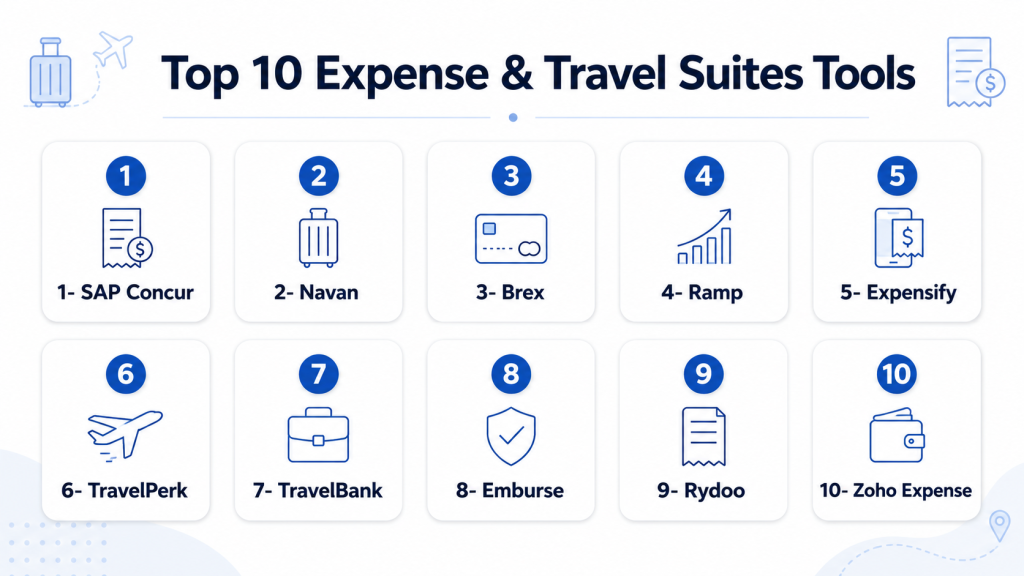
Top 10 Expense & Travel Suites Tools
1- SAP Concur
Short description: SAP Concur is an enterprise travel, expense, and invoice management suite for organizations that need mature finance governance, travel controls, expense reporting, and ERP integration. It is best for large companies with structured approval, audit, compliance, and global spend management needs.
Key Features
- Travel booking and expense management workflows
- Receipt capture and expense report automation
- Policy enforcement and approval routing
- Invoice and AP workflow options
- ERP and finance system integration
- Reporting for travel, expense, and compliance
- Enterprise administration and audit controls
Pros
- Strong fit for large and complex organizations
- Mature travel and expense management ecosystem
- Useful for companies already using SAP or enterprise ERP systems
Cons
- Implementation can be more complex than lighter tools
- User experience may require training and configuration
- Pricing and module structure should be reviewed carefully
Platforms / Deployment
Web / iOS / Android
Cloud
Security & Compliance
Varies / N/A. Buyers should validate SSO, MFA, RBAC, encryption, audit logs, data retention, payment controls, regional compliance, and ERP security requirements directly.
Integrations & Ecosystem
SAP Concur works well when expense and travel workflows must connect with finance, ERP, HR, payroll, corporate cards, and audit systems.
- SAP and ERP systems
- Accounting and finance platforms
- Corporate cards
- Travel booking workflows
- Invoice and AP systems
- Reporting and analytics tools
Support & Community
SAP Concur provides enterprise documentation, implementation resources, partner services, customer support, and account management options. Support depth may vary by contract, region, and implementation complexity.
2- Navan
Short description: Navan is a modern travel and expense suite that combines travel booking, expense automation, corporate cards, policy controls, approvals, and real-time spend visibility. It is useful for companies that want employee-friendly travel and finance workflows in one platform.
Key Features
- Business travel booking workflows
- Expense capture and automated policy review
- Corporate card and spend management support
- Mobile-first traveler and employee experience
- Approval routing and budget visibility
- Real-time reporting for travel and expenses
- Finance and accounting integrations
Pros
- Strong all-in-one travel and expense experience
- Good fit for fast-growing SMBs and mid-market teams
- Useful for employees who need simple mobile workflows
Cons
- Best value depends on adopting the broader platform
- Regional travel content and support should be validated
- Card and expense model should be reviewed by finance teams
Platforms / Deployment
Web / iOS / Android
Cloud
Security & Compliance
Varies / N/A. Buyers should validate SSO, MFA, RBAC, encryption, audit logs, card controls, data retention, and compliance requirements directly.
Integrations & Ecosystem
Navan works well when travel booking, expense automation, cards, approvals, and finance reporting need to operate together.
- Corporate cards
- Expense workflows
- Accounting and ERP tools
- HR and identity systems
- Travel suppliers
- Reporting dashboards
Support & Community
Navan provides onboarding, traveler support, finance support resources, documentation, and customer success options. Support quality may vary by plan, travel volume, and region.
3- Brex
Short description: Brex is a spend management platform with corporate cards, expense management, bill pay, travel-related spend controls, reimbursements, and finance automation. It is useful for startups, scaleups, and enterprises that want card-led control over employee spend.
Key Features
- Corporate cards and virtual cards
- Expense capture and receipt matching
- Budget and policy controls
- Reimbursements and approvals
- Bill pay and AP workflow options
- Travel and event spend support
- Real-time finance reporting
Pros
- Strong corporate card and spend control experience
- Good fit for startups, scaleups, and finance-led teams
- Useful real-time visibility into employee spend
Cons
- Best value depends on card and spend platform adoption
- Travel booking depth should be validated for each use case
- Eligibility and product availability may vary by region
Platforms / Deployment
Web / iOS / Android
Cloud
Security & Compliance
Varies / N/A. Buyers should validate card security, SSO, MFA, RBAC, encryption, audit logs, user permissions, payment controls, and data retention directly.
Integrations & Ecosystem
Brex works well when companies want expense controls, corporate cards, reimbursements, and finance workflows connected in one environment.
- Accounting systems
- ERP workflows
- Corporate cards
- Bill pay and AP tools
- HR and identity systems
- Reporting dashboards
Support & Community
Brex provides documentation, customer support, onboarding help, and finance-focused resources. Support depth may vary by business size, geography, and product usage.
4- Ramp
Short description: Ramp is a finance automation and spend management platform that supports corporate cards, expense management, travel-related spend controls, reimbursements, AP workflows, and real-time reporting. It is useful for companies that want tighter financial control and faster month-end close.
Key Features
- Corporate card management
- Expense automation and receipt capture
- Spend policies and approval routing
- Travel spend visibility and controls
- Bill pay and vendor payment workflows
- Accounting and ERP sync
- Real-time spend analytics
Pros
- Strong finance automation and card control features
- Good fit for cost-conscious finance teams
- Useful for reducing manual expense review
Cons
- Travel booking depth should be validated depending on need
- Best value depends on adopting Ramp as a broader finance platform
- Availability and product fit may vary by region
Platforms / Deployment
Web / iOS / Android
Cloud
Security & Compliance
Varies / N/A. Buyers should validate SSO, MFA, RBAC, card controls, encryption, audit logs, approval controls, and data retention requirements directly.
Integrations & Ecosystem
Ramp is valuable when expense management is part of broader finance automation and spend governance.
- Accounting and ERP systems
- Corporate cards
- Bill pay workflows
- Vendor management
- Approval systems
- Reporting and analytics tools
Support & Community
Ramp provides onboarding, help resources, customer support, and finance operations guidance. Support experience may vary by plan, company size, and product scope.
5- Expensify
Short description: Expensify is an expense management platform with receipt capture, expense reports, reimbursements, corporate card options, bill pay, and travel-related expense workflows. It is best for small businesses, startups, and teams that want a simple employee-friendly expense process.
Key Features
- Receipt scanning and expense capture
- Expense reports and approval workflows
- Reimbursements and card transaction matching
- Corporate card options where available
- Bill pay and invoicing workflows
- Travel expense tracking
- Accounting integrations
Pros
- Easy for employees to submit expenses
- Good fit for SMBs and distributed teams
- Practical receipt capture and reimbursement workflows
Cons
- Complex enterprise travel programs may need deeper tools
- Advanced governance requirements should be validated
- Finance teams should review pricing and workflow fit carefully
Platforms / Deployment
Web / iOS / Android
Cloud
Security & Compliance
Varies / N/A. Buyers should validate user permissions, account security, encryption, audit trails, payment controls, card workflows, and retention policies directly.
Integrations & Ecosystem
Expensify works well when teams need simple receipt capture, approvals, reimbursements, and accounting sync.
- Accounting platforms
- Corporate cards
- Reimbursement workflows
- Bill pay and invoicing
- Travel expense tracking
- Team approval workflows
Support & Community
Expensify provides documentation, product support resources, and onboarding guidance. Support depth may vary by plan, company size, and workflow complexity.
6- TravelPerk
Short description: TravelPerk is a business travel platform with booking, travel policy controls, traveler support, reporting, and integrations with expense systems. It is useful for SMBs and mid-market companies that prioritize travel booking experience and travel program visibility.
Key Features
- Flight, hotel, rail, and car booking where available
- Travel policies and approval workflows
- Traveler profiles and itinerary management
- Reporting and travel spend visibility
- Flexible trip options where configured
- Traveler support workflows
- Expense and business system integrations
Pros
- Strong travel booking experience for SMBs and mid-market teams
- Good balance of flexibility and policy control
- Useful for companies with frequent employee travel
Cons
- Expense suite depth depends on connected workflows
- Global inventory and support should be validated by region
- Finance teams may still need a separate expense tool
Platforms / Deployment
Web / iOS / Android
Cloud
Security & Compliance
Varies / N/A. Buyers should validate SSO, MFA, user roles, encryption, traveler data handling, payment controls, and retention requirements directly.
Integrations & Ecosystem
TravelPerk works well when travel booking must connect with approvals, expense tools, finance systems, and traveler support.
- Expense management tools
- HR and identity systems
- Calendar and productivity tools
- Travel suppliers
- Finance workflows
- Reporting dashboards
Support & Community
TravelPerk provides onboarding, help resources, traveler support, and customer service. Support depth may vary by plan, region, and travel volume.
7- TravelBank
Short description: TravelBank is a travel and expense management platform for companies that need business travel booking, expense tracking, budget controls, approvals, reimbursements, and reporting. It is useful for SMB and mid-market finance teams.
Key Features
- Business travel booking workflows
- Expense tracking and reporting
- Travel policy and approval workflows
- Budget and spend visibility
- Receipt capture and reimbursement support
- Corporate card and finance workflow options
- Reporting dashboards
Pros
- Good fit for SMB and mid-market travel-expense workflows
- Practical budgeting and spend visibility
- Useful for teams moving away from manual travel tracking
Cons
- Enterprise global travel complexity should be validated
- Support and travel content may vary by region
- Buyers should compare expense depth against larger platforms
Platforms / Deployment
Web / iOS / Android
Cloud
Security & Compliance
Varies / N/A. Buyers should validate SSO, MFA, user roles, encryption, audit logs, expense data handling, payment controls, and retention policies directly.
Integrations & Ecosystem
TravelBank works well when teams need business travel booking and expense visibility in one platform.
- Expense workflows
- Corporate cards where supported
- Accounting and finance tools
- Travel booking content
- Budget reporting
- Approval workflows
Support & Community
TravelBank provides documentation, onboarding support, and customer service options. Support depth may vary by plan, company size, and travel volume.
8- Emburse
Short description: Emburse provides expense management, AP automation, invoice workflows, travel expense control, and spend optimization solutions for companies of different sizes. It is useful for organizations that need structured expense management and finance process automation.
Key Features
- Expense report automation
- Receipt capture and policy checks
- Invoice and AP automation options
- Approval workflows and audit trails
- Spend reporting and analytics
- Travel expense support
- Finance system integrations
Pros
- Strong finance operations and expense workflow depth
- Good fit for organizations with structured approval needs
- Useful for AP, invoice, and expense process alignment
Cons
- Travel booking may require connected tools or modules
- Product fit should be matched carefully to company size
- Implementation can vary based on selected Emburse product
Platforms / Deployment
Web / iOS / Android access varies
Cloud
Security & Compliance
Varies / N/A. Buyers should validate SSO, MFA, RBAC, encryption, audit logs, retention policies, payment controls, and compliance needs directly.
Integrations & Ecosystem
Emburse is useful when expense and AP workflows need to connect with accounting, ERP, finance operations, and reporting.
- Accounting and ERP systems
- Corporate cards
- Invoice and AP workflows
- Approval and audit tools
- Travel expense data
- Reporting systems
Support & Community
Emburse provides onboarding, support resources, implementation guidance, and finance-focused customer assistance. Support scope may vary by product, plan, and company size.
9- Rydoo
Short description: Rydoo is an expense management platform focused on mobile expense capture, approval workflows, compliance, travel expense tracking, and finance reporting. It is useful for international teams that need fast expense submission and policy control.
Key Features
- Mobile receipt capture
- Expense approval workflows
- Policy checks and compliance controls
- Mileage and travel expense support
- Multi-currency expense handling
- Finance and accounting integrations
- Reporting and analytics
Pros
- Strong mobile expense experience
- Good fit for distributed and international teams
- Practical policy and approval workflows
Cons
- Travel booking features may be limited compared with travel-first suites
- Buyers should validate regional tax and compliance needs
- Larger enterprise integrations may require planning
Platforms / Deployment
Web / iOS / Android
Cloud
Security & Compliance
Varies / N/A. Buyers should validate user roles, SSO, MFA, encryption, audit logs, retention settings, and data protection requirements directly.
Integrations & Ecosystem
Rydoo works well when companies need mobile expense capture connected with finance and approval workflows.
- Accounting systems
- ERP workflows
- Corporate cards
- Mileage tracking
- Approval workflows
- Travel expense reporting
Support & Community
Rydoo provides documentation, onboarding resources, and customer support options. Support depth may vary by plan, geography, and implementation needs.
10- Zoho Expense
Short description: Zoho Expense is an expense management platform for businesses that need receipt capture, approvals, reimbursements, travel expense tracking, mileage, policy enforcement, and integration with the Zoho ecosystem. It is useful for SMBs and growing teams.
Key Features
- Receipt scanning and expense reports
- Approval workflows and policy enforcement
- Mileage and per diem support where configured
- Corporate card reconciliation
- Reimbursement workflows
- Travel expense tracking
- Integration with Zoho and accounting tools
Pros
- Strong fit for Zoho ecosystem users
- Practical value for SMB expense management
- Useful for teams needing structured approvals without heavy complexity
Cons
- Travel booking depth is limited compared with travel-first platforms
- Best value depends on Zoho ecosystem fit
- Enterprise global travel needs may require additional tools
Platforms / Deployment
Web / iOS / Android
Cloud
Security & Compliance
Varies / N/A. Buyers should validate account security, user permissions, encryption, audit logs, data retention, payment controls, and compliance requirements directly.
Integrations & Ecosystem
Zoho Expense works well when expense management needs to connect with Zoho business applications and accounting systems.
- Zoho Books
- Zoho CRM
- Accounting platforms
- Corporate cards
- Reimbursement workflows
- Expense reporting dashboards
Support & Community
Zoho provides product documentation, support resources, onboarding guidance, and ecosystem help. Support depth may vary by plan and product bundle.
Comparison Table
| Tool Name | Best For | Platform Supported | Deployment | Standout Feature | Public Rating |
|---|---|---|---|---|---|
| SAP Concur | Enterprise travel, expense, and invoice governance | Web, iOS, Android | Cloud | Mature T&E and ERP-connected workflows | N/A |
| Navan | Unified travel, expense, and card workflows | Web, iOS, Android | Cloud | Travel booking plus real-time expense automation | N/A |
| Brex | Card-led spend and expense control | Web, iOS, Android | Cloud | Corporate cards with expense and spend controls | N/A |
| Ramp | Finance automation and spend control | Web, iOS, Android | Cloud | Real-time spend visibility and policy automation | N/A |
| Expensify | SMB expense reports and reimbursements | Web, iOS, Android | Cloud | Simple receipt capture and employee expense submission | N/A |
| TravelPerk | Business travel booking and policy control | Web, iOS, Android | Cloud | Employee-friendly travel booking and support | N/A |
| TravelBank | SMB travel and expense visibility | Web, iOS, Android | Cloud | Business travel booking plus budget tracking | N/A |
| Emburse | Structured expense and AP automation | Web, mobile varies | Cloud | Expense, invoice, and AP workflow depth | N/A |
| Rydoo | Mobile expense management for distributed teams | Web, iOS, Android | Cloud | Fast mobile expense capture and approval | N/A |
| Zoho Expense | SMB expense management and Zoho users | Web, iOS, Android | Cloud | Expense workflows connected with Zoho ecosystem | N/A |
Evaluation & Scoring of Expense & Travel Suites
| Tool Name | Core 25% | Ease 15% | Integrations 15% | Security 10% | Performance 10% | Support 10% | Value 15% | Weighted Total |
|---|---|---|---|---|---|---|---|---|
| SAP Concur | 9.3 | 7.5 | 9.2 | 8.6 | 8.8 | 8.6 | 7.4 | 8.5 |
| Navan | 9.0 | 8.8 | 8.8 | 8.2 | 8.7 | 8.4 | 8.1 | 8.6 |
| Brex | 8.7 | 8.7 | 8.6 | 8.3 | 8.6 | 8.3 | 8.2 | 8.5 |
| Ramp | 8.8 | 8.8 | 8.7 | 8.3 | 8.6 | 8.3 | 8.5 | 8.6 |
| Expensify | 8.1 | 8.8 | 8.1 | 7.7 | 8.2 | 8.0 | 8.5 | 8.2 |
| TravelPerk | 8.6 | 8.7 | 8.3 | 8.0 | 8.5 | 8.3 | 8.1 | 8.4 |
| TravelBank | 8.2 | 8.4 | 8.0 | 7.8 | 8.2 | 8.0 | 8.3 | 8.1 |
| Emburse | 8.5 | 8.0 | 8.5 | 8.1 | 8.4 | 8.2 | 7.8 | 8.3 |
| Rydoo | 8.0 | 8.6 | 8.1 | 7.9 | 8.2 | 8.0 | 8.2 | 8.1 |
| Zoho Expense | 7.9 | 8.5 | 8.2 | 7.9 | 8.1 | 8.0 | 8.6 | 8.2 |
Which Expense & Travel Suites Tool Is Right for You?
Solo / Freelancer
Solo professionals and freelancers usually do not need a full expense and travel suite unless they travel frequently or manage multiple client projects. A simple accounting tool, receipt app, or card statement review may be enough for very low expense volume.
If a solo operator wants structured expense tracking, Expensify, Zoho Expense, or Rydoo can be practical starting points. If business travel becomes frequent, TravelPerk or TravelBank may also be worth reviewing.
SMB
Small businesses need simple receipt capture, approvals, reimbursements, card controls, and accounting integration without heavy implementation. Expensify, Zoho Expense, Ramp, Brex, TravelBank, and Navan are strong candidates depending on whether the company wants expense-first, card-first, or travel-plus-expense workflows.
SMBs should prioritize ease of use, fast setup, mobile submission, accounting sync, reimbursement speed, and transparent cost.
Mid-Market
Mid-market companies often need department budgets, approval rules, corporate cards, travel policy, ERP integration, audit logs, and reporting by cost center. Navan, Ramp, Brex, TravelPerk, SAP Concur, Emburse, and TravelBank can fit different operating models.
This segment should test policy automation, finance controls, employee adoption, card reconciliation, travel booking coverage, and reporting flexibility before rollout.
Enterprise
Enterprise organizations need global policy controls, ERP integration, audit readiness, SSO, complex approvals, travel program visibility, duty of care, invoice workflows, and compliance reporting. SAP Concur, Navan, Emburse, Brex, Ramp, and TravelPerk are strong enterprise candidates depending on architecture and finance strategy.
Enterprise buyers should involve finance, procurement, travel managers, IT, security, HR, legal, and frequent travelers before standardizing a suite.
Budget vs Premium
Budget-conscious teams should evaluate Zoho Expense, Expensify, Rydoo, TravelBank, and selected entry-level options from Ramp or Brex. These tools can cover core expense workflows without immediate enterprise-level complexity.
Premium buyers should evaluate SAP Concur, Navan, Brex, Ramp, TravelPerk, and Emburse when global scale, ERP integration, corporate cards, travel booking, and audit governance matter more than lowest monthly cost.
Feature Depth vs Ease of Use
If ease of use matters most, Expensify, Zoho Expense, Ramp, Brex, Rydoo, and Navan are strong starting points. If feature depth matters more, SAP Concur, Emburse, Navan, Ramp, and TravelPerk should be reviewed closely.
The best platform should match the company’s finance maturity and employee behavior instead of creating a process employees avoid.
Integrations & Scalability
Expense and travel suites should be checked for integrations with ERP, accounting systems, HRIS, payroll, identity providers, corporate cards, banks, travel suppliers, AP tools, and reporting platforms. SAP Concur, Navan, Ramp, Brex, Emburse, and Zoho Expense are strong options for integration-heavy finance operations.
For scaling across regions, test multi-currency support, tax workflows, reimbursement methods, data export, user roles, and local policy rules.
Security & Compliance Needs
Expense and travel suites may store employee names, card details, receipts, travel records, payment data, merchant information, approvals, passport details, and finance records. Buyers should review MFA, SSO, RBAC, encryption, audit logs, card controls, data retention, and export permissions.
Regulated organizations should also validate approval history, audit trails, tax reporting, policy exceptions, and finance system sync before deployment.
Frequently Asked Questions
1. What are Expense & Travel Suites?
Expense & Travel Suites are platforms that manage business travel, employee expenses, reimbursements, corporate cards, approvals, and finance reporting.
They help employees submit receipts, book travel, follow policies, and get reimbursed faster.
Finance teams use them to control spend, review approvals, and export data to accounting or ERP systems.
The goal is to reduce manual work and improve spend visibility.
2. Who needs Expense & Travel Suites?
SMBs, mid-market companies, enterprises, consulting firms, sales teams, remote teams, and frequent travel organizations can use them.
They are especially useful when employees submit many expenses or travel regularly.
Finance teams benefit when approvals, reimbursements, card controls, and audit trails become difficult to manage manually.
Very small teams may only need basic accounting or receipt tools.
3. How much do Expense & Travel Suites cost?
Pricing varies by vendor, user count, modules, card program, travel booking needs, support level, integrations, and company size.
Some tools charge per user, some use custom enterprise pricing, and some are tied to card or spend management models.
SMS alerts, travel support, premium workflows, and implementation services may add cost.
Buyers should compare total cost and not only the starting subscription.
4. What features should buyers look for?
Buyers should look for receipt capture, expense reports, approvals, reimbursements, card controls, travel booking, and accounting sync.
Larger companies may need SSO, audit logs, ERP integration, global policy rules, multi-currency support, and advanced reporting.
Employee experience is also important because poor adoption weakens policy control.
Finance teams should test the full expense-to-close workflow.
5. Can these suites reduce manual finance work?
Yes, they can reduce manual work by automating receipt capture, policy checks, approval routing, card matching, reimbursement workflows, and accounting exports.
They also help finance teams identify duplicate claims, missing receipts, out-of-policy spend, and delayed approvals.
The biggest gains usually come when employees use the mobile app consistently.
Clean setup and strong policy design are essential.
6. Which tool is best for small businesses?
Expensify, Zoho Expense, Ramp, Brex, TravelBank, and Rydoo are practical options for many small businesses.
They support receipt capture, approvals, reimbursements, and basic spend visibility without heavy enterprise complexity.
If travel booking is important, Navan or TravelPerk may also be strong options.
The best choice depends on whether the business needs expenses, cards, travel, or all three.
7. Which tool is best for enterprises?
SAP Concur, Navan, Emburse, Ramp, Brex, and TravelPerk are strong enterprise candidates depending on travel, expense, card, and ERP needs.
SAP Concur is often suited to complex governance and ERP-connected environments.
Navan, Ramp, and Brex are stronger for modern user experience and card-led workflows.
Enterprises should run a pilot before replacing a legacy system.
8. What are common mistakes when choosing these tools?
Common mistakes include focusing only on price, ignoring employee experience, and not testing accounting or ERP sync.
Teams also forget to map approval rules, reimbursement timelines, card controls, and audit needs before rollout.
Another mistake is buying a travel tool when the real problem is expense compliance.
A pilot with finance admins and frequent travelers helps reveal gaps early.
9. Can Expense & Travel Suites integrate with accounting systems?
Yes, many suites integrate with accounting, ERP, HRIS, payroll, corporate card, banking, and reporting systems.
Integrations help match receipts, expenses, payments, invoices, cost centers, and reimbursement data.
The depth of integration varies by vendor and plan.
Buyers should test real data sync before going live.
10. What are alternatives to Expense & Travel Suites?
Alternatives include spreadsheets, paper receipts, email approvals, public travel booking sites, shared company cards, basic accounting tools, and manual reimbursements.
These methods may work for small teams with low travel and expense volume.
As the company grows, manual processes become slow, error-prone, and harder to audit.
A dedicated suite is better for policy control, spend visibility, and finance automation.
Conclusion
Expense & Travel Suites help companies bring travel booking, expense reporting, corporate cards, reimbursements, approvals, and finance reporting into a more controlled and automated workflow. The best platform depends on company size, travel volume, card strategy, ERP environment, employee experience needs, and compliance expectations. SAP Concur is strong for enterprise governance and ERP-connected travel and expense management, while Navan is strong for unified travel, expense, and card workflows. Brex and Ramp are strong for card-led spend control and finance automation, while Expensify, Rydoo, Zoho Expense, and TravelBank fit teams that want practical expense and travel visibility without heavy complexity. TravelPerk is stronger for travel-first programs, and Emburse is useful for structured expense and AP automation. The smartest next step is to shortlist two or three suites, test mobile expense capture and approval workflows, validate accounting and travel integrations, review security controls, and run a pilot before scaling across the company.

Find Trusted Cardiac Hospitals
Compare heart hospitals by city and services — all in one place.
Explore Hospitals
Expense and travel suites are most valuable when they help organizations manage business travel, employee expenses, reimbursements, and travel policies through a single integrated platform. By providing travel booking, automated expense reporting, receipt scanning, policy compliance, approval workflows, corporate card integration, reimbursement management, real-time spending analytics, and integration with ERP, HR, and accounting systems, these platforms enable businesses to reduce administrative effort, control travel costs, improve policy compliance, accelerate reimbursements, and gain greater visibility into corporate travel and expense spending.