Introduction
Ride-Hailing Apps connect passengers with nearby drivers through a mobile platform, allowing users to book rides, track drivers, compare fares, pay digitally, share trips, and rate service quality. These apps are used for daily commuting, airport transfers, business travel, city mobility, late-night transport, and last-mile connectivity. This category matters because urban mobility is becoming more app-based, cashless, safety-focused, and data-driven. Riders want faster pickups, transparent pricing, multiple vehicle options, reliable driver matching, and in-app safety tools. Businesses also use ride-hailing platforms for employee transport, corporate mobility, customer pickups, and travel expense workflows.
Real World Use Cases:
- Booking daily rides for office, school, airport, and city travel
- Comparing fare options across cars, bikes, autos, taxis, and premium rides
- Using corporate ride programs for employee and business travel
- Managing safer late-night transport with live trip sharing
- Supporting first-mile and last-mile connectivity near public transport
Evaluation Criteria for Buyers:
- City and country availability
- Ride categories and vehicle options
- Pricing transparency and fare controls
- Driver availability and pickup reliability
- Safety features and emergency support
- Payment methods and wallet support
- Corporate travel and business account features
- App usability and customer support
- Driver quality and rating system
- Data privacy and account security
Best for: Daily commuters, tourists, business travelers, students, office employees, enterprises, logistics teams, event organizers, and urban users who need flexible, on-demand transport across cities.
Not ideal for: Users in areas with weak ride-hailing coverage, poor driver availability, or strong public transport alternatives may not always need ride-hailing apps. For scheduled long-distance travel, fixed-route shuttles, public transit, private rentals, or traditional taxi contracts may sometimes be better.
Key Trends in Ride-Hailing Apps
- AI-based dispatch is becoming more advanced: Platforms are using smarter matching, demand forecasting, route prediction, fraud detection, and dynamic pricing controls to improve rider and driver experience.
- Safety features are becoming a major differentiator: Live trip sharing, emergency buttons, driver verification, ride PINs, audio recording, route monitoring, and support escalation are now expected.
- Electric mobility is growing: More platforms are adding electric cars, e-bikes, e-scooters, and low-emission ride options to support sustainability goals.
- Multi-modal transport is expanding: Ride-hailing apps are increasingly combining cars, bikes, taxis, autos, public transport links, deliveries, and micro-mobility options.
- Corporate ride programs are becoming more structured: Businesses need ride policies, central billing, employee travel controls, monthly reports, and duty-of-care visibility.
- Driver earnings and regulation remain key issues: Governments are paying closer attention to driver classification, platform licensing, fare transparency, insurance, and labor protections.
- Regional platforms remain powerful: While global brands dominate many markets, local leaders such as Ola, Grab, Careem, Gojek, and Cabify continue to win through regional pricing, language, payment, and vehicle fit.
- Digital payments and wallets are standard: Riders expect cards, wallets, UPI, cash options, corporate billing, promo codes, and local payment methods.
- Subscription and loyalty programs are increasing: Ride passes, premium memberships, bundled delivery benefits, and loyalty rewards help platforms retain frequent users.
- Privacy and data governance are under review: Ride-hailing apps process location history, payment data, phone numbers, trip routes, device data, and identity details, making privacy controls important.
How We Selected These Tools
The tools below were selected using practical ride-hailing and urban mobility evaluation logic:
- Market recognition across global and regional ride-hailing markets
- Availability across major cities, countries, and mobility corridors
- Strength of core ride-hailing features such as booking, fare estimates, driver matching, maps, and payments
- Safety features such as trip sharing, emergency support, driver checks, PINs, and support escalation
- Ride type variety including economy, premium, taxi, auto, bike, shared, corporate, and intercity options
- Payment flexibility including cards, wallets, cash, local methods, and corporate billing
- App usability for riders, drivers, travelers, and business users
- Customer support and issue resolution experience
- Regional fit for Asia, Europe, Latin America, Middle East, North America, Africa, and India
- Practical value for daily mobility, corporate travel, tourism, and urban commuting
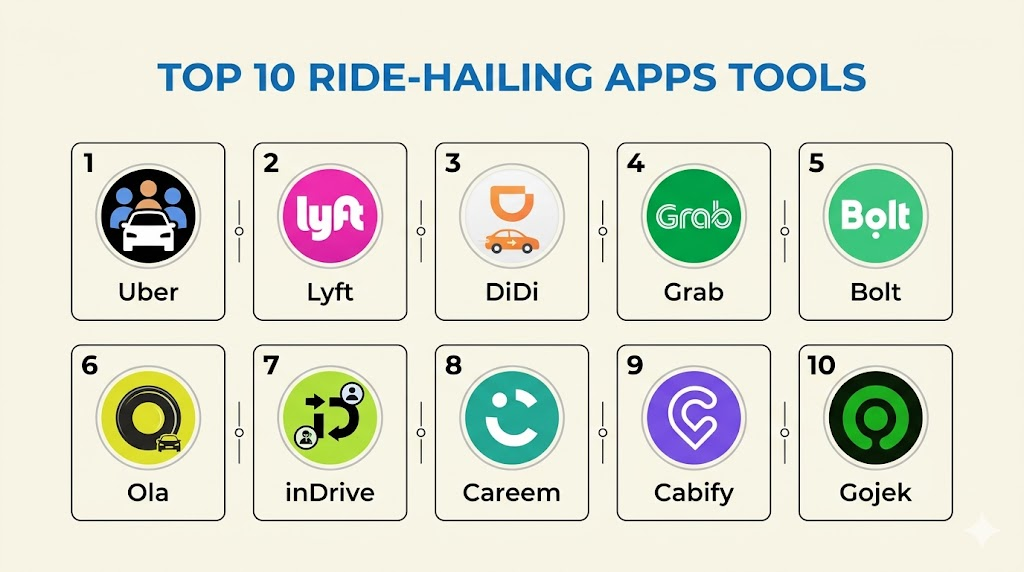
Top 10 Ride-Hailing Apps Tools
1- Uber
Short description: Uber is one of the most widely recognized ride-hailing apps, offering on-demand rides, airport trips, business rides, premium cars, shared mobility options in some markets, and driver-partner services. It is best for global travelers, daily commuters, enterprises, and cities where Uber has strong driver coverage.
Key Features
- On-demand ride booking with real-time driver tracking
- Multiple ride categories depending on city
- Fare estimate before booking
- In-app payments and digital receipts
- Trip sharing and safety tools
- Uber for Business support
- Driver and rider rating system
Pros
- Strong global brand recognition and city coverage
- Useful for both personal and corporate rides
- Mature app experience with broad payment and support workflows
Cons
- Pricing can increase during peak demand
- Availability and ride types vary by city
- Driver experience and support quality can vary by market
Platforms / Deployment
Web / iOS / Android
Cloud
Security & Compliance
Varies / N/A. Buyers should validate account security, payment protection, driver verification, trip safety features, location privacy, business account controls, and local regulatory compliance.
Integrations & Ecosystem
Uber works well for individuals and organizations that need ride booking connected with business travel, payments, maps, and reporting.
- Uber for Business
- Digital wallets and cards
- Travel and expense workflows
- Maps and navigation systems
- Corporate billing and reports
- Airport and event travel workflows
Support & Community
Uber provides in-app help, rider support, driver support, safety resources, and business account support. Support quality may vary by region, issue type, and account category.
2- Lyft
Short description: Lyft is a major ride-hailing platform focused mainly on the United States and Canada, offering personal rides, business rides, scheduled rides, bikes, scooters, and transportation services in selected areas. It is useful for North American riders and companies managing domestic employee travel.
Key Features
- On-demand rides and scheduled pickups
- Standard, premium, and larger vehicle options where available
- In-app payments and receipts
- Business ride programs
- Bikes and scooters in selected cities
- Driver and rider ratings
- Safety and support features
Pros
- Strong presence in North America
- Good option for business travel and everyday commuting
- Useful bike and scooter ecosystem in supported cities
Cons
- Geographic coverage is narrower than some global apps
- Peak pricing can affect affordability
- Ride availability varies by city and time
Platforms / Deployment
Web / iOS / Android
Cloud
Security & Compliance
Varies / N/A. Buyers should validate account protection, payment controls, trip safety tools, driver screening, business account permissions, and local ride-hailing regulations.
Integrations & Ecosystem
Lyft fits riders and organizations that need North America-focused ride-hailing and business mobility workflows.
- Lyft Business
- Digital payments
- Bikes and scooters where supported
- Travel and expense workflows
- Corporate ride programs
- Event and healthcare transport workflows where applicable
Support & Community
Lyft provides rider support, driver resources, safety guidance, and business travel support options. Support experience may vary by region and service type.
3- DiDi
Short description: DiDi is a major mobility technology platform with ride-hailing, taxi-hailing, designated driving, and related mobility services across several global markets. It is especially relevant in China, Latin America, and selected Asia-Pacific regions.
Key Features
- Ride-hailing and taxi-hailing services
- Multiple ride categories depending on market
- Fare estimates and driver matching
- In-app payments and local payment options
- Safety and trip monitoring features
- Driver and passenger rating systems
- Additional mobility services in selected regions
Pros
- Strong regional presence in key international markets
- Supports local payment and mobility behaviors
- Useful for riders in cities where DiDi has strong supply
Cons
- Availability varies significantly by country
- App experience and ride types can differ by region
- Corporate travel features may vary by market
Platforms / Deployment
iOS / Android
Cloud
Security & Compliance
Varies / N/A. Buyers should validate account security, driver verification, payment protection, location privacy, emergency support, and local mobility regulations.
Integrations & Ecosystem
DiDi works well in regions where it has strong local driver networks and mobility service coverage.
- Ride-hailing
- Taxi-hailing
- Local digital payments
- Driver services
- Mobility services
- Business travel workflows where available
Support & Community
DiDi provides app-based customer support and driver support resources. Support depth and language availability can vary by region.
4- Grab
Short description: Grab is a major Southeast Asian super app offering ride-hailing, food delivery, payments, financial services, and local mobility services. It is best for riders, tourists, and businesses operating across Southeast Asian markets.
Key Features
- Car, taxi, bike, and mobility services depending on market
- Food, delivery, and payments ecosystem
- Digital wallet and local payment support
- Fare estimates and real-time tracking
- Rewards and membership features
- Business travel options where available
- In-app safety and support tools
Pros
- Strong Southeast Asia coverage
- Super app ecosystem supports rides, food, and payments
- Useful for travelers and local commuters
Cons
- Not available globally
- Ride types vary across countries
- Pricing and availability can fluctuate in peak periods
Platforms / Deployment
iOS / Android
Cloud
Security & Compliance
Varies / N/A. Buyers should validate wallet security, account protection, driver checks, trip safety, data privacy, and local compliance requirements.
Integrations & Ecosystem
Grab is useful where mobility, payments, delivery, and customer loyalty need to operate inside one consumer ecosystem.
- Grab rides
- GrabPay
- Food and delivery services
- Rewards programs
- Business mobility workflows
- Local partner services
Support & Community
Grab provides in-app help, rider support, driver resources, merchant support, and business support where available. Support quality may vary by market.
5- Bolt
Short description: Bolt is a ride-hailing and mobility platform with services across many European and African markets, plus selected regions elsewhere. It offers ride-hailing, scooters, car-sharing, and food delivery in some markets.
Key Features
- On-demand ride booking
- Multiple vehicle categories where available
- Scooter and micro-mobility options in selected cities
- Transparent fare estimates
- Business ride support where available
- Driver and rider ratings
- In-app payment workflows
Pros
- Strong in many European and African cities
- Often positioned as a practical alternative to larger global platforms
- Supports multiple mobility services in selected markets
Cons
- Coverage varies by city and country
- Support and ride types differ by region
- Business features may not be equally mature everywhere
Platforms / Deployment
iOS / Android
Cloud
Security & Compliance
Varies / N/A. Buyers should validate payment security, driver verification, account protection, trip safety tools, business account controls, and local regulatory requirements.
Integrations & Ecosystem
Bolt fits users and organizations that need ride-hailing and mobility options in supported cities.
- Ride-hailing
- Scooters where available
- Food delivery where available
- Business rides
- Digital payments
- City mobility workflows
Support & Community
Bolt provides app support, driver resources, and customer help channels. Support depth may vary by market and service category.
6- Ola
Short description: Ola is a major Indian ride-hailing platform offering car rides, auto-rickshaws, bikes, rentals, outstation rides, and other mobility options depending on city. It is best for users in India and selected international markets where Ola operates.
Key Features
- City rides, autos, bikes, and rentals where available
- Outstation and hourly ride options
- Fare estimates and real-time tracking
- Cash and digital payment options depending on market
- Driver and rider ratings
- Ride categories for different budgets
- Local mobility support for Indian cities
Pros
- Strong India-focused ride-hailing ecosystem
- Useful vehicle mix including autos and bikes in many areas
- Practical for city, rental, and outstation use cases
Cons
- International coverage is limited compared with global platforms
- Service quality can vary by city
- Peak-time availability and pricing can fluctuate
Platforms / Deployment
iOS / Android
Cloud
Security & Compliance
Varies / N/A. Buyers should validate driver verification, trip sharing, payment protection, emergency support, data privacy, and local transport compliance.
Integrations & Ecosystem
Ola works well in India where ride-hailing often needs multiple vehicle categories and local payment support.
- Car rides
- Auto-rickshaw rides
- Bike rides
- Rentals and outstation rides
- Digital and cash payments
- Local mobility workflows
Support & Community
Ola provides in-app support, rider assistance, and driver support channels. Support experience can vary depending on location and issue type.
7- inDrive
Short description: inDrive is a ride-hailing app known for its price-negotiation model, where riders can suggest fares and drivers can accept, reject, or counter the offer. It is useful in markets where flexible pricing and direct fare agreement are valued.
Key Features
- Fare negotiation between rider and driver
- City rides and intercity rides in supported markets
- Courier and delivery services in selected regions
- Driver choice based on price, rating, and vehicle
- Cash and digital payment options depending on market
- Wide presence across many cities
- Flexible ride request workflow
Pros
- Unique fare negotiation model
- Useful in price-sensitive markets
- Gives riders more control over ride offers
Cons
- Fare negotiation may not suit users who prefer instant fixed pricing
- Availability varies by region
- Corporate ride controls may be limited compared with enterprise-focused tools
Platforms / Deployment
iOS / Android
Cloud
Security & Compliance
Varies / N/A. Buyers should validate payment handling, driver verification, rider safety features, trip support, location privacy, and local compliance requirements.
Integrations & Ecosystem
inDrive fits riders who want flexible pricing and multi-service mobility in supported markets.
- City rides
- Intercity travel
- Courier delivery where available
- Freight and delivery options where available
- Local payment methods
- Driver selection workflows
Support & Community
inDrive provides in-app support and driver/rider help resources. Support experience may vary by country, city, and service category.
8- Careem
Short description: Careem is a mobility and services app with strong presence across the Middle East and nearby regions. It supports ride-hailing, delivery, payments, and other everyday services depending on market.
Key Features
- Ride-hailing and taxi booking
- Multiple car categories depending on city
- Delivery and everyday services in selected markets
- Wallet and digital payment support
- Business travel options where available
- Customer support and safety features
- Regional service localization
Pros
- Strong Middle East regional presence
- Useful super-app style experience in supported cities
- Good local fit for payments, language, and mobility behavior
Cons
- Availability is regional, not global
- Services vary by country
- Business features should be validated market by market
Platforms / Deployment
iOS / Android
Cloud
Security & Compliance
Varies / N/A. Buyers should validate account security, payment protection, driver checks, emergency support, location privacy, and local regulatory compliance.
Integrations & Ecosystem
Careem works well for users in supported regions who need ride-hailing plus everyday app-based services.
- Ride-hailing
- Delivery services
- Digital wallet
- Business mobility where available
- Local payment methods
- Regional service marketplace
Support & Community
Careem provides app support, customer service, driver support, and business resources where available. Support depth can vary by city and service type.
9- Cabify
Short description: Cabify is a ride-hailing and mobility platform used in Spain and Latin American markets, offering private rides, taxi options, and corporate mobility services in selected regions. It is useful for riders and businesses in cities where Cabify has strong coverage.
Key Features
- Private ride and taxi booking
- Fare estimates and ride tracking
- Corporate mobility solutions
- Safety and driver rating features
- Digital payments and receipts
- Scheduled rides where available
- Local city mobility options
Pros
- Strong fit for Spain and Latin American markets
- Useful for corporate and personal rides
- Focused regional mobility experience
Cons
- Not available in many global markets
- Ride options vary by city
- Smaller ecosystem than global super apps
Platforms / Deployment
Web / iOS / Android
Cloud
Security & Compliance
Varies / N/A. Buyers should validate account controls, payment protection, driver verification, trip safety, corporate account permissions, and local regulations.
Integrations & Ecosystem
Cabify is useful for users and businesses that need ride-hailing in supported Spanish and Latin American markets.
- Private rides
- Taxi services
- Corporate mobility
- Digital receipts
- Business travel workflows
- Local payment options
Support & Community
Cabify provides customer support, driver resources, and business support where available. Support quality may vary by region and account type.
10- Gojek
Short description: Gojek is an Indonesian super app that includes ride-hailing, food delivery, logistics, payments, and everyday digital services. It is best for users in Indonesia and supported Southeast Asian markets where Gojek has strong service coverage.
Key Features
- Motorbike and car ride-hailing
- Food delivery and courier services
- Digital payments ecosystem
- Local service marketplace
- Real-time tracking and fare estimates
- Ratings and customer support
- Multi-service super app experience
Pros
- Strong local fit in Indonesia and selected Southeast Asian markets
- Useful motorbike ride-hailing for dense city travel
- Combines transport, delivery, and payments in one app
Cons
- Limited global availability
- Services vary by market
- Corporate ride management may be less relevant than consumer mobility
Platforms / Deployment
iOS / Android
Cloud
Security & Compliance
Varies / N/A. Buyers should validate wallet security, account protection, driver verification, trip support, location privacy, and local compliance requirements.
Integrations & Ecosystem
Gojek works well in markets where users want transport, payments, food, and logistics inside one everyday app.
- GoRide and GoCar where available
- Food delivery
- Courier and logistics services
- Wallet and payment services
- Local merchant ecosystem
- Customer support workflows
Support & Community
Gojek provides in-app help, customer support, driver resources, and merchant support across supported services. Support availability can vary by market.
Comparison Table
| Tool Name | Best For | Platform Supported | Deployment | Standout Feature | Public Rating |
|---|---|---|---|---|---|
| Uber | Global ride-hailing and business mobility | Web, iOS, Android | Cloud | Broad global reach and mature ride ecosystem | N/A |
| Lyft | North American rides and business travel | Web, iOS, Android | Cloud | Strong US and Canada ride-hailing presence | N/A |
| DiDi | China, Latin America, and regional mobility | iOS, Android | Cloud | Large mobility platform with regional strength | N/A |
| Grab | Southeast Asia super app mobility | iOS, Android | Cloud | Rides, payments, delivery, and rewards ecosystem | N/A |
| Bolt | Europe and Africa ride-hailing | iOS, Android | Cloud | Affordable mobility and micro-mobility options | N/A |
| Ola | India-focused ride-hailing | iOS, Android | Cloud | Cars, autos, bikes, rentals, and outstation rides | N/A |
| inDrive | Flexible fare negotiation markets | iOS, Android | Cloud | Rider-driver price agreement model | N/A |
| Careem | Middle East regional mobility | iOS, Android | Cloud | Regional super app for rides and services | N/A |
| Cabify | Spain and Latin America mobility | Web, iOS, Android | Cloud | Regional ride-hailing and corporate mobility | N/A |
| Gojek | Indonesia and Southeast Asia super app | iOS, Android | Cloud | Motorbike rides, cars, delivery, and payments | N/A |
Evaluation & Scoring of Ride-Hailing Apps
| Tool Name | Core 25% | Ease 15% | Integrations 15% | Security 10% | Performance 10% | Support 10% | Value 15% | Weighted Total |
|---|---|---|---|---|---|---|---|---|
| Uber | 9.4 | 9.0 | 9.0 | 8.2 | 9.0 | 8.5 | 8.0 | 8.8 |
| Lyft | 8.5 | 8.7 | 8.2 | 8.0 | 8.5 | 8.2 | 8.0 | 8.3 |
| DiDi | 8.9 | 8.5 | 8.3 | 7.9 | 8.7 | 8.1 | 8.3 | 8.5 |
| Grab | 9.0 | 8.8 | 8.8 | 8.0 | 8.7 | 8.3 | 8.4 | 8.7 |
| Bolt | 8.5 | 8.6 | 8.1 | 7.8 | 8.5 | 8.0 | 8.6 | 8.4 |
| Ola | 8.4 | 8.4 | 8.0 | 7.7 | 8.2 | 7.8 | 8.4 | 8.2 |
| inDrive | 8.2 | 8.3 | 7.7 | 7.6 | 8.1 | 7.8 | 8.8 | 8.1 |
| Careem | 8.4 | 8.5 | 8.3 | 7.8 | 8.3 | 8.0 | 8.2 | 8.3 |
| Cabify | 8.0 | 8.3 | 7.8 | 7.7 | 8.1 | 7.9 | 8.0 | 8.0 |
| Gojek | 8.6 | 8.7 | 8.6 | 7.9 | 8.4 | 8.1 | 8.5 | 8.5 |
Which Ride-Hailing Apps Tool Is Right for You?
Solo / Freelancer
Solo users, freelancers, tourists, and daily commuters should choose the app with the best local coverage, fastest pickup times, and most transparent fares. Uber, Bolt, Lyft, Grab, Ola, inDrive, and Gojek can all be strong choices depending on the city.
Frequent travelers should keep two or three apps installed because pricing, availability, and ride categories can change by location and time.
SMB
Small businesses should prioritize apps that support business profiles, monthly receipts, employee ride tracking, and simple payment management. Uber, Lyft, Grab, Careem, Cabify, and Ola may work well depending on region.
SMBs should define when employees can use ride-hailing, which ride types are allowed, and how receipts are submitted for reimbursement.
Mid-Market
Mid-market companies often need employee transport policies, central billing, regional coverage, ride reports, and duty-of-care visibility. Uber for Business, Lyft Business, Grab for Business, Careem for Business, and Cabify for Business are worth reviewing where available.
This segment should compare ride availability, invoice workflows, policy controls, rider safety, and integration with expense tools.
Enterprise
Enterprise teams need scalable corporate mobility controls, data privacy, consolidated billing, employee safety, travel policy enforcement, and reporting by department or cost center. Uber, Lyft, Grab, Careem, Cabify, and regional mobility providers can fit different enterprise needs.
Enterprises should involve HR, travel, finance, security, procurement, and legal teams before standardizing ride-hailing providers.
Budget vs Premium
Budget-conscious riders should compare Bolt, inDrive, Ola, Grab, Gojek, and local taxi apps where available. These platforms may provide economical ride categories, motorbike rides, autos, shared mobility, or fare negotiation depending on region.
Premium users may prefer Uber, Lyft, Careem, Cabify, and premium categories on regional platforms when comfort, reliability, business receipts, or higher service levels matter more.
Feature Depth vs Ease of Use
If ease of use matters most, Uber, Lyft, Grab, Bolt, and Careem are strong choices in supported markets. If feature depth matters more, Grab and Gojek offer super app ecosystems, while Uber and Lyft provide strong business mobility options in many locations.
If price control matters most, inDrive’s negotiation model may be useful in supported markets.
Integrations & Scalability
Ride-hailing apps should be reviewed for business account support, expense receipts, card billing, wallet payments, reporting, employee ride policies, and travel expense integrations. Uber, Lyft, Grab, Careem, and Cabify are strong options for business mobility where supported.
For larger teams, test reporting exports, policy controls, invoice options, employee onboarding, and support escalation.
Security & Compliance Needs
Ride-hailing apps process sensitive data such as live location, pickup and drop-off points, payment details, phone numbers, device data, trip history, and identity signals. Riders and businesses should review account security, emergency features, trip sharing, data privacy, payment protection, and driver verification.
Companies should also check local regulatory rules, employee safety policies, driver screening standards, and data retention practices before using ride-hailing for business travel.
Frequently Asked Questions
1. What are Ride-Hailing Apps?
Ride-Hailing Apps let users book rides from nearby drivers through a mobile app.
They show fare estimates, driver details, pickup location, route tracking, and payment options.
Most apps also include ratings, digital receipts, trip history, and safety tools.
They are commonly used for city travel, commuting, airport transfers, and business mobility.
2. Which ride-hailing app is best globally?
Uber is one of the strongest global options because it operates in many major cities and has mature rider, driver, and business workflows.
However, the best app depends on the country or city.
Grab is stronger in Southeast Asia, Ola is stronger in India, Careem is strong in the Middle East, and Bolt is strong in parts of Europe and Africa.
Travelers should compare local availability before relying on one app.
3. Are ride-hailing apps safe?
Ride-hailing apps usually include safety features such as driver profiles, trip tracking, emergency buttons, ratings, and trip sharing.
Safety still depends on local enforcement, driver verification, rider behavior, and platform support quality.
Users should check vehicle details, share trips when needed, and avoid off-app payment requests.
Businesses should review safety controls before approving employee use.
4. Why do ride-hailing prices change?
Prices can change because of demand, traffic, weather, driver supply, distance, time of day, local fees, and surge pricing.
During peak hours, airport rush, events, or bad weather, fares may increase quickly.
Some apps offer upfront pricing, while others may vary based on route or time.
Riders should compare prices across apps before booking.
5. Which ride-hailing app is best for India?
Ola, Uber, Rapido in many cities, and inDrive in supported areas are commonly considered by Indian riders.
Ola is strong for cars, autos, bikes, rentals, and outstation use cases in many Indian cities.
Uber is also widely used in major metros and business travel contexts.
The best choice depends on pickup location, vehicle type, fare, and driver availability.
6. Which ride-hailing app is best for business travel?
Uber, Lyft, Grab, Careem, and Cabify are strong business ride options where their corporate programs are available.
Business users should look for central billing, ride policies, receipts, reporting, and employee access controls.
For global companies, local availability matters as much as platform features.
Finance teams should test receipts and expense workflows before rollout.
7. What are common mistakes when using ride-hailing apps?
Common mistakes include not checking driver and vehicle details, ignoring surge pricing, choosing the wrong pickup point, and not comparing fare options.
Businesses also make mistakes when they allow ride-hailing without clear policies or expense rules.
Another mistake is depending on one app in a city where driver supply changes quickly.
Keeping backup mobility options helps avoid delays.
8. Can ride-hailing apps replace taxis?
Ride-hailing apps can replace taxis for many daily city rides, but not in every market or situation.
Traditional taxis may still be better at airports, regulated taxi stands, rural areas, or cities where app coverage is weak.
Some apps also include taxi-hailing inside the same platform.
The best option depends on fare, availability, regulation, and rider preference.
9. Do ride-hailing apps support cash payments?
Some ride-hailing apps support cash payments in selected countries, while others mainly use cards, wallets, or digital payments.
Payment options depend on local market rules, platform policy, and user account settings.
Cash can be convenient in some regions but digital payments usually provide better receipt tracking.
Business users should prefer digital payments for audit and reimbursement clarity.
10. What are alternatives to Ride-Hailing Apps?
Alternatives include public transport, traditional taxis, car rentals, bike rentals, scooters, chauffeur services, shuttle buses, company transport, and walking for short trips.
For daily commuting, public transport may be cheaper and more predictable.
For long trips, rentals or intercity transport may be better.
The best option depends on distance, cost, safety, timing, and local availability.
Conclusion
Ride-Hailing Apps have become a major part of modern urban mobility because they make city travel more flexible, trackable, and convenient. The best app depends on region, coverage, fare model, ride type, payment options, safety features, and business requirements. Uber is a strong global option, Lyft is strong in North America, DiDi has deep regional strength, Grab and Gojek are powerful Southeast Asian mobility platforms, Bolt is widely used in many European and African markets, Ola is important in India, inDrive is useful for flexible pricing, Careem is strong in the Middle East, and Cabify is relevant across Spain and Latin America. The smartest next step is to shortlist two or three apps for your target city, compare real-time pickup times and fares, review safety and payment features, and test the experience before relying on one platform for regular travel.

Find Trusted Cardiac Hospitals
Compare heart hospitals by city and services — all in one place.
Explore Hospitals
Ride-hailing apps are most valuable when they connect passengers with nearby drivers through a convenient, on-demand transportation platform. By offering real-time ride booking, GPS-based driver matching, fare estimation, cashless payments, live trip tracking, route optimization, ride scheduling, driver and passenger ratings, safety features, and integration with digital payment systems, these platforms provide faster, more reliable, and user-friendly mobility services while helping drivers maximize earnings and enabling transportation providers to operate more efficiently.