Introduction
Post-Quantum Cryptography Migration Tools help organizations prepare their infrastructure, applications, networks, and encryption systems for the future threat posed by quantum computing. Traditional cryptographic algorithms such as RSA and ECC are expected to become vulnerable once sufficiently powerful quantum computers emerge. These migration platforms help enterprises discover cryptographic assets, assess quantum risk exposure, test quantum-resistant algorithms, and transition toward post-quantum security frameworks. As governments, financial institutions, healthcare providers, cloud platforms, and critical infrastructure operators accelerate quantum-readiness programs, post-quantum migration has become a strategic cybersecurity priority. Organizations are increasingly adopting crypto-agility, hybrid encryption models, and quantum-safe communication strategies to protect long-term sensitive data from “harvest now, decrypt later” attacks.
Real-World Use Cases
- Enterprise Cryptography Discovery: Large organizations use migration tools to identify where vulnerable encryption algorithms are currently deployed across applications, APIs, certificates, VPNs, and databases. This helps security teams understand migration complexity before implementing post-quantum strategies.
- Quantum-Safe VPN and Network Security: Enterprises securing sensitive communications use quantum-resistant cryptographic algorithms to protect VPN tunnels, network traffic, and hybrid-cloud communications against future quantum attacks.
- Government and Defense Readiness: Public-sector organizations and defense agencies use post-quantum migration platforms to prepare classified systems and long-term confidential records for quantum-era security requirements.
- Financial Services Data Protection: Banks and financial institutions deploy crypto-agility frameworks to protect transaction systems, digital payments, customer records, and encrypted communications against long-term decryption risks.
- Cloud Infrastructure Modernization: Cloud providers and DevSecOps teams integrate quantum-safe encryption testing into CI/CD pipelines and infrastructure modernization projects to maintain long-term compliance readiness.
- Certificate and PKI Modernization: Enterprises modernize PKI infrastructures and digital certificate systems to support hybrid and post-quantum cryptographic standards across distributed environments.
Evaluation Criteria for Buyers
- Post-quantum algorithm support
- Crypto-agility capabilities
- Discovery and inventory functionality
- PKI modernization support
- Hybrid cryptography readiness
- Integration with existing infrastructure
- Scalability and performance
- Compliance and governance capabilities
- Automation and orchestration features
- Vendor ecosystem maturity
Best for
Large enterprises, government agencies, financial institutions, healthcare providers, cloud-native organizations, telecom operators, and security teams planning long-term cryptographic modernization initiatives.
Not ideal for
Very small organizations with minimal encryption infrastructure or teams without immediate regulatory, compliance, or long-term data protection concerns.
Key Trends in Post-Quantum Cryptography Migration Tools
- Hybrid cryptography deployments are becoming standard migration strategies.
- Governments are accelerating quantum-readiness mandates and guidance.
- Crypto-agility is becoming a core enterprise security requirement.
- Quantum-safe VPN and secure communication adoption is increasing.
- AI-assisted cryptographic discovery and risk analysis are emerging.
- PKI modernization projects are expanding across enterprises.
- Cloud providers are integrating post-quantum cryptography into managed services.
- Organizations are prioritizing “harvest now, decrypt later” threat mitigation.
- Automated cryptographic inventory and dependency mapping are growing rapidly.
- Standards alignment with NIST post-quantum algorithms is becoming critical.
How We Selected These Tools (Methodology)
- Evaluated support for post-quantum cryptographic standards
- Assessed crypto-agility and migration capabilities
- Reviewed enterprise scalability and deployment readiness
- Compared integration support for PKI and infrastructure environments
- Analyzed hybrid cryptography implementation flexibility
- Considered market adoption and vendor credibility
- Evaluated automation and orchestration capabilities
- Reviewed documentation, APIs, and ecosystem maturity
- Included both enterprise and developer-focused solutions
- Prioritized tools actively evolving for quantum-readiness initiatives
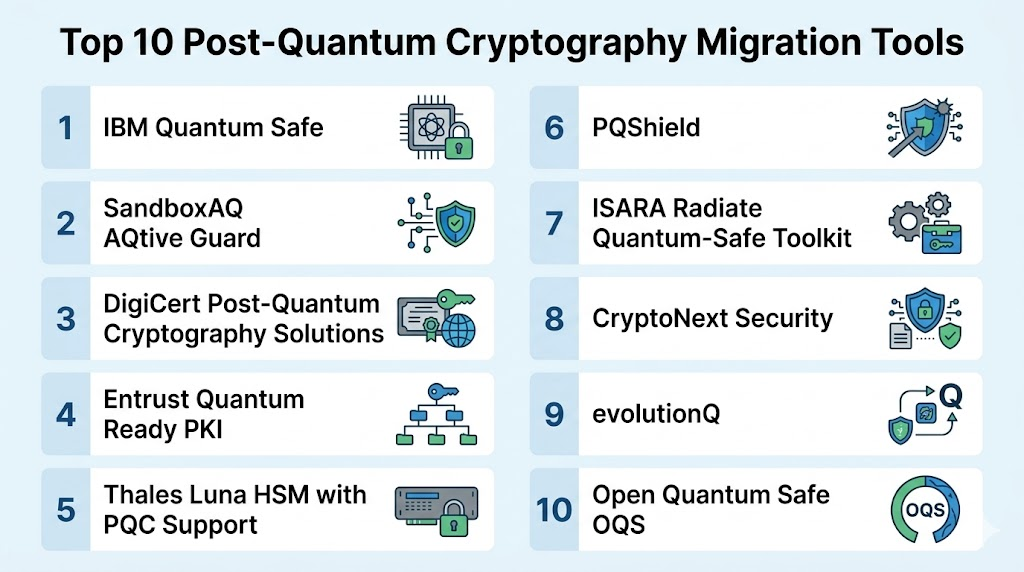
Top 10 Post-Quantum Cryptography Migration Tools
1- IBM Quantum Safe
Short description: IBM Quantum Safe helps enterprises discover cryptographic assets, assess quantum-related security risks, and plan migration strategies for post-quantum cryptography adoption. The platform focuses heavily on crypto-agility, enterprise modernization, and long-term quantum-risk management. It is commonly evaluated by large enterprises and regulated industries preparing for quantum-era cybersecurity requirements.
Key Features
- Cryptographic inventory discovery
- Quantum risk assessment
- Crypto-agility planning
- Post-quantum migration support
- PKI modernization guidance
- Hybrid cryptography workflows
- Enterprise governance controls
Pros
- Strong enterprise security focus
- Comprehensive quantum-risk visibility
- Useful for large-scale cryptographic modernization projects
Cons
- Enterprise-oriented deployment complexity
- Advanced implementations may require consulting support
- Smaller organizations may not need full platform capabilities
Platforms / Deployment
Cloud / Hybrid
Security & Compliance
Supports enterprise security governance, cryptographic assessment workflows, and modernization planning. Additional compliance certifications vary by deployment and IBM ecosystem integrations.
Integrations & Ecosystem
IBM Quantum Safe integrates with enterprise security and infrastructure environments to help organizations modernize encryption strategies gradually.
- IBM Cloud
- Enterprise PKI systems
- Security governance platforms
- Hybrid-cloud environments
- DevSecOps workflows
Support & Community
Strong enterprise support, consulting ecosystem, and global deployment experience for large modernization initiatives.
2- SandboxAQ AQtive Guard
Short description: SandboxAQ AQtive Guard is a cryptographic management and quantum-risk assessment platform designed to help enterprises identify vulnerable encryption systems and transition toward post-quantum security models. The platform emphasizes crypto-agility, automated discovery, and long-term cryptographic governance. It is increasingly adopted by enterprises preparing for future quantum computing risks.
Key Features
- Cryptographic asset discovery
- Risk prioritization
- Crypto-agility management
- Post-quantum migration planning
- Policy management
- Compliance visibility
- Automated analysis
Pros
- Strong visibility into cryptographic environments
- Useful automation capabilities
- Good fit for enterprise-scale infrastructures
Cons
- Enterprise-focused pricing and deployment
- Specialized cryptography expertise may be required
- Implementation complexity varies by environment
Platforms / Deployment
Cloud / Hybrid
Security & Compliance
Supports cryptographic governance and enterprise security visibility workflows. Additional compliance details are not publicly stated.
Integrations & Ecosystem
Designed to integrate with enterprise IT and security ecosystems.
- PKI infrastructure
- Security monitoring platforms
- Enterprise applications
- Cloud environments
Support & Community
Strong enterprise engagement and growing market visibility.
3- DigiCert Post-Quantum Cryptography Solutions
Short description: DigiCert provides post-quantum cryptography capabilities focused on certificate modernization, PKI infrastructure updates, and hybrid cryptographic deployment strategies. Organizations use these solutions to prepare digital trust environments for future quantum-safe standards. The platform is especially relevant for enterprises managing large certificate ecosystems.
Key Features
- Quantum-safe certificate support
- PKI modernization
- Hybrid cryptography deployment
- Certificate lifecycle management
- Trust infrastructure support
- Crypto-agility capabilities
- Enterprise scalability
Pros
- Strong PKI expertise
- Enterprise-ready trust infrastructure
- Well-suited for certificate modernization projects
Cons
- Primarily focused on PKI ecosystems
- Broader migration capabilities may require additional tooling
- Advanced deployments can be resource-intensive
Platforms / Deployment
Cloud / Hybrid
Security & Compliance
Supports enterprise certificate security and trust management workflows. Additional compliance certifications vary across DigiCert offerings.
Integrations & Ecosystem
DigiCert integrates broadly with enterprise trust and certificate management environments.
- Enterprise PKI
- Cloud infrastructure
- Certificate management systems
- Network security platforms
Support & Community
Mature enterprise support and strong digital trust ecosystem presence.
4- Entrust Quantum Ready PKI
Short description: Entrust Quantum Ready PKI helps organizations modernize certificate infrastructures and implement crypto-agile trust architectures. The platform supports hybrid cryptographic deployments and post-quantum readiness planning for enterprise security teams. It is widely used in identity and digital trust environments.
Key Features
- Quantum-ready PKI
- Hybrid certificate support
- Crypto-agility management
- Certificate lifecycle automation
- Trust infrastructure modernization
- Enterprise governance
- Secure identity integration
Pros
- Strong enterprise PKI capabilities
- Good identity security alignment
- Mature trust management workflows
Cons
- Primarily enterprise-focused
- Specialized deployment expertise may be needed
- Migration planning can be complex
Platforms / Deployment
Cloud / Self-hosted / Hybrid
Security & Compliance
Supports enterprise-grade trust management and certificate governance capabilities. Additional certifications vary by deployment.
Integrations & Ecosystem
Entrust integrates with identity, authentication, and enterprise trust environments.
- Enterprise PKI
- Identity platforms
- Authentication systems
- Network security infrastructure
Support & Community
Strong enterprise support and mature deployment ecosystem.
5- Thales Luna HSM with PQC Support
Short description: Thales Luna HSM provides hardware security modules with support for quantum-safe cryptographic strategies and secure key management. Organizations use the platform to protect sensitive cryptographic operations and modernize encryption infrastructures for long-term resilience. It is commonly deployed in financial services, telecom, and government environments.
Key Features
- Hardware-based key protection
- Quantum-safe cryptographic support
- Secure key lifecycle management
- High-assurance cryptographic processing
- PKI integration
- Enterprise scalability
- Hybrid cryptography support
Pros
- Strong hardware-backed security
- Excellent enterprise trust capabilities
- Useful for highly regulated environments
Cons
- Infrastructure deployment complexity
- Higher operational costs
- Hardware management requirements
Platforms / Deployment
Self-hosted / Hybrid
Security & Compliance
Supports high-assurance cryptographic protection and enterprise security governance. Compliance capabilities vary by deployment and configuration.
Integrations & Ecosystem
Frequently integrated into enterprise trust and encryption environments.
- PKI systems
- Banking infrastructure
- Telecom security
- Identity systems
- Enterprise encryption platforms
Support & Community
Strong enterprise support and mature security ecosystem.
6- PQShield
Short description: PQShield develops post-quantum cryptography software and hardware solutions focused on embedded systems, enterprise security, and quantum-safe communication. Organizations use the platform to integrate quantum-resistant encryption into devices, applications, and infrastructure. It is particularly relevant for IoT and hardware-security environments.
Key Features
- Post-quantum algorithms
- Embedded cryptography support
- Hardware security integration
- Quantum-safe communication
- Software development kits
- Secure firmware protection
- IoT security capabilities
Pros
- Strong embedded security focus
- Useful for device manufacturers
- Good hardware integration capabilities
Cons
- Specialized implementation requirements
- Smaller ecosystem than large enterprise vendors
- Some deployments may require customization
Platforms / Deployment
Cloud / Self-hosted / Hybrid
Security & Compliance
Focused on quantum-resistant cryptographic implementations and secure hardware environments.
Integrations & Ecosystem
Supports integration with embedded and enterprise security ecosystems.
- IoT devices
- Embedded systems
- Secure firmware environments
- Enterprise cryptography systems
Support & Community
Growing ecosystem and strong technical specialization.
7- ISARA Radiate Quantum-Safe Toolkit
Short description: ISARA provides quantum-safe cryptography migration solutions focused on secure communications, certificate modernization, and crypto-agility. The platform helps enterprises test and deploy hybrid cryptographic models while preparing for future post-quantum standards. It is commonly used in regulated industries and critical infrastructure projects.
Key Features
- Hybrid cryptography support
- Secure communication modernization
- Certificate migration workflows
- Quantum-safe VPN support
- Crypto-agility capabilities
- Enterprise testing tools
- Standards alignment
Pros
- Strong quantum-safe communication focus
- Good migration planning support
- Useful hybrid deployment strategies
Cons
- Specialized deployment expertise required
- Enterprise-focused implementation
- Broader governance may require additional platforms
Platforms / Deployment
Cloud / Hybrid
Security & Compliance
Supports secure communication modernization and cryptographic transition planning.
Integrations & Ecosystem
Designed for enterprise communication and trust modernization projects.
- VPN infrastructure
- PKI systems
- Secure communication platforms
- Enterprise applications
Support & Community
Strong technical support and focused quantum-safe specialization.
8- CryptoNext Security
Short description: CryptoNext Security develops post-quantum cryptographic software focused on enterprise security, communications protection, and quantum-safe infrastructure modernization. The platform supports hybrid and post-quantum encryption models for organizations preparing for future cryptographic risks. It is especially relevant for telecom and critical infrastructure sectors.
Key Features
- Post-quantum encryption
- Hybrid cryptographic deployment
- Secure communication support
- Enterprise integration
- VPN modernization
- Crypto-agility workflows
- Infrastructure protection
Pros
- Strong telecom and infrastructure focus
- Useful communication security capabilities
- Good post-quantum specialization
Cons
- Smaller market visibility
- Enterprise deployment focus
- Ecosystem maturity still growing
Platforms / Deployment
Cloud / Hybrid
Security & Compliance
Supports quantum-safe encryption and secure communications infrastructure.
Integrations & Ecosystem
Designed for enterprise communication modernization environments.
- Telecom infrastructure
- Secure communication systems
- Enterprise VPN environments
- PKI systems
Support & Community
Growing enterprise presence and specialized cryptography expertise.
9- evolutionQ
Short description: evolutionQ focuses on quantum-safe cybersecurity planning, cryptographic risk management, and migration strategy consulting. Organizations use the platform to assess quantum-related threats and implement long-term cryptographic modernization roadmaps. It is often used in highly regulated sectors and government-related projects.
Key Features
- Quantum-risk assessment
- Migration strategy planning
- Crypto-agility support
- Enterprise consulting
- Security modernization guidance
- Risk modeling
- Compliance planning
Pros
- Strong strategic advisory capabilities
- Useful risk assessment workflows
- Good fit for complex enterprise environments
Cons
- Less focused on operational tooling
- Consulting-heavy deployment model
- Specialized expertise requirements
Platforms / Deployment
Cloud / Hybrid
Security & Compliance
Focused on enterprise security planning and cryptographic modernization strategy.
Integrations & Ecosystem
Supports enterprise security modernization initiatives.
- Enterprise governance systems
- Security modernization programs
- Risk management environments
Support & Community
Strong consulting and advisory ecosystem.
10- Open Quantum Safe OQS
Short description: Open Quantum Safe is an open-source initiative that provides libraries, protocols, and development tools for integrating post-quantum cryptography into existing systems. Developers and researchers use it to experiment with and deploy quantum-resistant algorithms. It is one of the most influential open-source projects in the post-quantum cryptography ecosystem.
Key Features
- Open-source PQC libraries
- NIST algorithm support
- TLS experimentation
- Quantum-safe protocol testing
- Developer SDKs
- Community-driven development
- Research ecosystem integration
Pros
- Strong open-source ecosystem
- Excellent developer experimentation platform
- Useful for testing quantum-safe integrations
Cons
- Requires technical expertise
- Enterprise governance capabilities limited
- Production readiness depends on deployment architecture
Platforms / Deployment
Linux / Windows / macOS
Security & Compliance
Focused on research, experimentation, and implementation support for post-quantum algorithms.
Integrations & Ecosystem
Widely used in research and development environments.
- OpenSSL
- TLS environments
- Research platforms
- Developer ecosystems
Support & Community
Strong academic and open-source community participation.
Comparison Table (Top 10)
| Tool Name | Best For | Platforms Supported | Deployment | Standout Feature | Public Rating |
|---|---|---|---|---|---|
| IBM Quantum Safe | Enterprise quantum readiness | Cloud | Hybrid | Crypto-agility planning | N/A |
| SandboxAQ AQtive Guard | Cryptographic discovery | Cloud | Hybrid | Risk assessment automation | N/A |
| DigiCert PQC Solutions | PKI modernization | Cloud | Hybrid | Quantum-safe certificates | N/A |
| Entrust Quantum Ready PKI | Enterprise trust infrastructure | Multi-platform | Hybrid | Crypto-agile PKI | N/A |
| Thales Luna HSM | Hardware security | Self-hosted | Hybrid | HSM-based quantum-safe protection | N/A |
| PQShield | Embedded security | Multi-platform | Hybrid | Device-level PQC | N/A |
| ISARA Toolkit | Secure communications | Cloud | Hybrid | Hybrid cryptography migration | N/A |
| CryptoNext Security | Telecom security | Cloud | Hybrid | Quantum-safe communications | N/A |
| evolutionQ | Strategic modernization | Cloud | Hybrid | Quantum-risk planning | N/A |
| Open Quantum Safe | Developers and research | Multi-platform | Self-hosted | Open-source PQC libraries | N/A |
Evaluation & Scoring Table
| Tool Name | Core 25% | Ease 15% | Integrations 15% | Security 10% | Performance 10% | Support 10% | Value 15% | Weighted Total |
|---|---|---|---|---|---|---|---|---|
| IBM Quantum Safe | 10 | 8 | 9 | 10 | 9 | 9 | 8 | 9.05 |
| SandboxAQ AQtive Guard | 9 | 8 | 8 | 9 | 9 | 8 | 8 | 8.45 |
| DigiCert Post-Quantum Cryptography Solutions | 9 | 8 | 9 | 9 | 9 | 9 | 8 | 8.75 |
| Entrust Quantum Ready PKI | 9 | 8 | 8 | 9 | 8 | 9 | 8 | 8.50 |
| Thales Luna HSM with PQC Support | 9 | 7 | 8 | 10 | 9 | 9 | 7 | 8.45 |
| PQShield | 8 | 7 | 8 | 9 | 8 | 8 | 8 | 8.00 |
| ISARA Radiate Quantum-Safe Toolkit | 8 | 7 | 8 | 9 | 8 | 8 | 8 | 8.00 |
| CryptoNext Security | 8 | 7 | 7 | 9 | 8 | 8 | 8 | 7.85 |
| evolutionQ | 8 | 8 | 7 | 8 | 8 | 8 | 8 | 7.90 |
| Open Quantum Safe OQS | 8 | 7 | 8 | 8 | 8 | 9 | 10 | 8.10 |
Frequently Asked Questions
1. What is post-quantum cryptography?
Post-quantum cryptography refers to cryptographic algorithms designed to resist attacks from future quantum computers. These algorithms aim to replace vulnerable encryption standards such as RSA and ECC. Organizations are adopting them to prepare for long-term cybersecurity risks. Quantum-safe migration is becoming a major enterprise security priority.
2. Why are organizations preparing now for quantum threats?
Security experts are concerned about “harvest now, decrypt later” attacks where encrypted data is stolen today and decrypted in the future using quantum computers. Sensitive data with long-term value is particularly at risk. Organizations are starting migration projects early because cryptographic modernization can take years. Early preparation also improves compliance readiness.
3. What is crypto-agility?
Crypto-agility is the ability to quickly replace or update cryptographic algorithms without rebuilding entire systems. This flexibility is essential for post-quantum migration strategies. Organizations with strong crypto-agility can adapt faster as standards evolve. Many migration tools focus heavily on this capability.
4. Are post-quantum migration tools only for governments?
No. Financial institutions, healthcare organizations, telecom providers, cloud platforms, and enterprises managing sensitive data are also investing heavily in quantum-safe security. Any organization protecting long-term confidential information may eventually require migration planning. Adoption is expanding across many industries.
5. What is hybrid cryptography?
Hybrid cryptography combines traditional encryption algorithms with post-quantum algorithms during transition periods. This approach helps organizations maintain compatibility while improving future quantum resilience. Many vendors recommend hybrid deployments as a practical migration strategy. It reduces operational disruption during modernization projects.
6. How difficult is post-quantum migration?
Migration complexity depends on the size of an organization’s cryptographic infrastructure and dependencies. Large enterprises may have thousands of certificates, APIs, and encrypted systems requiring modernization. Discovery and inventory tools help reduce complexity by identifying vulnerable assets. Most organizations approach migration gradually rather than replacing everything at once.
7. What industries are prioritizing quantum-safe migration?
Government, defense, banking, healthcare, telecom, and critical infrastructure sectors are leading adoption because they manage sensitive long-term data. Cloud providers and technology vendors are also investing heavily in post-quantum readiness. Regulatory expectations are increasing across many industries. Early adoption is becoming a competitive advantage.
8. Are post-quantum standards finalized?
NIST has selected several post-quantum cryptographic algorithms, but migration strategies and standards continue evolving. Organizations are already testing and implementing approved algorithms in hybrid deployments. Standards maturity will continue improving over the next few years. Migration planning should begin even while standards evolve.
9. Can post-quantum cryptography impact performance?
Some post-quantum algorithms require larger keys or increased computational resources compared to traditional cryptography. Performance impact varies depending on implementation and workload type. Many vendors are optimizing algorithms to improve scalability and efficiency. Testing is important before large-scale deployment.
10. How should organizations start quantum-safe migration?
Organizations should begin with cryptographic discovery and inventory assessments to understand where vulnerable encryption exists. Security teams should prioritize high-risk systems and long-term sensitive data. Pilot projects using hybrid cryptography can help validate migration approaches. Building crypto-agility is often the most important first step.
Conclusion
Post-quantum cryptography migration is rapidly becoming one of the most important long-term cybersecurity initiatives for enterprises, governments, and critical infrastructure providers. As quantum computing capabilities continue advancing, organizations must prepare for future threats that could compromise today’s encryption systems. Platforms such as IBM Quantum Safe, SandboxAQ AQtive Guard, DigiCert PQC Solutions, Entrust Quantum Ready PKI, and Open Quantum Safe are helping organizations modernize cryptographic infrastructures while improving crypto-agility and long-term resilience. The best platform depends on whether your organization prioritizes PKI modernization, enterprise governance, hardware security, embedded cryptography, or quantum-safe communications. Organizations should begin with cryptographic discovery, shortlist two or three migration platforms, run pilot projects, and validate integration compatibility before implementing large-scale modernization strategies.

Find Trusted Cardiac Hospitals
Compare heart hospitals by city and services — all in one place.
Explore Hospitals