Introduction
SSL/TLS Certificate Authorities (CAs) Tooling refers to platforms and services that issue, manage, automate, and renew digital certificates that enable secure communication over the internet. These tools are critical for encrypting data in transit, validating domain ownership, and establishing trust between users, websites, and applications.SSL/TLS certificates are more important than ever due to increased cyber threats, regulatory requirements, eCommerce growth, remote work adoption, and the widespread use of cloud applications. Proper certificate management helps prevent breaches, downtime, and security warnings that can damage business reputation and revenue.
Real-world use cases include:
- Securing websites with HTTPS and browser trust validation.
- Encrypting APIs and microservices in cloud or hybrid architectures.
- Managing certificates for multi-domain environments and subdomains.
- Automating renewal processes for enterprise or cloud deployments.
- Supporting compliance with GDPR, HIPAA, PCI DSS, and SOC frameworks.
Evaluation Criteria for Buyers:
- Certificate types supported (DV, OV, EV, wildcard, multi-domain).
- Automation features (issuance, renewal, deployment).
- Integration with web servers, cloud platforms, DevOps tools, and CI/CD pipelines.
- Security standards, encryption strength, and certificate lifecycle management.
- Audit, reporting, and monitoring capabilities.
- Global trust, reputation, and browser compatibility.
- Multi-domain and multi-organization support.
- Ease of use, dashboard, and API availability.
- Cost, subscription model, and scalability.
- Support and customer service responsiveness.
Best for: SSL/TLS Certificate Authorities Tooling is best for IT managers, developers, security teams, enterprises, SaaS providers, eCommerce platforms, and organizations that require secure, trusted communications across web, mobile, and API environments.
Not ideal for: Small static websites with simple SSL needs may not require advanced tooling. Organizations that do not manage multiple domains, automate deployment, or enforce strict security policies may prefer basic certificate issuance services.
Key Trends in SSL/TLS Certificate Authorities Tooling
- Automation of certificate lifecycle management is now expected for enterprise-scale environments.
- Short-lived certificates are increasingly adopted for improved security and risk reduction.
- Integration with cloud, containers, and DevOps pipelines is essential for modern deployments.
- Wildcard and multi-domain certificates are required for complex domain architectures.
- AI-driven monitoring is emerging for certificate expiration, misconfiguration, and compliance checks.
- Stronger encryption standards such as TLS 1.3 and advanced ciphers are standard requirements.
- Global trust and browser compatibility remain critical for web and mobile applications.
- Centralized dashboards and API access for managing hundreds or thousands of certificates.
- Compliance reporting and audit-ready features are increasingly demanded by enterprises.
- Zero-trust and hybrid infrastructure support is growing to protect internal APIs and services.
How We Selected These Tools
- Market adoption and reputation among enterprises, SMBs, and developers.
- Feature completeness covering issuance, automation, deployment, and monitoring.
- Reliability and performance, including uptime, renewal processes, and error handling.
- Security posture and compliance readiness with industry standards.
- Integrations and ecosystem connectivity with cloud, DevOps, and infrastructure tooling.
- Support for multi-domain, wildcard, and EV certificates.
- Scalability for small, medium, and large organizations.
- Usability, dashboards, API documentation, and ease of onboarding.
- Pricing transparency and value for different organizational scales.
- Enterprise-grade reporting, audit, and monitoring features.
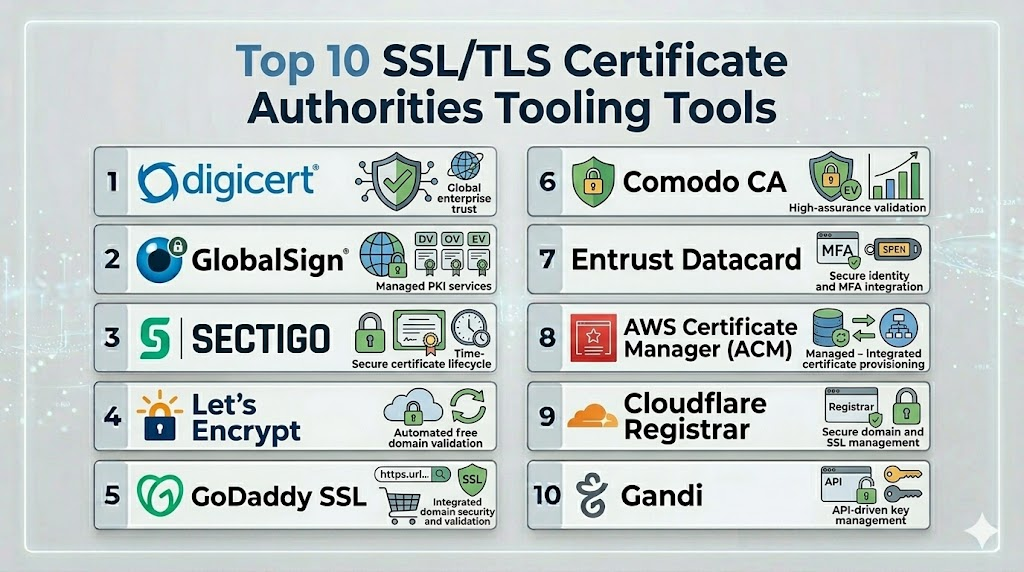
Top 10 SSL/TLS Certificate Authorities Tooling
1- DigiCert
Short description:
DigiCert is an enterprise-grade SSL/TLS CA offering certificate issuance, automation, and management for global businesses, SaaS platforms, and multi-domain environments.
Key Features
- High-assurance DV, OV, EV certificates.
- Wildcard and multi-domain support.
- Automation for issuance and renewal.
- Integration with web servers, cloud platforms, and DevOps tools.
- Certificate lifecycle management dashboard.
- Audit and reporting tools.
- API for automation and monitoring.
Pros
- Trusted CA with global recognition.
- Strong automation and enterprise integration.
- Broad certificate portfolio including EV and multi-domain.
Cons
- Higher pricing for smaller organizations.
- Some advanced features require enterprise plans.
- Setup complexity for smaller teams.
Platforms / Deployment
Web / Linux / Windows / macOS
Cloud
Security & Compliance
Supports MFA, secure issuance, revocation, TLS 1.3, encryption best practices. Compliance includes SOC 2 and ISO 27001 for enterprise customers.
Integrations & Ecosystem
- Cloud platforms: AWS, Azure, GCP.
- Web servers: Apache, Nginx, IIS.
- CI/CD and DevOps pipelines.
- Certificate monitoring tools.
- API for automated workflows.
- Enterprise IAM systems.
Support & Community
Documentation, enterprise support plans, dedicated account managers, and online community forums.
2- GlobalSign
Short description:
GlobalSign provides scalable SSL/TLS certificate management for enterprises, cloud apps, and developers, emphasizing automation, security, and trust.
Key Features
- DV, OV, EV, wildcard certificates.
- Managed PKI solutions.
- API and integration for automation.
- Certificate lifecycle dashboards.
- Multi-domain management.
- Compliance reporting tools.
- Cloud and server integrations.
Pros
- Strong global trust and browser recognition.
- Comprehensive automation features.
- Multi-domain and PKI solutions for enterprises.
Cons
- Complex setup for beginners.
- Premium pricing for enterprise plans.
- Support resources may require enterprise subscription.
Platforms / Deployment
Web / Linux / Windows / macOS
Cloud / Hybrid
Security & Compliance
Supports TLS 1.3, certificate transparency, MFA, audit logging, and SOC 2, ISO 27001 certifications.
Integrations & Ecosystem
- APIs for automation.
- Cloud platforms and hosting services.
- Enterprise DevOps tools.
- PKI management platforms.
- SSL deployment scripts.
Support & Community
24/7 enterprise support, documentation, training resources, and customer portals.
3- Sectigo
Short description:
Sectigo offers SSL/TLS certificates, automation, and identity protection tools, focusing on enterprise, SaaS, and multi-domain deployments.
Key Features
- DV, OV, EV certificates.
- Multi-domain and wildcard support.
- Automation and API integration.
- Certificate monitoring and reporting.
- PKI and identity management.
- Managed deployment for cloud and servers.
- Integration with DevOps pipelines.
Pros
- Broad certificate portfolio.
- Strong automation and monitoring.
- Suitable for cloud and hybrid infrastructure.
Cons
- Learning curve for beginners.
- Enterprise features may require additional costs.
- Complex pricing tiers.
Platforms / Deployment
Web / Linux / Windows / macOS
Cloud / Hybrid
Security & Compliance
Supports MFA, TLS 1.3, PKI, certificate transparency, SOC 2, and ISO 27001.
Integrations & Ecosystem
- Cloud hosting integration.
- Web server deployment.
- API access for DevOps automation.
- PKI management systems.
- Monitoring and alerting tools.
Support & Community
Documentation, live support, knowledge base, and enterprise training.
4- Let’s Encrypt
Short description:
Let’s Encrypt provides free SSL/TLS certificates with automated issuance and renewal, designed for developers, SMBs, and public websites.
Key Features
- DV certificates only.
- Automated issuance and renewal.
- API for integration with servers and cloud platforms.
- ACME protocol support.
- Large community support.
- Open-source tooling.
- Trusted across browsers.
Pros
- Free certificates for public websites.
- Easy automation using ACME clients.
- Broad community adoption and support.
Cons
- Limited to DV certificates.
- No wildcard support without DNS validation.
- Lacks enterprise support plans.
Platforms / Deployment
Web / Linux / Windows / macOS
Cloud
Security & Compliance
Supports TLS 1.3 and secure issuance. Compliance depends on implementation; no enterprise certifications.
Integrations & Ecosystem
- ACME clients: Certbot, acme.sh.
- Cloud hosting automation.
- Web server automation scripts.
- Developer APIs.
Support & Community
Community forums, documentation, and open-source projects.
5- GoDaddy SSL
Short description:
GoDaddy SSL provides domain-validated, organization-validated, and extended-validation certificates with simple dashboard management and website integration.
Key Features
- DV, OV, EV certificates.
- Wildcard support.
- Dashboard for certificate management.
- Integration with hosting and website builders.
- Automated renewal options.
- Email notifications for expiring certificates.
- Multi-domain support.
Pros
- Easy dashboard for beginners.
- Broad certificate options including EV.
- Integrated with GoDaddy hosting and website tools.
Cons
- Pricing is higher than some competitors.
- Less developer-focused.
- Advanced automation features are limited.
Platforms / Deployment
Web / Linux / Windows / macOS
Cloud
Security & Compliance
Supports TLS, MFA, domain validation, and revocation checks. Compliance certifications vary by service.
Integrations & Ecosystem
- GoDaddy hosting and website tools.
- DNS and domain integration.
- Limited API for automation.
- SSL installation guides.
Support & Community
Documentation, live chat, phone support, and community resources.
6- Comodo CA
Short description:
Comodo CA offers SSL/TLS certificates, managed PKI, and enterprise certificate automation for global businesses and SaaS providers.
Key Features
- DV, OV, EV, wildcard certificates.
- Multi-domain support.
- Certificate lifecycle automation.
- PKI solutions for enterprises.
- Cloud integration for certificate deployment.
- Monitoring and alerting.
- API for automated issuance.
Pros
- Wide certificate portfolio.
- Enterprise-grade automation and PKI.
- Trusted by global organizations.
Cons
- Pricing may be high for small businesses.
- Interface may be complex for new users.
- Support resources can be enterprise-focused.
Platforms / Deployment
Web / Linux / Windows / macOS
Cloud / Hybrid
Security & Compliance
Supports TLS 1.3, MFA, PKI, SOC 2, ISO 27001, and certificate transparency logs.
Integrations & Ecosystem
- Cloud hosting and web servers.
- PKI management platforms.
- DevOps pipelines.
- Monitoring tools.
- APIs for automation.
Support & Community
Documentation, training, enterprise support, and customer portals.
7- Entrust Datacard
Short description:
Entrust Datacard provides SSL/TLS certificate issuance, managed PKI, and automation solutions for enterprises, regulated industries, and global organizations.
Key Features
- DV, OV, EV certificates.
- Wildcard and multi-domain support.
- Enterprise PKI and certificate automation.
- Compliance reporting.
- API access for DevOps integration.
- Monitoring and alerts.
- Managed lifecycle and renewal automation.
Pros
- Enterprise-ready features.
- Strong security and compliance support.
- Integration with corporate PKI and infrastructure.
Cons
- Enterprise-focused pricing.
- Smaller footprint for individual developers.
- Setup can be complex for small teams.
Platforms / Deployment
Web / Linux / Windows / macOS
Cloud / Hybrid
Security & Compliance
Supports MFA, TLS 1.3, PKI, SOC 2, ISO 27001, audit logging, and compliance reporting.
Integrations & Ecosystem
- Cloud and on-premise integration.
- PKI management systems.
- API-driven automation.
- Monitoring tools.
- Enterprise workflows.
Support & Community
Documentation, enterprise support, training, and dedicated account management.
8- Sectigo (formerly Comodo CA)
Short description:
Sectigo provides SSL/TLS certificates, automation, and PKI solutions with strong enterprise and cloud integration.
Key Features
- DV, OV, EV certificates.
- Multi-domain and wildcard support.
- Automation and API integration.
- Certificate lifecycle management.
- Cloud, DevOps, and server deployment support.
- Monitoring dashboards.
- Managed PKI and identity tools.
Pros
- Broad enterprise certificate portfolio.
- Strong automation and developer integration.
- Trusted for regulated environments.
Cons
- Pricing complexity.
- Interface may require training.
- Advanced enterprise features for paid tiers.
Platforms / Deployment
Web / Linux / Windows / macOS
Cloud / Hybrid
Security & Compliance
TLS 1.3, PKI support, certificate transparency, MFA, SOC 2, ISO 27001.
Integrations & Ecosystem
- Cloud platforms, hosting, and servers.
- APIs for automation.
- PKI management tools.
- Monitoring and alerting.
- DevOps integration.
Support & Community
Enterprise support, documentation, training resources, and community forums.
9- AWS Certificate Manager (ACM)
Short description:
AWS Certificate Manager provides SSL/TLS certificate issuance, renewal, and deployment integrated with AWS services for developers and enterprises.
Key Features
- Free public certificates for AWS resources.
- Automatic renewal for managed certificates.
- Integration with Elastic Load Balancers, CloudFront, and API Gateway.
- Private PKI and ACM Private CA.
- Automated deployment in cloud environments.
- Multi-domain and wildcard support.
- API for certificate lifecycle management.
Pros
- Free public certificate issuance.
- Deep integration with AWS services.
- Automates renewal and deployment.
Cons
- Limited to AWS resources for managed deployment.
- Not a standalone registrar for on-premise servers.
- Best value requires AWS ecosystem adoption.
Platforms / Deployment
Web / Linux / Windows / macOS
Cloud
Security & Compliance
Supports TLS 1.3, MFA, ACM Private CA, SOC 2, ISO 27001 (AWS cloud environment).
Integrations & Ecosystem
- AWS CloudFront, ELB, API Gateway.
- EC2, S3, Lambda.
- CloudFormation automation.
- Monitoring through CloudWatch.
- DevOps pipelines via AWS CLI and SDK.
Support & Community
AWS documentation, forums, and enterprise support plans.
10- Let’s Encrypt
Short description:
Let’s Encrypt is a free, automated CA providing DV certificates for web developers, SMBs, and open-source projects. It simplifies certificate issuance and renewal through automation.
Key Features
- Free domain-validated certificates.
- Automatic issuance and renewal via ACME protocol.
- Integration with web servers and hosting platforms.
- Open-source tooling and client ecosystem.
- Widely trusted certificates.
- Supports HTTPS adoption at scale.
- Developer-focused automation.
Pros
- Free and widely trusted certificates.
- Strong automation and open-source support.
- Ideal for small websites and developers.
Cons
- Only DV certificates are available.
- Limited enterprise support.
- Multi-domain and wildcard options require DNS validation.
Platforms / Deployment
Web / Linux / Windows / macOS
Cloud
Security & Compliance
Supports TLS 1.3, ACME automation, and certificate transparency. Compliance depends on implementation; no formal enterprise certifications.
Integrations & Ecosystem
- ACME clients (Certbot, acme.sh).
- Web hosting and server automation.
- DevOps integration.
- API access for certificate issuance.
- Open-source community tools.
Support & Community
Community support, forums, and open-source documentation.
Comparison Table
| Tool Name | Best For | Platform(s) Supported | Deployment | Standout Feature | Public Rating |
|---|---|---|---|---|---|
| DigiCert | Enterprise, SaaS, multi-domain | Web, Linux, Windows, macOS | Cloud | Full lifecycle and automation | N/A |
| GlobalSign | Enterprises and developers | Web, Linux, Windows, macOS | Cloud / Hybrid | Scalable PKI and automation | N/A |
| Sectigo | Enterprise and cloud | Web, Linux, Windows, macOS | Cloud / Hybrid | Wide certificate portfolio | N/A |
| Let’s Encrypt | Developers, SMBs | Web, Linux, Windows, macOS | Cloud | Free automated DV certificates | N/A |
| GoDaddy SSL | SMBs and website owners | Web, Linux, Windows, macOS | Cloud | Integrated with GoDaddy hosting | N/A |
| Comodo CA | Enterprises | Web, Linux, Windows, macOS | Cloud / Hybrid | Enterprise PKI and certificate automation | N/A |
| Entrust Datacard | Enterprises, regulated sectors | Web, Linux, Windows, macOS | Cloud / Hybrid | Enterprise PKI and lifecycle automation | N/A |
| AWS Certificate Manager | AWS workloads | Web, Linux, Windows, macOS | Cloud | Free certificates and AWS integration | N/A |
| Cloudflare Registrar | Developers, technical teams | Web | Cloud | Security-focused and integrated DNS | N/A |
| Gandi | Developers and agencies | Web | Cloud | API access and professional portfolio | N/A |
Evaluation & Scoring of SSL/TLS Certificate Authorities Tooling
| Tool Name | Core 25% | Ease 15% | Integrations 15% | Security 10% | Performance 10% | Support 10% | Value 15% | Weighted Total |
|---|---|---|---|---|---|---|---|---|
| DigiCert | 10 | 8 | 9 | 9 | 9 | 9 | 7 | 8.7 |
| GlobalSign | 9 | 8 | 9 | 9 | 9 | 8 | 7 | 8.5 |
| Sectigo | 9 | 7 | 8 | 8 | 8 | 7 | 8 | 8.0 |
| Let’s Encrypt | 7 | 9 | 7 | 7 | 8 | 7 | 10 | 7.9 |
| GoDaddy SSL | 8 | 8 | 7 | 8 | 8 | 7 | 7 | 7.7 |
| Comodo CA | 9 | 7 | 8 | 8 | 8 | 7 | 7 | 7.9 |
| Entrust Datacard | 9 | 7 | 8 | 9 | 8 | 7 | 7 | 7.9 |
| AWS Certificate Manager | 8 | 8 | 8 | 8 | 8 | 7 | 9 | 8.0 |
| Cloudflare Registrar | 8 | 7 | 8 | 9 | 8 | 7 | 8 | 7.8 |
| Gandi | 8 | 7 | 7 | 8 | 8 | 7 | 7 | 7.5 |
Which SSL/TLS Certificate Authorities Tool Is Right for You?
Solo / Freelancer
For personal projects, blogs, and small websites, Let’s Encrypt or Gandi provides free or low-cost certificates with automation.
SMB
Small and medium businesses benefit from GoDaddy SSL, Namecheap SSL, or Sectigo, combining ease of use,
automation, and multi-domain support.
Mid-Market
Mid-sized companies managing multiple domains or services can leverage DigiCert, GlobalSign, or AWS Certificate Manager for automation, monitoring, and compliance.
Enterprise
Large enterprises should focus on DigiCert, GlobalSign, Sectigo, or Entrust Datacard for full PKI, compliance reporting, lifecycle automation, and integration with cloud and DevOps pipelines.
Budget vs Premium
Budget-conscious users may rely on Let’s Encrypt or Gandi, while premium options provide full enterprise support, automation, multi-domain certificates, and managed PKI.
Feature Depth vs Ease of Use
For deep security and automation, DigiCert, GlobalSign, and Sectigo excel. For simpler ease-of-use needs, GoDaddy SSL, AWS Certificate Manager, and Let’s Encrypt are practical.
Integrations & Scalability
Organizations using cloud and DevOps pipelines benefit from AWS Certificate Manager, Cloudflare Registrar, DigiCert, or GlobalSign due to APIs, automated deployment, and multi-domain support.
Security & Compliance Needs
Enterprises should prioritize MFA, PKI, certificate transparency, TLS 1.3 support, SOC 2, ISO 27001, and compliance reporting when selecting a CA tool.
Frequently Asked Questions (FAQs)
1- What is an SSL/TLS Certificate Authority Tool?
An SSL/TLS Certificate Authority (CA) Tool issues and manages digital certificates that encrypt online communications. It ensures websites, applications, and APIs remain secure while validating domain ownership. These tools also handle renewals, monitoring, and deployment to maintain uninterrupted HTTPS and trusted connections. They are essential for developers, businesses, and enterprises to protect sensitive data in transit.
2- Can I get SSL certificates for free?
Yes, free SSL/TLS certificates are available from providers like Let’s Encrypt. These are typically domain-validated (DV) certificates suitable for personal websites, blogs, and small projects. Enterprise-grade certificates such as OV or EV usually require a paid subscription but offer higher trust and extended validation. Free certificates also support automation and renewals via APIs or ACME clients.
3- How does certificate automation work?
Automation tools handle the issuance, renewal, deployment, and monitoring of SSL/TLS certificates. Using APIs or protocols like ACME, they integrate with cloud services, DevOps pipelines, and web servers. Automation prevents expired certificates, reduces manual errors, and ensures continuous HTTPS availability across websites, APIs, and microservices.
4- What are the main certificate types?
Certificate types include DV (Domain Validation) for basic encryption, OV (Organization Validation) that verifies company details, and EV (Extended Validation) for maximum trust and identity validation. There are also wildcard certificates that secure all subdomains and multi-domain certificates that cover multiple domains in a single certificate. Choosing the right type depends on security needs and deployment scale.
5- Why is certificate management important?
Proper certificate management ensures HTTPS reliability, prevents browser warnings, and maintains trust for visitors. It also secures APIs, mobile apps, and internal services. Automation, monitoring, and renewal processes help avoid downtime, protect sensitive data, and support compliance with regulations like GDPR, HIPAA, and PCI DSS.
6- Can SSL/TLS certificates secure APIs and microservices?
Yes, SSL/TLS certificates are critical for encrypting API communications and microservices. They prevent man-in-the-middle attacks and ensure data integrity. Enterprise and DevOps teams often use automation and monitoring tools to manage certificates across dynamic API environments, ensuring security without manual intervention.
7- How do I monitor certificate expiry?
Most CA tools provide dashboards, alerts, and email notifications for expiring certificates. APIs and automation can track multiple certificates across domains, subdomains, and cloud services. This proactive monitoring avoids unintentional downtime and prevents users from seeing browser security warnings.
8- Are SSL/TLS certificates compliant with regulations?
Yes, enterprise-grade certificate authorities like DigiCert, GlobalSign, and Entrust follow security standards such as TLS 1.3, SOC 2, ISO 27001, and certificate transparency. Proper implementation of these certificates can help organizations meet regulatory requirements for secure communication and data privacy.
9- Can certificates integrate with cloud platforms and DevOps pipelines?
Absolutely. Most modern CA tools offer APIs and integration support for AWS, Azure, GCP, Kubernetes, CI/CD pipelines, and serverless architectures. This allows automated deployment and renewal of certificates, reducing manual effort and ensuring HTTPS is always active in complex infrastructures.
10- What mistakes should I avoid when managing certificates?
Common mistakes include letting certificates expire, skipping automation, neglecting monitoring, and using weak encryption. Not enabling MFA, domain lock, or DNSSEC can also compromise security. Organizations should implement proper lifecycle management, regular audits, and automated renewal to maintain trust and avoid downtime.
Conclusion
SSL/TLS Certificate Authorities Tooling is vital for encrypting communications, securing websites, APIs, and applications, and maintaining compliance in 2026+. For small projects and developers, Let’s Encrypt and Gandi offer accessible solutions. For SMBs, GoDaddy SSL, Sectigo, and AWS Certificate Manager provide ease-of-use and automation. Enterprises should prioritize DigiCert, GlobalSign, and Entrust Datacard for full PKI, automation, and compliance support. The next step is to shortlist 2–3 tools, evaluate certificate types, automation features, and integration capabilities, then deploy a pilot to ensure smooth management and ongoing security.

Find Trusted Cardiac Hospitals
Compare heart hospitals by city and services — all in one place.
Explore Hospitals
I am learning about SSL/TLS certificates, and this content helped me understand how different certificate authorities and tools help improve website security and trust.