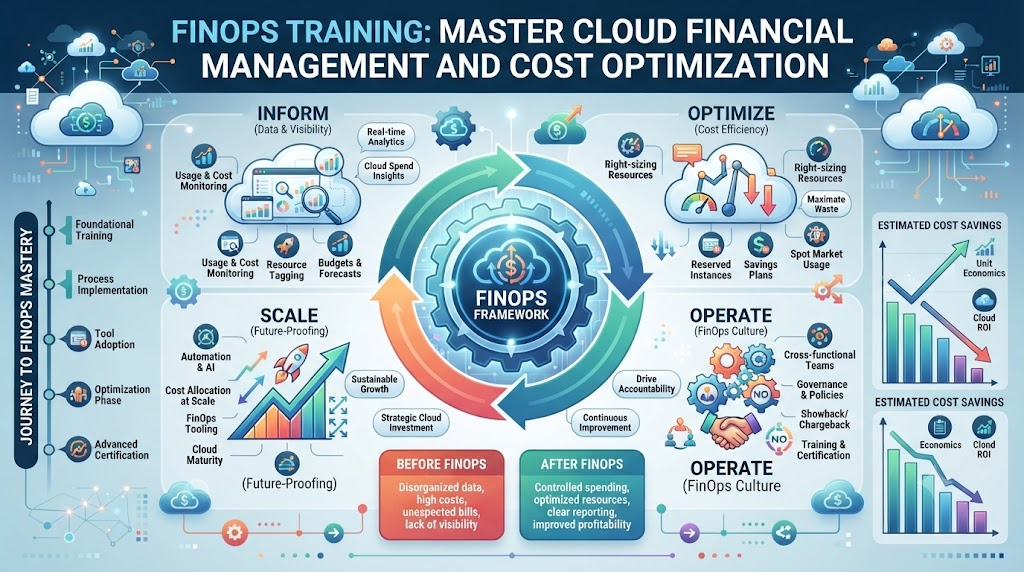
Many modern organizations face a shared challenge after adopting public cloud platforms: unexpected cloud spend. As engineering teams deploy microservices, provision virtual machines, and spin up storage volumes at rapid speed, monthly bills often rise faster than expected. Without clear operational visibility, finance teams struggle to understand dynamic cloud invoices, while engineering teams lack context regarding the commercial impact of infrastructure architecture.Closing this gap requires structured cloud financial management practices. Pursuing structured FinOps Training helps cross-functional teams establish shared accountability, align architectural choices with business goals, and control operational expenditures. This guide explores core FinOps frameworks, hands-on optimization strategies, role-based learning tracks, and practical implementation roadmaps to transform your cloud financial operations.
What Is FinOps?
FinOps, short for Cloud Financial Operations, is an operational framework and cultural discipline. It unites engineering, finance, procurement, and leadership teams to make data-driven decisions regarding cloud spending.
Definition of FinOps
FinOps brings financial accountability to the variable spending model of cloud computing. Instead of operating in functional silos, teams collaborate to treat cost as a primary architectural and operational metric alongside performance, security, and availability.
Why FinOps Matters in Cloud Computing
Traditional IT procurement relied on fixed capital expenditures planned years in advance. Public cloud environments operate on dynamic operational expenditures where engineers provision resources in seconds. Without proactive governance, unattached disks, overprovisioned compute instances, and unmonitored clusters cause unnecessary spending. FinOps provides visibility and structural processes to control these expenses without slowing down technical innovation.
FinOps and Cloud Financial Management
Cloud Financial Management encompasses the broad discipline of forecasting, monitoring, and controlling cloud budgets. FinOps provides the tactical operating model required to execute these financial policies across technical workflows.
Relationship Between Engineering, Finance, Procurement, and Business Teams
FinOps breaks down traditional corporate walls:
- Engineering and DevOps: Focus on delivering features and uptime while understanding resource costs.
- Finance: Tracks operational budgets, models margins, and forecasts infrastructure spending.
- Procurement: Negotiates committed enterprise discounts and contract terms with cloud providers.
- Business Leadership: Measures unit economics, such as the direct cloud cost required to serve an active customer.
       ┌──────────────────────────────────────────────┐
       │             Business Leadership              │
       └──────────────────────┬───────────────────────┘
                              │
       ┌──────────────────────┼───────────────────────┐
       ▼                      ▼                       ▼
┌──────────────┐      ┌──────────────┐      ┌───────────────────┐
│ Engineering  │◄────►│   Finance    │◄────►│    Procurement    │
└──────────────┘      └──────────────┘      └───────────────────┘
FinOps Lifecycle
The FinOps Foundation defines three continuous phases:
- Inform: Give teams immediate visibility into cloud consumption, allocation, and unit economics through granular metadata tagging and dashboards.
- Optimize: Identify idle assets, rightsize compute layers, and purchase rate commitments like Reserved Instances and Savings Plans.
- Operate: Evaluate ongoing operations against key performance indicators, automate infrastructure governance, and foster continuous organizational alignment.
What Is FinOps Training?
FinOps Training delivers the structured educational foundation needed to implement cloud financial management across enterprise platforms.
Purpose of FinOps Training
The primary goal is establishing a common operational vocabulary across departments. It teaches engineers how architectural choices impact operational expenditures, while teaching finance professionals how cloud workloads scale dynamically.
Skills Developed Through FinOps Training
Participants develop hands-on capabilities across multiple operational areas:
- Parsing multi-cloud billing files and telemetry data.
- Structuring organizational metadata and tag enforcement policies.
- Calculating unit metrics and allocating shared infrastructure costs.
- Evaluating compute, storage, and networking pricing models.
- Designing automated guardrails using policy engines and continuous integration pipelines.
Who Should Learn FinOps?
This discipline benefits diverse enterprise roles:
- Cloud and DevOps Engineers: To design cost-efficient architectures without reducing reliability.
- Platform Engineers: To establish shared services and manage multi-tenant Kubernetes costs.
- Cloud Architects: To factor cost efficiency into early system design.
- Finance and Procurement Professionals: To master usage-based cloud models and rate discounts.
- Engineering Managers and Directors: To monitor organizational budgets and measure efficiency.
FinOps Certification
Earning an industry-recognized FinOps Certification validates a professional’s understanding of cloud financial standards and operational frameworks. Certification programs verify core competency in cost allocation, forecasting, organizational governance, and cross-functional terminology.
While certification does not replace practical engineering or accounting experience, it proves that a practitioner understands the structured methodologies needed to coordinate engineering and finance teams.
FinOps Course
A practical FinOps Course bridges high-level theory and direct technical execution. Rather than focusing solely on static conceptual slides, effective courses dive into raw billing records, programmatic APIs, and infrastructure dashboards.
Key modules include:
- Cloud Billing Fundamentals: Understanding amortized costs, unblended rates, and shared operational fees.
- Cost Allocation and Tagging: Designing robust tagging strategies for multi-account structures.
- Showback and Chargeback: Distributing real expenses across business units to encourage accountability.
- Anomaly Detection: Spotting unexpected spending spikes before they affect monthly budgets.
- Tooling Workflows: Using cloud-native consoles, open-source utilities, and commercial reporting platforms.
FinOps Certification Training
Structured FinOps Certification Training combines theoretical frameworks with real-world scenarios to prepare individuals for industry examinations and real operational duties.
These programs help students analyze complex billing datasets, design cost allocation strategies, and establish continuous governance models. Preparing through real-world operational scenarios ensures practitioners can apply these principles directly within their day-to-day production environments.
Corporate FinOps Training
For enterprises running complex cloud footprints, Corporate FinOps Training aligns entire departments behind unified financial goals. Custom enterprise programs address company-specific architectures, deployment pipelines, and compliance requirements.
Enterprise training workshops focus on:
- Aligning DevOps, platform engineering, and finance workflows.
- Reviewing real enterprise cloud invoices to identify immediate cost-saving opportunities.
- Establishing internal governance policies for infrastructure provisioning.
- Implementing automated tag enforcement and policy-as-code guardrails.
FinOps Online Training
Modern distributed teams benefit significantly from FinOps Online Training. Delivered through live, instructor-led virtual sessions or modular self-paced content, online learning allows engineers and finance managers to collaborate across time zones.
High-quality virtual programs emphasize interactive workshops, screen-shared architectural reviews, and hands-on lab environments. This ensures participants gain practical experience troubleshooting billing data and building cost-tracking dashboards.
FinOps Training in India
Cloud adoption continues to accelerate rapidly across India’s technology ecosystem, from high-growth software startups to global enterprise capability centers. With organizations managing large-scale workloads across Amazon Web Services (AWS), Microsoft Azure, and Google Cloud Platform (GCP), skilled cloud financial management has become an operational priority.
Participating in FinOps Training in India equips local platform engineers, solutions architects, and financial analysts with the skills required to run multi-cloud environments efficiently, optimize resource spending, and support global delivery operations.
FinOps Practitioner Training
Foundational FinOps Practitioner Training is tailored for business analysts, operations teams, finance professionals, and engineering leads who need a comprehensive understanding of the FinOps lifecycle.
Key learning areas include:
- Core FinOps principles and cultural alignment.
- Real-time visibility and cost tracking mechanics.
- Budget creation and dynamic variance forecasting.
- Showback reporting and cost allocation across shared services.
- Establishing key performance indicators focused on unit economics.
FinOps Engineer Training
For technical practitioners who build and maintain infrastructure, FinOps Engineer Training covers the technical mechanics of cloud efficiency.
This technical curriculum focuses on:
- Infrastructure as Code (IaC): Integrating cost-estimation checks into continuous integration pipelines using tools like Infracost.
- Kubernetes Cost Allocation: Tracking pod-level compute consumption using solutions like OpenCost or Kubecost.
- Automated Tagging Governance: Enforcing mandatory metadata through AWS Organizations, Azure Policy, or GCP Resource Manager.
- Resource Optimization: Configuring automated rightsizing, storage tiering, and off-hours scheduling for non-production environments.
Cloud Cost Optimization Training
Cost optimization goes beyond simply shutting down unused servers. It involves running workloads reliably at the lowest sustainable price point. Comprehensive Cloud Cost Optimization Training focuses on systematic efficiency patterns across compute, storage, and networking layers.
┌─────────────────────────────────────────────────────────────┐
│               Cost Optimization Techniques                  │
├─────────────────┬─────────────────────┬─────────────────────┤
│   Rightsizing   │  Rate Commitments   │ Storage Lifecycle   │
│                 │                     │                     │
│ Match instance  │ Reserved Instances  │ Transition data to  │
│ capacity to     │ and Savings Plans   │ lower-cost archive  │
│ actual demands. │ for steady loads.   │ storage tiers.      │
└─────────────────┴─────────────────────┴─────────────────────┘
Core optimization methods include:
- Rightsizing Compute Instances: Analyzing historical CPU and memory utilization to select balanced instance families.
- Rate Commitment Management: Balancing on-demand resources with multi-year Savings Plans and Reserved Instances.
- Storage Lifecycle Management: Automatically archiving stale data to low-cost object storage tiers.
- Network Egress Optimization: Architecting private endpoints and content delivery networks to minimize inter-region bandwidth charges.
AWS, Azure, and Google Cloud FinOps
Each major public cloud provider supplies native services to help teams inspect, budget, and optimize expenditures.
| Cloud Platform | Important FinOps Services & Tools | Primary Focus Areas |
| Amazon Web Services (AWS) | AWS Cost Explorer, AWS Budgets, AWS Compute Optimizer, AWS Cost and Usage Reports (CUR) | Multi-account cost tracking, Savings Plans analysis, automated anomaly detection. |
| Microsoft Azure | Azure Cost Management, Azure Advisor, Azure Budgets, Microsoft Power BI Connectors | Enterprise Agreement (EA) billing, subscription management, reservation recommendations. |
| Google Cloud Platform (GCP) | Cloud Billing Reports, GCP Budgets, Active Assist Recommendations, BigQuery Billing Export | BigQuery cost analysis, Committed Use Discounts (CUDs), label-based allocation. |
Note: Cloud providers regularly update their tooling interfaces, discount mechanics, and reporting APIs. Always verify detailed pricing mechanics directly within official AWS, Azure, or GCP documentation.
FinOps Core Practices
Achieving high operational maturity requires embedding foundational FinOps practices into everyday engineering and operational workflows:
- Cost Visibility: Providing self-service cost reporting dashboards so development teams view the financial impact of their infrastructure in real time.
- Cost Allocation: Maintaining clean metadata tagging across all resources to map every dollar back to a specific team, service, or customer.
- Showback and Chargeback: Publishing financial consumption reports to development teams (showback) or directly charging departments for their resource usage (chargeback).
- Budgeting and Forecasting: Using historical trends and business growth projections to model future cloud expenditures accurately.
- Cost Optimization: Continuously identifying idle assets, optimizing overprovisioned databases, and purchasing commitment discounts.
- Anomaly Detection: Setting automated alerts that notify system owners whenever unexpected spending surges occur.
- Governance and Automation: Implementing automated policies that block unapproved provisioning or shut down orphaned disks automatically.
FinOps Tools and Technologies
Software tooling supports FinOps practices by aggregating operational data, but tools alone cannot fix broken organizational processes. Modern organizations use a balanced mix of tooling categories:
┌───────────────────────────┐     ┌───────────────────────────┐
│    Cloud-Native Tools     │     │     Open-Source Tools     │
│ (AWS Budgets, Azure Cost) │     │  (OpenCost, Infracost)    │
└─────────────┬─────────────┘     └─────────────┬─────────────┘
              │                                 │
              └──────────────►┌─────────────────▼─────────────┐
                              │  FinOps Platform Workflows   │
                              │ (Visibility & Shared Action) │
                              └───────────────────────────────┘
- Cloud-Native Consoles: Free utilities like AWS Cost Explorer, Azure Cost Management, and Google Cloud Billing for day-to-day tracking.
- Open-Source Utilities: Community-driven solutions such as OpenCost for container tracking or Infracost for pre-deployment spending estimates.
- Enterprise Management Platforms: Third-party solutions that aggregate multi-cloud invoices, automate recommendation lifecycles, and model unit economics across enterprise infrastructures.
FinOps Implementation Process
Adopting a structured framework helps organizations move smoothly from unexpected billing surprises to continuous cloud cost optimization.
Step 1: Establish Visibility
   │
Step 2: Define Ownership & Allocation
   │
Step 3: Set Budgets & Forecasts
   │
Step 4: Identify & Remove Waste
   │
Step 5: Implement Rate Optimization
   │
Step 6: Automate Cost Controls
   │
Step 7: Monitor & Continuously Improve
Step 1: Establish Cloud Cost Visibility
Enable comprehensive billing exports (such as AWS CUR or BigQuery exports) and set up consolidated dashboards accessible across departments.
Step 2: Define Ownership and Allocation
Create a standardized tagging policy covering environment, owner, service, and cost center. Enforce these tags through automated infrastructure pipelines.
Step 3: Set Budgets and Forecasts
Collaborate with finance teams to create dynamic monthly budgets and establish threshold alerts for resource consumption.
Step 4: Identify Waste
Scan environments regularly for unattached block storage volumes, idle load balancers, orphaned snapshots, and heavily underutilized compute nodes.
Step 5: Implement Optimization
Rightsize non-production workloads, adopt modern compute generations, and purchase commitment discounts for steady baseline traffic.
Step 6: Automate Cost Controls
Deploy automated scheduled shutdowns for testing environments and configure runtime policies to terminate non-compliant resources.
Step 7: Monitor and Improve Continuously
Review monthly unit metrics with technical and business stakeholders to measure continuous improvement over time.
Common FinOps Mistakes and Solutions
| Common FinOps Mistake | Practical Solution |
| Treating FinOps as only a finance responsibility | Embed cost metrics into engineering reviews and DevOps dashboards to build shared accountability. |
| Focusing solely on cost cuts over business value | Measure unit economics (cost per customer transaction) rather than slashing capacity needed for performance. |
| Poor or missing resource tagging | Use continuous delivery pipelines and policy engines to reject resource creation when required tags are missing. |
| Relying entirely on manual reviews | Implement automated anomaly detection and alerting hooks that notify developers directly via team chat channels. |
| Purchasing commitments without workload profiling | Profile application demand carefully to establish baseline capacity before purchasing long-term discount plans. |
Benefits of FinOps Training
Participating in structured training programs delivers measurable organizational and professional advantages:
- Accurate Spending Visibility: Eliminate surprise invoices through real-time allocation and tracking dashboards.
- Enhanced Engineering Context: Empower developers to evaluate the cost implications of architectural choices during the design phase.
- Proactive Budget Governance: Move away from reactive troubleshooting by setting up automated anomaly detection.
- Cross-Departmental Collaboration: Establish a shared operational language between technical engineers and corporate finance teams.
- Career Growth: Equip architects and systems engineers with in-demand cloud financial management skills.
How to Choose FinOps Training
When evaluating a professional development program, consider the following criteria:
- Curriculum Depth: Ensure the program covers both fundamental cultural principles and practical technical workflows.
- Hands-on Practice: Look for practical labs involving real billing exports, container cost tracking, and optimization techniques.
- Multi-Cloud Coverage: Confirm that the material covers AWS, Azure, and Google Cloud environments.
- Instructor Experience: Learn from practitioners with hands-on experience managing enterprise cloud infrastructures.
- Flexible Learning Formats: Choose a structure that matches your schedule, whether corporate team workshops or online learning.
FinOpsSchool Service Fit
FinOpsSchool provides hands-on, practical education designed for teams and individual professionals looking to master cloud financial management.
- Engineering and DevOps Teams: Focus on technical optimization, Kubernetes cost allocation, and policy enforcement via practical engineering tracks.
- Finance and Business Leaders: Build foundational expertise in dynamic cloud economics, forecasting models, and unit metrics.
- Enterprises: Upskill entire departments through structured corporate workshops tailored to your organization’s specific multi-cloud infrastructure.
Frequently Asked Questions
1. What is FinOps Training?
FinOps Training is an educational program that teaches engineers, finance teams, and technology leaders how to collaborate on cloud financial management. It covers cost visibility, tagging governance, resource rightsizing, pricing discount models, and automated budget controls.
2. How does FinOps Certification benefit cloud engineers?
Earning a FinOps certification validates your ability to design cost-efficient architectures and interpret cloud billing data. It proves you can balance performance requirements with financial accountability, making you a stronger asset to modern engineering teams.
3. What topics are typically covered in a practical FinOps Course?
A practical course covers cloud billing structures, resource tagging frameworks, showback and chargeback models, compute rightsizing, commitment discounts, anomaly alerting, and container cost management across AWS, Azure, and Google Cloud.
4. What is the difference between FinOps Certification Training and self-study?
Certification training provides structured instruction, real-world case studies, and hands-on lab environments guided by experienced mentors. This structured approach helps practitioners grasp both the exam requirements and day-to-day implementation practices faster than reading documentation alone.
5. Why should enterprises invest in Corporate FinOps Training?
Corporate training brings engineering, finance, and procurement teams together around a unified operating model. It establishes common terminology, aligns internal cost allocation standards, and enables cross-functional teams to eliminate infrastructure waste collaboratively.
6. Can technical teams complete FinOps Online Training effectively?
Yes. Quality online training programs feature live instructor-led discussions, interactive lab exercises, and collaborative teardowns of cloud billing data, ensuring remote technical teams build practical optimization skills.
7. Why is demand increasing for FinOps Training in India?
As technology companies, enterprise capability centers, and global consultancies across India expand their multi-cloud operations, managing cloud expenditures has become a critical business priority, driving demand for skilled cloud financial practitioners.
8. Who should participate in FinOps Practitioner Training?
Practitioner training is ideal for finance managers, business analysts, systems engineers, and operations leads who need a thorough understanding of the FinOps lifecycle, cost visibility, forecasting models, and cross-functional governance.
9. What core concepts are emphasized in FinOps Engineer Training?
Engineer-focused training explores infrastructure-as-code cost checks, container cost allocation, automated policy enforcement, continuous rightsizing, and building real-time dashboards to track resource utilization.
10. How does Cloud Cost Optimization Training help organizations reduce waste?
It teaches teams systematic optimization techniques, such as sizing instances correctly, eliminating orphaned volumes, utilizing spot instances, archiving stale object storage, and managing commitments without hurting application reliability.
11. Which tools are commonly explored during FinOps learning programs?
Training programs explore cloud-native consoles like AWS Cost Explorer and Azure Cost Management, open-source utilities like OpenCost and Infracost, and enterprise platforms used for multi-cloud governance and reporting.
12. What are the first steps to building an effective FinOps practice?
Organizations start by establishing resource visibility, enforcing strict tagging standards, setting dynamic threshold alerts, and reviewing initial optimization targets like idle compute resources and unattached storage volumes.
Conclusion
Managing modern cloud infrastructure effectively requires balancing rapid deployment speed with disciplined financial oversight. Organizations that treat cloud spending as a collaborative operational priority avoid unexpected billing spikes while driving higher return on their technical investments.Through structured FinOps Training, engineering, DevOps, architecture, and finance professionals build the skills needed to establish clear cost visibility, enforce robust governance, and execute continuous optimization across complex multi-cloud environments. Developing these collaborative capabilities ensures your organization innovates quickly while maintaining clear financial control.

Find Trusted Cardiac Hospitals
Compare heart hospitals by city and services — all in one place.
Explore Hospitals