Introduction
Royalty accounting software helps businesses calculate, track, report, and pay royalties to creators, licensors, artists, authors, publishers, partners, franchise owners, and rights holders. In simple terms, it replaces spreadsheets and manual calculations with a structured system that manages contracts, revenue shares, deductions, advances, recoupments, territories, currencies, and payment statements. royalty accounting matters more because digital revenue streams are fragmented across streaming platforms, marketplaces, distributors, licensing channels, subscriptions, and global territories. A single product, song, book, media asset, or licensed brand can generate revenue from many sources, making manual royalty management risky and time-consuming.
Real-world use cases include:
- Music labels calculating artist and producer royalties
- Publishers paying authors based on book, eBook, and audiobook sales
- Media companies managing rights-based revenue splits
- Licensing businesses tracking brand, product, or IP royalties
- SaaS and digital platforms handling partner revenue sharing
What buyers should evaluate:
- Contract rule flexibility
- Multi-currency and multi-territory support
- Statement generation and auditability
- Data import and sales file processing
- Rights and metadata management
- Integrations with accounting systems
- Payee portals and transparency features
- Security, access control, and approval workflows
- Scalability for large catalogues and high transaction volumes
Best for: Royalty accounting software is best for music labels, publishers, media companies, licensing teams, finance departments, rights administrators, and businesses that manage recurring royalty payments at scale.
Not ideal for: It may not be necessary for very small creators with only a few simple agreements. In those cases, direct accounting software, spreadsheets, or outsourced royalty administration may be more practical until royalty volume increases.
Key Trends in Royalty Accounting Software
- AI-assisted royalty reconciliation: Modern platforms are moving toward smarter matching of sales data, contract terms, deductions, and payee rules to reduce manual review.
- Streaming and micro-transaction complexity: Music, video, publishing, and digital content companies need systems that can process high-volume, low-value transactions accurately.
- Payee transparency portals: Artists, authors, licensors, and partners increasingly expect self-service access to statements, balances, contracts, and payment history.
- Multi-currency and global tax handling: Royalty teams need better support for exchange rates, withholding rules, local reporting requirements, and regional payment workflows.
- Rights and royalty convergence: Many buyers now prefer systems that combine rights management, contract management, and royalty accounting in one connected workflow.
- API-first integrations: Finance teams expect royalty platforms to connect with ERP, accounting, payment, data warehouse, distributor, and content management systems.
- Audit-ready reporting: Royalty disputes are costly, so audit trails, approval logs, statement history, and calculation transparency are becoming essential.
- Flexible contract modeling: Modern royalty agreements often include escalators, recoupments, reserves, advances, territory rules, minimum guarantees, and revenue-sharing exceptions.
- Cloud-based deployment: Cloud royalty systems are becoming more common because distributed finance, legal, and rights teams need secure access from multiple locations.
- Data quality and metadata governance: Royalty accuracy depends heavily on clean metadata, payee data, contract data, and sales source mapping.
How We Selected These Tools
- We prioritized tools with clear relevance to royalty accounting, rights management, revenue sharing, or royalty payment workflows.
- We included a balanced mix of enterprise platforms, music-specific tools, publishing-focused solutions, and SMB-friendly systems.
- We considered market visibility and practical adoption across music, publishing, media, licensing, and IP-driven industries.
- We evaluated feature completeness, including contract rules, royalty calculations, statement generation, payee management, and reporting.
- We considered scalability for large catalogues, multiple revenue sources, and complex rights structures.
- We looked for platforms that support integrations with accounting, ERP, distributor, payment, or rights management systems.
- We gave preference to platforms that improve transparency for rights holders and reduce manual spreadsheet dependency.
- We avoided guessing ratings, certifications, or pricing details where they are not clearly public.
- We considered buyer fit across solo operators, SMBs, mid-market teams, and enterprise rights organizations.
- We assessed overall value based on automation depth, usability, ecosystem strength, and operational reliability.
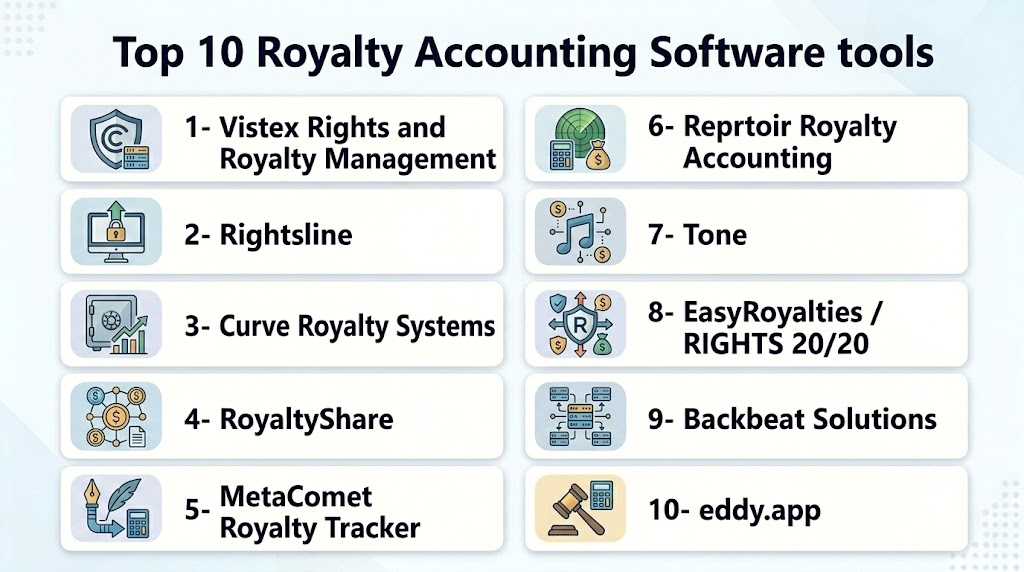
Top 10 Royalty Accounting Software Tools
1 — Vistex Rights and Royalty Management
Short description: Vistex is an enterprise-grade rights and royalty management solution used by organizations managing complex contracts, licensing, IP rights, and royalty calculations. It is best suited for large media, music, licensing, consumer products, and enterprise finance teams.
Key Features
- Rights and royalty management for complex licensing models
- Support for inbound and outbound royalty workflows
- Contract administration and obligation tracking
- Royalty calculation, payment, and reporting workflows
- Subledger accounting and financial visibility
- Support for large catalogues and high-volume transactions
- Analytics and reporting for rights and revenue performance
Pros
- Strong fit for enterprise royalty and rights operations
- Supports complex agreements across multiple business models
- Useful for organizations needing end-to-end rights and royalty control
Cons
- May be too complex for small teams with simple royalty needs
- Implementation can require planning, data cleanup, and expert configuration
- Pricing and deployment details may vary by business requirement
Platforms / Deployment
Web / Cloud / Hybrid
Security & Compliance
Not publicly stated. Buyers should validate SSO/SAML, MFA, encryption, audit logs, RBAC, SOC 2, ISO 27001, GDPR, and regional compliance requirements during procurement.
Integrations & Ecosystem
Vistex is typically used in enterprise environments where royalty data must connect with finance, content, licensing, and reporting systems.
- ERP and financial management systems
- Rights and contract management workflows
- Reporting and analytics tools
- Content and IP management systems
- Data import and export workflows
- Enterprise approval and accounting processes
Support & Community
Vistex generally fits organizations that require formal onboarding, implementation support, and enterprise service models. Support, documentation, and training availability may vary by package and implementation partner.
2 — Rightsline
Short description: Rightsline provides rights and royalty management software for businesses managing complex contracts, revenue allocations, title libraries, rights ownership, and payments. It is best for media, entertainment, licensing, and IP-heavy organizations.
Key Features
- Royalty calculation and payment workflows
- Rights and contract management capabilities
- Revenue allocation across complex terms
- Statement generation for licensors and partners
- Support for high-volume title and contract management
- Reporting for royalties, rights, and obligations
- Workflow support for approvals and administration
Pros
- Strong fit for complex media and entertainment royalty models
- Helps reduce manual work in contract-driven royalty accounting
- Designed for organizations managing large rights portfolios
Cons
- May require careful setup for complex business rules
- Not ideal for very small creators or basic royalty statements
- Pricing and security certifications are not always publicly stated
Platforms / Deployment
Web / Cloud
Security & Compliance
Not publicly stated. Buyers should confirm MFA, SSO/SAML, role-based permissions, audit logs, encryption, and compliance requirements before purchase.
Integrations & Ecosystem
Rightsline is commonly positioned as part of a broader rights and royalties workflow where contract, revenue, and payment data must work together.
- Accounting and finance systems
- Rights and content management workflows
- Reporting and business intelligence tools
- Data import and export processes
- Contract and deal management systems
- API-based workflow extensions where available
Support & Community
Support is generally oriented toward business and enterprise teams that need implementation assistance, onboarding, and operational guidance. Public community depth is limited compared with open-source tools.
3 — Curve Royalty Systems
Short description: Curve Royalty Systems is a music royalty accounting platform designed for record labels, music publishers, and music rights organizations. It helps teams process royalties, manage catalogues, and produce royalty statements.
Key Features
- Royalty accounting for labels and publishers
- Contract and rate management
- Sales and income statement imports
- Royalty calculations across artists, composers, and rights holders
- Statement generation and reporting
- Catalogue and metadata management
- Tools for music-specific royalty workflows
Pros
- Built specifically for music royalty accounting
- Good fit for independent and growing labels or publishers
- Helps reduce spreadsheet-heavy royalty workflows
Cons
- Less suitable for non-music royalty use cases
- Requires clean catalogue and contract data for best results
- Advanced workflow configuration may require onboarding effort
Platforms / Deployment
Web / Cloud
Security & Compliance
Not publicly stated. Buyers should verify encryption, MFA, access controls, audit history, and data protection obligations.
Integrations & Ecosystem
Curve is designed around music industry royalty workflows and commonly supports the types of imports, exports, and data structures used by labels and publishers.
- Distributor sales statement imports
- Music catalogue data workflows
- Publishing and label royalty operations
- Reporting exports
- Payee and statement processes
- Metadata migration and onboarding workflows
Support & Community
Curve provides support and educational resources for music royalty teams. Community strength is strongest among labels, publishers, and royalty administrators rather than general accounting users.
4 — RoyaltyShare
Short description: RoyaltyShare provides revenue management and royalty solutions for music and book publishing businesses. It is useful for organizations that need royalty processing, digital revenue management, and reporting support.
Key Features
- Royalty processing for music and publishing workflows
- Revenue management for digital sales channels
- Royalty statement preparation
- Rights holder and payee reporting
- Data processing for complex revenue files
- Support for music and book publishing industries
- Customer portal access for royalty workflows
Pros
- Strong relevance for music and book publishing
- Designed for digital royalty complexity
- Useful for businesses that need structured royalty processing support
Cons
- May not fit industries outside music and publishing
- Public product detail can be limited compared with some SaaS platforms
- Buyers may need demos to confirm exact feature coverage
Platforms / Deployment
Web / Cloud
Security & Compliance
Not publicly stated. Buyers should confirm encryption, MFA, role permissions, audit logs, data retention, and privacy controls.
Integrations & Ecosystem
RoyaltyShare is positioned around digital revenue and royalty workflows for media and publishing organizations.
- Digital distributor data workflows
- Publishing royalty processes
- Music royalty statements
- Payee reporting workflows
- Accounting exports
- Customer login and portal workflows
Support & Community
Support appears business-service oriented, with customer login and assistance workflows. Public community information is limited, so buyers should confirm onboarding and support tiers directly.
5 — MetaComet Royalty Tracker
Short description: MetaComet Royalty Tracker is a royalty management and accounting platform focused on simplifying royalty calculations, statements, payments, and reporting. It is widely relevant for publishers, licensing businesses, education, life sciences, entertainment, and IP-based revenue sharing.
Key Features
- Royalty calculation automation
- Contract and payee management
- Statement generation and reporting
- Support for advances, reserves, deductions, and revenue sharing
- Product-level and recipient-level royalty tracking
- Exportable financial and royalty data
- Rights and royalty lifecycle support
Pros
- Strong fit for publishing and broader royalty-driven businesses
- Helps reduce manual calculation errors
- Purpose-built for rights and royalty management instead of generic accounting
Cons
- Advanced use cases may require setup and data migration
- Public pricing may not be simple for all buyer segments
- May be more than needed for very small royalty portfolios
Platforms / Deployment
Web / Cloud
Security & Compliance
Not publicly stated. Buyers should validate encryption, MFA, RBAC, audit logs, SSO, data backup, and privacy compliance.
Integrations & Ecosystem
MetaComet is designed to fit into finance and royalty administration workflows where structured contracts, products, recipients, and statements must connect.
- Accounting exports
- Sales and royalty data imports
- Payment workflow support
- Publishing and licensing operations
- Rights management workflows
- Reporting and financial analysis processes
Support & Community
MetaComet provides business-focused support, onboarding, and royalty workflow guidance. Community is more industry-specific than broad developer-focused.
6 — Reprtoir Royalty Accounting
Short description: Reprtoir offers royalty accounting software for record labels and music publishers, with tools to manage income, advances, fees, contracts, and royalty statements. It is best for music organizations wanting an all-in-one operational workspace.
Key Features
- Royalty accounting for labels and publishers
- Income and fee management
- Advance tracking and recoupment workflows
- Royalty statement processing
- Multi-currency royalty handling
- Catalogue and release management connection
- Workflow support for music business operations
Pros
- Strong fit for music labels and publishers
- Useful for teams that want royalty accounting connected to catalogue workflows
- Supports modern music industry royalty operations
Cons
- Less suitable for non-music industries
- Requires accurate contract and metadata setup
- Some enterprise compliance details are not publicly stated
Platforms / Deployment
Web / Cloud
Security & Compliance
Not publicly stated. Buyers should check encryption, access permissions, MFA, audit logs, GDPR readiness, and internal security policies.
Integrations & Ecosystem
Reprtoir is built around music catalogue, rights, and royalty administration, making it useful for teams that want connected workflows instead of isolated spreadsheets.
- Distributor and revenue statement workflows
- Catalogue and release management
- Publishing and label operations
- Royalty statement exports
- Payee and contract data workflows
- Accounting export support
Support & Community
Support appears focused on music industry users, with onboarding and product guidance available depending on plan. Public community information is limited.
7 — Tone
Short description: Tone is a music royalty accounting and management platform focused on automating royalty calculations, contract splits, statements, and payouts. It is suited for music companies that want faster royalty cycles and clearer partner reporting.
Key Features
- Royalty calculation automation
- Contract split management
- Payout workflow support
- Royalty statement generation
- Contract simulation and deal modeling
- Recalculation support for corrections and adjustments
- Music royalty reporting workflows
Pros
- Designed for music royalty speed and transparency
- Useful contract simulation capability for deal planning
- Helps teams reduce statement preparation time
Cons
- Primarily focused on music royalty accounting
- May not fit broader publishing or licensing industries
- Public security and compliance details are limited
Platforms / Deployment
Web / Cloud
Security & Compliance
Not publicly stated. Buyers should verify MFA, encryption, role-based access, audit logs, and compliance posture.
Integrations & Ecosystem
Tone is designed to support royalty workflows where contracts, sales data, statements, and payouts must remain connected.
- Music royalty data imports
- Contract split workflows
- Statement and payout processes
- Accounting exports
- Revenue adjustment workflows
- Payee reporting workflows
Support & Community
Support information varies. Buyers should confirm onboarding, implementation timelines, migration assistance, and ongoing customer support options before purchase.
8 — EasyRoyalties / RIGHTS 20/20
Short description: EasyRoyalties and RIGHTS 20/20 support royalty accounting, rights management, permissions, and royalty reporting workflows, especially for publishers and rights-driven organizations. It is best for teams that need structured royalty administration with rights management context.
Key Features
- Royalty calculation and reporting
- Rights and permissions management
- Contract rule management
- Statement generation
- Author and payee royalty tracking
- Publishing-focused royalty workflows
- Support for complex royalty structures
Pros
- Strong fit for book publishing and rights administration
- Combines royalty and rights workflows
- Helps teams move beyond spreadsheet-based royalty processing
Cons
- Public product details may require direct vendor discussion
- May be less flexible for music-specific royalty workflows
- Setup quality depends on contract and title data quality
Platforms / Deployment
Web / Cloud / Varies / N/A
Security & Compliance
Not publicly stated. Buyers should check MFA, encryption, user permissions, audit logs, and data privacy requirements.
Integrations & Ecosystem
EasyRoyalties and RIGHTS 20/20 are relevant for publishing and rights teams that need royalty calculations connected to permissions and rights data.
- Publishing royalty workflows
- Rights and permissions processes
- Accounting exports
- Sales data imports
- Author and payee statement workflows
- Contract and title data management
Support & Community
Support appears specialized for publishing and royalty teams. Public community depth is limited, so buyers should verify training, migration, and support tiers.
9 — Backbeat Solutions
Short description: Backbeat Solutions provides music royalty software for labels and publishers, helping teams process sales sheets, generate statements, manage CWR registrations, and distribute royalty information. It is well suited for independent music businesses with structured royalty operations.
Key Features
- Royalty statement generation
- Sales sheet processing
- Payee statement distribution
- CWR registration support for publishing workflows
- Music royalty data processing
- Catalogue and metadata workflow support
- Reporting for labels and publishers
Pros
- Practical fit for independent music labels and publishers
- Helpful for processing large sales sheets
- Supports music publishing registration workflows
Cons
- Focused mainly on music use cases
- May not offer broad enterprise rights management depth
- Public security and compliance information is limited
Platforms / Deployment
Web / Cloud / Varies / N/A
Security & Compliance
Not publicly stated. Buyers should verify encryption, access controls, MFA, audit logs, and privacy requirements.
Integrations & Ecosystem
Backbeat is built around music royalty workflows and metadata-driven publishing operations.
- Distributor sales sheet imports
- CWR registration workflows
- Label and publisher royalty statements
- Payee reporting processes
- Catalogue data workflows
- Exportable accounting data
Support & Community
Support appears focused on music industry operators. Buyers should confirm training, onboarding, data migration, and customer service availability.
10 — eddy.app
Short description: eddy.app is music royalty accounting software for independent record labels and distributors. It helps users configure contracts, import sales reports, add costs and advances, generate royalty statements, and support payment workflows.
Key Features
- Royalty accounting for independent labels
- Contract configuration and beneficiary setup
- Distributor sales report imports
- Recoupable cost and advance tracking
- Royalty statement generation
- Automated payment workflow support
- Transparent reporting for artists and partners
Pros
- Strong fit for independent labels and distributors
- Designed for simpler, faster royalty workflows
- Helpful for teams moving away from manual spreadsheets
Cons
- Less suitable for large enterprise rights portfolios
- Primarily focused on music royalty accounting
- Advanced compliance details are not publicly stated
Platforms / Deployment
Web / Cloud
Security & Compliance
Not publicly stated. Buyers should validate encryption, MFA, access permissions, audit logs, and payment security controls.
Integrations & Ecosystem
eddy.app focuses on music royalty accounting workflows for labels and distributors that need practical automation without heavy enterprise complexity.
- Distributor report imports
- Contract and beneficiary management
- Cost and advance tracking
- Royalty statement workflows
- Payment process support
- Artist and partner reporting
Support & Community
Support appears targeted toward independent music businesses. Buyers should confirm onboarding help, data migration support, and support response levels.
Comparison Table
| Tool Name | Best For | Platform(s) Supported | Deployment | Standout Feature | Public Rating |
|---|---|---|---|---|---|
| Vistex Rights and Royalty Management | Enterprise rights and royalty teams | Web | Cloud / Hybrid | Enterprise royalty and rights administration | N/A |
| Rightsline | Media and licensing businesses | Web | Cloud | Complex rights, contracts, and royalty workflows | N/A |
| Curve Royalty Systems | Record labels and music publishers | Web | Cloud | Music royalty accounting specialization | N/A |
| RoyaltyShare | Music and book publishing businesses | Web | Cloud | Digital revenue and royalty processing | N/A |
| MetaComet Royalty Tracker | Publishers and IP licensing businesses | Web | Cloud | Purpose-built royalty lifecycle management | N/A |
| Reprtoir Royalty Accounting | Labels and music publishers | Web | Cloud | Connected catalogue and royalty accounting | N/A |
| Tone | Music royalty teams | Web | Cloud | Contract simulation and fast recalculation | N/A |
| EasyRoyalties / RIGHTS 20/20 | Book publishers and rights teams | Web | Cloud / Varies | Publishing royalty and rights workflows | N/A |
| Backbeat Solutions | Independent labels and publishers | Web | Cloud / Varies | Sales sheet processing and CWR support | N/A |
| eddy.app | Independent labels and distributors | Web | Cloud | Simple royalty reporting and payment workflows | N/A |
Evaluation & Scoring of Royalty Accounting Software
| Tool Name | Core (25%) | Ease (15%) | Integrations (15%) | Security (10%) | Performance (10%) | Support (10%) | Value (15%) | Weighted Total (0–10) |
|---|---|---|---|---|---|---|---|---|
| Vistex Rights and Royalty Management | 9.5 | 7.0 | 9.0 | 8.0 | 9.0 | 8.5 | 7.0 | 8.35 |
| Rightsline | 9.0 | 7.5 | 8.5 | 7.5 | 8.5 | 8.0 | 7.5 | 8.18 |
| Curve Royalty Systems | 8.5 | 8.5 | 8.0 | 7.0 | 8.5 | 8.0 | 8.0 | 8.13 |
| RoyaltyShare | 8.0 | 7.5 | 7.5 | 7.0 | 8.0 | 7.5 | 7.5 | 7.63 |
| MetaComet Royalty Tracker | 8.5 | 8.0 | 7.5 | 7.0 | 8.0 | 8.0 | 8.0 | 7.98 |
| Reprtoir Royalty Accounting | 8.0 | 8.5 | 7.5 | 7.0 | 8.0 | 7.5 | 8.0 | 7.85 |
| Tone | 7.8 | 8.5 | 7.0 | 7.0 | 8.0 | 7.0 | 8.0 | 7.67 |
| EasyRoyalties / RIGHTS 20/20 | 8.0 | 7.8 | 7.0 | 7.0 | 7.8 | 7.5 | 7.8 | 7.62 |
| Backbeat Solutions | 7.5 | 8.0 | 7.0 | 6.8 | 7.8 | 7.2 | 8.0 | 7.48 |
| eddy.app | 7.3 | 8.8 | 6.8 | 6.8 | 7.8 | 7.2 | 8.5 | 7.58 |
Which Royalty Accounting Software Tool Is Right for You?
Solo / Freelancer
Solo creators, small publishers, and independent royalty administrators should prioritize ease of use, affordability, and simple statement generation. eddy.app, Backbeat Solutions, or Reprtoir can be strong choices for music-focused users, while MetaComet may fit creators or small rights businesses with broader royalty needs.
SMB
SMBs need more automation than spreadsheets but may not need heavy enterprise implementation. Curve Royalty Systems, MetaComet Royalty Tracker, Reprtoir, and Tone are good options depending on whether the business is music-focused, publishing-focused, or licensing-focused.
Mid-Market
Mid-market royalty teams usually need contract flexibility, structured approvals, payee reporting, multi-source imports, and better audit trails. Rightsline, Curve, RoyaltyShare, and MetaComet are strong candidates for teams managing growing catalogues and complex royalty statements.
Enterprise
Enterprise organizations should focus on scale, governance, auditability, integrations, and complex contract rules. Vistex Rights and Royalty Management and Rightsline are strong options for large rights, media, licensing, and enterprise finance operations.
Budget vs Premium
Budget-conscious teams should choose tools that reduce manual effort without adding excessive implementation overhead. Premium buyers should focus on platforms that can handle large catalogues, global revenue, complex rules, and enterprise reporting.
Feature Depth vs Ease of Use
If your royalty model is simple, ease of use matters more than deep configuration. If your contracts include escalators, advances, recoupments, multiple territories, multi-party splits, or high-volume revenue data, feature depth becomes more important than simplicity.
Integrations & Scalability
Choose a tool that can connect with your sales sources, distributor reports, accounting software, ERP, payment systems, and data warehouse. Scalability becomes critical when your revenue files grow from hundreds of lines to millions of transactions.
Security & Compliance Needs
Royalty systems store sensitive contract, financial, payee, and revenue information. Buyers should validate MFA, access control, encryption, audit logs, approval history, data retention, and privacy compliance before signing a contract.
Frequently Asked Questions
1- What is royalty accounting software?
Royalty accounting software calculates and manages payments owed to rights holders, creators, licensors, artists, authors, partners, or franchise owners. It tracks contracts, revenue, deductions, advances, and statements in one system.
2- Who needs royalty accounting software?
Music labels, publishers, media companies, licensing businesses, education platforms, life sciences companies, and IP-based businesses commonly use royalty accounting software. Any company paying recurring royalties can benefit.
3- How is royalty accounting software priced?
Pricing varies by vendor, user count, transaction volume, catalogue size, implementation scope, and support level. Some tools may offer subscriptions, while enterprise platforms often use custom pricing.
4- Can royalty software replace spreadsheets?
Yes, for most growing royalty operations. Spreadsheets may work for small royalty volumes, but dedicated software improves accuracy, auditability, statement generation, and scalability.
5- What are common mistakes when choosing royalty software?
Common mistakes include ignoring data migration, underestimating contract complexity, skipping integration testing, and choosing a tool without testing real royalty statements. Buyers should run a pilot before full rollout.
6- Does royalty accounting software integrate with accounting systems?
Many platforms support exports, imports, APIs, or accounting integrations. Buyers should confirm compatibility with their ERP, accounting software, payment systems, and distributor data sources.
7- Is royalty accounting software secure?
Security varies by vendor. Buyers should verify MFA, encryption, RBAC, audit logs, SSO, data backup, and compliance requirements instead of assuming they are included.
8- Can these tools handle multi-currency royalties?
Many modern royalty tools support multi-currency workflows, but depth varies. Buyers should test exchange rates, withholding rules, payment exports, and territory-based reporting before purchase.
9- How long does implementation take?
Implementation depends on contract complexity, catalogue size, data quality, integrations, and number of users. Small teams may move faster, while enterprise projects can require phased rollout and data cleanup.
10- What are alternatives to royalty accounting software?
Alternatives include spreadsheets, generic accounting systems, outsourced royalty administration, ERP custom modules, or legal/accounting service providers. These may work for simple workflows but can become risky at scale.
Conclusion
Royalty accounting software helps businesses replace manual royalty calculations with structured, accurate, and transparent workflows. The best choice depends on your industry, catalogue size, contract complexity, payee volume, and integration needs. Music labels may prefer tools like Curve, Reprtoir, Tone, Backbeat, or eddy.app, while enterprise rights teams may need Vistex or Rightsline. Publishing and IP licensing teams should also evaluate MetaComet, RoyaltyShare, and EasyRoyalties based on workflow fit. Before choosing, shortlist two or three platforms, test real royalty data, validate integrations, and confirm security requirements. A focused pilot is the safest next step before full implementation.

Find Trusted Cardiac Hospitals
Compare heart hospitals by city and services — all in one place.
Explore Hospitals
Royalty accounting software is most effective when it automates complex royalty calculations while providing clear, transparent reporting for creators, publishers, and rights holders. By streamlining contract management, payment processing, and financial tracking, these platforms help reduce errors, ensure timely payouts, and simplify royalty administration across multiple revenue streams.