Introduction
Product Feed Management Tools help businesses create, clean, optimize, transform, and distribute product data feeds across marketplaces, advertising platforms, comparison shopping engines, social commerce channels, and e-commerce systems. In simple terms, they make sure product titles, descriptions, prices, images, inventory, categories, and attributes are accurate and channel-ready before being sent to platforms like Google Shopping, Meta, TikTok, Amazon, Walmart, or regional marketplaces. These tools matter now because online selling has become more complex, competitive, and data-driven. Retailers and brands need fast updates, clean attributes, feed rule automation, channel-specific mapping, and performance optimization to avoid rejected listings, wasted ad spend, and poor product visibility.
Real-world use cases include:
- Managing Google Shopping and Microsoft Shopping feeds.
- Sending optimized product feeds to marketplaces.
- Updating prices and stock availability across channels.
- Creating channel-specific product titles and descriptions.
- Improving product ad performance through feed enrichment.
What buyers should evaluate:
- Feed mapping and transformation flexibility
- Channel coverage and marketplace connectors
- Rule-based automation
- AI-powered feed optimization
- Error detection and diagnostics
- E-commerce platform integrations
- API and custom feed support
- Reporting and feed performance insights
- Security controls and user permissions
- Pricing model and scalability
Best for: Product Feed Management Tools are best for e-commerce brands, retailers, agencies, marketplace sellers, DTC companies, and growth teams managing product data across multiple channels. They are especially useful for businesses with large catalogs, frequent pricing changes, paid shopping campaigns, and marketplace expansion goals.
Not ideal for: These tools may not be necessary for very small stores selling only a few products through one simple e-commerce platform. If a business only uses one sales channel and rarely updates product information, built-in platform feed features or basic manual uploads may be enough.
Key Trends in Product Feed Management Tools
- AI-powered feed optimization: Modern tools are moving beyond basic field mapping and using AI to improve product titles, descriptions, categorization, and attribute completeness.
- More focus on product ad performance: Feed quality is now directly linked to paid shopping performance, so tools increasingly provide optimization suggestions for clicks, impressions, conversions, and return on ad spend.
- Marketplace and social commerce expansion: Businesses now need feeds for Google, Meta, TikTok, Amazon, Walmart, eBay, Pinterest, and regional platforms, making multi-channel feed management more important.
- Real-time inventory and pricing updates: Delayed feed updates can cause overselling, rejected ads, or poor customer experiences, so faster synchronization is becoming a major requirement.
- Rule-based automation at scale: Teams want flexible rules for excluding low-margin products, rewriting titles, grouping SKUs, adding labels, and correcting missing attributes automatically.
- Stronger diagnostics and feed error handling: Feed rejection issues can hurt sales quickly, so platforms are improving alerts, validation checks, and channel-specific error resolution workflows.
- Deeper integration with PIM and e-commerce systems: Feed tools increasingly connect with PIM, ERP, DAM, Shopify, BigCommerce, WooCommerce, Magento, and custom product databases.
- Agency-friendly workflows: Marketing agencies need multi-account management, client workspaces, campaign-level labels, approval flows, and reporting to manage feeds across many brands.
- Privacy, governance, and access control: As feeds become more connected with business-critical product and pricing data, role-based access, audit logs, and secure integrations matter more.
- Flexible pricing models: Vendors are offering pricing based on SKU volume, channel count, order volume, managed services, or platform usage depending on the buyer segment.
How We Selected These Tools Methodology
- We considered market adoption and category relevance across e-commerce, retail, paid media, and marketplace selling.
- We prioritized tools with strong product feed creation, transformation, enrichment, and syndication capabilities.
- We looked for platforms that support multiple channels, including shopping engines, ad platforms, marketplaces, and social commerce networks.
- We evaluated automation depth, including rules, scheduled updates, validation workflows, and error handling.
- We considered integration strength with e-commerce platforms, PIM systems, marketplaces, APIs, and advertising platforms.
- We included a balanced mix of enterprise, mid-market, SMB, agency-friendly, and commerce-focused tools.
- We reviewed how well each platform supports catalog scale, feed reliability, and performance monitoring.
- We considered buyer fit across different use cases, such as paid shopping optimization, marketplace expansion, full-service feed operations, and simple feed cleanup.
- We avoided guessing public ratings, certifications, or exact pricing where details are not clearly known.
- We focused on practical selection logic rather than promotional claims.
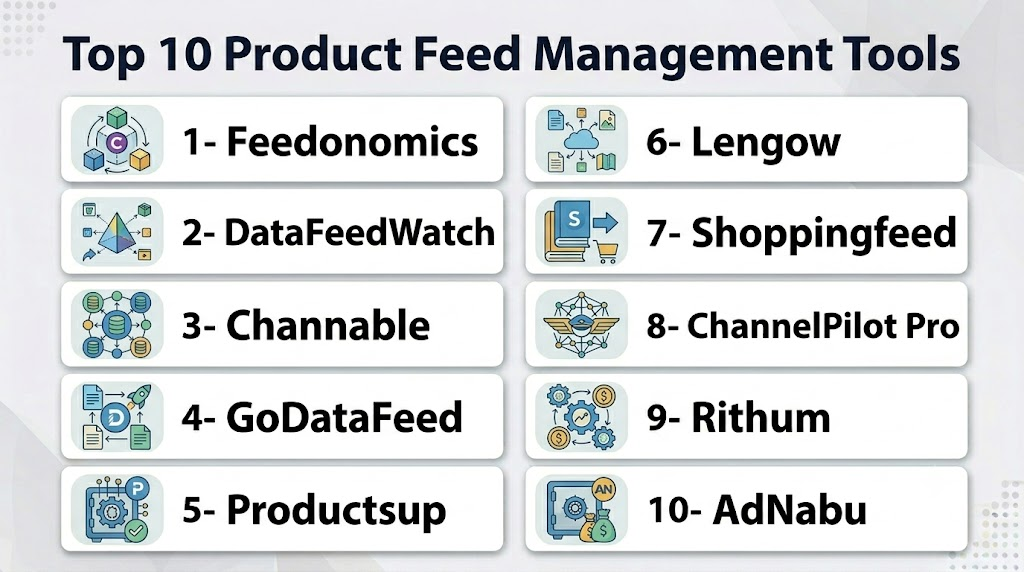
Top 10 Product Feed Management Tools
1 — Feedonomics
Short description: Feedonomics is a product feed management and optimization platform used by brands, retailers, and marketplaces that need high-quality feed transformation, syndication, and managed services. It is especially suitable for businesses that want expert support along with technology.
Key Features
- Product feed creation, cleanup, and transformation
- Feed optimization for advertising and marketplace channels
- Channel-specific mapping and attribute management
- Error monitoring and diagnostics
- Marketplace and shopping engine syndication
- Managed feed operations and support services
- Catalog normalization and data enrichment workflows
Pros
- Strong fit for large and complex product catalogs.
- Helpful for companies that want hands-on managed feed support.
- Good for multi-channel e-commerce and marketplace selling.
Cons
- May be more than small businesses need.
- Pricing and onboarding can vary depending on complexity.
- Less ideal for teams that want a fully self-service lightweight tool.
Platforms / Deployment
- Web
- Cloud
Security & Compliance
Not publicly stated.
Integrations & Ecosystem
Feedonomics connects product data with major advertising, marketplace, and commerce channels. It is commonly used in environments where feed quality, mapping accuracy, and channel requirements are business-critical.
- E-commerce platform integrations
- Marketplace feed destinations
- Advertising channel feeds
- API-based data ingestion
- Custom feed formats
- Product catalog data workflows
Support & Community
Feedonomics is known for combining software with managed service support. Documentation, onboarding, and support may vary by account size, service package, and implementation scope.
2 — DataFeedWatch
Short description: DataFeedWatch is a feed management tool designed for merchants, agencies, and e-commerce teams that need to optimize product feeds across advertising and shopping channels. It is often chosen for its usability, feed rules, and multi-channel support.
Key Features
- Feed mapping and transformation rules
- Product title and description optimization
- Channel templates for shopping platforms
- Error detection and feed diagnostics
- Product exclusion and segmentation rules
- Campaign labels and custom fields
- Store platform integrations
Pros
- Easy to use for marketers and e-commerce teams.
- Strong fit for Google Shopping and paid commerce campaigns.
- Useful for agencies managing multiple client feeds.
Cons
- Enterprise-level customization may be limited compared with heavier platforms.
- Advanced use cases may require careful rule setup.
- Some features may vary by plan.
Platforms / Deployment
- Web
- Cloud
Security & Compliance
Not publicly stated.
Integrations & Ecosystem
DataFeedWatch supports common e-commerce platforms, shopping engines, and advertising channels. It is especially useful for teams that want to connect store data, transform it, and push optimized feeds to multiple destinations.
- Shopify integrations
- WooCommerce integrations
- BigCommerce integrations
- Google Shopping support
- Meta product feed support
- Custom feed export options
Support & Community
DataFeedWatch offers documentation, onboarding resources, and customer support options. Support depth may vary depending on plan, region, and account requirements.
3 — Channable
Short description: Channable is a product feed management and e-commerce automation platform for brands, retailers, and agencies. It supports feed optimization, marketplace listing automation, PPC automation, and order connections.
Key Features
- Feed management and channel mapping
- Rule-based product data optimization
- Marketplace listing automation
- PPC campaign automation
- Order connection support
- Product segmentation and filtering
- Multi-country and multi-channel feed support
Pros
- Strong all-in-one functionality for feeds, marketplaces, and PPC.
- Suitable for agencies and growing e-commerce teams.
- Good balance between automation and usability.
Cons
- Advanced workflows may need setup time.
- Pricing can increase with more channels, projects, or features.
- Some enterprise needs may require custom configuration.
Platforms / Deployment
- Web
- Cloud
Security & Compliance
Not publicly stated.
Integrations & Ecosystem
Channable integrates with e-commerce platforms, ad channels, marketplaces, and order systems. Its ecosystem is useful for businesses that want both feed optimization and marketplace selling workflows from one place.
- Shopify integrations
- WooCommerce integrations
- Magento integrations
- Google Ads and Shopping support
- Marketplace connections
- API and feed import options
Support & Community
Channable provides documentation, customer support, onboarding materials, and educational resources. Support availability and depth may depend on plan and region.
4 — GoDataFeed
Short description: GoDataFeed helps online sellers manage, optimize, and distribute product feeds to shopping channels and marketplaces. It is suitable for SMBs and mid-market businesses that want practical feed automation without excessive complexity.
Key Features
- Product feed import and export
- Channel-specific feed templates
- Feed rule automation
- Product data validation
- Marketplace and shopping channel distribution
- Product listing monitoring
- Scheduled feed updates
Pros
- Practical option for growing e-commerce sellers.
- Helps reduce manual feed formatting work.
- Useful for multi-channel catalog distribution.
Cons
- May not match enterprise platforms for complex governance needs.
- Advanced customization may require technical understanding.
- Support and feature depth may vary by plan.
Platforms / Deployment
- Web
- Cloud
Security & Compliance
Not publicly stated.
Integrations & Ecosystem
GoDataFeed connects product data from e-commerce stores and sends optimized feeds to multiple channels. It is commonly used by merchants that need a manageable system for feed distribution and error reduction.
- Shopify support
- BigCommerce support
- Magento support
- Google Shopping feed support
- Marketplace feed support
- Custom feed options
Support & Community
GoDataFeed provides support resources, help documentation, and onboarding assistance. Community visibility is moderate compared with larger enterprise platforms.
5 — Productsup
Short description: Productsup is an enterprise product-to-consumer platform that supports product feed management, data syndication, marketplace operations, and commerce channel optimization. It is designed for larger businesses with complex product data and global channel needs.
Key Features
- Enterprise product feed syndication
- Feed transformation and enrichment
- Marketplace and retailer channel distribution
- Product content governance
- Automated data validation
- Large-scale catalog processing
- Multi-market and multi-region support
Pros
- Strong fit for enterprise product data operations.
- Supports complex, global, and high-volume feed needs.
- Useful for brands managing many markets and channels.
Cons
- May be too complex for smaller sellers.
- Implementation can require dedicated resources.
- Pricing is likely better suited for mid-market and enterprise budgets.
Platforms / Deployment
- Web
- Cloud
Security & Compliance
Not publicly stated.
Integrations & Ecosystem
Productsup is built for complex commerce ecosystems where product data must move across many channels, partners, and regions. It supports feed workflows for retailers, brands, marketplaces, and commerce teams.
- E-commerce integrations
- Marketplace integrations
- PIM and product data connections
- Advertising channel feeds
- API-based workflows
- Enterprise data pipelines
Support & Community
Productsup generally serves enterprise and mid-market customers with onboarding, account support, and professional services. Public community depth is limited compared with open-source ecosystems.
6 — Lengow
Short description: Lengow is a product feed management and e-commerce automation platform that helps merchants optimize, enrich, and distribute product data across marketplaces, comparison shopping engines, and advertising channels. It is suitable for retailers expanding across multiple digital sales channels.
Key Features
- Product feed import from multiple formats
- Feed cleaning, mapping, and enrichment
- Marketplace and advertising channel distribution
- Product segmentation and rule automation
- Performance-oriented feed optimization
- Multi-country selling support
- Catalog monitoring and diagnostics
Pros
- Strong option for European and international commerce teams.
- Useful for merchants selling across marketplaces and ad channels.
- Supports flexible feed import and transformation workflows.
Cons
- Some advanced capabilities may require deeper setup.
- Pricing may vary based on catalog and channel complexity.
- Smaller sellers may not need the full feature set.
Platforms / Deployment
- Web
- Cloud
Security & Compliance
Not publicly stated.
Integrations & Ecosystem
Lengow connects product catalogs with online marketplaces, comparison shopping engines, social commerce platforms, and ad networks. It is useful for businesses that need multi-channel catalog automation and channel-specific optimization.
- Marketplace integrations
- Shopping engine integrations
- Advertising platform feeds
- API and file-based imports
- E-commerce platform connections
- Custom feed exports
Support & Community
Lengow offers onboarding, help resources, documentation, and customer support options. Support levels may vary by plan, region, and account size.
7 — Shoppingfeed
Short description: Shoppingfeed is a product feed and marketplace management platform for e-commerce merchants that want to publish products across multiple channels and manage orders more efficiently. It is useful for sellers focused on marketplace growth.
Key Features
- Product feed management
- Marketplace listing distribution
- Product data mapping
- Channel-specific rules
- Order synchronization
- Inventory and price updates
- Multi-channel selling workflows
Pros
- Good for marketplace-focused businesses.
- Combines feed publishing with order-related workflows.
- Helps reduce manual work across selling channels.
Cons
- May not be as focused on ad feed optimization as specialist tools.
- Advanced enterprise data governance may be limited.
- Feature availability may depend on connected channels.
Platforms / Deployment
- Web
- Cloud
Security & Compliance
Not publicly stated.
Integrations & Ecosystem
Shoppingfeed connects e-commerce product catalogs with marketplaces and sales channels. It is especially relevant for merchants that want to centralize listing distribution and operational updates.
- E-commerce platform integrations
- Marketplace integrations
- Order management connections
- Inventory synchronization
- Feed mapping tools
- Channel-specific publishing
Support & Community
Shoppingfeed provides onboarding materials, support resources, and customer assistance. Support scope may vary by subscription and region.
8 — ChannelPilot Pro
Short description: ChannelPilot Pro is a product data feed management and performance marketing platform used by retailers and agencies to optimize product feeds across marketing channels. It is suitable for teams focused on campaign performance and feed-driven advertising.
Key Features
- Product feed optimization
- Channel mapping and export
- Product data quality checks
- Campaign performance support
- Rule-based feed customization
- Marketplace and comparison site distribution
- Reporting and analytics features
Pros
- Strong fit for performance marketing teams.
- Useful for feed-based advertising optimization.
- Suitable for agencies and online retailers.
Cons
- May require setup knowledge for advanced rules.
- Less suitable for very small stores with basic feed needs.
- Security and compliance details are not broadly public.
Platforms / Deployment
- Web
- Cloud
Security & Compliance
Not publicly stated.
Integrations & Ecosystem
ChannelPilot Pro works with product data sources and distributes feeds to marketing and commerce destinations. It is particularly useful for businesses that treat feed quality as part of performance marketing strategy.
- Shopping channel support
- Marketplace feed support
- Advertising platform feeds
- E-commerce data imports
- Custom export formats
- Analytics-oriented workflows
Support & Community
ChannelPilot Pro provides customer support, onboarding guidance, and documentation. Community visibility is more limited than some global SMB-focused tools.
9 — Rithum
Short description: Rithum supports commerce operations across marketplaces, retail media, and digital selling channels. For product feed management use cases, it is best suited to larger retailers and brands that need broad commerce network connectivity.
Key Features
- Product data distribution
- Marketplace and commerce channel management
- Listing and catalog workflows
- Inventory and order-related connectivity
- Retail and marketplace integrations
- Commerce network support
- Operational reporting capabilities
Pros
- Strong fit for large brands and retailers.
- Useful for marketplace and commerce channel expansion.
- Supports broader commerce operations beyond basic feed exports.
Cons
- May be too broad for teams only needing simple feed cleanup.
- Implementation can be more complex than lightweight tools.
- Pricing and packaging may vary significantly by use case.
Platforms / Deployment
- Web
- Cloud
Security & Compliance
Not publicly stated.
Integrations & Ecosystem
Rithum is positioned around broader commerce connectivity, making it useful for teams that need product data, listings, inventory, and marketplace workflows connected across many destinations.
- Marketplace integrations
- Retail channel connections
- Commerce platform integrations
- Product listing workflows
- Inventory and order-related connections
- Enterprise commerce ecosystem support
Support & Community
Rithum typically supports mid-market and enterprise commerce customers with documentation, onboarding, and account support. Support structure may depend on contracted services and implementation scope.
10 — AdNabu
Short description: AdNabu is a product feed management tool focused heavily on Shopify merchants and shopping feed optimization. It is suitable for small and growing e-commerce brands that want easier feed management for Google Shopping and related channels.
Key Features
- Shopify product feed management
- Google Shopping feed optimization
- Product attribute improvement
- Rule-based feed customization
- Multi-language and multi-currency support where available
- Feed error detection
- Product performance improvement workflows
Pros
- Strong fit for Shopify sellers.
- Easier to adopt for small and growing e-commerce teams.
- Helpful for improving Google Shopping feed quality.
Cons
- Less suitable for non-Shopify or complex enterprise environments.
- Channel depth may be narrower than broader platforms.
- Advanced requirements may require higher plans or alternative tools.
Platforms / Deployment
- Web
- Cloud
Security & Compliance
Not publicly stated.
Integrations & Ecosystem
AdNabu is closely aligned with Shopify-based e-commerce workflows and product feed optimization. It works well for merchants who want a simpler way to prepare product feeds for shopping ads and related channels.
- Shopify integration
- Google Shopping feed support
- Product data optimization workflows
- Feed validation features
- Multi-market feed support where available
- App-based commerce ecosystem
Support & Community
AdNabu provides help documentation, app support, and onboarding resources. Community strength is mostly tied to the Shopify merchant ecosystem.
Comparison Table Top 10
| Tool Name | Best For | Platform Supported | Deployment | Standout Feature | Public Rating |
|---|---|---|---|---|---|
| Feedonomics | Enterprise brands and full-service feed management | Web | Cloud | Managed feed optimization and syndication | N/A |
| DataFeedWatch | Merchants and agencies optimizing shopping feeds | Web | Cloud | Easy rule-based feed optimization | N/A |
| Channable | Feed management, PPC, and marketplace automation | Web | Cloud | Combined feed and campaign automation | N/A |
| GoDataFeed | SMB and mid-market multi-channel sellers | Web | Cloud | Practical feed distribution workflows | N/A |
| Productsup | Enterprise product data syndication | Web | Cloud | Large-scale product-to-channel management | N/A |
| Lengow | International marketplace and ad feed expansion | Web | Cloud | Multi-channel catalog optimization | N/A |
| Shoppingfeed | Marketplace sellers and order-connected workflows | Web | Cloud | Feed publishing plus order synchronization | N/A |
| ChannelPilot Pro | Performance marketing and feed analytics teams | Web | Cloud | Feed optimization for marketing channels | N/A |
| Rithum | Large retailers and commerce network operations | Web | Cloud | Broad marketplace and commerce connectivity | N/A |
| AdNabu | Shopify merchants and Google Shopping optimization | Web | Cloud | Shopify-focused feed improvement | N/A |
Evaluation & Scoring of Product Feed Management Tools
| Tool Name | Core 25% | Ease 15% | Integrations 15% | Security 10% | Performance 10% | Support 10% | Value 15% | Weighted Total 0–10 |
|---|---|---|---|---|---|---|---|---|
| Feedonomics | 9 | 7 | 9 | 7 | 9 | 9 | 7 | 8.2 |
| DataFeedWatch | 8 | 9 | 8 | 6 | 8 | 8 | 8 | 8.0 |
| Channable | 9 | 8 | 9 | 6 | 8 | 8 | 8 | 8.2 |
| GoDataFeed | 8 | 8 | 8 | 6 | 8 | 7 | 8 | 7.7 |
| Productsup | 9 | 7 | 9 | 7 | 9 | 8 | 7 | 8.2 |
| Lengow | 8 | 8 | 9 | 6 | 8 | 8 | 8 | 8.0 |
| Shoppingfeed | 7 | 8 | 8 | 6 | 7 | 7 | 8 | 7.3 |
| ChannelPilot Pro | 8 | 7 | 8 | 6 | 8 | 7 | 7 | 7.4 |
| Rithum | 8 | 7 | 9 | 7 | 8 | 8 | 7 | 7.8 |
| AdNabu | 7 | 9 | 7 | 6 | 7 | 7 | 9 | 7.5 |
Which Product Feed Management Tool Is Right for You?
Solo / Freelancer
Solo sellers and freelancers usually need a tool that is simple, affordable, and quick to launch. AdNabu is a strong fit for Shopify sellers who mainly want to improve Google Shopping feeds. DataFeedWatch can also work well for freelancers handling multiple small stores or client accounts.
For very small catalogs, avoid overbuying a large enterprise platform. Start with a tool that supports your current store platform, your most important ad channel, and basic feed rules. The goal is to reduce manual editing without creating unnecessary complexity.
SMB
SMBs should look for a balance of usability, channel support, and automation. DataFeedWatch, GoDataFeed, Channable, and Shoppingfeed are practical options depending on whether the main need is ad feed optimization, marketplace publishing, or multi-channel selling.
A growing SMB should also evaluate how the tool handles product exclusions, custom labels, category mapping, pricing updates, and feed errors. These features directly affect shopping campaign performance and marketplace listing approval.
Mid-Market
Mid-market businesses often need stronger integrations, more channel coverage, and better workflow control. Channable, Lengow, GoDataFeed, ChannelPilot Pro, and Productsup can be useful depending on the channel mix and regional needs.
At this stage, buyers should focus on automation, performance reporting, and feed reliability. A mid-market team may also need multiple users, approval workflows, custom feed formats, and support for large product catalogs across multiple countries.
Enterprise
Enterprises should prioritize scalability, governance, data quality, service depth, and global channel operations. Feedonomics, Productsup, Rithum, and Lengow are better suited to large-scale product feed operations where internal teams manage thousands or millions of SKUs across multiple markets.
Enterprise buyers should also evaluate API flexibility, support quality, managed services, role-based access, auditability, performance under high SKU volume, and compatibility with PIM, ERP, DAM, and commerce platforms.
Budget vs Premium
Budget-focused teams should consider AdNabu, DataFeedWatch, GoDataFeed, or Shoppingfeed depending on their platform and channel needs. These tools can help smaller teams improve feed quality without a heavy enterprise implementation.
Premium tools such as Feedonomics, Productsup, Rithum, and some larger Channable or Lengow setups are better for businesses where feed management directly affects large advertising budgets, marketplace revenue, or global commerce operations.
Feature Depth vs Ease of Use
If ease of use is the top priority, DataFeedWatch, AdNabu, and GoDataFeed are easier starting points for many teams. They help users build feed rules, fix errors, and publish feeds without requiring a large technical team.
If feature depth is more important, Channable, Productsup, Feedonomics, Lengow, and Rithum offer broader capabilities for marketplace automation, advanced mapping, large-scale syndication, and complex commerce workflows.
Integrations & Scalability
Teams with simple e-commerce stacks should choose tools that directly integrate with Shopify, WooCommerce, BigCommerce, or Magento. For this scenario, AdNabu, DataFeedWatch, Channable, and GoDataFeed can be strong options.
Companies with complex stacks should prioritize API support, custom imports, PIM compatibility, ERP data ingestion, marketplace connectivity, and high-volume feed processing. Feedonomics, Productsup, Lengow, and Rithum are more aligned with this need.
Security & Compliance Needs
Security-conscious buyers should ask every vendor about SSO, MFA, RBAC, encryption, audit logs, data retention, and compliance documentation. Since product feeds often include pricing, inventory, and product strategy data, access control matters.
If compliance details are not publicly clear, treat them as “Not publicly stated” and verify directly during procurement. Enterprise buyers should include security review, legal review, and integration testing before final rollout.
Frequently Asked Questions FAQs
1- What is a Product Feed Management Tool?
A Product Feed Management Tool helps businesses organize, clean, optimize, and send product data to marketplaces, ad platforms, and shopping engines. It converts raw catalog data into channel-ready feeds with correct titles, prices, images, categories, and attributes. These tools reduce manual updates and help avoid product disapprovals. They are especially useful for e-commerce teams selling across multiple channels.
2- How much do Product Feed Management Tools cost?
Pricing usually depends on SKU volume, number of channels, feed refresh frequency, users, support level, and advanced features. Some tools offer affordable plans for small stores, while enterprise platforms usually use custom pricing. Managed services, marketplace automation, and large catalog processing may increase the cost. Buyers should compare total value, not only monthly price.
3- How long does implementation take?
Basic setup can be completed quickly for small stores with clean product data and standard channels. Larger businesses may need more time for feed mapping, rule creation, marketplace testing, and integration work. Enterprise implementations can involve PIM, ERP, DAM, and custom data pipelines. A controlled pilot with a limited product set is the safest first step.
4- What are the most common feed management mistakes?
The most common mistake is pushing incomplete or poor-quality product data to sales channels. Teams also forget to map required attributes, exclude unavailable products, or check channel-specific errors. Another mistake is relying on one generic feed for every platform instead of optimizing per channel. Regular feed audits help prevent rejected listings and wasted ad spend.
5- Are Product Feed Management Tools secure?
Security varies by vendor, plan, and deployment model. Buyers should ask about SSO, MFA, RBAC, encryption, audit logs, and data handling policies. Compliance claims should be verified directly with the vendor because not every tool publicly states certifications. If security information is unclear, mark it as “Not publicly stated” during evaluation.
6- Can these tools scale for large catalogs?
Yes, many product feed management tools can scale to large catalogs, but capability differs by platform. Enterprise tools are better suited for high SKU volumes, multiple markets, frequent updates, and complex feed rules. Smaller tools may work well for limited catalogs but can become harder to manage at scale. Always test real catalog volume before full rollout.
7- Do these tools integrate with Shopify, Magento, and WooCommerce?
Many leading tools support popular e-commerce platforms such as Shopify, WooCommerce, BigCommerce, and Magento. Some also support custom feeds, APIs, CSV imports, XML imports, and product database connections. Integration quality can vary by platform and plan. Buyers should test the exact integration they need before committing.
8- Can Product Feed Management Tools improve ad performance?
Yes, better product feeds can improve shopping ad performance by making product data more accurate, relevant, and complete. Optimized titles, descriptions, categories, images, custom labels, and availability fields can help campaigns perform better. However, feed tools do not replace campaign strategy, bidding, or landing page quality. They work best as part of a broader performance marketing process.
9- What are alternatives to Product Feed Management Tools?
Small businesses may use built-in e-commerce feed apps, spreadsheets, manual uploads, or marketplace-specific tools. PIM systems can also manage product data, but they may not always handle channel-specific feed optimization. For simple catalogs, native platform tools may be enough. For multi-channel growth, dedicated feed management software is usually more scalable.
10- How do I switch from one feed management tool to another?
Start by exporting current feeds, rules, mappings, custom labels, and channel configurations. Clean product data before migration and document each destination’s requirements. Test a small product group in the new tool before moving the full catalog. After validation, migrate channel by channel to reduce disruption and feed errors.
Conclusion
Product Feed Management Tools are essential for businesses that rely on accurate product data across marketplaces, shopping engines, ad platforms, and social commerce channels. The best tool depends on your catalog size, channel mix, internal team skills, budget, and need for managed support. Small Shopify sellers may prefer AdNabu or DataFeedWatch, while growing SMBs may choose GoDataFeed, Channable, or Shoppingfeed for broader feed automation. Mid-market and enterprise teams may need Feedonomics, Productsup, Lengow, Rithum, or ChannelPilot Pro for larger catalogs and complex channel workflows. Before choosing, review your current feed errors, SKU volume, marketplace requirements, integration stack, security expectations, and reporting needs. A practical next step is to shortlist two or three tools, run a pilot with real product data, and validate feed quality, integrations, support, and pricing. Once the pilot proves reliable, scale the selected platform across your priority channels and keep improving feed rules based on performance data.#ProductFeedManagement, #EcommerceTools, #FeedOptimization, #MarketplaceSelling, #DigitalCommerce

Find Trusted Cardiac Hospitals
Compare heart hospitals by city and services — all in one place.
Explore Hospitals
Product feed management tools are most valuable when they keep product information accurate, optimized, and synchronized across multiple sales and advertising channels. By automating feed updates, attribute optimization, and channel-specific formatting, these platforms help businesses improve product visibility, reduce listing errors, and maximize e-commerce performance.