Introduction
Solar Asset Monitoring Software (SAMS) is a specialized platform designed to track, manage, and optimize the performance of solar energy installations. These tools provide real-time monitoring of energy generation, system health, and operational efficiency across residential, commercial, and utility-scale solar plants. as solar adoption accelerates globally, effective monitoring software has become essential to maximize energy yield, reduce maintenance costs, and ensure regulatory compliance.
Real-world use cases include:
- Real-time tracking of solar panel performance and energy production.
- Predictive maintenance to prevent system downtime and reduce repair costs.
- Energy forecasting for grid integration and power trading.
- Remote monitoring for geographically dispersed solar installations.
- Compliance reporting and environmental impact assessment.
Key evaluation criteria for buyers:
- Real-time data collection and analytics.
- Predictive maintenance and AI-driven insights.
- Integration with SCADA, ERP, and IoT systems.
- Security and compliance features (SSO, encryption, ISO 27001).
- Deployment flexibility (cloud, hybrid, on-premises).
- Scalability to handle multi-site or multi-region installations.
- Vendor support and documentation quality.
- Cost-effectiveness and flexible pricing models.
- Customizable dashboards and alerts.
- Interoperability with sensors, inverters, and other equipment.
Best for: Solar plant operators, renewable energy companies, EPC firms, and maintenance teams across residential, commercial, and utility-scale projects.
Not ideal for: Individual homeowners with single-panel systems, where simpler monitoring apps or inverter dashboards may suffice.
Key Trends in Solar Asset Monitoring Software
- AI-driven predictive maintenance for proactive failure prevention.
- Cloud-native platforms enabling remote monitoring and centralized analytics.
- Integration with digital twin technology for scenario planning and optimization.
- IoT-enabled sensors and edge computing for real-time local data processing.
- Advanced reporting for regulatory compliance and ESG tracking.
- Energy yield forecasting leveraging weather and historical data.
- Multi-vendor system support for mixed solar installations.
- Enhanced cybersecurity, including RBAC, MFA, and encryption.
- Subscription-based SaaS pricing with flexible scalability options.
- Mobile dashboards and automated notifications for operators and maintenance teams.
How We Selected These Tools (Methodology)
- Market adoption and global mindshare.
- Feature completeness, including monitoring, analytics, and predictive maintenance.
- Reliability and performance metrics from active installations.
- Security posture signals, certifications, and compliance capabilities.
- Integration capabilities with SCADA, ERP, and IoT ecosystems.
- Customer fit across residential, commercial, and utility-scale projects.
- Ease of deployment and user interface quality.
- AI and advanced analytics for energy forecasting.
- Vendor support quality and community engagement.
- Alignment with 2026+ renewable energy operational needs.
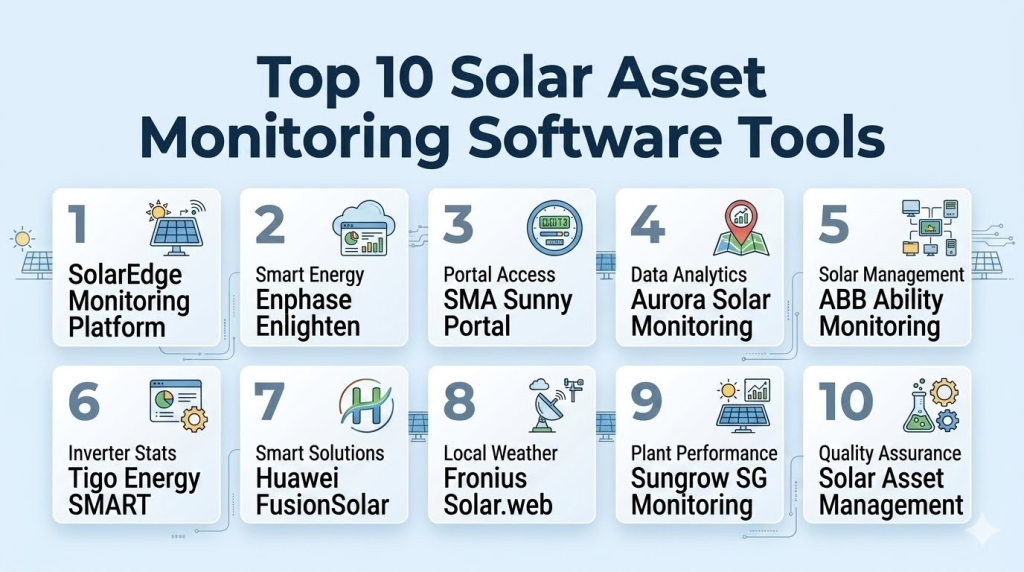
Top 10 Solar Asset Monitoring Software Tools
1- SolarEdge Monitoring Platform
Short description: Cloud-based platform for monitoring SolarEdge inverters and solar assets, providing real-time insights for residential and commercial systems.
Key Features
- Real-time performance monitoring for panels and inverters.
- Alerts for underperformance and faults.
- Energy yield forecasting.
- Mobile and web dashboards.
- Analytics for maintenance and optimization.
Pros
- Optimized for SolarEdge hardware.
- User-friendly interface for homeowners and operators.
Cons
- Limited compatibility with non-SolarEdge inverters.
- Advanced analytics require premium subscription.
Platforms / Deployment
- Web, iOS, Android
- Cloud
Security & Compliance
- SSO/MFA, encryption
- Not publicly stated for ISO/SOC certifications
Integrations & Ecosystem
Supports APIs for ERP, IoT, and smart home platforms.
- SCADA systems
- IoT sensor integration
- ERP reporting
Support & Community
- Vendor support and online documentation.
- Community forums for troubleshooting.
2- Enphase Enlighten
Short description: Comprehensive monitoring software for Enphase microinverter systems across residential and commercial solar assets.
Key Features
- Microinverter-level monitoring.
- Automated fault detection and alerts.
- Historical data analysis.
- Mobile and desktop dashboards.
- Reporting for system performance and efficiency.
Pros
- Detailed panel-level insights.
- Simple user interface for non-technical users.
Cons
- Limited multi-vendor support.
- Advanced analytics require premium plans.
Platforms / Deployment
- Web, iOS, Android
- Cloud
Security & Compliance
- SSO, MFA, encryption
- Not publicly stated
Integrations & Ecosystem
- SCADA integration for commercial setups
- Weather data APIs
- Custom reporting via API
Support & Community
- Tiered vendor support and training resources.
- Active user community.
3- SMA Sunny Portal
Short description: Monitoring and management software for SMA inverters and solar installations with remote access for performance optimization.
Key Features
- Real-time inverter monitoring.
- Alerts for underperforming panels.
- Historical and predictive analytics.
- Customizable dashboards.
- Reporting for maintenance and compliance.
Pros
- Reliable SMA integration.
- Strong analytics for performance tracking.
Cons
- Limited multi-vendor inverter support.
- Interface may be less intuitive for small operators.
Platforms / Deployment
- Web, iOS, Android
- Cloud
Security & Compliance
- SSO/MFA, encryption
- Not publicly stated
Integrations & Ecosystem
- SCADA and ERP integration
- Weather and energy data APIs
- API support for reporting
Support & Community
- Vendor support with training modules.
- Community forums available.
4- Aurora Solar Monitoring
Short description: Cloud platform offering solar performance monitoring and energy production forecasting for commercial and utility-scale projects.
Key Features
- Multi-vendor panel support.
- Real-time performance analytics.
- Energy yield forecasting and reporting.
- Maintenance alerts.
- Mobile-friendly dashboards.
Pros
- Scalable for commercial and utility-scale solar.
- Multi-vendor compatibility.
Cons
- Residential features less advanced.
- Premium features require subscription.
Platforms / Deployment
- Web, iOS, Android
- Cloud
Security & Compliance
- Not publicly stated
Integrations & Ecosystem
- SCADA, ERP, IoT devices
- Weather data APIs
- Custom analytics via API
Support & Community
- Vendor support tiers
- Documentation and onboarding guides
5- ABB Ability Solar Monitoring
Short description: Enterprise-grade platform for monitoring ABB solar inverters and large-scale solar farms with predictive analytics.
Key Features
- Real-time monitoring and analytics.
- Predictive maintenance alerts.
- Multi-site and multi-vendor support.
- KPI dashboards for operations.
- Energy yield and efficiency reporting.
Pros
- Strong predictive maintenance capabilities.
- Suitable for large-scale operations.
Cons
- Less user-friendly for small commercial sites.
- Premium pricing for enterprise features.
Platforms / Deployment
- Web
- Cloud / Hybrid
Security & Compliance
- SOC 2, MFA, encryption
- Not publicly stated
Integrations & Ecosystem
- SCADA, ERP, IoT sensor integration
- API for reporting and dashboards
Support & Community
- Enterprise-level support
- Training resources and forums
6- Tigo Energy SMART
Short description: Monitoring software focusing on module-level monitoring and optimization for residential and commercial solar arrays.
Key Features
- Module-level monitoring.
- Automated alerts for faults.
- Energy yield analytics.
- Cloud dashboards for real-time tracking.
- Maintenance reporting.
Pros
- Detailed insights at panel level.
- Supports retrofitting existing systems.
Cons
- Limited large-scale deployment features.
- Advanced analytics are subscription-based.
Platforms / Deployment
- Web, iOS, Android
- Cloud
Security & Compliance
- Not publicly stated
Integrations & Ecosystem
- SCADA integration
- IoT sensors
- API support for dashboards
Support & Community
- Documentation and vendor support.
- User community for troubleshooting.
7- Huawei FusionSolar
Short description: Cloud and on-premises platform for monitoring Huawei inverters and solar installations with AI-driven analytics.
Key Features
- Real-time inverter monitoring.
- Predictive maintenance using AI.
- Multi-site and multi-panel dashboards.
- Energy yield analytics and reporting.
- Automated alerts and notifications.
Pros
- AI-based predictive maintenance.
- Scalable for commercial and utility projects.
Cons
- Limited third-party inverter support.
- Learning curve for small operators.
Platforms / Deployment
- Web, iOS, Android
- Cloud / Hybrid
Security & Compliance
- MFA, encryption
- Not publicly stated
Integrations & Ecosystem
- SCADA, ERP, IoT sensors
- Weather data APIs
- Custom reporting via API
Support & Community
- Tiered vendor support.
- Community forums and documentation.
8- Fronius Solar.web
Short description: Monitoring platform for Fronius inverters, providing real-time performance insights for residential and commercial systems.
Key Features
- Real-time panel and inverter monitoring.
- Fault detection and alerts.
- Historical performance analysis.
- Mobile and web dashboards.
- Reporting and energy optimization analytics.
Pros
- Simple interface for residential users.
- Reliable Fronius integration.
Cons
- Limited predictive analytics.
- Less suitable for multi-vendor setups.
Platforms / Deployment
- Web, iOS, Android
- Cloud
Security & Compliance
- SSO, MFA, encryption
- Not publicly stated
Integrations & Ecosystem
- SCADA, IoT sensors, ERP
- API for reporting
- Cloud dashboard integration
Support & Community
- Vendor documentation and support.
- Moderate user community.
9- Sungrow SG Monitoring
Short description: Monitoring software for Sungrow inverters, supporting multi-site solar installations with performance analytics and reporting.
Key Features
- Real-time inverter and module monitoring.
- Alerts for system faults.
- Historical data visualization.
- Energy forecasting dashboards.
- Maintenance scheduling support.
Pros
- Reliable for commercial and utility-scale solar.
- Easy-to-read dashboards.
Cons
- Limited multi-vendor support.
- Advanced features require subscription.
Platforms / Deployment
- Web, iOS, Android
- Cloud / Hybrid
Security & Compliance
- Not publicly stated
Integrations & Ecosystem
- SCADA, ERP, IoT sensor integration
- API for reporting and dashboards
Support & Community
- Vendor support and training resources.
- User documentation available.
10- PVEL Solar Asset Management
Short description: Cloud-based platform offering monitoring, analytics, and predictive maintenance for multi-vendor solar assets.
Key Features
- Multi-vendor support.
- Predictive maintenance alerts.
- Energy yield and efficiency dashboards.
- Historical and real-time analytics.
- Mobile-friendly monitoring.
Pros
- Broad compatibility for mixed fleets.
- AI-driven insights for maintenance planning.
Cons
- Enterprise features may be costly.
- Residential setup less emphasized.
Platforms / Deployment
- Web, iOS, Android
- Cloud
Security & Compliance
- Not publicly stated
Integrations & Ecosystem
- SCADA, ERP, IoT devices
- API for custom dashboards and analytics
Support & Community
- Standard vendor support
- Documentation and user guides.
Comparison Table (Top 10)
| Tool Name | Best For | Platform(s) Supported | Deployment | Standout Feature | Public Rating |
|---|---|---|---|---|---|
| SolarEdge Monitoring | Residential & commercial | Web, iOS, Android | Cloud | Real-time inverter monitoring | N/A |
| Enphase Enlighten | Residential & commercial | Web, iOS, Android | Cloud | Microinverter-level analytics | N/A |
| SMA Sunny Portal | Residential & commercial | Web, iOS, Android | Cloud | Predictive analytics | N/A |
| Aurora Solar Monitoring | Commercial & utility | Web, iOS, Android | Cloud | Multi-vendor support | N/A |
| ABB Ability | Enterprise | Web | Cloud / Hybrid | Predictive maintenance | N/A |
| Tigo SMART | Residential & commercial | Web, iOS, Android | Cloud | Module-level monitoring | N/A |
| Huawei FusionSolar | Commercial & utility | Web, iOS, Android | Cloud / Hybrid | AI-driven maintenance | N/A |
| Fronius Solar.web | Residential & commercial | Web, iOS, Android | Cloud | Real-time performance insights | N/A |
| Sungrow SG Monitoring | Commercial & utility | Web, iOS, Android | Cloud / Hybrid | Performance dashboards | N/A |
| PVEL Solar Asset Management | Multi-vendor | Web, iOS, Android | Cloud | Predictive maintenance | N/A |
Evaluation & Scoring of Solar Asset Monitoring Software
| Tool Name | Core (25%) | Ease (15%) | Integrations (15%) | Security (10%) | Performance (10%) | Support (10%) | Value (15%) | Weighted Total |
|---|---|---|---|---|---|---|---|---|
| SolarEdge | 9 | 8 | 8 | 8 | 9 | 8 | 8 | 8.5 |
| Enphase | 8 | 9 | 7 | 8 | 8 | 8 | 8 | 8.2 |
| SMA Sunny Portal | 8 | 8 | 7 | 8 | 8 | 8 | 8 | 8.0 |
| Aurora Solar | 9 | 8 | 8 | 7 | 8 | 8 | 7 | 8.0 |
| ABB Ability | 9 | 7 | 8 | 9 | 9 | 8 | 7 | 8.3 |
| Tigo SMART | 8 | 8 | 7 | 7 | 8 | 8 | 7 | 7.7 |
| Huawei FusionSolar | 9 | 7 | 8 | 8 | 8 | 8 | 7 | 8.0 |
| Fronius | 8 | 9 | 7 | 7 | 8 | 8 | 7 | 7.8 |
| Sungrow | 8 | 8 | 7 | 7 | 8 | 7 | 7 | 7.6 |
| PVEL | 9 | 7 | 8 | 7 | 8 | 7 | 7 | 7.8 |
Which Solar Asset Monitoring Tool Is Right for You?
Solo / Freelancer
- Residential solar panels: SolarEdge, Enphase, Tigo SMART.
SMB
- Small commercial rooftop or community solar: SMA Sunny Portal, Fronius.
Mid-Market
- Commercial & multi-site installations: Aurora Solar, Huawei FusionSolar.
Enterprise
- Utility-scale and multi-vendor operations: ABB Ability, PVEL.
Budget vs Premium
- Budget: Fronius, Tigo SMART, Enphase.
- Premium: ABB Ability, Huawei FusionSolar, Aurora Solar.
Feature Depth vs Ease of Use
- Feature-rich: ABB Ability, Aurora Solar, Huawei FusionSolar.
- Ease-of-use: SolarEdge, Enphase, Fronius.
Integrations & Scalability
- Cloud-native platforms scale efficiently: Aurora Solar, PVEL, Huawei FusionSolar.
- Multi-vendor support: PVEL, Aurora Solar.
Security & Compliance Needs
- Enterprise operators should prioritize SOC 2 or ISO 27001 compliant platforms: ABB Ability, Huawei FusionSolar.
Frequently Asked Questions (FAQs)
1- What are typical pricing models for SAMS?
Most platforms use subscription per inverter, panel, or site. Enterprise plans may include analytics modules and cloud storage.
2- How long does implementation take?
Residential setups can be online in days; commercial or utility-scale farms may require several weeks.
3- Can these platforms predict failures?
Yes, predictive maintenance features analyze sensor data to flag potential faults.
4- Are these tools compatible with all solar brands?
Some platforms are brand-specific (SolarEdge, Enphase), while others (Aurora, PVEL) support multi-vendor fleets.
5- Do they support remote monitoring?
Yes, all major platforms offer mobile and web dashboards for real-time monitoring.
6- How secure is my solar data?
Encryption, SSO/MFA, and RBAC are standard; certifications like ISO 27001 or SOC 2 may apply for enterprise systems.
7- What integrations are common?
SCADA, ERP, IoT sensors, weather APIs, and reporting systems are typically supported.
8- Can I scale these platforms for multiple sites?
Cloud-native solutions like Aurora Solar, PVEL, and Huawei FusionSolar scale easily for large, multi-site operations.
9- Common mistakes when selecting a tool?
Choosing brand-specific software for mixed assets, ignoring predictive analytics, or underestimating reporting needs.
10- Are there alternatives to full-featured monitoring software?
Yes, inverter dashboards or simpler IoT monitoring apps may suffice for small residential or commercial sites.
Conclusion
Solar Asset Monitoring Software is essential for optimizing energy production, preventing equipment failure, and ensuring regulatory compliance. Selection depends on solar asset size, system brand, operational scale, and desired analytics. Operators should shortlist 2–3 platforms, run pilot integrations, and validate security and interoperability. Cloud-first platforms and AI-driven predictive analytics are increasingly standard, while ease-of-use, cost, and vendor support remain key selection factors. Proper evaluation ensures maximized uptime, energy yield, and maintenance efficiency.

Find Trusted Cardiac Hospitals
Compare heart hospitals by city and services — all in one place.
Explore Hospitals
Solar asset monitoring platforms deliver the greatest value when they provide actionable performance insights instead of simply reporting energy production. Real-time monitoring, fault detection, and predictive maintenance capabilities help operators maximize energy yield, reduce downtime, and improve the long-term return on solar investments.