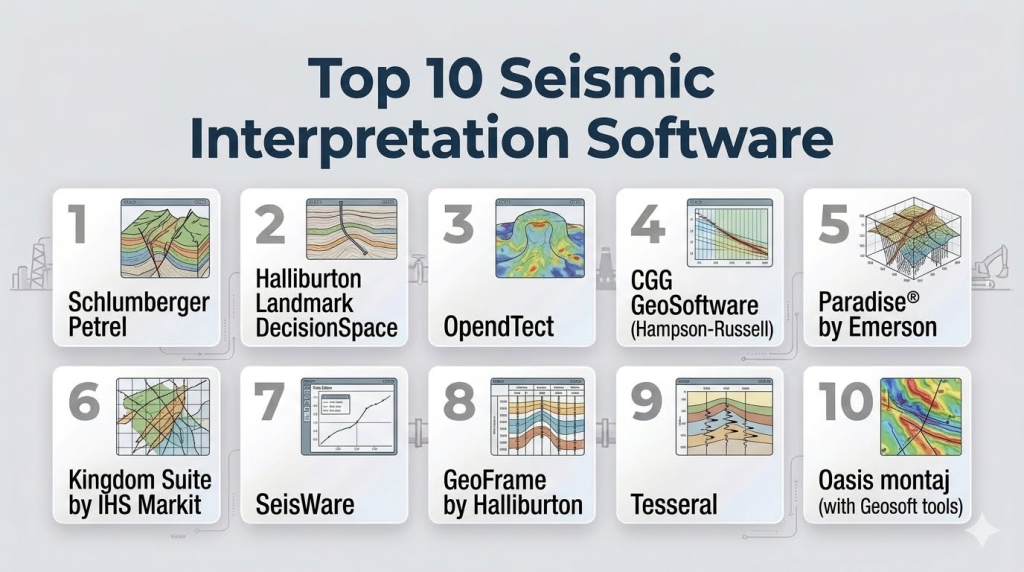
Introduction
Seismic Interpretation Software refers to specialized applications that help geoscientists visualize, interpret, and analyze seismic data to understand subsurface structures. In plain language, these tools take complex seismic survey inputs such as seismic traces, velocity models, well ties, and attribute volumes and turn them into meaningful maps of rock layers, faults, and reservoirs. This interpretation is foundational for industries such as oil & gas exploration, geothermal energy, carbon storage, and subsurface geotechnical planning. seismic interpretation is being reshaped by rising data volumes, machine‑assisted interpretation, cloud compute adoption, and the need to reduce exploration risk and carbon output. As exploration budgets tighten and data sizes grow, software that can help teams interpret results faster, with higher confidence and collaboration, is increasingly strategic.
Real‑world use cases include:
- Identifying hydrocarbon reservoirs from 3D seismic volumes in frontier basins.
- Assessing fault integrity and fracture networks for geothermal drilling.
- Mapping reservoir heterogeneity to inform well placement and completion strategies.
- Integrating seismic with well logs and petrophysical data to refine subsurface models.
- Monitoring time‑lapse seismic changes in reservoir management.
What buyers should evaluate (criteria):
- Visual clarity and performance with large 3D seismic volumes.
- Tools for horizon picking, fault interpretation, and attribute analysis.
- AI/ML‑assisted interpretation and automation features.
- Integration with well logs, petrophysics, and external workflows.
- Scalability for distributed teams and large datasets.
- Cloud and on‑prem deployment flexibility.
- Quality of visualization, annotation, and reporting.
- Security posture and access controls.
- Interoperability with data standards (SEG‑Y, LAS, etc.).
- Support, training, and community engagement.
Best for: Geoscientists, seismic interpreters, exploration and reservoir teams in oil & gas, geothermal, carbon storage, and deep mining sectors.
Not ideal for: Casual users with occasional mapping needs, basic GIS tasks, or organizations without structured subsurface data; in those cases, simpler visualization tools or general GIS software may suffice.
Key Trends in Seismic Interpretation Software
- AI‑Assisted Interpretation: Automated horizon picking, fault detection, and attribute extraction to reduce manual effort and improve consistency.
- Cloud Native Analytics: Using cloud compute and storage to manage large 3D/4D seismic datasets and support remote teamwork.
- Digital Twin Integration: Feeding interpreted models into larger digital twin frameworks for drilling simulation, production planning, and reservoir management.
- Real‑Time Data Ingestion: Integrating real‑time seismic, well logs, and drilling data for dynamic interpretation workflows.
- Augmented Visualization: Including VR/AR and immersive 3D environments for collaborative subsurface exploration sessions.
- Open Standards and APIs: Enhancing data interoperability through open file formats and APIs for third‑party tool integration.
- Collaborative Workspaces: Multi‑user version control, shared annotations, and concurrent model updates.
- Predictive Seismic Analytics: Leveraging historical data, ML, and pattern recognition to suggest features and reduce interpretation time.
- Cost‑Flexible Licensing: Subscription, cloud credits, and modular approaches to reduce upfront costs and align fees with usage patterns.
- Security & Governance: Increasing focus on data access controls, audit trails, and secure collaboration for sensitive exploration data.
How We Selected These Tools (Methodology)
- Prioritized market adoption and mindshare among energy and geoscience professionals.
- Evaluated feature completeness for key interpretation tasks (horizons, faults, attributes, volumes).
- Considered performance and reliability with large seismic datasets.
- Assessed security posture, including access controls and data governance (where known).
- Analyzed integration capabilities with well logs, petrophysics, modeling, and visualization tools.
- Measured AI/ML functionality for pattern recognition and automation.
- Checked deployment flexibility (cloud, hybrid, on‑prem).
- Considered support and community strength as a proxy for knowledge sharing and adoption.
- Ensured representation across industry segments (oil & gas, geothermal, mining).
- Factored ease of use and learning curve for both expert interpreters and newcomers.
Top 10 Seismic Interpretation Software Tools
1 — Schlumberger Petrel
Short description: A flagship seismic interpretation and reservoir characterization platform widely used in global oil & gas and geothermal projects.
Key Features
- Integrated 2D/3D/4D seismic interpretation tools
- Well correlation and synthetic seismogram generation
- Fault and horizon picking automation
- Attribute analysis and visualization
- Reservoir modeling and simulation interfaces
- Project workflows and version control
Pros
- Deep integration across interpretation to reservoir modeling
- Mature platform with broad industry trust
Cons
- Enterprise focus; steep learning curve for new users
- Licensing and compute requirements can be high
Platforms / Deployment
- Windows / Linux
- Cloud / Hybrid
Security & Compliance
- Not publicly stated
Integrations & Ecosystem
Petrel integrates with major geophysical, geological, and reservoir workflows:
- Well log and petrophysical tools
- Seismic processing systems
- Reservoir simulators
- Data management frameworks
Support & Community
Extensive documentation, structured support tiers, and a large global user community.
2 — Halliburton Landmark DecisionSpace
Short description: A comprehensive subsurface exploration and interpretation suite with strong seismic workflows and data management.
Key Features
- 3D seismic visualization and interpretation
- Attribute computation and analysis
- Horizon and fault modeling tools
- Integrated data management
- Well correlation and petrophysics linkage
- Scalable collaborative workflows
Pros
- Robust data management and multi‑disciplined workflows
- Well suited for enterprise teams
Cons
- Requires significant infrastructure planning
- Interface complexity for occasional users
Platforms / Deployment
- Windows / Linux
- Cloud / Hybrid
Security & Compliance
- Not publicly stated
Integrations & Ecosystem
Supports pipelines to well, petrophysical, and reservoir systems:
- Petrophysics suites
- Seismic processors
- Well planning tools
Support & Community
Vendor support contracts and user forums; training offerings available.
3 — OpendTect
Short description: Open‑source and extensible seismic interpretation platform with strong plugin support and visualization capabilities.
Key Features
- 2D/3D seismic viewing and interpretation
- Fault and horizon auto‑tracking plugins
- Attribute analysis toolkit
- Scripting and plugin extensions
- Volume rendering
Pros
- Cost‑effective and extensible via plugins
- Active development community
Cons
- Plugins vary in quality and completeness
- Base package may be less polished than commercial suites
Platforms / Deployment
- Windows / Linux / macOS
- Cloud / Self‑hosted
Security & Compliance
- Varies / N/A
Integrations & Ecosystem
Extensible via community plugins and scripting:
- Attribute libraries
- Custom interpreters
- Data import/export filters
Support & Community
Strong community forums and documentation; commercial support options exist.
4 — CGG GeoSoftware (Hampson‑Russell)
Short description: A seismic interpretation and reservoir characterization suite focused on advanced geophysical analysis and inversion workflows.
Key Features
- Seismic inversion and rock physics analysis
- Attribute generation and viewing
- Horizon and fault interpretation tools
- AVO/AVA analysis
- Integrated well tie and calibration
Pros
- Strong geophysical analysis capabilities
- Well suited for complex interpretation scenarios
Cons
- Specialized focus may not suit all workflows
- Licensing and training requirements
Platforms / Deployment
- Windows / Linux
- Cloud / Hybrid
Security & Compliance
- Not publicly stated
Integrations & Ecosystem
Ecosystem integrates with petrophysical and reservoir tools:
- Inversion engines
- Well log interpreters
- Data management systems
Support & Community
Vendor support and professional services; active user base in geophysics.
5 — Paradise® by Emerson
Short description: A seismic interpretation and data integration environment popular for visualization, correlation, and horizon mapping.
Key Features
- Seismic display and correlation tools
- Well and log integration
- Fault interpretation and mapping
- Volume interpretation
- Data management across projects
Pros
- Clean visualization and correlation workflows
- Practical for diverse interpretation needs
Cons
- Not as advanced in AI automation
- Enterprise workflows require addons
Platforms / Deployment
- Windows / Linux
- Cloud / Hybrid
Security & Compliance
- Not publicly stated
Integrations & Ecosystem
Integrates with reservoir and well planning systems:
- Data repositories
- Log interpretation tools
- Simulator connections
Support & Community
Technical support and documentation available; moderate user base.
6 — Kingdom Suite by IHS Markit
Short description: A subsurface interpretation platform with strong seismic and well correlation tools geared toward integrated exploration workflows.
Key Features
- 2D/3D seismic interpretation
- Well tie and correlation tools
- Basic attribute analysis
- Mapping and structural interpretation
- Data management for teams
Pros
- User‑friendly interface for fast interpretation
- Good for multidisciplinary teams
Cons
- Less advanced attribute and automation features
- Licensing varies by module
Platforms / Deployment
- Windows / Cloud / Hybrid
Security & Compliance
- Not publicly stated
Integrations & Ecosystem
Integrates with well logs and basic reservoir workflows:
- Well data systems
- GIS mapping tools
Support & Community
Vendor support and documentation; training courses available.
7 — SeisWare
Short description: Flexible seismic interpretation platform emphasizing ease of use and rapid workflows for seismic analysis and mapping.
Key Features
- Interactive seismic interpretation
- Attribute analysis and mapping
- Fault and horizon picking
- Well log correlation
- Custom scripting tools
Pros
- Easy to adopt with rapid learning curve
- Useful for both 2D and 3D projects
Cons
- Advanced automation features limited
- Integrations may require customization
Platforms / Deployment
- Windows / Cloud / Hybrid
Security & Compliance
- Not publicly stated
Integrations & Ecosystem
Supports data connections for logs and project data:
- Well data imports
- Project repositories
- Custom export formats
Support & Community
Documentation and technical support; active user community.
8 — GeoFrame by Halliburton
Short description: A mature interpretation platform combining seismic, well, and petrophysical data in a unified environment.
Key Features
- Integrated seismic and well interpretation
- Petrophysical workflows
- Structural mapping and fault analysis
- Cross‑section and visualization tools
Pros
- All‑in‑one interpretation environment
- Deep linking between seismic and petrophysics
Cons
- Legacy platform; UI feels dated
- Advance modules needed for modern workflows
Platforms / Deployment
- Windows / Linux
- Hybrid
Security & Compliance
- Not publicly stated
Integrations & Ecosystem
Ties to other Halliburton tools and data systems:
- Well logs and petrophysics
- Reservoir databases
Support & Community
Vendor support; documentation exists though limited community engagement.
9 — Tesseral
Short description: A seismic interpretation and processing suite with strong visualization and modeling capabilities.
Key Features
- 3D seismic interpretation
- Gravity and magnetic data integration
- Velocity model building
- Mapping and visualization tools
Pros
- Good integration of seismic with potential field data
- Practical modeling workflows
Cons
- Smaller user base than enterprise tools
- Fewer automation features
Platforms / Deployment
- Windows / Linux
- Hybrid
Security & Compliance
- Not publicly stated
Integrations & Ecosystem
Supports multi‑discipline data types:
- Gravity and magnetics
- Well ties
- Seismic volumes
Support & Community
Documentation and support; moderate user community.
10 — Oasis montaj (with Geosoft tools)
Short description: A geoscience interpretation platform with seismic import and visualization, often used with broader geospatial workflows.
Key Features
- Seismic import and visualization
- Geospatial analysis
- Gravity and magnetic support
- Data integration tools
Pros
- Good for multi‑discipline integration
- Flexible data handling
Cons
- Not focused solely on seismic interpretation
- Advanced seismic workflows limited
Platforms / Deployment
- Windows / Hybrid
Security & Compliance
- Not publicly stated
Integrations & Ecosystem
Integrates with geospatial and geoscience data workflows:
- GIS systems
- Geophysical datasets
Support & Community
Vendor support and training; broader geoscience user base.
Comparison Table (Top 10)
| Tool Name | Best For | Platform(s) Supported | Deployment | Standout Feature | Public Rating |
|---|---|---|---|---|---|
| Petrel | Full subsurface integration | Windows/Linux | Cloud/Hybrid | Comprehensive workflows | N/A |
| DecisionSpace | Enterprise teams | Windows/Linux | Cloud/Hybrid | Data management & scalability | N/A |
| OpendTect | Cost‑effective extensible | Windows/Linux/macOS | Cloud/Self‑hosted | Plugin ecosystem | N/A |
| CGG Hampson‑Russell | Advanced geophysics | Windows/Linux | Cloud/Hybrid | Inversion & analysis | N/A |
| Paradise | Visualization & mapping | Windows/Linux | Cloud/Hybrid | Clean visuals | N/A |
| Kingdom Suite | Team integration | Windows/Cloud | Cloud/Hybrid | Well‑seismic correlation | N/A |
| SeisWare | Ease of use | Windows/Cloud | Cloud/Hybrid | Rapid interpretation | N/A |
| GeoFrame | Integrated well/seismic | Windows/Linux | Hybrid | Unified data environment | N/A |
| Tesseral | Multi‑data integration | Windows/Linux | Hybrid | Gravity & seismic combo | N/A |
| Oasis montaj | Broad geoscience | Windows | Hybrid | Cross‑discipline data | N/A |
Evaluation & Scoring of Seismic Interpretation Software
| Tool Name | Core (25%) | Ease (15%) | Integrations (15%) | Security (10%) | Performance (10%) | Support (10%) | Value (15%) | Weighted Total |
|---|---|---|---|---|---|---|---|---|
| Petrel | 9 | 7 | 9 | 8 | 9 | 8 | 7 | 8.6 |
| DecisionSpace | 9 | 7 | 8 | 8 | 8 | 8 | 7 | 8.3 |
| OpendTect | 7 | 8 | 7 | 7 | 8 | 8 | 8 | 7.7 |
| Hampson‑Russell | 8 | 6 | 8 | 7 | 8 | 7 | 7 | 7.6 |
| Paradise | 7 | 8 | 7 | 7 | 7 | 7 | 8 | 7.5 |
| Kingdom Suite | 7 | 8 | 7 | 7 | 7 | 7 | 8 | 7.5 |
| SeisWare | 7 | 9 | 6 | 7 | 7 | 7 | 8 | 7.6 |
| GeoFrame | 7 | 6 | 7 | 7 | 7 | 7 | 6 | 6.8 |
| Tesseral | 6 | 7 | 6 | 7 | 7 | 7 | 8 | 7.1 |
| Oasis montaj | 6 | 7 | 7 | 7 | 6 | 7 | 8 | 7.0 |
Which Seismic Interpretation Tool Is Right for You?
Solo / Freelancer
Independent interpreters often prefer OpendTect or SeisWare for cost‑effectiveness and rapid adoption without enterprise overhead.
SMB
Small to mid‑sized firms benefit from Paradise or Kingdom Suite, which balance ease of use with core interpretation features and moderate cost.
Mid‑Market
Teams with recurring interpretation demands should consider CGG Hampson‑Russell or DecisionSpace for structured workflows and data governance.
Enterprise
Global exploration operations typically rely on Petrel for its comprehensive interpretation to reservoir linkage and enterprise scalability.
Budget vs Premium
- Budget: OpendTect, SeisWare
- Premium: Petrel, DecisionSpace
Feature Depth vs Ease of Use
- Deep feature depth: Petrel, Hampson‑Russell
- Ease of use: SeisWare, Paradise
Integrations & Scalability
- Maximum scalability and integrations: Petrel, DecisionSpace
- Flexible workflows: OpendTect, Kingdom Suite
Security & Compliance Needs
Enterprises with strict access governance should prioritize platforms with documented security controls and central data governance—for example, Petrel and DecisionSpace backed by corporate IT policies.
Frequently Asked Questions (FAQs)
1- What pricing models are common for seismic interpretation software?
Most tools use subscription or perpetual licensing with annual support renewals. Cloud options may use usage‑based compute credits.
2- How long does implementation take?
Deployment varies: simple desktop setups can be days, while enterprise integrated systems may take weeks to months.
3- Can these tools handle 4D/time‑lapse seismic?
Yes — advanced platforms like Petrel and Hampson‑Russell support 4D seismic workflows to monitor reservoir changes over time.
4- Do these platforms require high‑end hardware?
Large 3D volumes benefit from powerful GPUs, multicore CPUs, and high memory. Cloud deployments can mitigate local hardware limitations.
5- What data formats are supported?
Common standards include SEG‑Y for seismic, LAS for well logs, and various industry proprietary formats; support varies by tool.
6- Is AI used in seismic interpretation?
Yes. AI and ML are increasingly used for automated horizon picking, fault identification, and attribute analysis, especially in premium packages.
7- How do teams collaborate in these systems?
Enterprise tools support shared data repositories, version control, and multi‑user access to ensure consistency across interpreters.
8- Can seismic interpretation integrate with reservoir modeling?
Most leading platforms integrate directly or via export into reservoir modeling systems, enabling a seamless interpretation‑to‑simulation workflow.
9- What are common mistakes when choosing seismic software?
Mistakes include ignoring integration needs, overlooking data size limits, and choosing tools without adequate training support.
10- Are there open‑source alternatives?
Yes — OpendTect is a notable open‑source option with extensible plugin support, though it may lack some advanced enterprise features.
Conclusion
Seismic Interpretation Software plays a pivotal role in subsurface exploration, reservoir engineering, and development planning. As data volumes and complexity grow, the right interpretation platform can accelerate insight, improve precision, and facilitate collaboration across teams. There is no single best tool for every organization; instead, selection depends on needs such as scale, automation, budget, and integration. For many, shortlisting 2–3 tools, piloting real datasets, and validating integration and automation workflows is the most practical next step toward unlocking better subsurface insight.

Find Trusted Cardiac Hospitals
Compare heart hospitals by city and services — all in one place.
Explore Hospitals
Seismic interpretation software is most valuable when it transforms complex subsurface data into clear, actionable geological insights. Advanced visualization, AI-assisted interpretation, and integration with geological models can help geoscientists improve exploration accuracy, reduce uncertainty, and make more confident drilling decisions.