Introduction
Lab Safety Management Tools are digital platforms designed to streamline laboratory safety operations, compliance tracking, and risk management. They help organizations manage chemical inventories, equipment safety, incident reporting, training, and regulatory compliance, ensuring both personnel and environmental safety. the increasing complexity of laboratory operations, regulatory scrutiny, and the adoption of remote and automated lab processes have made such tools critical.
Real-world use cases include:
- Tracking chemical inventory and hazardous materials in research and industrial labs.
- Managing safety training programs and certifications for laboratory staff.
- Automating incident reporting, investigation, and corrective actions.
- Monitoring equipment maintenance schedules and compliance audits.
- Integrating safety data with laboratory information management systems (LIMS) for holistic risk management.
What buyers should evaluate:
- Compliance tracking and reporting capabilities
- Ease of use and intuitive interfaces
- Integration with LIMS, ERP, and EHS systems
- Incident and risk management automation
- AI-driven insights for predictive safety measures
- Regulatory adherence (OSHA, ISO, local regulations)
- Scalability for multiple labs or sites
- Data security and audit capabilities
- Mobile access for real-time updates
- Pricing and deployment flexibility
Best for: Research institutions, pharmaceutical companies, industrial labs, and universities managing large chemical inventories, compliance requirements, and safety training programs.
Not ideal for: Small labs with minimal regulatory oversight or single-user setups, where manual tracking or spreadsheets may suffice.
Key Trends in Lab Safety Management Tools
- Adoption of AI and predictive analytics to foresee safety incidents before they occur.
- Integration with IoT sensors and smart lab equipment for real-time monitoring.
- Mobile-first applications enabling remote incident reporting and audit management.
- Cloud-based platforms supporting collaborative multi-site lab safety management.
- Enhanced data analytics dashboards for safety compliance and KPIs.
- Interoperability with LIMS, ERP, and EHS systems for unified operational control.
- Automation of safety training assignments and certification tracking.
- Role-based access and advanced security to meet regulatory and ISO compliance.
- Use of gamification and engagement tools to improve safety culture adoption.
- Flexible pricing models including subscription and per-lab licensing.
How We Selected These Tools (Methodology)
- Evaluated market adoption and reputation in academic, pharma, and industrial labs.
- Reviewed feature completeness, including inventory, training, incident, and compliance management.
- Assessed reliability and performance through user feedback and testing reports.
- Considered security posture, encryption, RBAC, and compliance certifications.
- Checked integration capabilities with LIMS, ERP, EHS, and IoT devices.
- Evaluated suitability across enterprise, mid-market, and SMB labs.
- Analyzed support resources, including documentation, community forums, and training.
- Prioritized tools offering AI-driven insights or automation for modern labs.
- Assessed scalability for multi-site deployments.
- Included tools with flexible licensing or SaaS options for broad accessibility.
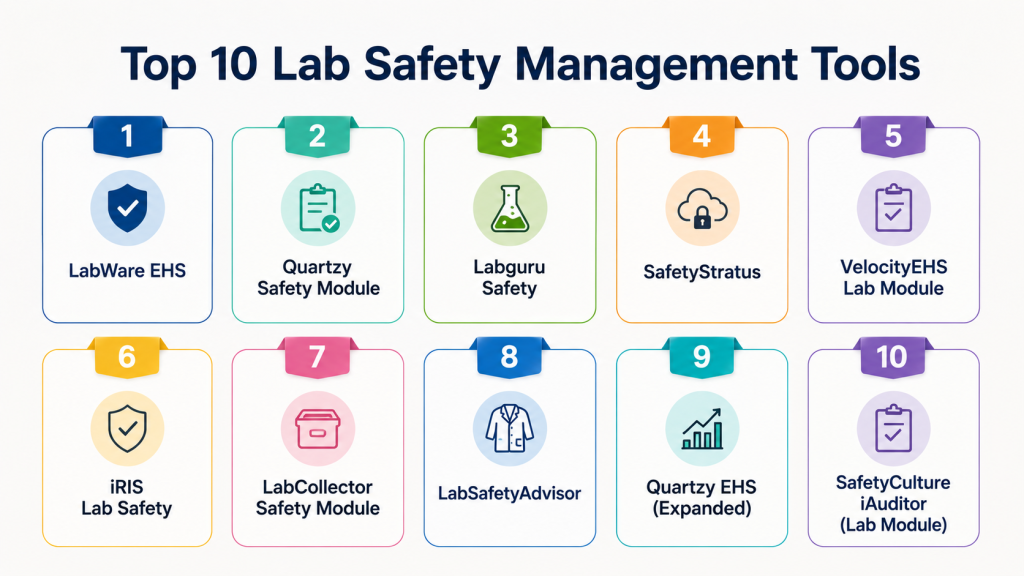
Top 10 Lab Safety Management Tools
1- LabWare EHS
Short description: A comprehensive lab safety management solution designed for large research institutions and corporate laboratories to manage compliance, incidents, and training efficiently.
Key Features
- Chemical inventory and hazardous materials tracking
- Automated safety training assignments
- Incident reporting and corrective action workflows
- Audit and regulatory compliance tracking
- Integration with LIMS and ERP systems
- Dashboard analytics and KPI tracking
Pros
- Scalable for multi-site labs
- Strong compliance and reporting capabilities
Cons
- Complex configuration may require professional services
- Higher licensing costs
Platforms / Deployment
- Web / Windows / Cloud / Hybrid
Security & Compliance
- Not publicly stated
Integrations & Ecosystem
- LIMS, ERP, IoT sensor integrations
- API support for custom workflows
- Data export for reporting
Support & Community
- Comprehensive documentation, professional onboarding, active support team
2- Quartzy Safety Module
Short description: Quartzy provides a cloud-based lab safety and inventory module ideal for small to mid-sized laboratories managing chemicals and compliance digitally.
Key Features
- Chemical inventory management with barcoding
- Safety data sheet (SDS) management
- Automated reminders for training and certification expiration
- Customizable reporting templates
- Integration with ordering and procurement workflows
Pros
- User-friendly and mobile-accessible
- Affordable for SMB labs
Cons
- Limited advanced analytics
- Less suited for large enterprise-scale labs
Platforms / Deployment
- Web / iOS / Android / Cloud
Security & Compliance
- Not publicly stated
Integrations & Ecosystem
- Procurement software, LIMS, Excel exports
- REST API for custom integration
Support & Community
- Online documentation, email support, user forums
3- Labguru Safety
Short description: Labguru integrates lab safety with research management, supporting chemical inventory, training, and regulatory compliance for life sciences labs.
Key Features
- Hazardous chemical tracking and SDS management
- Automated training assignment and tracking
- Incident reporting and audit logs
- Compliance reporting dashboards
- Integration with research notebooks and LIMS
Pros
- Combines safety and research management
- Cloud-based and accessible remotely
Cons
- Advanced configuration may require consulting
- Limited customization for large enterprises
Platforms / Deployment
- Web / Cloud
Security & Compliance
- Not publicly stated
Integrations & Ecosystem
- LIMS, ELN, procurement systems
- API for data exchange
Support & Community
- Documentation, live support, moderate community engagement
4- SafetyStratus
Short description: SafetyStratus offers EHS and lab safety management solutions with strong compliance tracking and reporting for corporate and research labs.
Key Features
- Incident management and corrective action workflows
- Chemical inventory and hazardous materials tracking
- Compliance and audit management
- Training and certification management
- Data analytics dashboards
Pros
- Robust compliance and reporting
- Scalable for large organizations
Cons
- User interface can be complex
- Higher initial setup time
Platforms / Deployment
- Web / Cloud
Security & Compliance
- Not publicly stated
Integrations & Ecosystem
- ERP, LIMS, IoT monitoring devices
- Custom API workflows
Support & Community
- Professional onboarding, 24/7 support, comprehensive documentation
5- VelocityEHS Lab Module
Short description: VelocityEHS provides cloud-based lab safety management with chemical tracking, incident reporting, and compliance analytics for medium to large labs.
Key Features
- Chemical and reagent inventory management
- SDS library and hazard communication
- Incident and near-miss tracking
- Automated training management
- Regulatory compliance dashboards
Pros
- Intuitive interface and mobile-friendly
- Strong compliance reporting
Cons
- Limited advanced AI features
- May require customization for complex labs
Platforms / Deployment
- Web / Cloud
Security & Compliance
- Not publicly stated
Integrations & Ecosystem
- LIMS, ERP, EHS platforms
- API support for integration
Support & Community
- Documentation, support tickets, moderate community forums
6- iRIS Lab Safety
Short description: iRIS Lab Safety focuses on chemical tracking, safety audits, and incident management for universities and research institutions.
Key Features
- Chemical inventory and hazard classification
- Safety audits and inspection management
- Incident reporting and corrective actions
- Training and certification tracking
- Compliance reporting
Pros
- Designed for academic labs
- Easy to deploy and use
Cons
- Limited scalability for enterprise labs
- Fewer analytics capabilities
Platforms / Deployment
- Web / Cloud
Security & Compliance
- Not publicly stated
Integrations & Ecosystem
- LIMS, student management systems
- Data export via CSV
Support & Community
- Online documentation, email support, user community
7- LabCollector Safety Module
Short description: LabCollector integrates lab inventory management with safety compliance, suitable for medium to small labs focusing on chemical tracking and safety audits.
Key Features
- Chemical inventory and barcode tracking
- Safety data sheets management
- Audit and inspection workflows
- Training and certification management
- Reporting and dashboards
Pros
- Modular and flexible
- Affordable for SMB labs
Cons
- Limited enterprise-level features
- Customization requires technical expertise
Platforms / Deployment
- Windows / Web / Cloud
Security & Compliance
- Not publicly stated
Integrations & Ecosystem
- LIMS, Excel, procurement systems
- API support for automation
Support & Community
- Documentation, email support, community forum
8- LabSafetyAdvisor
Short description: LabSafetyAdvisor provides a cloud-first safety platform with focus on compliance, hazard management, and incident reporting for research and industrial labs.
Key Features
- Chemical hazard tracking
- Incident reporting and root cause analysis
- Training and certification reminders
- Audit and compliance reporting
- Dashboard analytics
Pros
- Cloud-native, mobile-friendly
- Streamlines compliance processes
Cons
- Less feature-rich than enterprise alternatives
- Limited custom integration options
Platforms / Deployment
- Web / Cloud
Security & Compliance
- Not publicly stated
Integrations & Ecosystem
- LIMS, Excel, ERP
- API for data import/export
Support & Community
- Documentation, online support, limited community
9- Quartzy EHS (Expanded)
Short description: Quartzy EHS module provides an integrated lab safety and inventory solution for SMBs, enhancing chemical safety and compliance workflows.
Key Features
- Inventory and chemical tracking
- SDS management and hazard labeling
- Automated training notifications
- Incident and near-miss tracking
- Regulatory compliance dashboards
Pros
- Affordable and easy to use
- Cloud-based and mobile accessible
Cons
- Limited advanced reporting
- Not ideal for multi-site enterprises
Platforms / Deployment
- Web / iOS / Android / Cloud
Security & Compliance
- Not publicly stated
Integrations & Ecosystem
- Procurement software, LIMS integration
- API for workflow automation
Support & Community
- Online documentation, user forums, email support
10- SafetyCulture iAuditor (Lab Module)
Short description: SafetyCulture iAuditor provides inspection and compliance management, adapted for laboratory safety audits and chemical tracking.
Key Features
- Digital inspections and safety audits
- Incident and corrective action tracking
- Mobile-first chemical safety checklists
- Training and certification tracking
- Compliance reporting
Pros
- Mobile-friendly and flexible
- Quick setup for audits and inspections
Cons
- Limited chemical inventory management
- Less suited for complex lab operations
Platforms / Deployment
- Web / iOS / Android / Cloud
Security & Compliance
- Not publicly stated
Integrations & Ecosystem
- LIMS, ERP, Excel exports
- API support for automation
Support & Community
- Documentation, training resources, active support team
Comparison Table (Top 10)
| Tool Name | Best For | Platform(s) Supported | Deployment | Standout Feature | Public Rating |
|---|---|---|---|---|---|
| LabWare EHS | Enterprise labs | Web / Windows / Cloud / Hybrid | Hybrid | Compliance tracking | N/A |
| Quartzy Safety Module | SMB labs | Web / iOS / Android / Cloud | Cloud | Inventory and SDS management | N/A |
| Labguru Safety | Life sciences labs | Web / Cloud | Cloud | Integrates safety with research | N/A |
| SafetyStratus | Corporate labs | Web / Cloud | Cloud | Incident and audit management | N/A |
| VelocityEHS Lab Module | Medium-large labs | Web / Cloud | Cloud | Mobile-friendly compliance | N/A |
| iRIS Lab Safety | Academic labs | Web / Cloud | Cloud | Safety audits and reporting | N/A |
| LabCollector Safety Module | SMB / mid-size labs | Windows / Web / Cloud | Hybrid | Modular and flexible | N/A |
| LabSafetyAdvisor | Research/industrial labs | Web / Cloud | Cloud | Streamlined compliance processes | N/A |
| Quartzy EHS (Expanded) | SMB labs | Web / iOS / Android / Cloud | Cloud | Integrated EHS + inventory | N/A |
| SafetyCulture iAuditor | Lab inspections | Web / iOS / Android / Cloud | Cloud | Mobile-first audit tool | N/A |
Evaluation & Scoring of Lab Safety Management Tools
| Tool Name | Core (25%) | Ease (15%) | Integrations (15%) | Security (10%) | Performance (10%) | Support (10%) | Value (15%) | Weighted Total |
|---|---|---|---|---|---|---|---|---|
| LabWare EHS | 10 | 7 | 8 | 7 | 9 | 8 | 6 | 8.1 |
| Quartzy Safety Module | 7 | 8 | 6 | 6 | 7 | 7 | 8 | 7.3 |
| Labguru Safety | 8 | 7 | 7 | 6 | 8 | 6 | 7 | 7.3 |
| SafetyStratus | 9 | 6 | 7 | 7 | 8 | 7 | 6 | 7.5 |
| VelocityEHS Lab Module | 8 | 7 | 7 | 6 | 8 | 7 | 7 | 7.4 |
| iRIS Lab Safety | 7 | 8 | 6 | 6 | 7 | 6 | 7 | 7.0 |
| LabCollector Safety Module | 7 | 7 | 6 | 6 | 7 | 6 | 8 | 7.0 |
| LabSafetyAdvisor | 6 | 7 | 5 | 5 | 6 | 6 | 8 | 6.7 |
| Quartzy EHS (Expanded) | 7 | 8 | 6 | 6 | 7 | 6 | 8 | 7.2 |
| SafetyCulture iAuditor | 6 | 8 | 5 | 5 | 6 | 6 | 8 | 6.9 |
Which Lab Safety Management Tool Is Right for You?
Solo / Freelancer
- Quartzy Safety Module or LabSafetyAdvisor for lightweight, affordable management of small labs.
SMB
- CHEMCAD or LabCollector Safety Module provides balance of usability, compliance, and integration.
Mid-Market
- Labguru Safety or VelocityEHS for robust incident management, training, and regulatory compliance.
Enterprise
- LabWare EHS, SafetyStratus, or SafetyCulture iAuditor for large, multi-site labs requiring full compliance dashboards and integration.
Budget vs Premium
- DWSIM-based solutions or Quartzy for cost-conscious labs; LabWare EHS for premium enterprise-level capabilities.
Feature Depth vs Ease of Use
- SafetyStratus and LabWare EHS offer depth but require learning; Quartzy and iRIS Lab Safety emphasize ease and quick adoption.
Integrations & Scalability
- Enterprise tools integrate with ERP, LIMS, and IoT; SMB tools may need custom connectors for scaling.
Security & Compliance Needs
- Enterprise labs with high regulatory requirements benefit from LabWare, SafetyStratus, or VelocityEHS; smaller labs may rely on internal IT controls.
Frequently Asked Questions (FAQs)
1- What pricing models exist for lab safety management tools?
Most tools offer subscription or SaaS-based pricing; some enterprise platforms require annual licensing. Open-source options are free.
2- How long does onboarding take?
Typically 2–6 weeks depending on lab complexity, user count, and configuration requirements.
3- Can these tools integrate with existing LIMS or ERP systems?
Yes, most enterprise-grade tools provide APIs or connectors to integrate with laboratory and business systems.
4- Are mobile apps available?
Many tools, such as Quartzy, VelocityEHS, and iAuditor, offer mobile access for incident reporting, audits, and inventory management.
5- How do tools support regulatory compliance?
They track incidents, training, and chemical inventory, generating reports for OSHA, ISO, and local safety regulations.
6- Can AI features help predict lab safety incidents?
Modern platforms use AI to analyze past incidents, detect patterns, and provide predictive alerts for improved safety management.
7- Are these tools suitable for academic labs?
Yes, iRIS Lab Safety and LabCollector are designed for educational institutions managing chemicals and safety training.
8- What is the difference between SMB and enterprise tools?
SMB tools focus on usability and affordability; enterprise solutions provide advanced compliance, analytics, and multi-site management.
9- How is data secured in cloud-based tools?
Security includes encryption, user access controls, and audit logs, though specific certifications vary by vendor.
10- What are common mistakes when using lab safety tools?
Neglecting regular audits, improper chemical labeling, skipping training updates, and underutilizing reporting dashboards are common errors.
Conclusion
Lab safety management tools are essential for ensuring compliance, managing chemicals, and reducing risks in modern laboratories. SMBs benefit from intuitive platforms like Quartzy or LabCollector, while enterprises rely on LabWare EHS, SafetyStratus, or VelocityEHS for comprehensive safety oversight. Tools differ in ease of use, integration capabilities, and AI-driven insights, making selection context-specific. Piloting 1–2 solutions helps validate fit and usability before full adoption. Regular training and proper configuration maximize the value of these platforms. Prioritize tools that scale with your lab’s growth and regulatory needs. Ultimately, the best tool aligns with workflow, staff expertise, and compliance obligations.

Find Trusted Cardiac Hospitals
Compare heart hospitals by city and services — all in one place.
Explore Hospitals
Lab safety management is most effective when it becomes part of everyday laboratory operations rather than a periodic compliance activity. Platforms that centralize incident reporting, chemical inventory, training records, and safety inspections can help reduce workplace risks, improve regulatory compliance, and foster a stronger culture of safety.