Introduction
Materials Informatics Platforms are specialized software solutions that leverage data analytics, AI, and machine learning to accelerate materials discovery, design, and optimization. These platforms enable scientists, engineers, and researchers to analyze large datasets of material properties, simulate potential compounds, and identify high-performing materials faster than traditional trial-and-error methods. the need for rapid innovation in energy storage, pharmaceuticals, semiconductors, and advanced manufacturing has made these tools increasingly critical.
Real-world use cases include:
- Accelerating the discovery of battery materials with enhanced energy density.
- Predicting properties of alloys and composites for aerospace and automotive applications.
- Optimizing polymers and chemical compounds for pharmaceutical development.
- Identifying sustainable materials to reduce environmental impact.
- Integrating simulation and experimental data to guide R&D decision-making.
What buyers should evaluate:
- AI/ML model capabilities and prediction accuracy
- Data handling, storage, and integration options
- Visualization and simulation tools
- Interoperability with lab and manufacturing systems
- Scalability across projects and teams
- Security, compliance, and IP protection
- User interface and ease of adoption
- Vendor support and community engagement
- Cost and licensing flexibility
Best for: R&D teams, materials scientists, and industrial labs in sectors like energy, pharmaceuticals, aerospace, and manufacturing.
Not ideal for: Small-scale labs or organizations with minimal materials research needs, where manual experimentation or basic spreadsheets may suffice.
Key Trends in Materials Informatics Platforms
- AI-driven prediction models for accelerated material discovery.
- Integration with high-throughput experimentation and lab automation.
- Cloud-based collaboration enabling multi-site research teams.
- Digital twin applications for materials performance simulation.
- Adoption of graph-based and generative models for novel compound design.
- Enhanced data visualization and interactive dashboards for material analytics.
- Regulatory compliance and IP protection features for proprietary material data.
- Open data and open-source materials informatics initiatives promoting collaboration.
- Flexible SaaS subscription models replacing legacy licensing.
- Focus on sustainable and green material innovation.
How We Selected These Tools (Methodology)
- Evaluated market adoption and visibility in research and industrial labs.
- Assessed AI and ML capabilities for materials prediction and simulation.
- Reviewed data integration and interoperability with lab systems and ERP.
- Considered security, IP protection, and compliance features.
- Examined scalability and multi-project support.
- Reviewed user experience, onboarding, and interface design.
- Prioritized tools with proven results in materials discovery.
- Considered community, support resources, and training availability.
- Evaluated pricing and licensing models for diverse organizational sizes.
- Focused on practical, current, and near-future relevance in 2026.
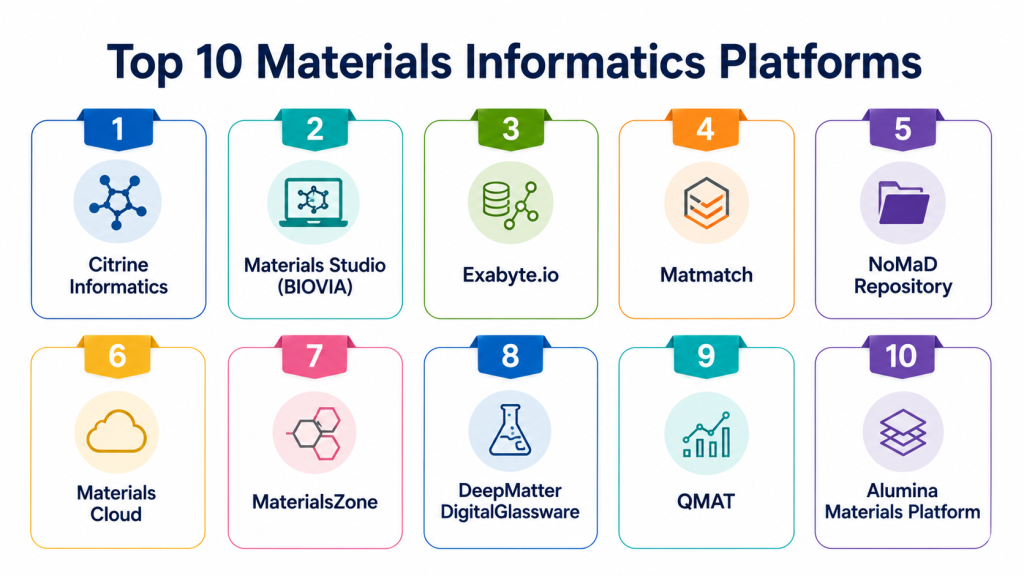
Top 10 Materials Informatics Platforms
1- Citrine Informatics
Short description: Citrine Informatics provides an AI-driven platform for materials discovery and development, helping industrial and academic teams predict material properties and accelerate innovation.
Key Features
- Machine learning-based property prediction
- Material data integration from experiments and simulations
- Workflow automation for R&D pipelines
- Advanced visualization and dashboards
- Collaboration tools for multi-site teams
- Integration with simulation and lab management tools
Pros
- Accelerates material discovery and reduces R&D costs
- Scales across large enterprise and academic projects
Cons
- Premium pricing for full-feature access
- Steep learning curve for non-technical users
Platforms / Deployment
- Web / Cloud
Security & Compliance
- Not publicly stated
Integrations & Ecosystem
- LIMS, ERP, simulation tools
- API support for custom pipelines
Support & Community
- Professional onboarding, documentation, and support team
2- Materials Studio (BIOVIA)
Short description: Materials Studio offers computational modeling and simulation tools to support materials design, property prediction, and optimization for industrial applications.
Key Features
- Molecular modeling and crystal structure simulation
- Quantum and classical simulation engines
- Property prediction and analysis
- Workflow and data management tools
- Collaboration and reporting dashboards
Pros
- Comprehensive modeling for polymers, metals, and composites
- Industry-standard in chemical and materials R&D
Cons
- Requires significant computational expertise
- Licensing costs can be high
Platforms / Deployment
- Windows / Cloud / Hybrid
Security & Compliance
- Not publicly stated
Integrations & Ecosystem
- Simulation software, LIMS, ERP
- API access for workflow automation
Support & Community
- Extensive documentation and training programs
3- Exabyte.io
Short description: Exabyte.io is a cloud-based materials informatics platform that combines simulation and AI to accelerate material design and experimentation.
Key Features
- Cloud-native computational platform
- AI and machine learning property prediction
- High-throughput simulation integration
- Interactive visualization dashboards
- Workflow automation and collaboration
Pros
- Rapid access to scalable cloud resources
- Integrates simulation and experimental data
Cons
- Limited offline capabilities
- Platform complexity may require onboarding
Platforms / Deployment
- Web / Cloud
Security & Compliance
- Not publicly stated
Integrations & Ecosystem
- LIMS, simulation tools, cloud storage
- API for custom integrations
Support & Community
- Online documentation and customer support
4- Matmatch
Short description: Matmatch is a material search and data platform that enables engineers and researchers to explore material properties and find suitable materials quickly.
Key Features
- Extensive materials database
- Search and comparison of properties
- Material selection guidance
- Integration with simulation and CAD tools
- Collaboration features for research teams
Pros
- Easy access to comprehensive material data
- Facilitates rapid material selection
Cons
- Limited predictive AI modeling
- Not designed for deep simulation workflows
Platforms / Deployment
- Web / Cloud
Security & Compliance
- Not publicly stated
Integrations & Ecosystem
- CAD software, ERP, simulation platforms
- API for data retrieval
Support & Community
- Online tutorials and documentation
5- NoMaD Repository
Short description: The Novel Materials Discovery (NoMaD) Repository provides a data-driven informatics platform for storing, sharing, and analyzing materials simulation data.
Key Features
- Centralized materials data repository
- Standardized data formats for interoperability
- Data visualization and analysis tools
- Supports high-throughput simulation outputs
- Collaboration and sharing tools
Pros
- Facilitates open data sharing and collaboration
- Standardizes simulation and experimental data
Cons
- Less focus on predictive AI
- Requires integration with external modeling tools
Platforms / Deployment
- Web / Cloud
Security & Compliance
- Not publicly stated
Integrations & Ecosystem
- Simulation software, LIMS, and workflow tools
- API support for data access
Support & Community
- Community-driven support, documentation
6- Materials Cloud
Short description: Materials Cloud provides a web-based platform for storing, analyzing, and sharing materials research data, integrating simulation and informatics capabilities.
Key Features
- Cloud-based data repository
- Computational workflows for materials simulation
- AI-driven property predictions
- Interactive visualization dashboards
- Collaboration and data sharing
Pros
- Cloud-native and scalable
- Facilitates collaborative research
Cons
- Limited offline access
- Some advanced features require technical expertise
Platforms / Deployment
- Web / Cloud
Security & Compliance
- Not publicly stated
Integrations & Ecosystem
- LIMS, simulation software, Python APIs
- Workflow automation support
Support & Community
- Online documentation, community forums
7- MaterialsZone
Short description: MaterialsZone is a materials informatics platform designed for data management, analysis, and machine learning in material science research.
Key Features
- Material data management and curation
- Machine learning-based prediction
- Experiment tracking and analysis
- Data visualization and dashboards
- Collaboration for multi-user projects
Pros
- AI-assisted materials property prediction
- Centralized data management
Cons
- May require learning curve for new users
- Smaller community compared to enterprise platforms
Platforms / Deployment
- Web / Cloud
Security & Compliance
- Not publicly stated
Integrations & Ecosystem
- Simulation tools, Python APIs, LIMS
- Custom workflow support
Support & Community
- Documentation and support services
8- Citrine Informatics (Extended)
Short description: Citrine Informatics combines materials data management with AI to predict material performance and accelerate R&D cycles.
Key Features
- Materials property prediction with machine learning
- Integration of experimental and simulated datasets
- Workflow automation for R&D pipelines
- Dashboard analytics and reporting
- Collaborative features for research teams
Pros
- Accelerates material discovery and reduces experimental costs
- Scales across enterprise-level R&D
Cons
- Premium pricing
- Requires expertise in data analytics
Platforms / Deployment
- Web / Cloud
Security & Compliance
- Not publicly stated
Integrations & Ecosystem
- LIMS, ERP, simulation tools
- API support for custom pipelines
Support & Community
- Professional onboarding and documentation
9- DeepMatter DigitalGlassware
Short description: DeepMatter DigitalGlassware provides a digital platform for recording, analyzing, and predicting chemical and materials experiments using AI and informatics.
Key Features
- Automated experiment capture
- AI-driven prediction for materials properties
- Data visualization and dashboards
- Workflow automation and integration
- Collaboration features
Pros
- Streamlines experimental recording and analysis
- Integrates AI for predictive insights
Cons
- Limited coverage for all material types
- May require training for proper usage
Platforms / Deployment
- Web / Cloud
Security & Compliance
- Not publicly stated
Integrations & Ecosystem
- LIMS, lab automation equipment, Python API
- Workflow integration support
Support & Community
- Documentation, customer support
10- QMAT
Short description: QMAT is a materials informatics platform designed for accelerated R&D and discovery, integrating simulation, AI, and data analytics tools.
Key Features
- Material property prediction
- Simulation and modeling integration
- AI-assisted R&D decision-making
- Data management and collaboration tools
- Visualization dashboards
Pros
- Accelerates material discovery cycles
- Combines simulation and AI insights
Cons
- Niche adoption; smaller user community
- Some features require technical expertise
Platforms / Deployment
- Web / Cloud
Security & Compliance
- Not publicly stated
Integrations & Ecosystem
- LIMS, simulation software, Python APIs
- Workflow automation support
Support & Community
- Documentation and support services
Comparison Table (Top 10)
| Tool Name | Best For | Platform(s) Supported | Deployment | Standout Feature | Public Rating |
|---|---|---|---|---|---|
| Citrine Informatics | Enterprise R&D labs | Web / Cloud | Cloud | AI-driven material prediction | N/A |
| Materials Studio (BIOVIA) | Industrial and chemical R&D | Windows / Cloud / Hybrid | Hybrid | Molecular modeling and simulation | N/A |
| Exabyte.io | Cloud-based R&D | Web / Cloud | Cloud | Cloud-native simulation platform | N/A |
| Matmatch | Material selection | Web / Cloud | Cloud | Extensive materials database | N/A |
| NoMaD Repository | Open materials data | Web / Cloud | Cloud | Standardized data repository | N/A |
| Materials Cloud | Collaborative R&D | Web / Cloud | Cloud | Workflow and data sharing | N/A |
| MaterialsZone | Research data management | Web / Cloud | Cloud | AI-assisted prediction | N/A |
| Citrine Informatics | Enterprise R&D labs | Web / Cloud | Cloud | Integrated experimental and AI | N/A |
| DeepMatter DigitalGlassware | Lab experiments | Web / Cloud | Cloud | Automated experiment capture | N/A |
| QMAT | Accelerated R&D | Web / Cloud | Cloud | Simulation + AI integration | N/A |
Evaluation & Scoring of Materials Informatics Platforms
| Tool Name | Core (25%) | Ease (15%) | Integrations (15%) | Security (10%) | Performance (10%) | Support (10%) | Value (15%) | Weighted Total |
|---|---|---|---|---|---|---|---|---|
| Citrine Informatics | 10 | 7 | 8 | 7 | 9 | 8 | 6 | 8.1 |
| Materials Studio | 9 | 6 | 7 | 6 | 8 | 7 | 7 | 7.4 |
| Exabyte.io | 8 | 7 | 7 | 6 | 8 | 7 | 7 | 7.4 |
| Matmatch | 7 | 8 | 6 | 6 | 7 | 7 | 8 | 7.3 |
| NoMaD Repository | 7 | 7 | 6 | 6 | 7 | 6 | 8 | 7.0 |
| Materials Cloud | 8 | 7 | 7 | 6 | 8 | 7 | 7 | 7.4 |
| MaterialsZone | 8 | 6 | 7 | 6 | 7 | 6 | 7 | 7.0 |
| DeepMatter DigitalGlassware | 7 | 7 | 6 | 6 | 7 | 6 | 7 | 6.9 |
| QMAT | 7 | 6 | 6 | 6 | 7 | 6 | 7 | 6.8 |
Which Materials Informatics Platform Is Right for You?
Solo / Freelancer
- Matmatch or MaterialsZone for cost-effective research and basic materials selection.
SMB
- Exabyte.io or Materials Cloud for cloud-based simulation and collaborative workflows.
Mid-Market
- Citrine Informatics or DeepMatter DigitalGlassware for AI-assisted material discovery.
Enterprise
- Materials Studio or Citrine Informatics for full-scale R&D, simulation, and AI modeling.
Budget vs Premium
- Open-source or cloud-native options for budget-conscious teams; Citrine Informatics and Materials Studio for premium enterprise capabilities.
Feature Depth vs Ease of Use
- DeepMatter and Materials Studio offer depth with learning curve; Matmatch emphasizes ease and speed.
Integrations & Scalability
- Enterprise solutions integrate with LIMS, ERP, and simulation software; SMB solutions may need custom connectors.
Security & Compliance Needs
- Enterprise R&D benefits from IP-protective and compliance-aware platforms; SMBs rely on standard access controls.
Frequently Asked Questions (FAQs)
1- What pricing models are common for materials informatics platforms?
Most enterprise tools use subscription or SaaS models; open-source or cloud-native platforms may offer free tiers or usage-based pricing.
2- How long does onboarding take?
Typically 2–6 weeks depending on platform complexity, project scale, and team experience.
3- Can these platforms predict material properties accurately?
Yes, AI and ML models trained on experimental and simulation data provide predictive insights, though accuracy depends on dataset quality.
4- Are these platforms cloud-based or desktop-based?
Many platforms are cloud-native (Exabyte.io, Materials Cloud), while others (Materials Studio) offer hybrid deployment options.
5- How do platforms integrate with existing lab systems?
Most provide APIs or connectors to LIMS, ERP, and simulation software, enabling seamless data workflows.
6- Can these platforms accelerate materials discovery?
Yes, by combining AI, data analytics, and simulation, discovery timelines can be significantly shortened.
7- Are mobile apps available?
Few platforms provide mobile access; most focus on web-based cloud interfaces.
8- What are common mistakes when implementing these tools?
Failing to standardize data, not training staff, and neglecting integration with existing workflows are common pitfalls.
9- Can open-source platforms replace enterprise platforms?
Open-source platforms provide cost-effective options but may lack predictive AI, high-throughput simulation, and enterprise support.
10- How secure is sensitive materials data?
Enterprise-grade platforms offer access controls, encryption, and audit logging, though specific certifications vary by vendor.
Conclusion
Materials informatics platforms are transforming R&D by combining AI, simulation, and data analytics for faster material discovery and optimization. SMBs can benefit from cloud-native, user-friendly platforms like Matmatch or Exabyte.io, while enterprises may require full-featured solutions like Citrine Informatics or Materials Studio. Selection should consider data integration, AI capabilities, ease of use, and scalability. Piloting one or two tools helps validate performance and usability. Regular training and workflow integration maximize ROI. Ultimately, the right platform depends on project scale, team expertise, and material discovery goals.

Find Trusted Cardiac Hospitals
Compare heart hospitals by city and services — all in one place.
Explore Hospitals
Materials informatics platforms deliver the greatest value when they combine experimental data, simulations, and AI into a unified research workflow. By helping scientists predict material properties before physical testing, these platforms can accelerate innovation, reduce development costs, and shorten the time required to bring new materials from discovery to real-world applications.