Introduction
SLA (Service Level Agreement) Management Tools are designed to help organizations monitor, enforce, and optimize the performance of service commitments with both internal and external stakeholders. In simple terms, these platforms ensure that service providers meet agreed-upon standards for response time, uptime, and service quality. As organizations increasingly rely on multi-cloud infrastructures, hybrid IT environments, and remote service delivery, effective SLA management has become critical to business performance and customer satisfaction .
Real-world use cases include:
- Monitoring uptime and response times for IT and SaaS services.
- Tracking internal departmental service commitments in IT, HR, and Facilities.
- Automating alerts and escalations when SLA thresholds are breached.
- Generating audit-ready reports for regulatory and compliance purposes.
- Optimizing vendor performance for multi-supplier service agreements.
Key criteria for buyers to evaluate include:
- SLA creation and customization flexibility.
- Real-time monitoring and automated alerting.
- Integration with ITSM, cloud platforms, and ticketing systems.
- Reporting and analytics capabilities.
- Multi-service and multi-tenant support.
- AI-assisted predictions and breach prevention.
- Ease of use and accessibility across devices.
- Security and compliance with industry standards.
- Deployment options: cloud, on-premises, or hybrid.
Best for: IT operations teams, managed service providers, enterprises with multiple service vendors, and organizations in regulated industries.
Not ideal for: Small organizations with simple service structures where manual tracking is sufficient.
Key Trends in SLA Management Tools
- AI-driven SLA breach prediction and automated preventive actions.
- Real-time dashboards with advanced analytics and SLA health metrics.
- Low-code/no-code workflow design for SLA escalation and approvals.
- Seamless integration with ITSM, ERP, CRM, and cloud platforms.
- Multi-cloud SLA tracking for hybrid infrastructures.
- Automated notifications and escalation workflows.
- Compliance tracking aligned with ISO, SOC, HIPAA, and GDPR.
- Personalized SLA reporting for different user roles.
- Subscription-based and usage-based pricing models.
- Mobile-friendly self-service portals for SLA monitoring.
How We Selected These Tools (Methodology)
- Evaluated market adoption and vendor mindshare.
- Assessed feature completeness for SLA definition, monitoring, and reporting.
- Reviewed performance and reliability signals from enterprise clients.
- Verified security posture including encryption, audit logs, and access controls.
- Analyzed integration capabilities with ITSM, cloud, and ERP platforms.
- Considered suitability across SMB, mid-market, and enterprise segments.
- Evaluated automation, AI, and predictive analytics capabilities.
- Examined deployment flexibility: cloud, on-premises, hybrid.
- Considered support, documentation quality, and community engagement.
- Assessed scalability and multi-tenant capabilities.
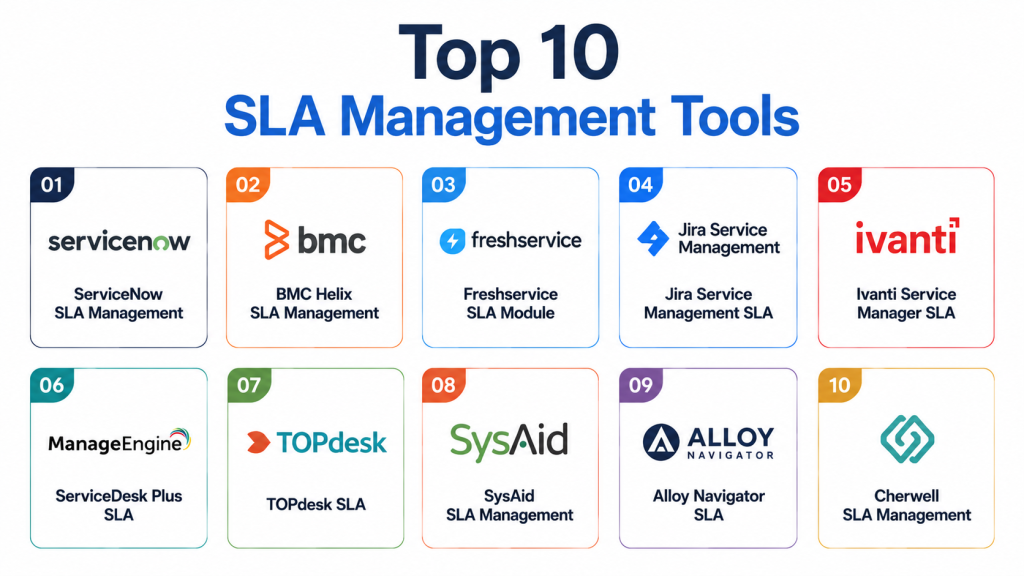
Top 10 SLA Management Tools
1- ServiceNow SLA Management
Short description: Enterprise-grade SLA monitoring integrated within ServiceNow ITSM for large-scale organizations.
Key Features
- SLA creation with customizable thresholds and rules.
- Automated breach alerts and escalations.
- Integration with incidents, problems, and change workflows.
- Dashboards for SLA performance and compliance.
- AI-assisted SLA breach prediction.
- Multi-service and multi-tenant support.
- Mobile accessibility.
Pros
- Deep enterprise-level integrations.
- Highly customizable workflows.
- Predictive analytics improve SLA reliability.
Cons
- High cost for SMBs.
- Implementation complexity.
- Advanced customization requires expert services.
Platforms / Deployment
- Web, iOS, Android
- Cloud / Hybrid
Security & Compliance
- SSO/SAML, MFA, RBAC
- SOC 2, ISO 27001, GDPR
Integrations & Ecosystem
Supports ITSM, ERP, cloud connectors, and REST APIs.
- Jira, Slack, Azure AD
- AWS, Azure, GCP
- HR and Facilities systems
Support & Community
- Comprehensive documentation, training, and enterprise support tiers.
- Active community forums.
2- BMC Helix SLA Management
Short description: SLA module within BMC Helix Digital Workplace offering AI-guided monitoring and management.
Key Features
- SLA monitoring and breach alerts.
- Predictive AI analytics for SLA management.
- Integration with ITSM, CMDB, and cloud platforms.
- Comprehensive reporting dashboards.
- Multi-channel notifications.
- Customizable SLA templates.
Pros
- Strong AI capabilities.
- User-friendly dashboards.
- Comprehensive reporting.
Cons
- Expensive for mid-market organizations.
- Configuration can be complex.
Platforms / Deployment
- Web, iOS, Android
- Cloud / Hybrid
Security & Compliance
- SSO/SAML, MFA
- Not publicly stated
Integrations & Ecosystem
Integrates with ITSM, ERP, and ticketing systems.
- Slack, Teams, Jira
- AWS/Azure connectors
Support & Community
- Professional services and documentation available.
- Standard support tiers.
3- Freshservice SLA Module
Short description: Cloud-native SLA management in Freshservice ITSM, suited for SMBs and mid-size enterprises.
Key Features
- Multi-priority SLA creation.
- Automated breach notifications.
- SLA dashboards and reporting.
- Integration with incident and change modules.
- AI suggestions for ticket prioritization.
- Historical SLA trends.
Pros
- Easy to deploy and configure.
- AI-assisted monitoring.
- Rapid setup for small teams.
Cons
- Limited enterprise scalability.
- Some features restricted to higher subscription tiers.
Platforms / Deployment
- Web, iOS, Android
- Cloud
Security & Compliance
- SSO/SAML, MFA
- Not publicly stated
Integrations & Ecosystem
- ITSM, cloud apps, communication platforms
- Slack, Teams, Jira
- REST API for custom workflows
Support & Community
- Tutorials, knowledge base, standard support tiers.
4- Jira Service Management SLA
Short description: SLA management integrated with Jira projects, ideal for IT and DevOps teams.
Key Features
- Custom SLA definitions per service type.
- Countdown timers with breach alerts.
- Integration with Jira workflows and DevOps pipelines.
- SLA dashboards and reports.
- Automated escalations and notifications.
Pros
- Tight DevOps integration.
- Flexible SLA rules.
- Developer-friendly customization.
Cons
- Less intuitive for non-technical users.
- Complex advanced SLA configurations.
Platforms / Deployment
- Web
- Cloud / On-prem / Hybrid
Security & Compliance
- SSO/SAML, MFA
- Not publicly stated
Integrations & Ecosystem
- Jira, Confluence, GitHub, Slack
- REST API for custom integrations
Support & Community
- Documentation, active Atlassian community, support tiers.
5- Ivanti Service Manager SLA
Short description: SLA tracking within Ivanti Service Manager, suited for mid to large enterprises.
Key Features
- SLA monitoring and alerts.
- Multi-tiered escalation rules.
- Integration with ITSM and CMDB.
- Automated notifications.
- SLA reporting dashboards.
Pros
- Flexible workflows.
- Multi-service support.
- Built-in reporting and analytics.
Cons
- UI may feel outdated.
- Customization requires expertise.
Platforms / Deployment
- Web, Windows
- Cloud / On-prem / Hybrid
Security & Compliance
- Not publicly stated
Integrations & Ecosystem
- ITSM, endpoint management, cloud connectors
- REST API for workflow customization
Support & Community
- Documentation, professional services, community forums.
6- ServiceDesk Plus SLA
Short description: SLA module for SMBs and mid-market within ManageEngine ServiceDesk Plus.
Key Features
- SLA definitions and breach tracking.
- Escalation management.
- Integration with ITSM and assets.
- SLA dashboards and reporting.
- Automated notifications.
Pros
- Affordable and scalable.
- Easy setup for small teams.
Cons
- Limited enterprise-level features.
- UI less modern.
Platforms / Deployment
- Web, iOS, Android
- Cloud / On-prem / Hybrid
Security & Compliance
- Not publicly stated
Integrations & Ecosystem
- Active Directory, ERP connectors
- APIs for automation
- Email integrations
Support & Community
- Documentation, standard support.
7- TOPdesk SLA
Short description: SLA management for IT and business services focusing on workflow efficiency and self-service.
Key Features
- SLA definitions per priority.
- Breach alert notifications.
- Dashboards for compliance.
- Integration with ITSM and knowledge base.
Pros
- Strong self-service portal.
- Flexible deployment options.
Cons
- Limited advanced customization.
- Some integrations require effort.
Platforms / Deployment
- Web, iOS, Android
- Cloud / On-prem / Hybrid
Security & Compliance
- Not publicly stated
Integrations & Ecosystem
- ITSM, ERP, cloud connectors
- REST API extensions
Support & Community
- Documentation and support plans.
8- SysAid SLA Management
Short description: SLA monitoring module for SMB IT teams in SysAid ITSM platform.
Key Features
- SLA tracking and escalations.
- Automated notifications.
- Dashboards and reporting.
- Integration with tickets and assets.
Pros
- Easy deployment.
- Cost-effective for SMBs.
Cons
- Limited enterprise scalability.
- UI may feel dated.
Platforms / Deployment
- Web, iOS, Android
- Cloud / On-prem / Hybrid
Security & Compliance
- Not publicly stated
Integrations & Ecosystem
- ITSM and asset integrations
- APIs for workflow extensions
Support & Community
- Documentation, standard support.
9- Alloy Navigator SLA
Short description: SLA management module for mid-market IT and service operations.
Key Features
- SLA creation and breach monitoring.
- Workflow automation.
- Reporting dashboards.
- Integration with ITSM and asset management.
Pros
- Affordable for SMBs and mid-market.
- Customizable workflows.
Cons
- Limited AI features.
- Smaller community support.
Platforms / Deployment
- Web
- Cloud / On-prem / Hybrid
Security & Compliance
- Not publicly stated
Integrations & Ecosystem
- Active Directory, ITSM tools
- REST API for custom workflows
Support & Community
- Documentation, standard support.
10- Cherwell SLA Management
Short description: SLA management module for mid-market and enterprise Cherwell ITSM users.
Key Features
- SLA monitoring and alerts.
- Automated escalation workflows.
- Multi-service support.
- Reporting dashboards.
Pros
- Low-code configuration.
- Multi-service and multi-tenant support.
Cons
- UI may feel less modern.
- Advanced customization requires expertise.
Platforms / Deployment
- Web, iOS, Android
- Cloud / On-prem / Hybrid
Security & Compliance
- Not publicly stated
Integrations & Ecosystem
- ITSM, ERP, HR systems
- REST API for workflow extensions
Support & Community
- Documentation, training, community forums.
Comparison Table (Top 10)
| Tool Name | Best For | Platform(s) Supported | Deployment | Standout Feature | Public Rating |
|---|---|---|---|---|---|
| ServiceNow SLA Management | Enterprise | Web, iOS, Android | Cloud / Hybrid | AI breach prediction | N/A |
| BMC Helix SLA Management | Enterprise | Web, iOS, Android | Cloud / Hybrid | AI-guided monitoring | N/A |
| Freshservice SLA Module | SMB / Mid-market | Web, iOS, Android | Cloud | Intuitive SLA dashboards | N/A |
| Jira Service Management SLA | IT/DevOps | Web | Cloud / On-prem / Hybrid | Jira integration | N/A |
| Ivanti Service Manager SLA | Mid / Large Enterprise | Web, Windows | Cloud / On-prem / Hybrid | Multi-service SLA | N/A |
| ServiceDesk Plus SLA | SMB / Mid-market | Web, iOS, Android | Cloud / On-prem / Hybrid | Affordable SLA tracking | N/A |
| TOPdesk SLA | IT & Business Teams | Web, iOS, Android | Cloud / On-prem / Hybrid | Self-service focus | N/A |
| SysAid SLA Management | SMB IT Teams | Web, iOS, Android | Cloud / On-prem / Hybrid | Easy deployment | N/A |
| Alloy Navigator SLA | Mid-market / SMB | Web | Cloud / On-prem / Hybrid | Workflow automation | N/A |
| Cherwell SLA Management | Mid-market / Enterprise | Web, iOS, Android | Cloud / On-prem / Hybrid | Low-code SLA configuration | N/A |
Evaluation & Scoring of SLA Management Tools
| Tool Name | Core | Ease | Integrations | Security | Performance | Support | Value | Weighted Total |
|---|---|---|---|---|---|---|---|---|
| ServiceNow SLA Management | 10 | 8 | 9 | 9 | 9 | 8 | 7 | 8.8 |
| BMC Helix SLA Management | 9 | 8 | 8 | 8 | 8 | 8 | 7 | 8.1 |
| Freshservice SLA Module | 7 | 9 | 7 | 7 | 7 | 8 | 8 | 7.7 |
| Jira Service Management SLA | 8 | 7 | 8 | 7 | 8 | 7 | 7 | 7.5 |
| Ivanti Service Manager SLA | 8 | 7 | 7 | 7 | 8 | 7 | 8 | 7.6 |
| ServiceDesk Plus SLA | 7 | 8 | 6 | 6 | 7 | 7 | 9 | 7.3 |
| TOPdesk SLA | 7 | 8 | 6 | 7 | 7 | 7 | 7 | 7.1 |
| SysAid SLA Management | 6 | 8 | 6 | 6 | 7 | 6 | 8 | 6.8 |
| Alloy Navigator SLA | 6 | 7 | 6 | 6 | 7 | 6 | 7 | 6.7 |
| Cherwell SLA Management | 8 | 7 | 7 | 7 | 7 | 7 | 7 | 7.3 |
Which SLA Management Tool Is Right for You?
Solo / Freelancer
- Freshservice SLA or Alloy Navigator SLA for simple SLA tracking with minimal setup.
SMB
- Freshservice, ServiceDesk Plus, or SysAid SLA for cost-effective SLA monitoring and dashboards.
Mid-Market
- Cherwell, Ivanti, or TOPdesk SLA for flexible workflows and multi-service monitoring.
Enterprise
- ServiceNow or BMC Helix SLA for AI-assisted SLA management, compliance reporting, and multi-tenant support.
Budget vs Premium
- Budget: Freshservice, ServiceDesk Plus, SysAid
- Premium: ServiceNow, BMC Helix, Cherwell
Feature Depth vs Ease of Use
- Deep features: ServiceNow, BMC Helix
- Ease of use: Freshservice, Alloy Navigator
Integrations & Scalability
- Extensive integrations: ServiceNow, BMC Helix
- Moderate integrations: Freshservice, SysAid
Security & Compliance Needs
- Enterprise-grade security: ServiceNow, BMC Helix
- Standard SMB security: Freshservice, Alloy Navigator
Frequently Asked Questions (FAQs)
1- What pricing models are SLA tools offered in?
Subscription-based plans are standard, often tiered by users, services, or features. Enterprise deployments typically require custom quotes.
2- How long does implementation take?
SMB cloud setups can take days, while enterprise-scale deployments can last months due to workflow complexity.
3- Can small companies benefit from SLA tools?
Yes, modern cloud-native SLA tools provide affordable monitoring and dashboards suitable for smaller teams.
4- Are these tools secure for sensitive data?
Leading tools include SSO, MFA, encryption, and audit logging. Verify compliance standards like GDPR, SOC 2, and HIPAA.
5- Can these tools integrate with ITSM or ERP systems?
Most provide APIs, connectors, or native integrations for seamless workflow automation.
6- How customizable are SLA workflows?
Platforms support multi-tier SLA definitions, automated escalation paths, and low-code workflow customization.
7- What common mistakes should be avoided?
Avoid overly complex SLA definitions, insufficient alerting, and neglecting reporting best practices.
8- How scalable are SLA management tools?
Enterprise solutions support thousands of services with multi-tenant capabilities. SMB tools scale efficiently for smaller teams.
9- How do AI features improve SLA management?
AI predicts SLA breaches, suggests prioritization, and automates escalation, improving reliability and reducing manual effort.
10- Can I switch SLA management tools easily?
Migration depends on export/import capabilities and workflow complexity. Planning and vendor support are critical.
Conclusion
Choosing the right SLA Management Tool depends on organizational size, service complexity, and integration needs. SMBs benefit from Freshservice or Alloy Navigator for straightforward SLA tracking. Mid-market organizations can leverage Cherwell, Ivanti, or TOPdesk for flexible workflows and multi-service monitoring. Enterprises gain maximum value from ServiceNow or BMC Helix with AI-assisted management, compliance reporting, and multi-tenant support. Consider usability, integrations, and security when evaluating options. Balance budget against feature depth to align with priorities. Running a pilot can validate workflows and performance. Start by shortlisting 2–3 tools and testing them with live SLA data before full-scale deployment.

Find Trusted Cardiac Hospitals
Compare heart hospitals by city and services — all in one place.
Explore Hospitals
SLA management is not just about measuring response and resolution times—it’s about ensuring service commitments align with business expectations. The most effective tools help organizations spot potential breaches early, allowing teams to take corrective action before customer satisfaction is impacted.