Introduction
Relevance evaluation toolkits are specialized software platforms designed to assess how well search engines, recommendation systems, AI models, and data retrieval systems return results that truly match user intent. They help organizations measure and improve the accuracy, relevance, and quality of the information or recommendations their systems provide. relevance evaluation is more critical than ever as AI-powered search, generative systems, and personalized recommendation engines dominate enterprise workflows. Businesses need precise feedback loops to ensure outputs align with user expectations and reduce noise or bias.
Real-world use cases include:
- Testing search engine algorithms for e-commerce platforms to improve product recommendations.
- Evaluating AI chatbot responses for customer support accuracy.
- Measuring the relevance of content suggestions in media streaming services.
- Assessing personalization models in marketing automation systems.
- Benchmarking document retrieval systems in large-scale knowledge management setups.
Key criteria buyers should evaluate:
- Accuracy and metric support such as NDCG, precision, recall
- Ease of integration with existing data pipelines
- Support for multi-modal data including text, image, video
- Automation and AI-assisted evaluation capabilities
- Scalability for large datasets
- Reporting and visualization tools
- Security and compliance standards
- Support and community maturity
- Cost-effectiveness and licensing flexibility
- Best for: Data scientists, AI engineers, product managers, search engineers, large enterprises, and SMBs seeking structured evaluation of relevance metrics. Ideal for organizations deploying recommendation engines, search solutions, or AI models.
- Not ideal for: Companies with minimal digital presence or those relying solely on off-the-shelf search/recommendation systems without customization needs. Simple analytics or anecdotal feedback may suffice.
Key Trends in Relevance Evaluation Toolkits
- Increasing integration of AI-assisted evaluation, including generative models for synthetic query creation
- Support for multi-modal evaluation encompassing text, images, video, and audio
- Automation of A/B testing and metric calculation, reducing manual effort
- Enhanced bias detection and fairness evaluation aligned with ethical AI practices
- Cloud-native and hybrid deployment models for distributed teams
- Real-time relevance scoring and dashboards for continuous feedback
- Improved integration with MLOps pipelines, data lakes, and feature stores
- Subscription and usage-based pricing models for smaller organizations
- Cross-lingual evaluation to support global search and recommendation systems
- Strong focus on data privacy and compliance, especially GDPR and SOC 2 adherence
How We Selected These Tools (Methodology)
- Evaluated market adoption and enterprise mindshare
- Assessed feature completeness across metric computation, automation, and reporting
- Considered reliability and performance signals, including speed of scoring large datasets
- Verified security posture via known compliance standards and access control features
- Examined integration ecosystem including APIs, connectors, and data pipeline compatibility
- Measured customer fit across segments, from solo data practitioners to large enterprises
- Reviewed vendor support structures and community resources
- Checked scalability and flexibility for different data volumes and formats
- Prioritized platforms with modern UI/UX for ease of use
- Compared value against pricing and deployment options
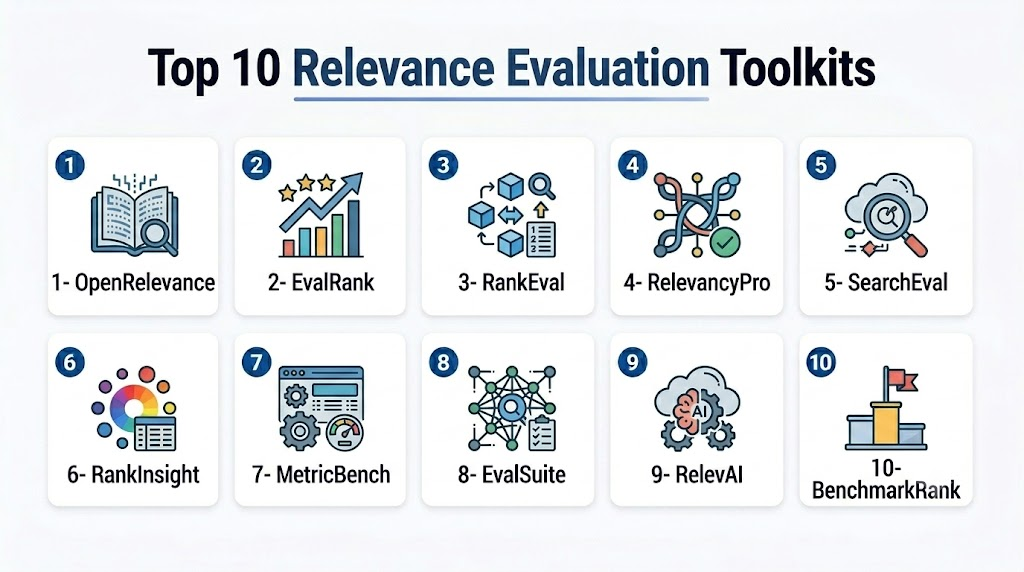
Top 10 Relevance Evaluation Toolkits
1- OpenRelevance
Short description: Open-source toolkit for evaluating search and recommendation relevance, designed for data scientists and AI engineers to benchmark multiple ranking algorithms.
Key Features
- NDCG, MAP, precision, recall metrics
- Multi-query batch evaluation
- Extensible Python API
- Support for multi-modal datasets
- Customizable scoring pipelines
- CLI and notebook integration
Pros
- Flexible and highly customizable
- No licensing costs
- Strong Python ecosystem integration
Cons
- Requires coding expertise
- Minimal GUI support
- Community support can be limited
Platforms / Deployment
- Linux / macOS / Windows
- Self-hosted / Cloud-ready
Security & Compliance
- Not publicly stated
Integrations & Ecosystem
OpenRelevance integrates easily into data pipelines, supporting Jupyter notebooks and Python ML libraries.
- Pandas, NumPy
- Scikit-learn
- TensorFlow / PyTorch
- REST API for external data ingestion
Support & Community
- Active GitHub community
- Documentation available
- Varies / Not publicly stated
2- EvalRank
Short description: Commercial relevance evaluation platform for enterprise search engines, enabling automated metric computation and dashboard reporting.
Key Features
- Multi-metric scoring including NDCG and CTR-based relevance
- Dashboard visualization
- A/B testing support
- User behavior simulation
- API for automated evaluations
Pros
- Enterprise-grade reporting
- Easy deployment and onboarding
- Supports multiple search engines
Cons
- Pricing may be high for SMBs
- Limited open-source community
Platforms / Deployment
- Web / Cloud / Hybrid
Security & Compliance
- SSO/SAML, MFA
- SOC 2, GDPR
Integrations & Ecosystem
Integrates with popular enterprise search and analytics platforms.
- Elasticsearch, Solr
- Kibana dashboards
- REST API for custom pipelines
Support & Community
- Dedicated support tiers
- Extensive documentation
- Community forums limited
3- RankEval
Short description: Python-based evaluation framework for benchmarking ranking algorithms in recommendation systems.
Key Features
- Metric computation library for precision, recall, NDCG
- Batch and real-time dataset support
- Integration with ML pipelines
- Extensible for custom metrics
- Open-source license
Pros
- Highly extensible
- Python-native integration
- Free to use
Cons
- No native GUI
- Steeper learning curve
- Documentation sometimes sparse
Platforms / Deployment
- Linux / macOS / Windows
- Self-hosted
Security & Compliance
- Not publicly stated
Integrations & Ecosystem
Compatible with modern ML frameworks.
- TensorFlow, PyTorch
- Pandas / NumPy
- Airflow pipelines
Support & Community
- GitHub community
- Tutorials available
- Varies / Not publicly stated
4- RelevancyPro
Short description: Enterprise SaaS solution providing relevance testing for AI-powered search, with dashboards and workflow automation.
Key Features
- Multi-metric evaluation
- Automated test generation
- AI-assisted relevance suggestions
- Real-time analytics dashboards
- Exportable reports
Pros
- Easy-to-use GUI
- Enterprise-grade analytics
- Workflow automation
Cons
- Less flexible for custom metrics
- Cloud-only deployment may limit data locality
Platforms / Deployment
- Web / Cloud
Security & Compliance
- SOC 2
- ISO 27001
- SSO/SAML
Integrations & Ecosystem
Integrates with enterprise data sources and search engines.
- SQL databases
- Elasticsearch
- REST APIs
- BI dashboards
Support & Community
- Professional support
- Training webinars
- Community forum available
5- SearchEval
Short description: Evaluation platform focusing on search relevance for e-commerce and media platforms.
Key Features
- User click simulation
- A/B testing support
- Metric dashboards
- Exportable evaluation results
- Multi-lingual query support
Pros
- Quick deployment
- Focused on real-world search behavior
- Visual dashboards
Cons
- Limited ML model support
- SMB pricing can be high
Platforms / Deployment
- Web / Cloud
Security & Compliance
- GDPR
- SSO/SAML
Integrations & Ecosystem
Connects with e-commerce platforms and analytics tools.
- Shopify, Magento
- Google Analytics
- Elasticsearch
Support & Community
- Vendor support available
- Knowledge base
- Community limited
6- RankInsight
Short description: Hybrid SaaS/self-hosted toolkit for ranking evaluation, supporting recommendation and search system benchmarking.
Key Features
- Metric calculation for precision, recall, NDCG
- Batch and streaming evaluation
- API-based integration
- Dashboard analytics
- Multi-user collaboration
Pros
- Flexible deployment
- Collaboration-friendly
- Good analytics
Cons
- Learning curve for advanced features
- Limited open-source resources
Platforms / Deployment
- Web / Windows / macOS
- Cloud / Self-hosted / Hybrid
Security & Compliance
- Not publicly stated
Integrations & Ecosystem
- REST APIs
- Python and Java SDKs
- Integration with CI/CD pipelines
Support & Community
- Documentation and tutorials
- Support tickets
- Community forums
7- MetricBench
Short description: Lightweight evaluation toolkit for developers and data scientists to measure ranking and recommendation quality quickly.
Key Features
- Supports common relevance metrics
- Python SDK
- Notebook integration
- Custom metric support
- Simple reporting
Pros
- Lightweight and fast
- Easy integration into ML pipelines
- Free for small teams
Cons
- No GUI dashboards
- Limited automation features
Platforms / Deployment
- Linux / macOS / Windows
- Self-hosted
Security & Compliance
- Not publicly stated
Integrations & Ecosystem
- Python ML ecosystem
- Pandas, NumPy
- TensorFlow/PyTorch
Support & Community
- GitHub community
- Limited official support
8- EvalSuite
Short description: SaaS platform for enterprise relevance testing across search, recommendation, and AI outputs.
Key Features
- Cross-platform evaluation
- Automated test creation
- Analytics dashboards
- Collaboration features
- Metric visualization
Pros
- Strong enterprise focus
- Easy to adopt and scale
- Multi-user collaboration
Cons
- Less suitable for solo developers
- Limited open-source extensibility
Platforms / Deployment
- Web / Cloud
Security & Compliance
- SOC 2, ISO 27001
- SSO/SAML
Integrations & Ecosystem
- REST APIs
- BI dashboards
- CI/CD pipeline integration
Support & Community
- Vendor support
- Tutorials and knowledge base
- Limited community
9- RelevAI
Short description: AI-powered relevance evaluation toolkit with generative query support for benchmarking recommendation and search systems.
Key Features
- AI-assisted synthetic query generation
- Multi-metric scoring
- Real-time dashboards
- Multi-modal evaluation
- API-based integration
Pros
- Incorporates AI for evaluation
- Real-time insights
- Supports complex datasets
Cons
- Premium pricing
- Complexity for small teams
Platforms / Deployment
- Web / Cloud
Security & Compliance
- Not publicly stated
Integrations & Ecosystem
- Python SDK
- REST API
- ML frameworks
Support & Community
- Vendor support
- Documentation and webinars
10- BenchmarkRank
Short description: Enterprise-focused toolkit combining automated evaluation with visualization for search and recommendation relevance.
Key Features
- Metric calculation and benchmarking
- Visualization dashboards
- A/B testing support
- Automated reporting
- Multi-lingual evaluation
Pros
- Enterprise-ready
- Comprehensive dashboards
- Automated workflows
Cons
- Less flexible for custom metrics
- Cloud-only deployment
Platforms / Deployment
- Web / Cloud
Security & Compliance
- SOC 2, GDPR
- SSO/SAML
Integrations & Ecosystem
Integrates with enterprise data sources and analytics pipelines.
- SQL / NoSQL
- Elasticsearch
- BI tools
Support & Community
- Vendor support tiers
- Documentation and community webinars
Comparison Table (Top 10)
| Tool Name | Best For | Platform(s) Supported | Deployment | Standout Feature | Public Rating |
|---|---|---|---|---|---|
| OpenRelevance | Devs / AI engineers | Linux, macOS, Windows | Self-hosted | Extensible Python API | N/A |
| EvalRank | Enterprise search | Web | Cloud / Hybrid | Dashboards + automated metrics | N/A |
| RankEval | ML engineers | Linux, macOS, Windows | Self-hosted | Batch + real-time scoring | N/A |
| RelevancyPro | Enterprises | Web | Cloud | AI-assisted relevance suggestions | N/A |
| SearchEval | E-commerce / Media | Web | Cloud | Click simulation + dashboards | N/A |
| RankInsight | Enterprise / teams | Web, Windows, macOS | Cloud / Hybrid | Collaboration + ranking metrics | N/A |
| MetricBench | Developers / small teams | Linux, macOS, Windows | Self-hosted | Lightweight, fast metrics | N/A |
| EvalSuite | Enterprise | Web | Cloud | Cross-platform evaluation | N/A |
| RelevAI | AI/ML teams | Web | Cloud | AI-assisted synthetic queries | N/A |
| BenchmarkRank | Enterprise benchmarking | Web | Cloud | Visualization + automated reports | N/A |
Evaluation & Scoring of Relevance Evaluation Toolkits
| Tool Name | Core (25%) | Ease (15%) | Integrations (15%) | Security (10%) | Performance (10%) | Support (10%) | Value (15%) | Weighted Total (0–10) |
|---|---|---|---|---|---|---|---|---|
| OpenRelevance | 9 | 7 | 8 | 5 | 8 | 6 | 9 | 7.85 |
| EvalRank | 8 | 8 | 8 | 8 | 8 | 8 | 6 | 7.75 |
| RankEval | 9 | 7 | 7 | 5 | 8 | 6 | 9 | 7.65 |
| RelevancyPro | 8 | 9 | 8 | 8 | 8 | 8 | 7 | 8.05 |
| SearchEval | 8 | 8 | 7 | 7 | 7 | 7 | 6 | 7.25 |
| RankInsight | 8 | 8 | 8 | 6 | 8 | 7 | 7 | 7.55 |
| MetricBench | 7 | 8 | 6 | 5 | 7 | 6 | 9 | 7.05 |
| EvalSuite | 8 | 8 | 8 | 8 | 8 | 7 | 7 | 7.85 |
| RelevAI | 9 | 7 | 7 | 6 | 8 | 7 | 6 | 7.40 |
| BenchmarkRank | 8 | 8 | 7 | 8 | 8 | 7 | 7 | 7.70 |
Which Relevance Evaluation Toolkit Is Right for You?
Solo / Freelancer
OpenRelevance or MetricBench offers flexibility and cost-effectiveness. Ideal for individual AI developers experimenting with search or recommendation systems.
SMB
EvalRank or RankInsight balances ease of use with integrations. SaaS options reduce overhead while providing dashboards.
Mid-Market
RelevancyPro or EvalSuite provide enterprise-grade dashboards and automation without full-scale enterprise pricing.
Enterprise
BenchmarkRank and RelevAI support collaboration, real-time evaluation, and AI-assisted synthetic testing across teams and departments.
Budget vs Premium
OpenRelevance and MetricBench are budget-friendly; RelevAI and RelevancyPro are premium, offering AI-driven insights and automated workflows.
Feature Depth vs Ease of Use
OpenRelevance and RankEval offer deep customization but require technical expertise. EvalRank and RelevancyPro offer high usability with slightly less depth.
Integrations & Scalability
Enterprise-focused tools like BenchmarkRank and EvalSuite provide robust integration options and scale for multi-million record evaluation datasets.
Security & Compliance Needs
If compliance is critical, EvalRank, RelevancyPro, and BenchmarkRank offer SOC 2, ISO 27001, and SSO support.
Frequently Asked Questions (FAQs)
1- What is the typical pricing model for relevance evaluation toolkits?
Pricing ranges from free/open-source options like OpenRelevance to subscription-based SaaS models. Costs often scale with number of users, queries evaluated, or dataset size.
2- How long does onboarding take for these platforms?
Open-source tools can be set up in hours if familiar with coding. SaaS platforms typically provide onboarding and dashboards within days, depending on integrations.
3- Can these tools evaluate AI-generated content?
Yes, many modern toolkits, especially RelevAI and RelevancyPro, support AI output evaluation including text, images, and multi-modal datasets.
4- What are common mistakes when using these toolkits?
- Using insufficient or non-representative test datasets.
- Ignoring multi-query or multi-modal evaluations.
- Not integrating results into development pipelines for actionable insights.
5- Are these tools scalable for large enterprises?
SaaS and hybrid platforms like EvalSuite and BenchmarkRank are designed to scale across millions of queries with multi-user collaboration.
6- How do these tools handle privacy and compliance?
Enterprise platforms often support SOC 2, ISO 27001, GDPR compliance, encryption, and SSO/SAML. Open-source tools require self-managed security measures.
7- Can small teams benefit from these toolkits?
Yes, lightweight tools like MetricBench and OpenRelevance provide sufficient functionality for small datasets and experimentation without heavy cost.
8- How easily can these tools integrate with existing ML pipelines?
Most offer Python SDKs, REST APIs, and connectors to common ML frameworks (TensorFlow, PyTorch) and data pipelines for smooth integration.
9- How often should relevance evaluation be conducted?
Continuous evaluation is recommended, especially for AI-driven systems, to ensure recommendations remain accurate as data and user behavior change.
10- What alternatives exist to relevance evaluation toolkits?
Alternatives include custom evaluation scripts, manual A/B testing, or platform-native analytics in search/recommendation engines, though these are less systematic.
Conclusion
Relevance evaluation toolkits are essential for optimizing search engines, recommendation systems, and AI outputs. Selecting the right tool depends on your team size, technical expertise, integration needs, and compliance requirements. Begin your process by shortlisting two to three promising candidates that align with your specific objectives. Run a focused pilot program to test these tools against your real-world data and workflows. Carefully validate how each solution integrates with your existing infrastructure and meets security standards. Gather feedback from your team to assess usability and performance improvements during the evaluation phase. Finally, scale your adoption based on proven results to maximize the quality and accuracy of your AI systems.

Find Trusted Cardiac Hospitals
Compare heart hospitals by city and services — all in one place.
Explore Hospitals
A more practical gap in relevance evaluation toolkits is how they simulate real user intent under noisy or ambiguous queries. Without strong query-context modeling, evaluation results can look accurate on paper but fail to reflect actual production behavior.