Introduction
Model explainability tools are software solutions that help data scientists, ML engineers, and organizations understand how machine learning models make predictions. These platforms provide insights into feature importance, prediction drivers, and overall model behavior.explainability is essential as AI is increasingly deployed in high-stakes environments like healthcare, finance, legal, and autonomous systems. Regulatory scrutiny and the need for ethical AI demand transparency and interpretability across ML pipelines.
Real-world use cases include:
- Explaining credit scoring decisions to meet regulatory requirements.
- Interpreting predictive maintenance alerts in industrial IoT systems.
- Understanding recommendations in e-commerce or personalized content engines.
- Validating medical diagnosis models for transparency and safety.
- Auditing large language models to identify biases and potential risks.
Evaluation criteria for buyers:
- Support for multiple ML frameworks and model types.
- Explainability methods (SHAP, LIME, feature attribution, counterfactuals).
- Integration with MLOps pipelines.
- Visualization and reporting capabilities.
- Scalability for large datasets and models.
- Human-in-the-loop validation support.
- Security, access controls, and compliance readiness.
- Ease of deployment (cloud, self-hosted, hybrid).
- Community and support resources.
Best for: Data science teams, AI ethics officers, compliance teams, enterprises with high-risk ML applications, and developers working on complex models.
Not ideal for: Small-scale projects with low regulatory oversight or teams working with models that do not require interpretability.
Key Trends in Model Explainability Tools
- Increased adoption of SHAP, LIME, and counterfactual explanation methods across industries.
- Support for large language models (LLMs) and generative AI explainability.
- Integration with MLOps pipelines for continuous monitoring and governance.
- Enhanced visualization dashboards for business stakeholders.
- Hybrid human-in-the-loop workflows for validation and ethical review.
- Automated bias and fairness assessment for regulated domains.
- Cloud-native and hybrid deployment options for scalability.
- Interoperability with multiple ML frameworks like PyTorch, TensorFlow, scikit-learn.
- Subscription-based and enterprise licensing models for flexible adoption.
- Regulatory alignment (GDPR, CCPA, and emerging AI governance frameworks).
How We Selected These Tools (Methodology)
- Evaluated market adoption and industry recognition.
- Reviewed feature completeness including interpretability, visualization, and bias detection.
- Assessed reliability and performance on large-scale deployments.
- Examined security posture, access control, and encryption support.
- Verified integration capabilities with ML frameworks and MLOps pipelines.
- Determined customer fit for solo developers, SMBs, mid-market, and enterprise teams.
- Reviewed documentation, onboarding, and support resources.
- Considered scalability, multi-modal data support, and real-time capabilities.
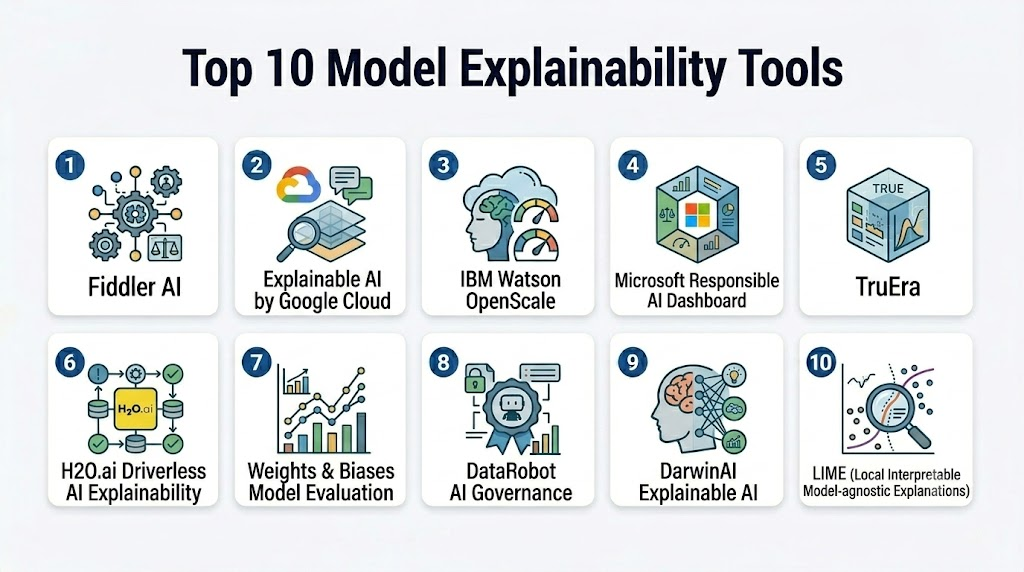
Top 10 Model Explainability Tools
1- Fiddler AI
Short description: Enterprise-grade platform offering model explainability, bias detection, and monitoring for complex ML pipelines.
Key Features
- Real-time model insights and explainability dashboards.
- Bias and fairness detection.
- Integration with multiple ML frameworks.
- Automated alerts for drift and anomalous predictions.
- Collaboration and reporting tools for stakeholders.
Pros
- Real-time interpretability for production models.
- Strong enterprise governance features.
Cons
- High subscription cost for small teams.
- Requires technical expertise for advanced features.
Platforms / Deployment
- Web
- Cloud
Security & Compliance
Not publicly stated
Integrations & Ecosystem
Supports Python SDK and APIs.
- TensorFlow
- PyTorch
- MLOps pipelines
- BI tools
Support & Community
Documentation, enterprise support available.
2- Explainable AI by Google Cloud
Short description: Provides explainability for models deployed on Google Cloud, including feature attribution and fairness metrics.
Key Features
- Local and global model explanations.
- Integration with Vertex AI pipelines.
- Bias detection capabilities.
- Visualization dashboards.
- Automated reporting for compliance.
Pros
- Tight integration with Google Cloud AI ecosystem.
- Scalable and cloud-native.
Cons
- Limited to Google Cloud users.
- Requires ML knowledge to configure advanced settings.
Platforms / Deployment
- Web
- Cloud
Security & Compliance
Not publicly stated
Integrations & Ecosystem
- Vertex AI
- TensorFlow, PyTorch
- BigQuery
Support & Community
Google Cloud support tiers; extensive documentation.
3- IBM Watson OpenScale
Short description: Enterprise AI governance platform providing explainability, fairness, and bias detection for deployed models.
Key Features
- Feature attribution and SHAP analysis.
- Bias detection and fairness scoring.
- Continuous model monitoring.
- Audit logs for compliance.
- Integration with hybrid and multi-cloud environments.
Pros
- Comprehensive enterprise governance.
- Supports multiple deployment environments.
Cons
- Complexity for small teams.
- Best suited for IBM ecosystem users.
Platforms / Deployment
- Web
- Cloud / Hybrid
Security & Compliance
SOC 2, ISO 27001
Integrations & Ecosystem
- IBM Cloud AI and ML pipelines
- Python and Java SDKs
- REST APIs
Support & Community
Enterprise support; extensive documentation.
4- Microsoft Responsible AI Dashboard
Short description: Platform to evaluate and monitor AI models for fairness, interpretability, and responsible deployment.
Key Features
- Feature importance and counterfactual explanations.
- Bias and fairness monitoring.
- Integration with Azure ML pipelines.
- Audit and compliance reporting.
- Team collaboration dashboards.
Pros
- Strong Azure ecosystem integration.
- Enterprise-ready compliance and monitoring.
Cons
- Limited outside Azure stack.
- Cloud-dependent.
Platforms / Deployment
- Web
- Cloud
Security & Compliance
Not publicly stated
Integrations & Ecosystem
- Azure AI and ML frameworks
- REST APIs
- Power BI
Support & Community
Enterprise support available; documentation strong.
5- TruEra
Short description: AI observability and explainability platform for model evaluation, monitoring, and bias detection.
Key Features
- Real-time performance and fairness monitoring.
- Explainability dashboards for stakeholders.
- Multi-model support across frameworks.
- Drift detection and alerts.
- Collaboration and reporting tools.
Pros
- Detailed model health insights.
- Supports complex ML pipelines.
Cons
- Subscription cost may be high.
- Implementation requires ML expertise.
Platforms / Deployment
- Web
- Cloud
Security & Compliance
Not publicly stated
Integrations & Ecosystem
- Python SDK
- TensorFlow, PyTorch
- MLOps pipelines
Support & Community
Documentation and enterprise support available.
6- H2O.ai Driverless AI Explainability
Short description: AutoML explainability with feature importance, SHAP analysis, and bias detection.
Key Features
- Automated feature attribution.
- Bias and fairness scoring.
- Integration with H2O.ai AutoML pipelines.
- Visualization dashboards.
- Reporting and compliance tools.
Pros
- End-to-end AutoML integration.
- Enterprise-scale support.
Cons
- Primarily focused on H2O AutoML users.
- Learning curve for beginners.
Platforms / Deployment
- Web / Windows / Linux
- Cloud / Hybrid
Security & Compliance
Not publicly stated
Integrations & Ecosystem
- H2O.ai ecosystem
- Python SDK
- Visualization tools
Support & Community
Professional support; documentation available.
7- Weights & Biases Model Evaluation
Short description: Platform for tracking, evaluating, and explaining ML model performance.
Key Features
- Model versioning and comparison.
- Fairness and bias detection.
- Explainability dashboards.
- API and SDK integrations.
- Team collaboration features.
Pros
- Strong model tracking and collaboration.
- Multi-framework support.
Cons
- Cloud-only; limited self-hosting.
- Less focused on remediation.
Platforms / Deployment
- Web
- Cloud
Security & Compliance
Not publicly stated
Integrations & Ecosystem
- TensorFlow, PyTorch, scikit-learn
- Python SDK
- CI/CD pipeline integrations
Support & Community
Documentation and active community.
8- DataRobot AI Governance
Short description: Enterprise platform for AI governance, model explainability, and compliance.
Key Features
- Feature importance and SHAP explanations.
- Bias and fairness scoring.
- Audit-ready compliance dashboards.
- Multi-model monitoring.
- Integration with ML pipelines.
Pros
- Enterprise-grade governance.
- Comprehensive compliance reporting.
Cons
- Best suited for large organizations.
- Less flexible for individual developers.
Platforms / Deployment
- Web
- Cloud
Security & Compliance
SOC 2, ISO 27001
Integrations & Ecosystem
- DataRobot AutoML
- Python SDK
- Cloud ML pipelines
Support & Community
Enterprise support; documentation robust.
9- DarwinAI Explainable AI
Short description: Provides neural network explainability and transparency for enterprise deep learning models.
Key Features
- SHAP and counterfactual explanations.
- Bias and fairness metrics.
- Model audit logs.
- Integration with deep learning frameworks.
- Deployment monitoring.
Pros
- Strong deep learning transparency.
- Enterprise reporting features.
Cons
- Primarily for advanced neural networks.
- Higher cost for SMBs.
Platforms / Deployment
- Web
- Cloud
Security & Compliance
Not publicly stated
Integrations & Ecosystem
- TensorFlow, PyTorch
- Python SDK
- Enterprise MLOps pipelines
Support & Community
Enterprise support; documentation available.
10- LIME (Local Interpretable Model-agnostic Explanations)
Short description: Open-source framework for explaining individual predictions across any ML model.
Key Features
- Local model interpretability.
- Supports structured, text, and image data.
- Python-based SDK.
- Visualization of feature contributions.
- Model-agnostic approach.
Pros
- Open-source and flexible.
- Works with any ML framework.
Cons
- Requires programming knowledge.
- Limited enterprise features and dashboards.
Platforms / Deployment
- Web / Windows / Linux / macOS
- Self-hosted
Security & Compliance
Varies / N/A
Integrations & Ecosystem
- Python ML frameworks
- Custom pipelines
- Visualization libraries
Support & Community
Strong open-source community; documentation available.
Comparison Table (Top 10)
| Tool Name | Best For | Platform(s) Supported | Deployment | Standout Feature | Public Rating |
|---|---|---|---|---|---|
| Fiddler AI | Enterprise interpretability | Web | Cloud | Real-time model insights | N/A |
| Explainable AI by Google Cloud | Google Cloud models | Web | Cloud | Feature attribution | N/A |
| IBM Watson OpenScale | Enterprise governance | Web | Cloud/Hybrid | Bias detection & audit | N/A |
| Microsoft Responsible AI Dashboard | Azure AI workflows | Web | Cloud | Compliance dashboards | N/A |
| TruEra | Model evaluation | Web | Cloud | Bias & performance monitoring | N/A |
| H2O.ai Driverless AI Explainability | AutoML pipelines | Web/Windows/Linux | Cloud/Hybrid | Automated explanations | N/A |
| Weights & Biases Model Evaluation | Tracking & collaboration | Web | Cloud | Model version & fairness tracking | N/A |
| DataRobot AI Governance | Enterprise compliance | Web | Cloud | Governance dashboards | N/A |
| DarwinAI Explainable AI | Deep learning transparency | Web | Cloud | Neural network explainability | N/A |
| LIME | Open-source interpretability | Web/Windows/Linux/macOS | Self-hosted | Local interpretable explanations | N/A |
Evaluation & Scoring of Model Explainability Tools
| Tool Name | Core (25%) | Ease (15%) | Integrations (15%) | Security (10%) | Performance (10%) | Support (10%) | Value (15%) | Weighted Total (0–10) |
|---|---|---|---|---|---|---|---|---|
| Fiddler AI | 9 | 7 | 8 | 6 | 8 | 7 | 7 | 7.85 |
| Explainable AI by Google Cloud | 8 | 7 | 7 | 6 | 7 | 6 | 7 | 7.05 |
| IBM Watson OpenScale | 9 | 6 | 7 | 8 | 8 | 7 | 6 | 7.5 |
| Microsoft Responsible AI Dashboard | 8 | 7 | 6 | 7 | 7 | 6 | 6 | 6.85 |
| TruEra | 8 | 7 | 7 | 6 | 7 | 6 | 6 | 6.85 |
| H2O.ai Driverless AI Explainability | 8 | 6 | 7 | 6 | 7 | 6 | 6 | 6.75 |
| Weights & Biases Model Evaluation | 7 | 7 | 7 | 6 | 6 | 6 | 6 | 6.55 |
| DataRobot AI Governance | 9 | 6 | 7 | 8 | 8 | 7 | 6 | 7.5 |
| DarwinAI Explainable AI | 8 | 6 | 7 | 6 | 7 | 6 | 6 | 6.75 |
| LIME | 7 | 6 | 6 | 5 | 6 | 5 | 8 | 6.45 |
Which Model Explainability Tool Is Right for You?
Solo / Freelancer
LIME, Weights & Biases, and TruEra are ideal for individuals or small teams needing flexible interpretability without heavy enterprise features.
SMB
Fiddler AI and H2O.ai provide dashboards, explainability features, and integrations suitable for mid-sized organizations.
Mid-Market
TruEra, Microsoft Responsible AI Dashboard, and Google Cloud Explainable AI balance usability, monitoring, and governance for growing teams.
Enterprise
IBM Watson OpenScale, DataRobot AI Governance, and DarwinAI provide large-scale model explainability, compliance, and bias mitigation suitable for regulated industries.
Budget vs Premium
Open-source tools like LIME and W&B are cost-effective. Enterprise-grade platforms provide governance, monitoring, and SLA-backed support.
Feature Depth vs Ease of Use
Complex platforms offer advanced explainability but require technical knowledge. Smaller teams may prioritize usability and simpler dashboards.
Integrations & Scalability
Cloud-native platforms scale easily and integrate with existing MLOps pipelines, while self-hosted tools provide more control.
Security & Compliance Needs
Enterprises should choose tools offering audit logs, encryption, and access control to meet regulatory and governance requirements.
Frequently Asked Questions (FAQs)
1- What is a model explainability tool?
A platform that provides insights into how ML models make predictions, including feature importance and prediction drivers.
2- Do these tools work with all ML models?
Many are model-agnostic; some are tailored for specific frameworks or AutoML platforms.
3- Can these tools detect bias?
Yes, several provide fairness metrics and bias detection to support ethical AI.
4- Are they cloud-based or self-hosted?
Some offer cloud-native deployment; others can be self-hosted or hybrid depending on enterprise needs.
5- How do they integrate with ML pipelines?
Most provide SDKs, REST APIs, or native integrations with frameworks like TensorFlow, PyTorch, and scikit-learn.
6- Can explainability tools work with LLMs?
Yes, modern platforms include explainability for large language models, including feature attribution and prediction insights.
7- Are these tools suitable for small teams?
Open-source tools like LIME or Weights & Biases are suitable; enterprise platforms may be overkill for small deployments.
8- How do they help with compliance?
By generating audit-ready reports, logging predictions, and providing interpretability dashboards.
9- What is the cost model?
Open-source options are free; enterprise-grade platforms use subscription-based pricing.
10- Do explainability tools improve AI performance?
They do not improve accuracy but provide transparency, bias detection, and trust in model outputs.
Conclusion
Model explainability tools are essential for organizations deploying AI in high-stakes environments. They enable transparency, detect bias, and ensure compliance while supporting collaboration across teams. Choosing the right tool depends on model complexity, deployment scale, team size, and governance requirements. Solo developers may prefer open-source options, while enterprises may need robust dashboards and audit-ready features. Start by shortlisting 2–3 tools, pilot on real datasets, validate integrations, and scale according to organizational needs. Adopting explainability platforms fosters trust, accountability, and ethical AI deployment.

Find Trusted Cardiac Hospitals
Compare heart hospitals by city and services — all in one place.
Explore Hospitals
A valuable consideration is how explainability outputs are communicated to non-technical stakeholders. Clear and understandable explanations can be just as important as technical accuracy when building trust and supporting business decisions.