Introduction
Payment Fraud Scoring APIs help businesses assess the risk level of a transaction before approving, reviewing, or declining it. These APIs analyze hundreds or thousands of signals such as device fingerprints, transaction patterns, behavioral indicators, geolocation, identity attributes, and historical fraud data to generate a fraud risk score in real time. As digital payments continue to grow across e-commerce, fintech, marketplaces, gaming, SaaS, and subscription businesses, fraud attacks have become more sophisticated. Modern fraud scoring platforms now use AI, machine learning, behavioral analytics, and consortium intelligence to detect threats while minimizing false positives.
Real World Use Cases
- E-commerce checkout fraud prevention
- Account takeover detection
- Subscription and recurring payment risk assessment
- Marketplace seller and buyer verification
- Digital banking and fintech transaction monitoring
Evaluation Criteria for Buyers
When evaluating Payment Fraud Scoring APIs, consider:
- Accuracy of fraud detection
- False positive reduction capabilities
- Real-time response speed
- AI and machine learning sophistication
- Global fraud intelligence network
- Ease of integration
- Custom rule engine flexibility
- Compliance and security controls
- Reporting and analytics
- Pricing scalability
Best for: E-commerce retailers, fintech companies, payment processors, banks, digital marketplaces, gaming platforms, SaaS businesses, and enterprises handling high transaction volumes.
Not ideal for: Small businesses with very low transaction volumes that can rely on basic payment gateway fraud controls. Some organizations may find enterprise fraud platforms more complex than necessary.
Key Trends in Payment Fraud Scoring APIs
- AI-driven fraud detection models continue replacing static rule-based systems.
- Behavioral biometrics are becoming a core fraud signal.
- Device intelligence and fingerprinting are increasingly important.
- Consortium-based fraud networks improve detection accuracy.
- Real-time decisioning under 100 milliseconds is becoming standard.
- Identity verification and fraud scoring are converging into unified platforms.
- Account takeover protection is growing alongside payment fraud prevention.
- Explainable AI features are helping compliance teams understand decisions.
- Cross-channel fraud detection is expanding across web, mobile, and APIs.
- Fraud platforms are increasingly integrated into broader risk orchestration systems.
How We Selected These Tools
The tools in this list were selected based on:
- Strong market presence and industry adoption
- Comprehensive fraud scoring capabilities
- Quality of machine learning models
- Real-time processing performance
- Integration flexibility and API maturity
- Global fraud intelligence coverage
- Security and compliance posture
- Customer adoption across industries
- Documentation and developer experience
- Suitability for SMB, mid-market, and enterprise environments
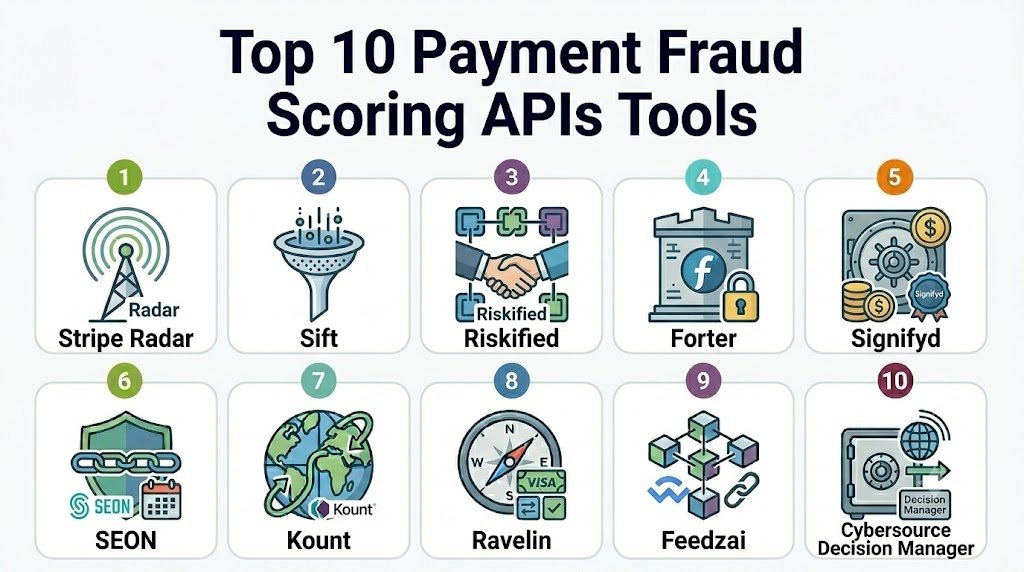
Top 10 Payment Fraud Scoring APIs Tools
1- Stripe Radar
Short description: Stripe Radar is Stripe’s native fraud detection solution that leverages data from millions of businesses across the Stripe ecosystem. It is ideal for businesses already using Stripe payments.
Key Features
- Real-time fraud scoring
- Adaptive machine learning models
- Custom fraud rules
- Risk insights dashboard
- Chargeback management
- Device and behavioral analysis
- Automated risk decisions
Pros
- Seamless Stripe integration
- Easy implementation
- Strong machine learning capabilities
Cons
- Best suited for Stripe users
- Limited flexibility outside Stripe ecosystem
- Enterprise customization may require additional tools
Platforms / Deployment
Cloud
Security & Compliance
Encryption, audit controls, MFA support through Stripe ecosystem. Additional certifications vary by service.
Integrations & Ecosystem
Deep integration with Stripe payment infrastructure.
- Stripe Payments
- Stripe Billing
- Stripe Connect
- Stripe Checkout
- Developer APIs
Support & Community
Strong documentation, extensive developer resources, and enterprise support options.
2- Sift
Short description: Sift provides AI-powered fraud prevention APIs designed for payment fraud, account protection, and marketplace risk management.
Key Features
- Machine learning risk scoring
- Global fraud network
- Account takeover protection
- Behavioral analytics
- Device intelligence
- Chargeback protection
- Custom workflows
Pros
- Strong AI models
- Excellent marketplace support
- Broad fraud coverage
Cons
- Premium pricing
- Enterprise-focused implementation
- Can require tuning
Platforms / Deployment
Cloud
Security & Compliance
Encryption, role-based access controls, audit capabilities. Additional compliance details vary.
Integrations & Ecosystem
Supports modern commerce and payment environments.
- Payment gateways
- E-commerce platforms
- Mobile applications
- Identity systems
- Custom APIs
Support & Community
Comprehensive onboarding and strong enterprise customer support.
3- Riskified
Short description: Riskified specializes in e-commerce fraud prevention and transaction approval optimization through machine learning-driven risk analysis.
Key Features
- Transaction risk scoring
- Chargeback guarantees
- Machine learning models
- Shopper behavior analysis
- Policy customization
- Automated approvals
- Global fraud intelligence
Pros
- Strong approval rates
- E-commerce specialization
- Revenue optimization focus
Cons
- Primarily e-commerce focused
- Enterprise pricing
- Limited non-commerce use cases
Platforms / Deployment
Cloud
Security & Compliance
Not publicly stated in full detail.
Integrations & Ecosystem
Designed for online retail ecosystems.
- Shopify
- Magento
- Salesforce Commerce
- Payment providers
- Custom integrations
Support & Community
Strong customer success programs and implementation assistance.
4- Forter
Short description: Forter delivers fraud prevention and trust decisioning for digital commerce organizations seeking high approval rates and reduced fraud losses.
Key Features
- Real-time fraud scoring
- Identity intelligence
- Device recognition
- Behavioral analytics
- Chargeback prevention
- Automated decisions
- Customer trust profiling
Pros
- Strong approval optimization
- Rich identity intelligence
- Enterprise-grade scalability
Cons
- Enterprise-focused pricing
- Advanced setup requirements
- Less suited to very small businesses
Platforms / Deployment
Cloud
Security & Compliance
Not publicly stated.
Integrations & Ecosystem
Broad commerce ecosystem support.
- Payment gateways
- Commerce platforms
- CRM systems
- Identity services
- APIs
Support & Community
Dedicated account management and enterprise support.
5- Signifyd
Short description: Signifyd helps merchants reduce fraud losses while increasing order approvals through AI-powered commerce protection.
Key Features
- Fraud scoring
- Chargeback guarantees
- Automated order review
- Machine learning analysis
- Customer trust insights
- Operational analytics
- Global commerce intelligence
Pros
- Strong e-commerce capabilities
- Easy deployment
- Chargeback protection
Cons
- Retail-focused
- Less suitable for banking use cases
- Enterprise-oriented pricing
Platforms / Deployment
Cloud
Security & Compliance
Not publicly stated.
Integrations & Ecosystem
Works with leading commerce ecosystems.
- Shopify
- BigCommerce
- Adobe Commerce
- Payment processors
- APIs
Support & Community
Strong onboarding and customer support.
6- SEON
Short description: SEON provides fraud prevention APIs combining digital footprint analysis, device intelligence, and machine learning.
Key Features
- Fraud scoring APIs
- Device fingerprinting
- Email intelligence
- Phone intelligence
- IP analysis
- Machine learning models
- Rule engine
Pros
- Flexible APIs
- Strong digital footprint capabilities
- Popular among fintech firms
Cons
- Requires configuration effort
- Learning curve for custom rules
- Enterprise features may increase costs
Platforms / Deployment
Cloud
Security & Compliance
Encryption and access controls. Additional certifications vary.
Integrations & Ecosystem
Developer-focused integration capabilities.
- REST APIs
- Payment systems
- CRM platforms
- KYC solutions
- Identity providers
Support & Community
Good developer documentation and implementation support.
7- Kount
Short description: Kount provides AI-driven fraud prevention and identity trust solutions across payments, account creation, and digital commerce.
Key Features
- Real-time fraud scoring
- Identity trust network
- Device intelligence
- Behavioral analytics
- Account protection
- Machine learning
- Policy management
Pros
- Mature fraud platform
- Strong identity signals
- Enterprise scalability
Cons
- Complex implementation
- Enterprise focus
- Advanced tuning required
Platforms / Deployment
Cloud
Security & Compliance
Not publicly stated.
Integrations & Ecosystem
Extensive ecosystem support.
- Payment providers
- Commerce systems
- CRM tools
- APIs
- Identity platforms
Support & Community
Enterprise-grade support and consulting services.
8- Ravelin
Short description: Ravelin provides fraud detection APIs designed for merchants, fintechs, subscription services, and marketplaces.
Key Features
- Machine learning risk scoring
- Device fingerprinting
- Behavioral analytics
- Chargeback prevention
- Customer profiling
- Fraud monitoring
- Decision automation
Pros
- Strong fintech support
- Flexible deployment
- Good reporting capabilities
Cons
- Requires optimization
- Enterprise-focused pricing
- Smaller ecosystem than some competitors
Platforms / Deployment
Cloud
Security & Compliance
Not publicly stated.
Integrations & Ecosystem
API-first architecture.
- Payment gateways
- Marketplaces
- Subscription platforms
- Mobile apps
- Custom APIs
Support & Community
Strong implementation guidance and documentation.
9- Feedzai
Short description: Feedzai offers enterprise-grade AI-powered fraud prevention focused on financial institutions and payment providers.
Key Features
- AI fraud detection
- Real-time scoring
- Transaction monitoring
- Risk orchestration
- Behavioral analytics
- Financial crime prevention
- Explainable AI
Pros
- Excellent banking capabilities
- Advanced analytics
- Enterprise-grade scale
Cons
- Complex deployments
- Premium pricing
- May exceed SMB requirements
Platforms / Deployment
Cloud, Hybrid
Security & Compliance
Not publicly stated.
Integrations & Ecosystem
Built for financial services ecosystems.
- Banking systems
- Payment processors
- Data platforms
- APIs
- Risk systems
Support & Community
Comprehensive enterprise support services.
10- Cybersource Decision Manager
Short description: Cybersource Decision Manager provides transaction risk scoring and fraud management for merchants processing digital payments.
Key Features
- Risk scoring
- Global fraud intelligence
- Custom rules
- Device fingerprinting
- Velocity checks
- Case management
- Real-time decisioning
Pros
- Strong payment ecosystem
- Global coverage
- Flexible rule controls
Cons
- Interface complexity
- Requires tuning
- Enterprise-focused pricing
Platforms / Deployment
Cloud
Security & Compliance
Not publicly stated.
Integrations & Ecosystem
Part of a large payment infrastructure ecosystem.
- Payment gateways
- Merchant systems
- E-commerce platforms
- APIs
- Reporting tools
Support & Community
Well-established support and enterprise services.
Comparison Table
| Tool Name | Best For | Platform Supported | Deployment | Standout Feature | Public Rating |
|---|---|---|---|---|---|
| Stripe Radar | Stripe merchants | Web | Cloud | Stripe ecosystem intelligence | N/A |
| Sift | Marketplaces | Web | Cloud | Global fraud network | N/A |
| Riskified | E-commerce | Web | Cloud | Chargeback guarantees | N/A |
| Forter | Large retailers | Web | Cloud | Identity intelligence | N/A |
| Signifyd | Online merchants | Web | Cloud | Commerce protection | N/A |
| SEON | Fintech | Web | Cloud | Digital footprint analysis | N/A |
| Kount | Enterprise commerce | Web | Cloud | Identity trust network | N/A |
| Ravelin | Subscription businesses | Web | Cloud | Flexible risk scoring | N/A |
| Feedzai | Financial institutions | Web | Cloud/Hybrid | AI-powered financial crime prevention | N/A |
| Cybersource Decision Manager | Global merchants | Web | Cloud | Visa ecosystem intelligence | N/A |
Evaluation & Scoring of Payment Fraud Scoring APIs
| Tool | Core | Ease | Integrations | Security | Performance | Support | Value | Weighted Total |
|---|---|---|---|---|---|---|---|---|
| Stripe Radar | 9 | 10 | 9 | 9 | 9 | 9 | 9 | 9.15 |
| Sift | 9 | 8 | 9 | 9 | 9 | 9 | 8 | 8.75 |
| Riskified | 9 | 8 | 8 | 8 | 9 | 9 | 8 | 8.50 |
| Forter | 9 | 8 | 8 | 8 | 9 | 9 | 8 | 8.50 |
| Signifyd | 8 | 9 | 8 | 8 | 8 | 8 | 8 | 8.15 |
| SEON | 8 | 8 | 9 | 8 | 8 | 8 | 9 | 8.30 |
| Kount | 9 | 7 | 8 | 8 | 9 | 8 | 7 | 8.10 |
| Ravelin | 8 | 8 | 8 | 8 | 8 | 8 | 8 | 8.00 |
| Feedzai | 10 | 7 | 8 | 9 | 10 | 9 | 6 | 8.45 |
| Cybersource | 8 | 7 | 9 | 8 | 9 | 8 | 8 | 8.10 |
Which Payment Fraud Scoring API Is Right for You?
Solo / Freelancer
Most freelancers do not require dedicated fraud scoring APIs. Built-in payment gateway protections such as Stripe Radar are usually sufficient.
SMB
SEON and Stripe Radar offer strong fraud protection with relatively straightforward implementation and good value for growing businesses.
Mid-Market
Sift, Signifyd, and Ravelin provide stronger customization, broader fraud intelligence, and scalable risk management capabilities.
Enterprise
Feedzai, Forter, Kount, and Riskified deliver enterprise-scale fraud prevention with advanced AI models and large transaction handling capabilities.
Budget vs Premium
Budget-conscious organizations should evaluate Stripe Radar and SEON. Premium enterprise buyers may benefit more from Feedzai, Forter, or Sift.
Feature Depth vs Ease of Use
Stripe Radar offers simplicity. Feedzai and Kount provide deeper functionality but require more implementation effort.
Integrations & Scalability
Sift, Cybersource, and Feedzai provide strong integration ecosystems and scalability for high-volume environments.
Security & Compliance Needs
Financial institutions and regulated organizations should prioritize platforms with mature governance controls, audit capabilities, and enterprise security features such as Feedzai, Sift, and Kount.
Frequently Asked Questions
1- What is a payment fraud scoring API?
A payment fraud scoring API evaluates transaction risk and returns a score indicating the likelihood of fraud. Businesses use these scores to approve, review, or decline transactions.
2- How do fraud scoring APIs work?
They analyze transaction data, device information, behavioral patterns, identity signals, and historical fraud intelligence to generate risk assessments.
3- Are machine learning models better than rule-based systems?
In most cases, yes. Machine learning can identify complex fraud patterns that static rules may miss while reducing false positives.
4- Can small businesses benefit from fraud scoring APIs?
Yes. Even growing online businesses can reduce chargebacks and fraud losses using affordable fraud scoring tools.
5- How long does implementation take?
Implementation can range from a few hours for simple API integrations to several months for enterprise fraud orchestration projects.
6- Do these tools prevent account takeover attacks?
Many platforms offer account takeover detection alongside payment fraud prevention through behavioral and device intelligence.
7- Are fraud scoring APIs suitable for mobile applications?
Yes. Most modern fraud scoring providers support web, mobile, API, and omnichannel environments.
8- How are these platforms typically priced?
Pricing varies. Common models include transaction-based pricing, subscription licensing, usage tiers, and custom enterprise agreements.
9- Can fraud scoring APIs reduce chargebacks?
Yes. One of their primary goals is preventing fraudulent transactions that later result in chargebacks.
10- Is it difficult to switch providers?
Migration complexity depends on integrations, workflows, and data models. Many organizations run parallel testing before fully switching providers.
Conclusion
Payment Fraud Scoring APIs have become essential infrastructure for digital commerce, fintech, banking, SaaS, and marketplace businesses. As fraud attacks become more sophisticated, organizations increasingly rely on AI-driven risk scoring, behavioral analytics, device intelligence, and consortium-based fraud networks to protect revenue while maintaining positive customer experiences. Stripe Radar remains an excellent choice for Stripe-centric businesses, while Sift, Forter, and Riskified provide strong commerce-focused fraud prevention. SEON offers flexibility for growing fintech organizations, and Feedzai stands out for large financial institutions requiring advanced fraud and financial crime detection capabilities. The best platform ultimately depends on transaction volume, risk tolerance, integration requirements, and compliance obligations. Before making a final decision, shortlist two or three vendors, run a controlled pilot, validate fraud detection performance, and confirm integration and security requirements align with your long-term strategy.

Find Trusted Cardiac Hospitals
Compare heart hospitals by city and services — all in one place.
Explore Hospitals
An interesting factor to consider is how fraud scoring APIs handle seasonal traffic spikes and changing purchasing patterns. Models that adapt quickly to shifting customer behavior can help reduce unnecessary declines while maintaining strong fraud detection accuracy.