Introduction
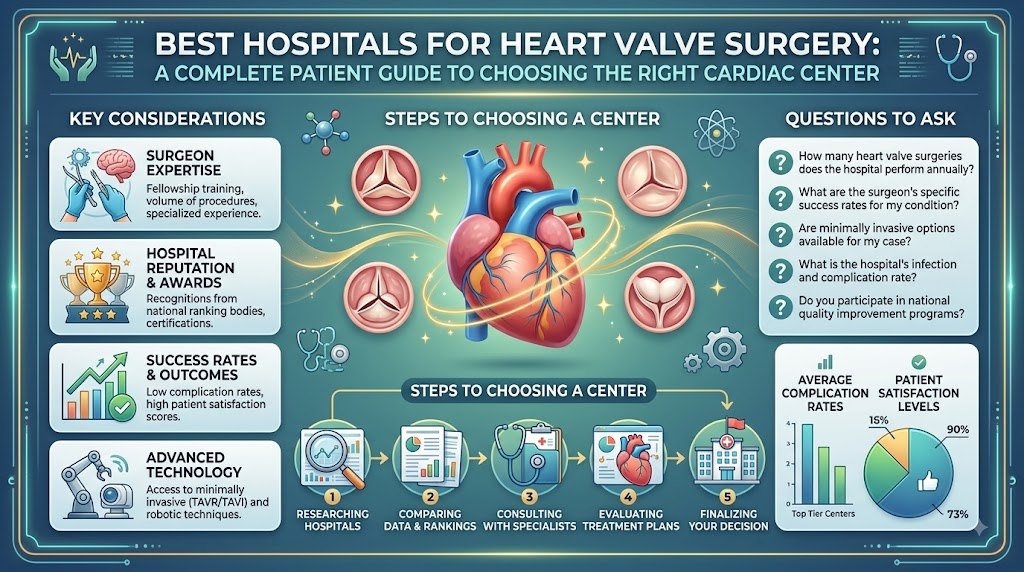
Receiving a recommendation for heart valve surgery can feel overwhelming for patients and their families. Choosing where to undergo a major cardiac procedure is one of the most critical healthcare decisions you will ever make. While it is tempting to simply search for the “best hospital” and pick the top name on an internet search list, selecting the right medical center requires looking far beyond brand recognition, marketing slogans, or general hospital rankings.Every heart is unique, and so is every valve condition. A facility that excels in routine coronary care may not necessarily have the specialized surgical expertise, advanced imaging technology, or dedicated cardiac intensive care required for complex valve repair or replacement. Evaluating a hospital requires a thorough look at the surgical team’s specific valve experience, the availability of a multidisciplinary “Heart Team,” the quality of the post-operative Intensive Care Unit (ICU), and the robustness of the cardiac rehabilitation program.Services like MyHospitalNow assist patients in discovering doctors and medical centers, requesting transparent treatment quotes, and comparing healthcare options, empowering families to make confident, well-informed decisions.
What Is Heart Valve Surgery?
To understand heart valve surgery, it helps to understand how a healthy heart functions. The human heart contains four valves that act as one-way doors, keeping blood flowing in the correct direction through the heart’s four chambers and out to the rest of the body:
- Tricuspid Valve: Controls blood flow from the right atrium to the right ventricle.
- Pulmonary Valve: Controls blood flow from the right ventricle into the pulmonary arteries leading to the lungs.
- Mitral Valve: Controls blood flow from the left atrium to the left ventricle.
- Aortic Valve: Controls blood flow from the left ventricle into the aorta, which supplies blood to the body.
       [ Blood from Body ]
               │
               ▼
      [ Right Atrium (RA) ]
               │
      ( Tricuspid Valve )
               │
               ▼
    [ Right Ventricle (RV) ]
               │
      ( Pulmonary Valve )
               │
               ▼
         [ To Lungs ]
               │
         [ From Lungs ]
               │
               ▼
       [ Left Atrium (LA) ]
               │
        ( Mitral Valve )
               │
               ▼
     [ Left Ventricle (LV) ]
               │
        ( Aortic Valve )
               │
               ▼
    [ Aorta ➔ Rest of Body ]
When a heart valve becomes diseased or damaged, its ability to regulate blood flow is compromised. Heart valve disease generally falls into two primary categories:
- Stenosis (Narrowing): The valve leaflets become stiff, thick, or fused together. This narrows the valve opening, forcing the heart muscle to work much harder to pump blood through the restricted space.
- Regurgitation (Leaking or Insufficiency): The valve leaflets fail to close tightly, allowing blood to flow backward into the previous chamber. This forces the heart to handle extra blood volume, leading to cardiac strain over time.
Heart Valve Interventions: Repair vs. Replacement
When valve disease significantly impairs heart function or causes severe symptoms, surgical intervention may be required. Heart valve surgery falls into two main surgical categories:
Valve Repair
Whenever clinically feasible, cardiac surgeons prefer to preserve and repair the patient’s native valve. Repairing the natural structure preserves heart muscle function, lowers the risk of long-term infection, and often eliminates the need for lifelong blood-thinning medications (anticoagulants). Surgical repair techniques may include reshaping tissue, removing excess leaflet tissue, separating fused valve leaflets, or placing an annuloplasty ring (a synthetic ring sewn around the base of the valve) to provide structural support and help the leaflets close properly.
Valve Replacement
If a valve is too severely damaged, calcified, or structurally degraded to be repaired safely, it must be replaced. During valve replacement, the surgeon removes the diseased valve tissue and implants a new artificial (prosthetic) valve. Replacement options primarily include mechanical valves (made from durable synthetic materials like carbon or titanium) or biological/tissue valves (made from animal tissue, such as bovine or porcine, or occasionally human donor tissue).
Types of Heart Valve Surgery
Different valves present distinct anatomical challenges, requiring tailored surgical techniques and approaches.
                  ┌─────────────────────────────────────────┐
                  │       Heart Valve Interventions         │
                  └────────────────────┬────────────────────┘
                                       │
            ┌──────────────────────────┴──────────────────────────┐
            ▼                                                     ▼
┌───────────────────────┐                             ┌───────────────────────┐
│   Surgical Options    │                             │  Interventional Arts │
└───────────┬───────────┘                             └───────────┬───────────┘
            │                                                     │
   ┌────────┴────────┐                                   ┌────────┴────────┐
   ▼                 ▼                                   ▼                 ▼
[ Repair ]     [ Replacement ]                       [ TAVR/TAVI ]    [ MitraClip ]
Aortic Valve Surgery
The aortic valve manages oxygen-rich blood exiting the heart to the entire body. Aortic valve disease most frequently manifests as aortic stenosis (often caused by age-related calcification or congenital bicuspid valve disease) or aortic regurgitation. While surgical aortic valve replacement (SAVR) remains a gold-standard therapy, aortic valve repair is sometimes possible, particularly in cases of aortic regurgitation due to root dilation or isolated leaflet tears.
Mitral Valve Surgery
The mitral valve regulates flow between the left atrium and left ventricle. Mitral valve disease commonly involves mitral valve prolapse (causing regurgitation) or rheumatic mitral stenosis. Surgical guidelines strongly emphasize mitral valve repair over replacement whenever possible, as repairing the mitral valve preserves the natural subvalvular apparatus, keeping the structural integrity of the left ventricle intact. When repair is impossible, replacement is performed.
Tricuspid Valve Surgery
Historically overshadowed by aortic and mitral disease, the tricuspid valve manages blood entering the right heart. Tricuspid regurgitation often develops secondarily to left-sided heart disease or pulmonary hypertension. Tricuspid surgery is frequently performed simultaneously during mitral or aortic valve operations. Surgeons strongly favor tricuspid repair (such as annuloplasty) over replacement whenever clinically appropriate.
Pulmonary Valve Surgery
Pulmonary valve procedures are less common in older adults and are most frequently required in pediatric patients or adults with congenital heart defects (such as Tetralogy of Fallot). Because of the complex anatomical considerations involving congenital cardiac conditions, pulmonary valve surgery requires specialized expertise from congenital or pediatric cardiac surgery teams.
Minimally Invasive Valve Procedures
Traditional heart surgery requires a full sternotomy (cutting through the breastbone). In contrast, minimally invasive valve surgery accesses the heart through smaller incisions—such as a mini-thoracotomy (a small cut between the ribs) or a mini-sternotomy (a partial cut of the breastbone). Specialized surgical instruments and tiny cameras are used to perform the repair or replacement. Potential benefits include less post-operative pain, reduced blood loss, shorter hospital stays, and a faster return to daily activities. However, minimally invasive surgery is not clinically appropriate for every patient; candidacy depends on anatomical factors, vascular access, and overall heart health.
Catheter-Based Procedures
Catheter-based (percutaneous) valve interventions allow structural heart cardiologists to treat valve disease without open-heart surgery. Using a thin, flexible tube (catheter) threaded through a blood vessel (typically starting in the groin), specialists can repair or replace a valve.
- TAVR / TAVI (Transcatheter Aortic Valve Replacement / Implantation): A foldable tissue valve is delivered inside a catheter and expanded directly within the diseased aortic valve.
- MitraClip / Transcatheter Edge-to-Edge Repair (TEER): A tiny clip is placed on the leaky mitral valve leaflets to help them close more tightly and reduce regurgitation.
Catheter-based therapies were initially developed for patients facing high surgical risk, but their use has expanded based on clinical trials. However, they are not automatically superior to traditional surgery for every individual. A multidisciplinary assessment is necessary to determine whether a surgical or catheter-based approach is safer and more effective for your specific case.
When Might Heart Valve Surgery Be Needed?
It is crucial to understand that not every patient with heart valve disease requires surgery immediately. Many individuals with mild or moderate valve dysfunction live symptom-free for years under careful monitoring (“watchful waiting”) by a cardiologist.
An intervention—whether surgical repair, replacement, or catheter-based treatment—is typically considered when specific clinical criteria are met, based on comprehensive imaging, patient health, and specialist evaluations.
Factors Influencing the Decision for Intervention
- Severity of Disease: Severe narrowing (stenosis) or severe leakage (regurgitation) observed on diagnostic imaging.
- Presence of Symptoms: Symptoms indicating that the heart is struggling to maintain adequate blood circulation throughout the body.
- Heart Function and Structure: Evidence that valve dysfunction is causing the heart to enlarge, weakening the ejection fraction (pumping strength), or causing elevated pressure in the lungs (pulmonary hypertension).
- Disease Progression: Rapid worsening of valve parameters over successive echocardiograms.
- Overall Health and Co-existing Conditions: Evaluating whether the patient can safely undergo a procedure and recover effectively.
Common Symptoms of Valve Disease
Patients should seek medical evaluation if they experience any of the following symptoms, which may indicate worsening heart valve function:
- Shortness of Breath (Dyspnea): Feeling winded during normal daily activities or while lying flat in bed.
- Chest Pain or Discomfort: Sensations of pressure, tightness, or squeezing in the chest, particularly during exertion.
- Dizziness or Lightheadedness: Feeling faint, unsteady, or experiencing brief loss of consciousness (syncope).
- Fatigue and Weakness: Unexplained, persistent exhaustion even after resting.
- Heart Palpitations: Sensations of a rapid, fluttering, pounding, or irregular heartbeat.
- Fluid Retention (Edema): Swelling in the feet, ankles, legs, or abdomen, accompanied by sudden weight gain.
What Makes a Good Heart Valve Surgery Hospital?
Choosing a hospital for heart valve surgery requires looking beyond brand recognition to evaluate specific clinical capabilities. A top-tier cardiac center should possess key structural, technological, and professional elements to ensure safe and effective care.
┌─────────────────────────────────────────────────────────────────┐
│               Core Components of a Leading Cardiac Center       │
├───────────────────┬─────────────────────────┬───────────────────┤
│ Surgical Team     │ Diagnostic Infrastructure│ Support & Rehab   │
├───────────────────┼─────────────────────────┼───────────────────┤
│ • Cardiac Surgeons│ • 3D TEE / TTE          │ • Dedicated CICU  │
│ • Heart Team      │ • High-Resolution CT    │ • Blood Bank      │
│ • Nurse Specialists│ • Cath/Hybrid Labs     │ • Cardiac Rehab   │
└───────────────────┴─────────────────────────┴───────────────────┘
Experienced Cardiac Surgery Team
The quality of a cardiac program depends fundamentally on the skills and experience of its medical team. Look for facilities staffed by board-certified cardiothoracic surgeons, structural cardiologists, cardiac anesthesiologists, and specialized critical-care physicians. High procedural volume correlates with lower complication rates and improved patient outcomes in cardiac surgery.
Multidisciplinary “Heart Team”
Leading heart centers do not rely on a single physician to make major treatment decisions. Instead, they use a Multidisciplinary Heart Team approach. This team includes cardiac surgeons, interventional cardiologists, imaging specialists, heart failure cardiologists, and cardiac anesthesiologists. Together, they review complex cases to determine the safest treatment plan—whether traditional open surgery, a minimally invasive approach, a catheter-based procedure, or medical management.
Advanced Cardiac Diagnostics
Accurate preoperative imaging is essential for guiding valve interventions. A top hospital must offer state-of-the-art diagnostic facilities, including:
- Echocardiography (TTE): High-definition transthoracic ultrasound to assess valve structure and blood flow.
- Transesophageal Echocardiography (TEE): 3D imaging using a probe guided down the esophagus to provide detailed views of valve leaflets.
- Cardiac CT and MRI: Specialized cross-sectional imaging to measure vessel sizes, assess structural details, and map calcification patterns before procedures like TAVR or complex valve repairs.
- Cardiac Catheterization Laboratory: Facilities to measure pressure differences within heart chambers and assess coronary artery disease prior to surgery.
Specialized Cardiac Operating Rooms and Hybrid Labs
Heart valve surgery requires dedicated operating rooms equipped with advanced life-support technology, such as cardiopulmonary bypass (heart-lung) machines, operated by certified perfusionists. Additionally, leading centers feature Hybrid Operating Rooms—advanced surgical suites that combine traditional operating room sterile environments with advanced interventional imaging technology. This allows the surgical team to perform catheter-based interventions or transition seamlessly to open surgery if needed.
Dedicated Cardiac Intensive Care Unit (CICU)
The initial hours and days following valve surgery are critical. A qualified hospital must feature a specialized Cardiac Intensive Care Unit (CICU), separate from a general medical ICU. The CICU should be staffed 24/7 by critical-care specialists (intensivists) and critical-care nurses trained specifically in managing post-operative cardiac patients, handling hemodynamics, and managing advanced monitoring equipment.
Blood Bank and Emergency Infrastructure
Valve surgery requires robust emergency support, including a 24/7 blood bank with immediate access to blood products, advanced infection control protocols, and rapid emergency intervention capabilities to address potential post-operative complications promptly.
Comprehensive Cardiac Rehabilitation
Recovery does not end when a patient is discharged from the hospital. A high-quality cardiac center offers an integrated, multidisciplinary Cardiac Rehabilitation Program. This includes medically supervised exercise, nutritional guidance, medication adjustment, and lifestyle counselling designed to help patients regain physical strength safely and maintain long-term cardiovascular health.
Heart Valve Repair vs. Replacement: A Clinical Comparison
The decision to repair or replace a heart valve depends on valve anatomy, the extent of tissue degradation, patient age, lifestyle, and overall health. Neither approach is universally “better”—the right choice depends entirely on individual clinical circumstances.
| Comparison Factor | Heart Valve Repair | Heart Valve Replacement |
| Basic Surgical Approach | Preserves and repairs the patient’s existing native valve tissue. | Removes diseased tissue and implants a new artificial valve. |
| Clinical Suitability | Highly feasible for mitral/tricuspid valves; dependent on valve anatomy. | Required when the native valve is severely calcified or destroyed. |
| Prosthetic Valve Implanted | No (sometimes an annuloplasty ring is sewn around the base). | Yes (either a mechanical or biological/tissue valve). |
| Long-Term Blood Thinners | Usually not required long-term (unless atrial fibrillation exists). | Mandatory long-term for mechanical valves; temporary for tissue valves. |
| Valve Durability | Excellent; long-lasting results using native tissue. | Mechanical: Lifetime durability; Tissue: May wear out over 10–20 years. |
| Infection Risk (Endocarditis) | Lower long-term risk of prosthetic valve infection. | Slightly higher risk compared to repaired native tissue. |
| Decision Driver | Anatomical repairability evaluated by the specialist. | Extent of valve destruction evaluated by the specialist. |
Types of Valve Replacements: Mechanical vs. Biological
When valve replacement is necessary, patients and their surgical teams must choose between two primary types of prosthetic valves. Each valve type presents distinct advantages and lifestyle considerations.
Mechanical Valves
Mechanical valves are manufactured entirely from synthetic materials, such as pyrolytic carbon and titanium.
+--------------------------------------------------------------------+
|                         MECHANICAL VALVES                          |
+--------------------------------------------------------------------+
|  PROS: Exceptionally durable; designed to last a lifetime.         |
|  CONS: Requires lifelong blood thinners (anticoagulants).          |
|  BEST FOR: Younger patients (< 50–60 years) to avoid redo surgery.  |
+--------------------------------------------------------------------+
- Durability: Mechanical valves are extremely durable and rarely wear out. They are designed to last a patient’s entire lifetime.
- Anticoagulation Considerations: Because blood tends to form clots on synthetic mechanical surfaces, patients with mechanical valves must take blood-thinning medication (such as warfarin) for the rest of their lives. This requires regular blood monitoring (INR tests) and dietary management to prevent both blood clots and excessive bleeding risks.
- Ideal Candidates: Often recommended for younger patients (typically under age 50–60) who wish to minimize the risk of needing a second surgery later in life and are comfortable managing long-term anticoagulation.
Biological (Tissue) Valves
Biological valves are made from natural animal tissues—most commonly bovine (cow) pericardium or porcine (pig) heart valves—mounted on a flexible frame.
+--------------------------------------------------------------------+
|                         BIOLOGICAL VALVES                          |
+--------------------------------------------------------------------+
|  PROS: Long-term blood thinners usually not required.              |
|  CONS: May degrade over time (typically lasting 10–20 years).      |
|  BEST FOR: Older patients (> 65 years) or those with bleeding risk.|
+--------------------------------------------------------------------+
- Durability: Tissue valves naturally degrade over time due to mechanical stress and calcification. They typically last between 10 and 20 years, depending on the patient’s age and health, after which a replacement or valve-in-valve procedure may be needed.
- Anticoagulation Considerations: Biological valves closely mimic human tissue, drastically reducing the risk of blood clots. Lifelong blood thinners are usually unnecessary unless required for another underlying condition, such as atrial fibrillation. Short-term anticoagulation may be prescribed for a few months post-surgery.
- Ideal Candidates: Often recommended for older individuals (typically age 65 and older), patients with high bleeding risks who cannot safely take blood thinners, or women of childbearing age planning future pregnancies.
Surgical vs. Minimally Invasive vs. Catheter-Based Approaches
Understanding the structural approach your surgeon recommends helps set realistic expectations for your hospital stay and recovery.
┌────────────────────────────────────────────────────────────────────────┐
│                        Procedural Approaches                           │
├───────────────────┬───────────────────────────┬────────────────────────┤
│ Traditional Open  │ Minimally Invasive        │ Catheter-Based         │
│ Surgery           │ Surgery                   │ Procedures             │
├───────────────────┼───────────────────────────┼────────────────────────┤
│ • Full Sternotomy │ • Small chest incision    │ • Femoral access       │
│ • Complete visual │ • Retains sternal integrity│ • Minimal invasiveness │
│   field           │ • Reduced blood loss      │ • Faster recovery      │
│ • Versatile       │ • Anatomy-dependent       │ • Specific criteria    │
└───────────────────┴───────────────────────────┴────────────────────────┘
Traditional Open Surgery
Traditional cardiac surgery involves a median sternotomy—a longitudinal incision down the center of the chest to separate the breastbone, allowing direct access to the heart. The patient is connected to a heart-lung bypass machine during the operation.
- Advantages: Gives the surgeon a direct, clear view of the heart and surrounding vessels. It is a proven approach suitable for complex repairs, multi-valve procedures, or combined valve and coronary bypass operations.
- Considerations: Requires a larger incision, longer hospital stays, and a standard bone-healing period (typically 6–8 weeks) for the sternum to heal fully.
Minimally Invasive Surgery
Minimally invasive approaches access the heart through smaller incisions—such as a mini-thoracotomy between the ribs—without fully cutting through the breastbone. Specialized long-handled instruments, video cameras, or robotic systems guide the surgeon.
- Advantages: Smaller incisions typically result in less post-operative pain, lower blood loss, a reduced risk of wound infection, shorter hospital stays, and a quicker return to routine activities.
- Considerations: Not every patient is a candidate. Suitability depends on vascular health, valve anatomy, chest structure, and whether additional complex cardiac repairs are needed.
Catheter-Based Treatments (TAVR / MitraClip)
Catheter-based therapies avoid major chest incisions entirely. Interventional cardiologists thread a catheter through blood vessels—usually starting in the groin (transfemoral access)—and guide it directly to the diseased valve under real-time imaging guidance.
- Advantages: Avoids chest incisions and cardiopulmonary bypass, leading to significantly shorter recovery times, shorter hospital stays, and less immediate physical trauma.
- Considerations: These procedures require specific anatomical dimensions and vessel pathways. While catheter interventions offer a less invasive option for selected patients, traditional surgery remains the gold standard for many individuals, particularly younger patients or those needing valve repair.
Important Preoperative Diagnostic Tests
Before valve surgery, hospitals conduct a detailed medical evaluation to map your heart’s anatomy, assess blood flow, and identify potential surgical risks.
                         ┌───────────────────────────┐
                         │   Preoperative Diagnostics│
                         └─────────────┬─────────────┘
                                       │
        ┌──────────────────────────────┼──────────────────────────────┐
        ▼                              ▼                              ▼
┌──────────────┐               ┌──────────────┐               ┌──────────────┐
│  Echocardiogram│             │ Coronary     │               │ Laboratory   │
│  (TTE / TEE) │               │ Angiography  │               │ Work & CT    │
└──────────────┘               └──────────────┘               └──────────────┘
- Transthoracic Echocardiogram (TTE): The foundational, non-invasive ultrasound scan used to evaluate valve structure, measure flow velocities, and calculate overall heart pumping strength (ejection fraction).
- Transesophageal Echocardiogram (TEE): Performed by inserting a thin transducer down the esophagus under mild sedation. Because the probe sits directly behind the heart, TEE provides high-resolution, detailed images of valve leaflets, structural defects, and potential blood clots.
- Electrocardiogram (ECG / EKG): Records the heart’s electrical activity to detect abnormal heart rhythms (arrhythmias) such as atrial fibrillation or conduction delays.
- Chest X-Ray: Assesses overall heart size, lung fields, fluid buildup, and thoracic bony structures.
- Cardiac Computed Tomography (CT) / Magnetic Resonance Imaging (MRI): Advanced imaging that provides precise cross-sectional maps of the heart, aorta, vascular structures, and calcification levels—essential for planning TAVR or minimally invasive approaches.
- Coronary Angiography (Cardiac Catheterization): An invasive X-ray procedure used to evaluate coronary artery health. If significant blockages are found, the surgeon can perform coronary artery bypass grafting (CABG) alongside the valve surgery during the same operation.
- Comprehensive Laboratory Panels: Complete blood counts, kidney and liver function panels, blood typing and cross-matching, and coagulation studies to ensure safety before surgery.
What to Look for in a Cardiac Surgery Team
A hospital’s capabilities depend heavily on the expertise, training, and communication of its medical staff. When researching surgical teams, look for the following characteristics:
- Subspecialty Expertise: Ensure your primary operating surgeon has specific expertise in valve repair or replacement, rather than practicing solely as a general cardiac surgeon.
- High Procedural Volume: High procedural volume is linked to better surgical outcomes. Research how many valve operations the surgeon and hospital perform annually.
- Collaborative Decision-Making: Choose teams that use a multidisciplinary “Heart Team” model, ensuring that multiple specialists evaluate your medical records together.
- Clear Communication and Empathy: Your medical team should explain your treatment options clearly, discuss potential risks openly, listen to your concerns, and answer your questions directly without rushing.
- Dedicated Post-Operative Care: Verify that the surgical team works closely with dedicated critical care specialists (intensivists) and cardiac rehabilitation teams to manage your care throughout recovery.
Hospital Infrastructure and Surgical Technology
Top-tier cardiac centers invest heavily in modern medical infrastructure to support high-quality patient care and safety. Key technological and facility features to look for include:
- Hybrid Operating Suites: Advanced operating rooms equipped with real-time high-resolution imaging equipment. They allow seamless collaboration between cardiac surgeons and interventional cardiologists during complex structural heart procedures.
- Advanced Cardiopulmonary Bypass Equipment: Modern heart-lung machines monitored by certified perfusionists ensure stable organ perfusion during open-heart surgery.
- Dedicated Cardiac ICU (CICU): A specialized ICU separate from general medical wards, featuring continuous hemodynamic monitoring, bedside echocardiography, mechanical circulatory support, and advanced ventilation systems.
- Advanced Infection Control Infrastructure: Rigorous positive-pressure air filtration systems (HEPA filters), strict sterilization protocols, and controlled isolation rooms designed to minimize post-operative infection risks.
- 24/7 Fully Stocked Blood Bank: On-site access to typed and cross-matched blood products, along with cell-saver technology in the operating room to recycle the patient’s own blood and reduce the need for external transfusions.
Understanding the Cost of Heart Valve Surgery
The overall cost of heart valve surgery varies widely based on several clinical, operational, and geographical factors. Because treatment plans are tailored to individual needs, there is no universal single price for valve surgery.
┌─────────────────────────────────────────────────────────────────┐
│               Key Drivers of Heart Valve Surgery Cost            │
├───────────────────┬─────────────────────────┬───────────────────┤
│ Procedure Type    │ Facility & Stay         │ Medical Services  │
├───────────────────┼─────────────────────────┼───────────────────┤
│ • Repair vs. Replace│ • ICU duration        │ • Surgeon fees    │
│ • Surgical vs. TAVR│ • Room category        │ • Diagnostics     │
│ • Prosthetic type │ • Rehab programs        │ • Medications     │
└───────────────────┴─────────────────────────┴───────────────────┘
Key Factors Influencing Overall Treatment Costs
- Type of Procedure: Surgical valve repairs, mechanical replacements, tissue replacements, and catheter-based interventions (such as TAVR) have different baseline equipment and material costs.
- Type of Implant: Biological valves, advanced mechanical valves, and catheter-delivered valve systems carry different manufacturing and acquisition costs.
- Hospital Location and Category: Medical fees vary significantly by region, city, and whether the facility is a private hospital or a public teaching center.
- Length of Stay: Total costs are directly impacted by the length of time spent in both the high-dependency Cardiac ICU and standard post-operative inpatient wards.
- Preoperative Diagnostics & Post-Op Medications: Extensive imaging scans, catheterization procedures, blood work, specialized medications, and blood thinners add to the final invoice.
- Managing Co-existing Conditions: Complex patients with pre-existing conditions like kidney disease, lung disease, or diabetes may require additional specialist consultations and extended supportive care.
Financial Advice for Patients
Always request a comprehensive, written treatment cost estimate from the hospital’s financial counseling office before undergoing an elective procedure. Ensure the estimate explicitly itemizes surgical fees, operating room charges, ICU fees, prosthetic device costs, diagnostic tests, and expected length of stay.
Healthcare platforms like MyHospitalNow help patients request transparent treatment quotes, submit medical requirements, and compare hospital estimates to make clear, well-informed financial decisions.
Recovery After Heart Valve Surgery: What to Expect
Recovery after heart valve surgery is a gradual process that varies based on the surgical approach (open surgery vs. minimally invasive vs. catheter-based), your overall health, and age.
 timeline
    title Typical Valve Surgery Recovery Timeline
    Inpatient CICU Stay (Days 1 - 2) : Intensive continuous monitoring & mobilization
    Hospital Ward Recovery (Days 3 - 7) : Walking, wound care & medication stabilization
    Early Home Recovery (Weeks 2 - 6) : Gradual activity, incision care & sternal recovery
    Full Rehabilitation (Weeks 6 - 12+) : Outpatient rehab, return to work & driving
Inpatient Care and Immediate Post-Op (Days 1 to 7)
- Cardiac ICU (1–2 Days): Following surgery, you will be moved to the Cardiac ICU for close continuous monitoring of heart rhythm, blood pressure, and oxygen levels. Breathing tubes are typically removed once you are awake and breathing stably. Gentle, assisted physical mobilization usually begins within 24 hours.
- Inpatient Ward (3–5 Days): Once stable, you will transfer to a standard step-down cardiac ward. Physical therapists will help you practice walking, deep-breathing exercises, and safe daily movements while staff manage your medications and monitor surgical wounds.
Home Recovery and Healing (Weeks 2 to 6)
- Activity Restrictions: If you had open-chest surgery with a median sternotomy, you must observe strict “sternal precautions” for 6 to 8 weeks to allow the breastbone to heal properly. Avoid lifting anything heavier than 5–10 pounds, pushing or pulling with your arms, and driving until cleared by your surgeon.
- Wound Care: Keep surgical incisions clean, dry, and regularly inspected for any signs of infection (such as redness, swelling, warmth, or drainage).
- Medication Adherence: Take all prescribed cardiac medications, blood pressure drugs, and blood thinners exactly as directed.
Long-Term Management (Weeks 6 to 12 and Beyond)
- Return to Normal Activities: Most patients gradually return to light work, driving, and routine physical activities between 6 to 12 weeks post-surgery, following specialist approval.
- Follow-Up Appointments: Scheduled follow-up visits with your cardiologist—including follow-up echocardiograms—are necessary to monitor valve function and heart recovery.
Cardiac Rehabilitation: Essential for Long-Term Recovery
Cardiac rehabilitation is a structured, medically supervised program designed to help heart patients recover safely after surgery. Participating in cardiac rehabilitation is strongly recommended for anyone recovering from heart valve repair or replacement.
┌─────────────────────────────────────────────────────────────────┐
│              Four Key Pillars of Cardiac Rehabilitation         │
├───────────────────┬─────────────────────────┬───────────────────┤
│ Monitored Exercise│ Medical Supervision     │ Nutritional Support│
├───────────────────┼─────────────────────────┼───────────────────┤
│ • EKG-monitored   │ • Blood pressure checks │ • Heart-healthy   │
│   cardio training │ • Symptom tracking      │   dietary plans   │
│ • Safe strength   │ • Medication review     │ • Weight control  │
│   building        │                         │   counseling      │
└───────────────────┴─────────────────────────┴───────────────────┘
Core Components of Cardiac Rehabilitation
- Supervised Exercise Training: Personalized, monitored physical exercise tailored to your recovery stage. Specialists track your heart rate, blood pressure, and heart rhythm (via ECG) while helping you safely build endurance.
- Health and Lifestyle Education: Guidance on eating a heart-healthy diet, managing stress, quitting smoking, and maintaining a healthy weight.
- Medication and Symptom Management: Professional guidance to help you understand your new medications—especially anticoagulants—and learn how to recognize potential complications early.
- Psychological and Emotional Support: Recovering from major heart surgery can lead to anxiety or low mood. Rehab programs offer counseling and peer support to help build emotional resilience.
Risks and Possible Complications of Heart Valve Surgery
While modern heart valve surgery is highly safe and effective, it remains major medical treatment and carries inherent risks. Open, transparent discussions about these risks with your care team are an essential part of preparing for surgery.
┌─────────────────────────────────────────────────────────────────┐
│               Potential Risks and Surgical Complications        │
├───────────────────┬─────────────────────────┬───────────────────┤
│ Operative Risks   │ Cardiac Complications   │ Long-Term Risks   │
├───────────────────┼─────────────────────────┼───────────────────┤
│ • Bleeding        │ • Arrhythmias (Afib)    │ • Structural decay│
│ • Infection       │ • Heart block / Pacemaker│   (tissue valves) │
│ • Stroke / Clots  │ • Kidney dysfunction    │ • Thromboembolism │
└───────────────────┴─────────────────────────┴───────────────────┘
Possible Surgical Risks
- Bleeding: Excessive bleeding during or after surgery may require blood transfusions or surgical exploration.
- Infection: Surgical wound infections at the incision site or, rarely, deep prosthetic valve endocarditis (infection of the artificial valve).
- Abnormal Heart Rhythms (Arrhythmias): Post-operative atrial fibrillation (irregular heartbeat) is common after valve surgery and is managed with medications or temporary pacing. Some patients may develop heart block and require a permanent pacemaker.
- Blood Clots and Stroke: Blood clots forming on valve structures or traveling to the brain pose a risk of stroke, emphasizing the importance of proper anticoagulation.
- Kidney or Respiratory Dysfunction: Temporary changes in kidney function or fluid accumulation in the lungs during the recovery phase.
- Prosthetic Dysfunction: Tissue valves may gradually degrade over time, while mechanical valves carry a small risk of mechanical malfunction or clot formation.
Note: Individual risk profiles vary significantly based on patient age, baseline heart function, emergency status, and underlying conditions like diabetes or renal disease.
How to Compare Two or More Hospitals: A Practical Framework
When deciding between multiple medical centers, use this structured comparison matrix to organize your findings and make an informed decision:
| Evaluation Criteria | Hospital A | Hospital B | Personal Priority / Notes |
| Surgical Team & Experience | Specialist credentials, surgical volume, and team approach. | ||
| Valve Repair Capabilities | Proven track record in valve preservation vs. replacement. | ||
| Advanced Diagnostics | Availability of 3D TEE, High-Res CT, and Cardiac MRI. | ||
| Dedicated Infrastructure | Dedicated Cardiac ICU and specialized Hybrid Operating Rooms. | ||
| Safety & Infection Control | Hospital accreditation, safety metrics, and cleanliness. | ||
| Cardiac Rehabilitation | Structured, medically supervised post-discharge programs. | ||
| Financial Transparency | Clear itemized quotes and insurance network compatibility. | ||
| Location & Logistics | Travel distance, family lodging, and ease of access. |
Red Flags When Choosing a Hospital
When researching cardiac hospitals, be cautious of misleading practices or warning signs. Avoid facilities that display any of the following red flags:
- Guaranteed Outcomes: Any hospital or surgeon claiming “100% guaranteed success” or “zero surgical risk” is being unrealistic. All major heart surgeries carry inherent risks.
- High-Pressure Tactics: Being pressured to make immediate financial commitments or book an elective surgery without adequate time to seek a second opinion.
- Lack of Pricing Transparency: Refusal to provide clear, written, itemized cost estimates prior to non-emergency procedures.
- Unverified Claims: Promoting vague or unverified “top hospital” rankings without backing them up with recognized national or international medical accreditations.
- One-Size-Fits-All Approach: Pushing a single procedure (such as claiming minimally invasive or TAVR is “best for everyone”) without conducting a personalized evaluation of your anatomy.
- Dismissing Questions: Surgical teams that appear reluctant to disclose their procedural volume, complication rates, or answer your detailed questions directly.
How MyHospitalNow.com Can Help Patients
Navigating cardiac care choices across multiple hospitals can be challenging for patients and families. MyHospitalNow simplifies this process by providing a user-friendly platform to help you explore and evaluate healthcare options.
┌─────────────────────────────────────────────────────────────────┐
│                    How MyHospitalNow Helps You                  │
├───────────────────┬─────────────────────────┬───────────────────┤
│ Discover Centers  │ Submit Requirements     │ Compare Quotes    │
├───────────────────┼─────────────────────────┼───────────────────┤
│ Search verified   │ Share medical records   │ Review transparent│
│ cardiac hospitals │ & diagnosis details     │ pricing estimates │
│ and specialists   │ securely                │ side-by-side      │
└───────────────────┴─────────────────────────┴───────────────────┘
- Discover Verified Hospitals: Search and review detailed profiles of accredited cardiac centers and experienced cardiac surgery teams.
- Submit Treatment Requirements: Share your diagnosis and medical needs securely to get personalized feedback from matching hospitals.
- Request Treatment Quotes: Receive and compare transparent treatment cost estimates directly from participating medical facilities.
- Compare Side-by-Side: Evaluate hospitals based on expertise, location, pricing, and available technologies, helping you choose the best fit for your needs.
Common Mistakes Patients Make When Choosing a Cardiac Hospital
Avoid these frequent pitfalls when selecting a medical center for your heart valve surgery:
- Choosing Based Solely on Brand Popularity: Assuming the largest or most famous hospital is automatically the best choice for your specific valve condition.
- Focusing Exclusively on Cost: Picking the lowest-priced option without considering the surgical team’s experience, ICU quality, or safety standards.
- Relying Entirely on Unverified Online Reviews: Treating star ratings or anecdotal online reviews as the primary measure of clinical quality.
- Ignoring Surgical Volume: Forgetting to ask how many procedures of your specific type the operating surgeon performs each year.
- Overlooking Post-Op Rehabilitation: Choosing a facility that lacks structured cardiac rehabilitation or clear post-discharge follow-up care.
- Not Seeking a Second Opinion: Proceeding with a major intervention without confirming the diagnosis and treatment plan with a second cardiac specialist.
Myths vs. Facts About Heart Valve Surgery
┌─────────────────────────────────────────────────────────────────────────┐
│                           MYTHS VS. FACTS                               │
├───────────────────────────────────────────┬─────────────────────────────┤
│ MYTH                                      │ FACT                        │
├───────────────────────────────────────────┼─────────────────────────────┤
│ "Every valve disease needs immediate      │ "Mild/moderate disease can   │
│  surgery."                                │  be safely monitored."      │
├───────────────────────────────────────────┼─────────────────────────────┤
│ "Valve replacement is always better       │ "Surgeons preserve native   │
│  than repair."                            │  tissue whenever possible." │
├───────────────────────────────────────────┼─────────────────────────────┤
│ "Minimally invasive surgery is best       │ "Suitability depends on     │
│  for all patients."                       │  individual anatomy."       │
├───────────────────────────────────────────┼─────────────────────────────┤
│ "Most expensive hospital = Best care."    │ "Quality depends on team    │
│                                           │  expertise and ICU care."   │
└───────────────────────────────────────────┴─────────────────────────────┘
- Myth 1: Every person diagnosed with heart valve disease requires immediate surgery.
- Fact: Many individuals with mild or moderate valve disease live active, symptom-free lives for years under careful monitoring by a cardiologist before any intervention is needed.
- Myth 2: Valve replacement is superior to valve repair.
- Fact: Surgeons prefer to repair a native valve whenever clinically feasible. Repairing the natural tissue preserves cardiac muscle function and reduces long-term blood thinner requirements.
- Myth 3: Minimally invasive surgery is always safer and better for everyone.
- Fact: Minimally invasive techniques offer clear benefits for suitable candidates, but traditional open surgery remains the safest, most effective choice for complex multi-valve repairs or patients with specific vascular anatomies.
- Myth 4: TAVR has completely replaced traditional surgical aortic valve replacement.
- Fact: TAVR is an excellent catheter-based option for many patients, but surgical replacement remains the preferred, highly durable choice for younger patients and complex cases.
- Myth 5: The most expensive cardiac hospital guarantees the best outcomes.
- Fact: Cost alone does not define medical quality. High surgical volumes, specialized Heart Teams, and robust ICU care are far reliable indicators of quality than pricing alone.
Frequently Asked Questions (FAQs)
1.What are the best hospitals for heart valve surgery?
The best hospital for heart valve surgery depends on your individual clinical needs, valve condition, and location. Rather than relying on popular rankings, look for facilities with high surgical volumes, dedicated Cardiac ICUs, multidisciplinary Heart Teams, and accredited quality standards.
2.How do I choose a hospital for heart valve surgery?
Compare hospitals using a structured checklist: evaluate the surgical team’s volume and experience, access to 3D diagnostic imaging, availability of a specialized Cardiac ICU, integrated cardiac rehabilitation programs, and transparent financial pricing.
3.Which specialists perform heart valve surgery?
Heart valve interventions are performed by board-certified cardiothoracic surgeons (for open and minimally invasive operations) or interventional cardiologists specializing in structural heart disease (for catheter-based procedures like TAVR or MitraClip).
4.What is the difference between valve repair and replacement?
Valve repair preserves and reconstructs your native valve tissue to restore function. Valve replacement removes the diseased valve and implants a new artificial valve, made either of synthetic materials (mechanical) or biological tissue (bovine/porcine).
5.Which heart valves can be repaired or replaced?
All four heart valves—aortic, mitral, tricuspid, and pulmonary—can be repaired or replaced. Mitral and tricuspid valves are frequently repaired, while aortic valves are more commonly replaced, though repair is sometimes possible.
6.Is minimally invasive valve surgery available everywhere?
No, minimally invasive valve procedures require specialized surgical training, advanced instruments, and tailored imaging systems. They are typically offered at specialized, high-volume cardiac centers.
7.How much does heart valve surgery cost?
Costs vary widely depending on whether you undergo repair or replacement, the type of prosthetic implant used, the duration of your ICU stay, the hospital’s location, and any co-existing conditions. Always request an itemized estimate from the hospital’s financial office.
8.What diagnostic tests are required before valve surgery?
Standard preoperative evaluations include a Transthoracic Echocardiogram (TTE), Transesophageal Echocardiogram (TEE), Electrocardiogram (ECG), Chest X-ray, Blood Tests, and often a Cardiac CT scan or Coronary Angiography (Cardiac Catheterization).
9.How long does recovery take after heart valve surgery?
Initial hospital recovery typically takes 4 to 7 days (including 1–2 days in the Cardiac ICU). Full physical recovery at home generally spans 6 to 12 weeks, depending on whether you underwent open surgery, minimally invasive surgery, or a catheter intervention.
10.What critical questions should I ask my cardiac surgeon?
Key questions include: Can my valve be repaired instead of replaced?, How many of these procedures do you perform annually?, What procedural approach do you recommend for me and why?, and What are the primary surgical risks for my health profile?
11.How do I compare two cardiac hospitals side-by-side?
Evaluate both facilities using objective clinical criteria: compare the surgical team’s procedural volume, availability of a dedicated Cardiac ICU, infection control standards, access to cardiac rehabilitation, overall treatment costs, and patient support services.
12.What specialized facilities should a heart valve hospital have?
A top cardiac hospital must feature a specialized Cardiac Intensive Care Unit (CICU), advanced 3D Echocardiography and Cardiac CT/MRI suites, a Hybrid Operating Room, a 24/7 fully stocked blood bank, and an integrated cardiac rehabilitation program.
13.Does health insurance cover heart valve surgery?
Most comprehensive health insurance plans cover medically necessary heart valve repair and replacement. However, pre-authorization is usually required, and coverage specifics regarding prosthetic implants, ICU stays, and out-of-pocket limits vary by policy.
14.Do all patients require cardiac rehabilitation after surgery?
While participation is highly recommended for almost everyone recovering from heart valve surgery, your individual rehabilitation plan should be tailored to your physical capabilities and guided by your cardiologist.
15.How can MyHospitalNow help me compare heart valve surgery options?
MyHospitalNow allows patients to discover accredited cardiac hospitals, explore specialist profiles, submit diagnostic details securely, and request side-by-side treatment estimates to compare costs and care options.
Final Conclusion
Selecting the right hospital for heart valve surgery is a vital decision that requires careful research beyond marketing claims or general hospital rankings. The best hospital for your care is one that offers verified cardiac surgical expertise, high procedural volumes, advanced diagnostic technology, a dedicated Cardiac ICU, and an integrated cardiac rehabilitation program tailored to your needs.Remember that valve repair and valve replacement are distinct approaches, and catheter-based or minimally invasive options depend heavily on your specific anatomical requirements. Always engage in open, detailed discussions with qualified cardiologists and cardiac surgeons to review your diagnostic results, weigh treatment alternatives, and understand the expected recovery path.

Find Trusted Cardiac Hospitals
Compare heart hospitals by city and services — all in one place.
Explore Hospitals