Introduction
Modern software delivery often resembles a balancing act. Engineering teams want to move fast, ship features quickly, and innovate continuously, but they frequently hit roadblocks caused by manual infrastructure provisioning, complex tooling, and fragmented deployment workflows. As organizations scale their cloud footprints, developers can easily become bogged down by operational overhead rather than focusing on building product value.This friction has driven a major shift in how modern engineering organizations approach infrastructure and operations. Instead of relying solely on traditional DevOps models where developers manage everything themselves or hand everything off to a separate operations silo, forward-thinking organizations are adopting platform engineering.
What Are Platform Engineering Services?
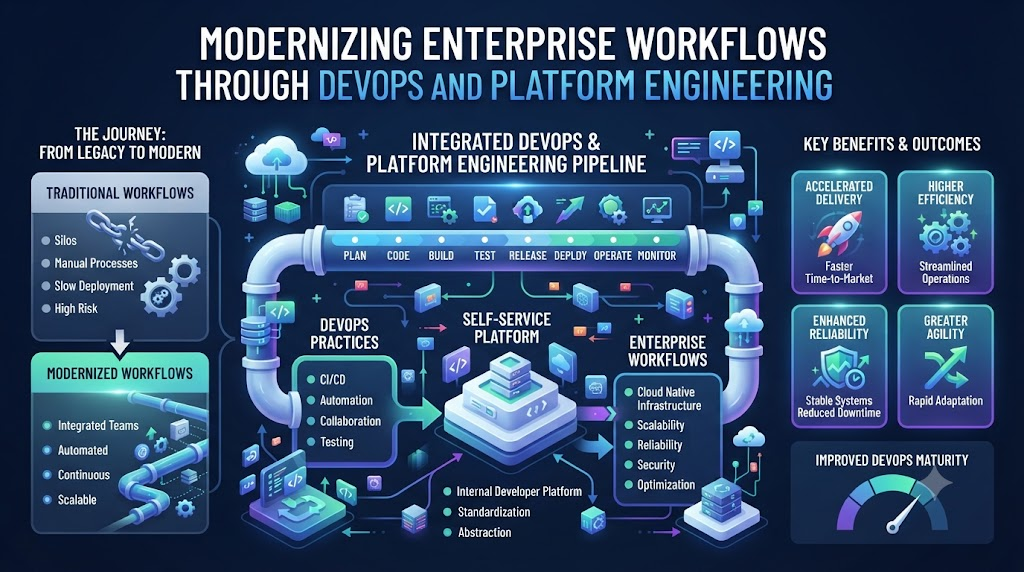
Platform engineering services focus on designing and building internal developer platforms (IDPs). These platforms act as a dedicated software layer sitting between an organization’s underlying cloud infrastructure and its application development teams.Rather than expecting developers to configure raw Kubernetes clusters, write complex Terraform scripts, or manage intricate CI/CD pipelines from scratch, platform engineering teams create self-service portals and golden paths. These workflows abstract away unnecessary complexity while enforcing security, compliance, and architectural standards automatically.At its core, platform engineering treats internal developers as customers. The primary objective is to build reliable, user-friendly tools that make it easy for developers to do their jobs efficiently. This approach combines elements of software development, cloud architecture, and site reliability engineering into a cohesive operational model. Organizations partnering with external experts for platform engineering services typically look to streamline their internal delivery workflows and improve developer productivity.
Why Platform Engineering Matters for Modern Organizations
As companies migrate to cloud-native architectures, microservices, and containerized environments, the sheer volume of tools and configurations can overwhelm engineering teams. Developers often find themselves spending a significant portion of their working hours managing infrastructure, troubleshooting build failures, and dealing with deployment scripts rather than writing application logic.This operational overhead slows down feature delivery and increases the risk of configuration drift and security misconfigurations. Platform engineering addresses these challenges by providing consistent, repeatable workflows.
When implemented effectively, platform engineering helps organizations achieve several important outcomes:
- Reduced Cognitive Load: Developers do not need to become experts in every underlying cloud service or infrastructure tool to deploy their code safely.
- Faster Time to Market: Self-service provisioning allows teams to spin up new environments in minutes rather than waiting days or weeks for manual approvals.
- Consistent Security and Compliance: Guardrails are baked directly into the platform templates, ensuring that every deployment adheres to organizational standards.
- Improved Developer Experience: Intuitive interfaces and streamlined workflows keep developers focused on building great products.
Core Components of an Internal Developer Platform
A robust internal developer platform typically consists of several integrated components designed to support the entire software delivery lifecycle.
Developer Portals
The developer portal serves as the single pane of glass for engineering teams. It provides a centralized interface where developers can discover available services, view documentation, trigger deployments, and monitor application health.
Self-Service Provisioning
Instead of filing tickets for infrastructure, developers use self-service templates to provision databases, staging environments, and microservices. These templates ensure resources are created according to approved organizational patterns.
CI/CD Integration
Platform engineering workflows integrate continuous integration and continuous delivery pipelines directly into the developer experience, automating testing, building, and deployment processes.
Automated Guardrails
Security policies, cost controls, and architectural best practices are embedded into the platform as automated checks, preventing non-compliant code from reaching production environments.
How Platform Engineering Complements DevOps and SRE
Organizations frequently confuse platform engineering with DevOps or Site Reliability Engineering (SRE). While these disciplines share common goals around speed and stability, they focus on different aspects of the engineering lifecycle.
- DevOps focuses primarily on cultural practices, collaboration, and automation to bridge the gap between software development and IT operations.
- SRE focuses on system reliability, service level objectives, error budgets, and incident management.
- Platform Engineering focuses on building scalable internal tooling and self-service platforms that make it easy for developers to practice DevOps and maintain reliability.
Rather than replacing DevOps or SRE, platform engineering acts as an enabler. It operationalizes DevOps principles by providing the tools and platforms that development teams use every day.
Implementation Considerations for Platform Engineering Services
Building an internal developer platform requires a product-minded approach. Organizations cannot simply purchase a tool and expect instant success; they must understand their developers’ daily workflows and pain points.
When planning an initiative involving platform engineering services, engineering leaders should evaluate several key areas:
- Developer Needs: Conduct interviews and surveys with internal development teams to identify their biggest bottlenecks and friction points.
- Incremental Adoption: Start small by building a minimum viable platform that solves one specific problem, such as environment provisioning, before expanding scope.
- Tool Selection: Choose technologies that integrate well with existing cloud providers, version control systems, and CI/CD pipelines.
- Cultural Alignment: Ensure that engineering leadership supports the initiative and views the internal platform as a strategic product rather than an IT project.
Common Challenges and Pitfalls
Organizations embarking on platform engineering initiatives often encounter predictable obstacles that can derail progress if not managed carefully.
Treating the Platform as an IT Project
Building an internal platform like a traditional top-down IT project often leads to low adoption rates. If developers find the platform cumbersome or restrictive, they will bypass it and create shadow infrastructure.
Overengineering Early
Trying to build a massive, all-encompassing platform on day one leads to delays and wasted effort. Successful platform teams start with focused solutions and iterate based on user feedback.
Neglecting Maintenance
An internal developer platform requires ongoing maintenance, updates, and support just like any customer-facing software product. Organizations must dedicate sufficient engineering resources to keep the platform running smoothly.
Practical Tips / Key Takeaways
- Treat your internal developers as customers and prioritize their workflow friction points.
- Start with a focused minimum viable platform before expanding capabilities.
- Incorporate security and compliance guardrails directly into platform templates.
- Measure platform adoption and developer satisfaction regularly.
- Combine platform engineering with proper corporate training to ensure team alignment.
10 FAQs
1.What are platform engineering services?
Platform engineering services help organizations design and build internal developer platforms that provide self-service infrastructure, automated workflows, and standardized tooling for software development teams.
2.How does platform engineering differ from DevOps?
While DevOps focuses on culture, collaboration, and delivery practices, platform engineering builds the actual internal platforms and self-service tools that enable developers to implement DevOps efficiently.
3.Why do organizations build internal developer platforms?
Internal developer platforms reduce cognitive load for developers, eliminate manual infrastructure bottlenecks, enforce security standards, and accelerate software delivery.
4.When should a company invest in platform engineering?
Organizations typically invest in platform engineering when their engineering teams scale to a point where manual infrastructure management and fragmented deployment processes begin to slow down feature delivery.
5.Do platform engineering services replace DevOps teams?
No, platform engineering services complement existing DevOps and SRE practices by providing the scalable tooling and automation required for modern cloud-native applications.
6.What is included in an internal developer portal?
An internal developer portal typically includes service catalogs, documentation, self-service provisioning templates, deployment dashboards, and monitoring integrations.
7.How do platform engineering services improve security?
Platform engineering embeds security policies, access controls, and compliance checks directly into infrastructure templates, ensuring secure deployments by default.
8.Can small startups benefit from platform engineering?
While enterprise organizations with large engineering teams benefit most from dedicated platforms, startups can adopt lightweight platform principles early to prevent future operational debt.
9.How does Cotocus.cn support platform engineering?
Cotocus.cn offers expert technology consulting, custom software development, cloud solutions, and corporate training to help organizations modernize their engineering practices.
10.What is the first step in implementing platform engineering?
The first step is conducting internal discovery to understand developer pain points, define product requirements, and design a focused minimum viable platform.
Conclusion
Scaling modern software development requires more than just adopting new tools; it requires removing operational friction so that engineering teams can focus on creating business value. By investing in strategic platform engineering services, organizations can build robust internal developer platforms that combine self-service provisioning, automated guardrails, and seamless workflows.Whether an organization is modernizing legacy systems or scaling cloud-native applications, establishing a solid platform engineering strategy paves the way for sustainable growth. Companies looking to accelerate their technical capabilities can partner with experienced teams like Cotocus.cn to design and implement tailored solutions that drive long-term engineering success.

Find Trusted Cardiac Hospitals
Compare heart hospitals by city and services — all in one place.
Explore Hospitals