Introduction
Embarking on a journey to build a family can bring a profound mix of hope, anticipation, and emotional reflection. For individuals and couples navigating fertility challenges, finding clear, reliable guidance is often the first and most crucial step. Whether facing unexplained infertility, medical conditions affecting reproductive health, or exploring family-building alternatives, understanding the medical landscape makes all the difference.To explore specialized fertility care options, readers often utilize resources like MyHospitalNow to research institutional capabilities and specialist services. Consider a hypothetical couple, Maya and Liam, who spent months feeling overwhelmed by conflicting online advice regarding fertility care. By learning the fundamental differences between treatments and understanding what specialized hospitals offer, they gained the confidence to schedule their first consultation with a reproductive endocrinologist.
Understanding IVF and Surrogacy
What Is IVF?
In vitro fertilization, commonly known as IVF, is a complex series of procedures used to help with fertility or prevent genetic problems and assist with the conception of a child. During IVF, mature eggs are collected from the ovaries and fertilized by sperm in a laboratory dish.The process involves several key biological phases. After successful fertilization, the resulting embryo or embryos are cultured in a specialized laboratory environment for a few days before one or more are transferred into the uterus. Pregnancy testing is subsequently performed to determine if the procedure was successful.
What Is Surrogacy?
Surrogacy is an arrangement in which another person carries and gives birth to a baby for intended parents. In modern reproductive medicine, gestational surrogacy is the most common form. Here, the surrogate carrier has no genetic relation to the child; instead, the embryo is created using eggs and sperm from the intended parents or donors via IVF.Fertility specialists play a central role in coordinating surrogacy cycles, managing embryo creation, and ensuring thorough medical screening of all parties. Legal, ethical, and psychological considerations are carefully evaluated to protect the well-being of the intended parents, the surrogate, and the future child.
IVF vs. Surrogacy
It is important to understand that IVF and surrogacy represent different aspects of family-building care. IVF is a medical treatment process designed to achieve fertilization outside the body and establish a pregnancy within the uterus.Gestational surrogacy, by contrast, is a care pathway where another person carries the pregnancy. IVF is frequently utilized as an essential component of a surrogacy journey to create the embryo that will be transferred to the gestational carrier.
Who May Consider IVF?
Fertility specialists may evaluate patients for IVF based on comprehensive diagnostic findings and reproductive histories. While every individual case is unique, common clinical indicators include:
- Tubal blockages or structural damage
- Ovulation disorders or diminished ovarian reserve
- Male-factor infertility, including low sperm count or motility
- Endometriosis affecting pelvic structures
- Unexplained infertility after initial treatments
- Previous unsuccessful fertility treatments, such as intrauterine insemination
- The need for fertility preservation prior to medical treatments
- Pre-implantation genetic testing requirements
Eligibility and appropriate treatment pathways are determined strictly through a personalized evaluation by a qualified fertility specialist.
Who May Consider Surrogacy?
Gestational surrogacy may be explored when carrying a pregnancy poses severe health risks or is medically unachievable. Situations evaluated by specialists often involve:
- Medical conditions that make pregnancy unsafe for the intended parent
- Absence, structural abnormalities, or severe conditions of the uterus
- Recurrent pregnancy loss or repeated unsuccessful IVF cycles related to uterine factors
- Certain individual or family-building circumstances where traditional pregnancy is not medically appropriate
Surrogacy is not automatically suitable for everyone and requires rigorous medical, psychological, and legal preparation.
IVF Treatment Process
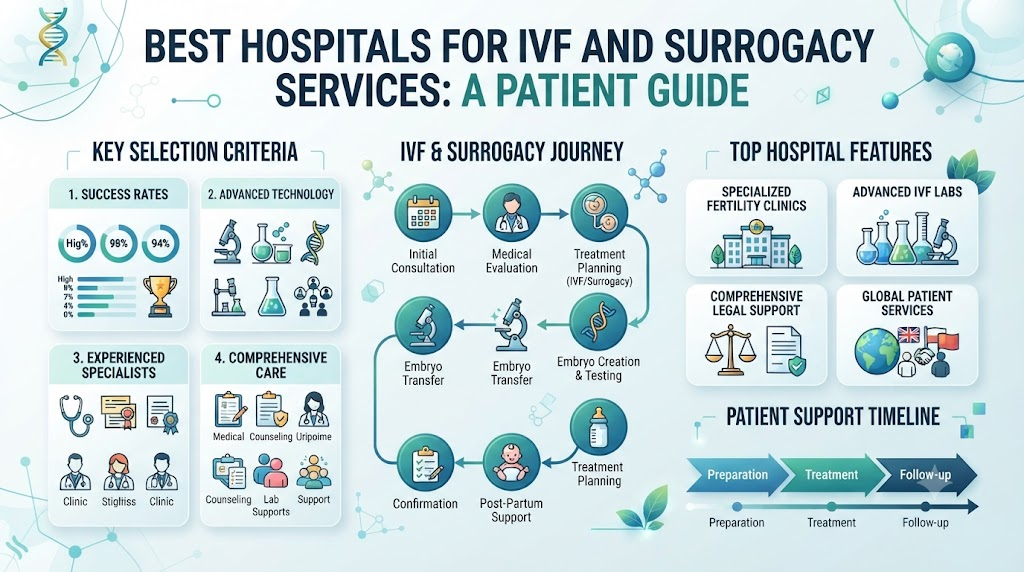
The typical IVF journey follows a structured medical protocol designed to optimize the chances of successful fertilization and embryo transfer.
Initial Fertility Consultation
The journey begins with a detailed review of medical, surgical, and reproductive histories. Specialists discuss previous treatments, lifestyle factors, and order initial diagnostic tests.
Ovarian Stimulation
Medications are administered to stimulate the ovaries, encouraging multiple follicles to develop mature eggs rather than the single egg typically released during a natural cycle.
Monitoring
Throughout stimulation, patients undergo regular transvaginal ultrasounds and blood hormone level monitoring so the medical team can track follicular growth and adjust medication doses safely.
Egg Retrieval
Once follicles reach maturity, a minor surgical procedure called egg retrieval is performed under sedation to collect the mature eggs from the ovaries.
Sperm Collection
A sperm sample is collected and prepared in the laboratory to isolate healthy, motile sperm for fertilization.
Fertilization
Sperm and eggs are combined in the laboratory using conventional insemination or Intracytoplasmic Sperm Injection, where a single sperm is injected directly into an egg.
Embryo Development
Embryologists monitor fertilized eggs over several days as they divide and develop into embryos, assessing quality and development stage.
Embryo Transfer
A selected embryo is gently placed into the uterus using a thin catheter. The specific timing and number of transferred embryos depend on individual clinical factors.
Pregnancy Testing
Blood tests are conducted approximately two weeks after embryo transfer to measure hormone levels and confirm whether pregnancy has been established.
Table 1: IVF Treatment Stages
| IVF Stage | Main Purpose | What Patients Can Generally Expect |
| Initial Consultation | Fertility Testing | Review of medical history, physical exams, and diagnostic blood work. |
| Ovarian Stimulation | Multiple Follicle Growth | Daily hormone injections to encourage egg maturation. |
| Monitoring | Tracking Response | Frequent ultrasound scans and blood tests to monitor follicle development. |
| Egg Retrieval | Collecting Mature Eggs | A short, sedated outpatient procedure to harvest eggs from the ovaries. |
| Fertilization | Combining Gametes | Laboratory combination of sperm and eggs via standard methods or ICSI. |
| Embryo Development | Monitoring Growth | Continuous laboratory observation of embryos over several days. |
| Embryo Transfer | Uterine Placement | A quick, non-surgical procedure placing an embryo into the uterine cavity. |
| Pregnancy Testing | Confirming Outcomes | Blood hormone testing scheduled about two weeks post-transfer. |
Individual IVF protocols differ significantly according to a patient’s medical history, ovarian response, age, specific fertility diagnosis, and the recommendations of the specialist team. No two treatment cycles are identical, and medical professionals tailor every step to suit physiological needs.
Types of Surrogacy
Gestational Surrogacy
In gestational surrogacy, the surrogate has no genetic link to the baby. Embryos created through IVF using the intended parents’ or donors’ genetic material are transferred to the surrogate’s uterus.
Traditional Surrogacy
Traditional surrogacy involves using the surrogate’s own eggs, meaning she is genetically related to the child. This approach involves complex emotional, legal, and ethical considerations, and is less commonly practiced in modern fertility centers.
Altruistic and Compensated Arrangements
Surrogacy arrangements can be structured differently depending on regional regulations. Altruistic surrogacy involves no financial compensation beyond medical and travel expenses, whereas compensated arrangements include agreed financial support. Laws governing these arrangements vary widely across jurisdictions.
How a Surrogacy Program Generally Works
Navigating a surrogacy program involves a coordinated sequence of medical, psychological, and administrative phases:
- Initial Consultation: Intended parents meet with fertility specialists and coordinators to outline their path.
- Medical Assessment: Comprehensive evaluations of intended parents and matching criteria.
- Surrogate Screening: Rigorous medical, psychological, and background evaluations for potential gestational carriers.
- Intended-Parent Evaluation: Counseling and medical preparations for embryo creation.
- Fertility Treatment & Embryo Creation: Performing IVF cycles to generate viable embryos.
- Embryo Transfer: Transferring the created embryo into the gestational carrier.
- Pregnancy Monitoring: Routine obstetric care and ongoing support throughout gestation.
- Delivery Planning: Establishing birth plans, legal parentage protocols, and hospital coordination.
- Post-Pregnancy Support: Ensuring smooth transitions and follow-up care for all involved parties.
Medical Screening for IVF and Surrogacy
Thorough medical screening protects the health of patients, gestational carriers, and future children. Standard evaluations include:
- Fertility Evaluation: Comprehensive assessments of pelvic anatomy and reproductive health.
- Ovarian Reserve Assessment: Blood tests and ultrasound counts to measure egg supply potential.
- Semen Evaluation: Laboratory analysis of sperm concentration, motility, and morphology.
- Infectious Disease Screening: Mandatory blood panels for transmissible conditions.
- Genetic Testing: Carrier screening or pre-implantation genetic testing when clinically indicated.
- Uterine Assessment: Hysteroscopy or imaging to ensure the uterine cavity is receptive.
- Surrogate Medical Evaluation: Extensive physical and psychological clearance for the gestational carrier.
- Psychological Support: Counseling sessions to prepare individuals and surrogates for the emotional aspects of the journey.
IVF and Surrogacy Risks and Limitations
IVF Considerations
While IVF helps many individuals build families, patients should be aware of potential considerations. Ovarian stimulation can occasionally lead to ovarian hyperstimulation syndrome. Multiple pregnancy risks exist if multiple embryos are transferred, though single embryo transfer is standard practice today. Procedures carry minor physical risks, and cycles can involve emotional stress and financial investment. Unsuccessful cycles are also a possibility that patients should discuss with their care team.
Surrogacy Considerations
Gestational surrogacy involves medical risks related to pregnancy for the carrier, complex legal frameworks, and significant financial responsibilities. Emotional dynamics require careful management, and clear communication between intended parents and the surrogate is essential throughout the process.
Table 2: Comparing IVF and Surrogacy Services
| Aspect | IVF Treatment | Surrogacy Services |
| Primary Purpose | To achieve fertilization and establish a uterine pregnancy | To enable pregnancy carriage through a gestational carrier |
| Who May Be Involved | Individuals or couples experiencing infertility or genetic conditions | Intended parents, gestational carrier, and medical coordinators |
| Role of Fertility Specialists | Managing stimulation, egg retrieval, fertilization, and transfer | Coordinating embryo creation, medical screening, and transfer |
| Pregnancy Carrier | The intended parent or patient (usually) | A designated gestational surrogate |
| Common Medical Steps | Ovarian stimulation, egg retrieval, fertilization, embryo transfer | Medical screening, IVF embryo creation, and carrier transfer |
| Screening Requirements | Hormonal, infectious, and reproductive diagnostic testing | Comprehensive physical, psychological, and legal screening for carriers |
| Legal Considerations | Consent forms and parental rights (typically straightforward) | Complex parentage orders, contracts, and jurisdiction laws |
| Emotional Considerations | Coping with treatment stress and outcome uncertainty | Managing surrogate relationships and emotional milestones |
| Follow-Up Care | Early pregnancy monitoring and obstetric transition | Post-transfer monitoring, delivery coordination, and support |
IVF and surrogacy should not be viewed as competing treatments. In many clinical scenarios, IVF serves as an essential foundation for creating embryos utilized within a surrogacy pathway.
Services Offered by Specialized Fertility Hospitals
Leading fertility hospitals provide comprehensive reproductive care tailored to diverse patient needs. Common services include:
- Initial fertility consultations and diagnostic evaluations
- Standard in vitro fertilization and ICSI procedures
- Advanced embryo culture and laboratory monitoring
- Embryo transfer and post-transfer support
- Fertility preservation, including egg and sperm freezing
- Donor egg, sperm, and embryo programs where legally permitted
- Pre-implantation genetic testing when medically appropriate
- Cryopreservation and secure long-term storage facilities
- Surrogacy coordination and multidisciplinary care management
- Professional psychological counseling and emotional support services
- Early pregnancy monitoring and endocrinology care
How to Choose the Best Hospital for IVF and Surrogacy
Selecting a fertility hospital is a significant decision. Patients can evaluate institutions using the following practical checklist:
- Specialist experience and board-certified reproductive endocrinologists
- Multidisciplinary reproductive medicine team collaboration
- Advanced embryology laboratory quality and air filtration standards
- Comprehensive diagnostic facilities on-site
- Secure cryopreservation and embryo storage capabilities
- Availability of genetic testing and specialized andrology services
- Established surrogacy coordination infrastructure
- Integrated psychological counseling and patient support groups
- Seamless access to maternal-fetal medicine and emergency care
- Transparent cost breakdowns and treatment packages
- Clear, empathetic communication from medical staff
- Thorough follow-up and transition care to obstetricians
- Compliance with ethical standards and regional regulations
- Strong reputation and documented experience with complex cases
The “best” hospital is ultimately the one that aligns with your specific medical needs, personal values, and diagnostic profile.
Cost Considerations
Financial planning is an essential part of fertility care. Expenses vary widely based on geographic location, hospital choice, specific treatment plans, and legal requirements. Key components often include:
- Initial consultations and specialist visits
- Diagnostic blood work and imaging studies
- Fertility medications required for stimulation
- Laboratory procedures, egg retrieval, and embryology fees
- Anesthesia and surgical center costs
- Embryo freezing and annual cryostorage maintenance
- Specialized genetic testing procedures
- Surrogacy agency fees, legal representation, and carrier compensation
- Pregnancy monitoring and delivery care
Patients are strongly encouraged to request a complete, transparent written cost breakdown from their chosen hospital before beginning treatment.
Emotional and Psychological Support
Fertility challenges and assisted reproduction can be emotionally demanding. Coping with uncertainty, hormonal shifts, treatment setbacks, and the unique dynamics of surrogacy requires strong support systems. Professional counseling helps individuals and couples process stress, strengthen relationship communication, and navigate decision-making with confidence. Support groups and compassionate medical teams ensure that patients never feel alone during their journey.
Real-Life Hypothetical Scenarios
Scenario 1: Couple Exploring IVF
A couple in their early thirties experiencing difficulty conceiving after a year visits a fertility specialist. Following comprehensive baseline testing, the physician explains ovulatory and sperm parameters, outlining how an initial IVF protocol could support their family-building goals without rushing into decisions.
Scenario 2: Previous Unsuccessful IVF Cycle
An individual who experienced an unsuccessful previous IVF cycle consults a new reproductive endocrinologist. The medical team reviews past laboratory reports, assesses embryo quality, and adjusts the stimulation protocol to optimize outcomes for a subsequent attempt.
Scenario 3: Considering Gestational Surrogacy
Intended parents with medical contraindications to pregnancy consult a fertility clinic. Specialists explain how gestational surrogacy works, detailing the necessary medical screening for a surrogate and how IVF-created embryos will be integrated into the surrogacy journey.
Scenario 4: Choosing a Fertility Hospital
A patient researches multiple fertility centers by comparing laboratory accreditations, specialist credentials, patient communication styles, and counseling availability, ultimately selecting a hospital that provides transparent and comprehensive care tailored to their situation.
Common Mistakes Patients Make
- Choosing a clinic based only on advertising: Prioritize clinical expertise and laboratory quality over marketing claims.
- Focusing only on success percentages: Understand that success rates depend heavily on individual patient age and diagnosis.
- Ignoring laboratory quality: Inquire about embryology lab standards, as advanced equipment heavily influences outcomes.
- Not asking about total cost: Request comprehensive, itemized financial estimates to avoid unexpected expenses.
- Starting treatment without understanding the process: Review every step with your specialist to feel prepared.
- Ignoring emotional support: Utilize counseling services to manage stress and anxiety effectively.
- Not reviewing medical records: Gather complete past health histories before your initial consultation.
- Assuming IVF guarantees pregnancy: Understand that success is variable and depends on unique biological factors.
- Treating online information as a diagnosis: Rely on professional medical evaluation rather than generalized internet searches.
- Ignoring legal considerations in surrogacy: Consult qualified legal professionals regarding regional surrogacy laws.
- Not asking about embryo storage policies: Clarify long-term storage agreements and annual maintenance fees.
- Skipping follow-up appointments: Attend all scheduled post-treatment monitoring sessions for optimal care.
Future of IVF and Reproductive Medicine
Reproductive medicine continues to evolve through technological advancements and scientific research. Innovations in embryology, time-lapse embryo imaging, and advanced genetic screening techniques aim to provide deeper insights into embryo health. Artificial intelligence tools are increasingly studied to assist embryologists in assessing embryo development parameters with greater consistency. Furthermore, improvements in cryopreservation techniques enhance egg and embryo survival rates, while personalized reproductive medicine allows specialists to tailor hormone protocols more precisely to individual patient profiles. These emerging developments reflect ongoing progress in maximizing safety and precision in fertility care.
FAQs
1.What is IVF?
In vitro fertilization is a medical procedure where mature eggs are collected from the ovaries and fertilized by sperm in a specialized laboratory dish. Once fertilization occurs and embryos develop, one or more are transferred into the uterus to establish a pregnancy. It is utilized for various causes of infertility, tubal factors, and genetic considerations.
2.What is surrogacy?
Surrogacy is an arrangement where another person carries and gives birth to a baby for intended parents. In gestational surrogacy, the surrogate is not genetically related to the child. Embryos are created using IVF with gametes from the intended parents or donors and then transferred to the gestational carrier’s uterus.
3.Who may consider IVF treatment?
Fertility specialists may evaluate individuals or couples for IVF based on diagnoses such as blocked fallopian tubes, ovulation disorders, male-factor infertility, endometriosis, unexplained infertility, or when genetic screening is required prior to pregnancy. Eligibility depends on personalized medical evaluations conducted by qualified professionals.
4.Is IVF suitable for everyone?
IVF is not universally suitable or required for every fertility challenge. Alternative treatments, such as lifestyle adjustments, ovulation induction, or intrauterine insemination, may be recommended depending on the underlying diagnosis. A thorough evaluation by a fertility specialist determines the most appropriate medical pathway.
5.How does the IVF process work?
The IVF process involves several distinct phases: an initial consultation and diagnostic evaluation, ovarian stimulation using hormone medications, follicular monitoring via ultrasounds and blood tests, egg retrieval, sperm collection, laboratory fertilization, embryo development, embryo transfer, and subsequent pregnancy testing.
6.What happens during egg retrieval?
Egg retrieval is a minor surgical procedure performed under sedation. A fertility specialist uses ultrasound guidance to pass a thin needle through the vaginal wall into the ovaries to collect mature eggs from the follicles. The procedure is typically brief, and patients rest briefly afterward before going home.
7.What is embryo transfer?
Embryo transfer is a quick, non-surgical procedure where a fertility specialist places a prepared embryo through a thin catheter directly into the uterine cavity. The timing of the transfer depends on whether embryos are transferred during a fresh cycle or after being thawed from cryopreservation.
8.What is gestational surrogacy?
Gestational surrogacy is a specialized arrangement where a gestational carrier carries a pregnancy resulting from an embryo created via IVF. The surrogate has no biological relationship to the child, distinguishing it from traditional surrogacy where the surrogate’s own eggs are utilized.
9.Is IVF always successful?
IVF does not guarantee pregnancy or live birth. Success rates vary significantly based on numerous factors, including patient age, ovarian reserve, underlying medical diagnosis, embryology laboratory quality, and individual treatment protocols. Specialists discuss realistic expectations during initial consultations.
10.What are the risks associated with IVF?
Potential risks of IVF include ovarian hyperstimulation syndrome resulting from hormone medications, multiple pregnancy risks if multiple embryos are transferred, minor procedure-related discomfort, emotional stress, and financial considerations. Modern clinical practices actively work to minimize these risks through careful monitoring and single embryo transfer protocols.
Final Thoughts
Navigating fertility challenges and exploring assisted reproductive technology requires thoughtful planning, patience, and expert medical guidance. Understanding the distinctions between IVF and surrogacy empowers individuals and couples to approach family-building decisions with clarity and confidence. Because every reproductive journey is unique, comprehensive evaluations by qualified fertility specialists are essential to determine the most appropriate treatment pathway.Advanced diagnostic tools, state-of-the-art embryology laboratories, and multidisciplinary medical teams play a vital role in delivering safe and effective care. Furthermore, acknowledging the emotional, financial, and legal dimensions of treatment ensures that patients are thoroughly prepared for each stage of their care. Transparent communication with healthcare providers helps address questions and align expectations before beginning any medical protocol.

Find Trusted Cardiac Hospitals
Compare heart hospitals by city and services — all in one place.
Explore Hospitals