Introduction
Enterprise Content Management (ECM) tools are not just about storing files—they are the digital backbone of how enterprises manage, govern, and activate content at scale. From contracts and records to emails, media, and business documents, ECM platforms bring everything into a structured, secure, and intelligent ecosystem.
In today’s enterprise landscape, content is everywhere—and without control, it becomes chaos. ECM systems solve this by enabling centralized content management, workflow automation, compliance enforcement, and enterprise-wide collaboration. Modern platforms go even further with AI-driven classification, content lifecycle management, and deep integrations, transforming content into a strategic business asset.
Common use cases include:
- Enterprise-wide document and content management
- Records management and regulatory compliance
- Workflow automation and approvals
- Digital transformation initiatives
- Secure collaboration across departments
What buyers should evaluate:
- Content organization and metadata capabilities
- Workflow automation and lifecycle management
- Security, access control, and governance
- Integration with enterprise systems (ERP, CRM)
- Scalability for large organizations
- Compliance and audit capabilities
- AI-driven search and classification
- Deployment flexibility (cloud, hybrid, on-prem)
- Performance at scale
- User experience and adoption
Best for: Large enterprises, government agencies, regulated industries, and organizations managing high volumes of structured and unstructured content.
Not ideal for: Small teams needing simple file storage or lightweight collaboration tools.
Key Trends in Enterprise Content Management (ECM)
- AI-powered content classification and tagging
- Automated content lifecycle and retention policies
- Cloud-native ECM replacing legacy on-prem systems
- Advanced compliance and governance features
- Integration with digital experience platforms
- Content analytics and insights
- Workflow automation at enterprise scale
- API-first and integration-driven architectures
- Mobile and remote content access
- Convergence of ECM with document management and collaboration tools
How We Selected These Tools (Methodology)
- Strong enterprise adoption and market presence
- Comprehensive ECM feature sets (content, workflows, governance)
- Proven scalability in large organizations
- Integration with enterprise ecosystems
- Security and compliance readiness
- Innovation in AI and automation
- Balance between usability and enterprise complexity
- Vendor support and ecosystem maturity
- Flexibility across deployment models
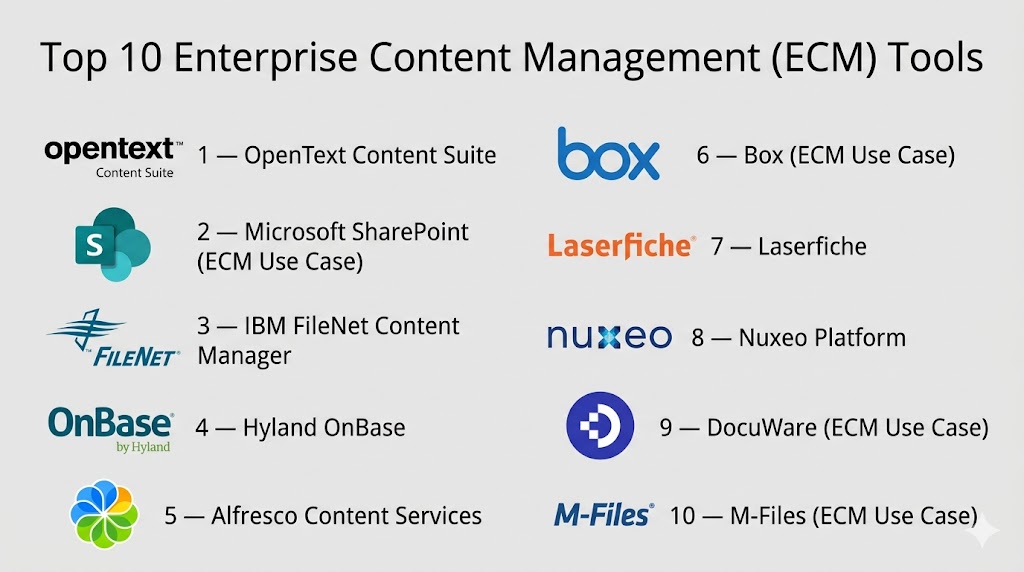
Top 10 Enterprise Content Management (ECM) Tools
#1 — OpenText Content Suite
Short description: A comprehensive ECM platform designed for large enterprises needing deep content governance and lifecycle management.
Key Features
- Enterprise content repository
- Workflow automation
- Records management
- Content lifecycle management
- AI-driven classification
- Compliance controls
- Integration framework
Pros
- Extremely powerful for enterprises
- Strong compliance capabilities
Cons
- Complex implementation
- High cost
Platforms / Deployment
Cloud / On-prem / Hybrid
Security & Compliance
Role-based access, audit trails (details not publicly stated)
Integrations & Ecosystem
- SAP
- Microsoft
- Enterprise systems
Support & Community
Strong enterprise support ecosystem.
#2 — Microsoft SharePoint (ECM Use Case)
Short description: A widely adopted platform that combines content management, collaboration, and enterprise integration.
Key Features
- Document libraries
- Version control
- Workflow automation
- Content search
- Permissions management
- Collaboration tools
Pros
- Deep Microsoft ecosystem integration
- Highly scalable
Cons
- Complex setup
- Requires governance planning
Platforms / Deployment
Cloud / On-prem
Security & Compliance
Enterprise-grade controls (details not publicly stated)
Integrations & Ecosystem
- Microsoft 365
- Teams
- OneDrive
Support & Community
Extensive enterprise adoption.
#3 — IBM FileNet Content Manager
Short description: A robust ECM solution focused on automation, governance, and large-scale content processing.
Key Features
- Content management
- Workflow automation
- Records management
- AI-powered processing
- Document capture
- Compliance tools
Pros
- Strong automation
- Enterprise-grade scalability
Cons
- Expensive
- Complex deployment
Platforms / Deployment
Cloud / On-prem
Security & Compliance
Not publicly stated
Integrations & Ecosystem
- IBM ecosystem
- Enterprise applications
Support & Community
Strong enterprise support.
#4 — Hyland OnBase
Short description: A unified ECM platform designed for workflow automation and content-driven processes.
Key Features
- Document management
- Workflow automation
- Records management
- Integration tools
- Content capture
- Analytics
Pros
- Strong process automation
- Flexible deployment
Cons
- Learning curve
- Cost considerations
Platforms / Deployment
Cloud / On-prem
Security & Compliance
Not publicly stated
Integrations & Ecosystem
- ERP systems
- CRM tools
Support & Community
Well-established enterprise presence.
#5 — Alfresco Content Services
Short description: An open and flexible ECM platform built for customization and integration-heavy environments.
Key Features
- Open-source core
- Content repository
- Workflow automation
- Records management
- API-first architecture
- Integration capabilities
Pros
- Highly customizable
- Strong developer ecosystem
Cons
- Requires technical expertise
- Setup complexity
Platforms / Deployment
Cloud / On-prem / Hybrid
Security & Compliance
Not publicly stated
Integrations & Ecosystem
- APIs
- Enterprise systems
Support & Community
Active developer community.
#6 — Box (ECM Use Case)
Short description: A cloud content management platform focused on secure collaboration and governance.
Key Features
- Secure content storage
- Workflow automation
- Collaboration tools
- Content governance
- API integrations
- Version control
Pros
- Strong security features
- Easy collaboration
Cons
- Expensive for enterprises
- Limited deep customization
Platforms / Deployment
Cloud
Security & Compliance
Encryption, MFA, access controls (details not publicly stated)
Integrations & Ecosystem
- Salesforce
- Microsoft
- Google Workspace
Support & Community
Strong enterprise support.
#7 — Laserfiche
Short description: An ECM platform focused on compliance, automation, and digital transformation initiatives.
Key Features
- Workflow automation
- Records management
- Document indexing
- Analytics
- Secure storage
- Integration tools
Pros
- Strong compliance support
- Scalable solution
Cons
- Complex setup
- Higher cost
Platforms / Deployment
Cloud / On-prem
Security & Compliance
Not publicly stated
Integrations & Ecosystem
- Business systems
- ERP tools
Support & Community
Enterprise-focused support.
#8 — Nuxeo Platform
Short description: A modern ECM platform built for content services, scalability, and digital asset management.
Key Features
- Content repository
- Workflow automation
- Digital asset management
- API-first architecture
- AI capabilities
- Scalability
Pros
- Highly scalable
- Developer-friendly
Cons
- Requires technical expertise
- Smaller ecosystem
Platforms / Deployment
Cloud / Hybrid
Security & Compliance
Not publicly stated
Integrations & Ecosystem
- APIs
- Enterprise systems
Support & Community
Growing adoption.
#9 — DocuWare (ECM Use Case)
Short description: A cloud-based platform combining document management and ECM capabilities.
Key Features
- Document capture
- Workflow automation
- Secure storage
- Version control
- Audit trails
- Mobile access
Pros
- Easy automation
- Scalable
Cons
- Pricing not transparent
- Limited customization
Platforms / Deployment
Cloud / Hybrid
Security & Compliance
Not publicly stated
Integrations & Ecosystem
- ERP
- CRM
- Office tools
Support & Community
Strong enterprise adoption.
#10 — M-Files (ECM Use Case)
Short description: A metadata-driven ECM platform focused on intelligent content organization and automation.
Key Features
- Metadata-based organization
- AI-powered search
- Workflow automation
- Compliance management
- Version control
- Integration capabilities
Pros
- Intelligent document handling
- Strong automation
Cons
- Complex setup
- Premium pricing
Platforms / Deployment
Cloud / On-prem / Hybrid
Security & Compliance
Not publicly stated
Integrations & Ecosystem
- Microsoft
- CRM tools
- Enterprise systems
Support & Community
Strong enterprise support.
Comparison Table (Top 10)
| Tool Name | Best For | Platform(s) Supported | Deployment | Standout Feature | Public Rating |
|---|---|---|---|---|---|
| OpenText | Enterprise | Multi-platform | Hybrid | Lifecycle management | N/A |
| SharePoint | Enterprise | Multi-platform | Hybrid | Microsoft ecosystem | N/A |
| IBM FileNet | Large enterprises | Multi-platform | Hybrid | Automation | N/A |
| OnBase | Workflow automation | Multi-platform | Hybrid | Process management | N/A |
| Alfresco | Customization | Multi-platform | Hybrid | Open-source | N/A |
| Box | Collaboration | Web | Cloud | Security | N/A |
| Laserfiche | Compliance | Multi-platform | Hybrid | Records management | N/A |
| Nuxeo | Scalability | Multi-platform | Hybrid | API-first | N/A |
| DocuWare | SMB/Enterprise | Web | Cloud | Automation | N/A |
| M-Files | Intelligent ECM | Multi-platform | Hybrid | Metadata system | N/A |
Evaluation & Scoring of Enterprise Content Management (ECM)
| Tool Name | Core | Ease | Integrations | Security | Performance | Support | Value | Weighted Total |
|---|---|---|---|---|---|---|---|---|
| OpenText | 10 | 6 | 9 | 9 | 9 | 9 | 7 | 8.6 |
| SharePoint | 10 | 7 | 10 | 9 | 9 | 9 | 7 | 8.9 |
| IBM FileNet | 10 | 6 | 9 | 9 | 9 | 9 | 6 | 8.5 |
| OnBase | 9 | 7 | 8 | 8 | 9 | 8 | 7 | 8.1 |
| Alfresco | 9 | 6 | 9 | 8 | 8 | 8 | 8 | 8.2 |
| Box | 8 | 8 | 9 | 9 | 8 | 8 | 7 | 8.1 |
| Laserfiche | 9 | 7 | 8 | 9 | 9 | 8 | 7 | 8.3 |
| Nuxeo | 9 | 6 | 9 | 8 | 9 | 7 | 7 | 8.0 |
| DocuWare | 9 | 8 | 8 | 8 | 8 | 8 | 8 | 8.2 |
| M-Files | 9 | 7 | 9 | 9 | 9 | 9 | 7 | 8.5 |
How to interpret scores:
These scores are comparative indicators of platform strengths across enterprise requirements. Higher scores reflect broader capabilities, but the best ECM depends on your organization’s complexity, compliance needs, and integration landscape.
Which Enterprise Content Management Tool Is Right for You?
Solo / Freelancer
ECM is usually overkill—consider simpler document tools.
SMB
DocuWare or Box provide manageable ECM capabilities.
Mid-Market
M-Files and Alfresco offer flexibility and scalability.
Enterprise
SharePoint, OpenText, and IBM FileNet dominate with full-scale capabilities.
Budget vs Premium
Alfresco offers flexibility; OpenText delivers enterprise depth.
Feature Depth vs Ease of Use
OpenText offers depth; Box offers usability.
Integrations & Scalability
SharePoint leads with unmatched ecosystem integration.
Security & Compliance Needs
Laserfiche and IBM FileNet excel in regulated environments.
Frequently Asked Questions (FAQs)
1. What is ECM?
A system for managing enterprise content across its lifecycle.
2. How is ECM different from DMS?
ECM includes broader content governance and workflows.
3. Why is ECM important?
It improves efficiency, compliance, and scalability.
4. Is ECM cloud-based?
Modern ECM systems are often cloud-first.
5. What industries use ECM?
Finance, healthcare, government, and more.
6. Does ECM include automation?
Yes, workflow automation is a core feature.
7. Is ECM scalable?
Yes, designed for enterprise-level growth.
8. Are ECM tools secure?
Yes, with advanced security controls.
9. Can ECM integrate with other systems?
Yes, with ERP, CRM, and business tools.
10. How do I choose an ECM tool?
Focus on scale, compliance, and integrations.
Conclusion
Enterprise Content Management platforms are no longer optional—they are critical infrastructure for managing content at scale. They bring order, automation, and governance to complex information ecosystems, helping organizations operate faster and smarter. Whether you choose a flexible platform like Alfresco or a powerful enterprise solution like OpenText or SharePoint, the right ECM can transform how your business handles information. The best approach is to shortlist a few tools, test them in real workflows, and choose the one that aligns with your scale, compliance, and long-term strategy.

Find Trusted Cardiac Hospitals
Compare heart hospitals by city and services — all in one place.
Explore Hospitals
This explains how ECM tools help manage and organize all business content in one central system.