Introduction
Customer Data Platforms (CDPs) are centralized software systems designed to collect, unify, and manage customer data from multiple sources into a single, persistent profile. By aggregating data across web, mobile, CRM, marketing, and transactional systems, CDPs enable organizations to gain a complete understanding of their customers and deliver highly personalized experiences.
In the 2026+ landscape, CDPs are more critical than ever due to the increasing demand for hyper-personalization, AI-driven marketing, and privacy-compliant data handling. Modern organizations leverage CDPs to streamline marketing automation, improve customer engagement, and optimize cross-channel interactions in real time.
Real-world use cases include:
- Retailers combining in-store and online shopping behavior to tailor promotions.
- SaaS companies integrating user behavior with CRM data for personalized onboarding.
- Financial services tracking multi-channel interactions to prevent churn.
- Media and entertainment platforms recommending content based on consumption patterns.
- Travel and hospitality aggregating booking and engagement data to improve loyalty programs.
Key evaluation criteria buyers should consider:
- Data unification and identity resolution
- Real-time analytics and segmentation
- AI/ML-powered insights and predictions
- Integration flexibility with CRMs, marketing, and analytics tools
- Compliance with privacy laws (GDPR, CCPA)
- Scalability and performance under high-volume data
- Ease of use for marketing and analytics teams
- Deployment options and operational flexibility
- Customer support and training resources
- Pricing and total cost of ownership
Best for: Marketing teams, CRM managers, data analysts, and mid-to-large enterprises seeking advanced personalization and customer insights.
Not ideal for: Small businesses with limited data or simple marketing workflows, where simpler analytics or CRM solutions suffice.
Key Trends in Customer Data Platforms (CDP)
- AI-powered predictive analytics for customer behavior and churn prevention.
- Real-time data ingestion and segmentation for hyper-personalization.
- Privacy-first architecture ensuring GDPR, CCPA, and other compliance adherence.
- Integration with CDPs, CRMs, marketing automation, and analytics ecosystems.
- Low-code and no-code interfaces to empower marketers without heavy IT involvement.
- Cloud-native, multi-tenant solutions with high scalability.
- Automated identity resolution and unification of cross-device profiles.
- Event-driven and API-first architectures for flexible data activation.
- Subscription and consumption-based pricing models for better cost alignment.
- Increasing adoption of hybrid deployment models combining cloud and on-premise sources.
How We Selected These Tools (Methodology)
- Evaluation of market adoption and brand awareness across industries.
- Assessment of feature completeness including data unification, segmentation, and activation.
- Performance reliability signals from real-world usage scenarios.
- Security posture, including encryption, access control, and compliance certifications.
- Ecosystem integrations and extensibility via APIs and connectors.
- Fit for different customer segments, including SMB, mid-market, and enterprise.
- User interface and ease-of-use for marketing and analytics teams.
- Support and onboarding infrastructure.
- Analytics, reporting, and AI/ML capability evaluation.
- Scalability and handling of large-scale customer data.
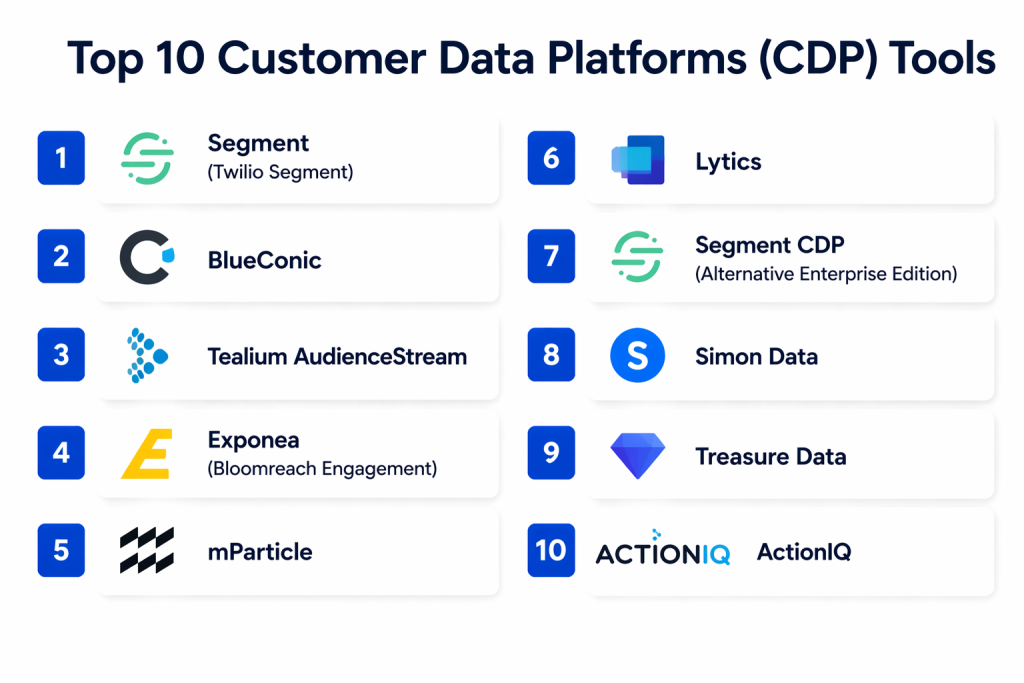
Top 10 Customer Data Platforms (CDP) Tools
#1 — Segment (Twilio Segment)
Short description (2–3 lines): A leading CDP that aggregates customer data across platforms for real-time activation. Designed for enterprises and developers seeking scalable, API-driven solutions.
Key Features
- Unified customer profiles across web, mobile, and CRM
- Event tracking and real-time analytics
- API-first architecture for integrations
- Data enrichment and identity resolution
- Audience segmentation for personalization
- Multi-channel activation
- AI-powered insights
Pros
- Developer-friendly with robust APIs
- Real-time customer data processing
- Broad integrations across marketing and analytics platforms
Cons
- Can be complex for non-technical users
- Enterprise pricing may be high
Platforms / Deployment
- Web, iOS, Android
- Cloud
Security & Compliance
- SSO/SAML, encryption, RBAC
- SOC 2, GDPR, CCPA
Integrations & Ecosystem
Integrates extensively with marketing, analytics, and CRM tools.
- Salesforce, HubSpot, Marketo
- Google Analytics, Mixpanel, Amplitude
- REST API for custom integrations
Support & Community
- Enterprise support tiers available
- Documentation, onboarding guides, active developer community
#2 — BlueConic
Short description (2–3 lines): A flexible CDP aimed at marketers, focusing on real-time customer segmentation and personalization across channels.
Key Features
- Real-time unified customer profiles
- Behavior-based segmentation
- Marketing campaign orchestration
- Data unification from multiple sources
- Cross-channel personalization
- Consent management and privacy compliance
Pros
- Marketer-friendly interface
- Real-time segmentation
- Flexible campaign management
Cons
- Limited AI prediction capabilities
- Smaller ecosystem compared to enterprise alternatives
Platforms / Deployment
- Web
- Cloud
Security & Compliance
- Not publicly stated
Integrations & Ecosystem
- Integrates with marketing automation and email platforms
- APIs for custom solutions
Support & Community
- Documentation and email support
- Limited community forums
#3 — Tealium AudienceStream
Short description (2–3 lines): An enterprise CDP focusing on real-time customer data unification and omnichannel activation.
Key Features
- Real-time identity resolution
- Event-driven data collection
- Audience segmentation and targeting
- AI-driven insights
- Integration with analytics and marketing platforms
- Consent and privacy management
Pros
- Strong enterprise features
- Comprehensive identity resolution
- Omnichannel activation capabilities
Cons
- Higher complexity and cost
- Steep learning curve for non-technical users
Platforms / Deployment
- Web
- Cloud / Hybrid
Security & Compliance
- SSO/SAML, encryption, RBAC
- SOC 2, GDPR
Integrations & Ecosystem
- CRM, marketing automation, analytics connectors
- APIs for data activation
Support & Community
- Enterprise support tiers
- Documentation and training resources
#4 — Exponea (Bloomreach Engagement)
Short description (2–3 lines): CDP focused on e-commerce and marketing automation, delivering unified profiles and AI-driven recommendations.
Key Features
- Customer profile unification
- Behavioral segmentation
- Multi-channel campaigns
- AI-powered recommendations
- Analytics dashboards
- Automated workflows
Pros
- Strong e-commerce focus
- Integrated marketing automation
- Real-time personalization
Cons
- Limited adoption outside retail
- Complex setup for small teams
Platforms / Deployment
- Web
- Cloud
Security & Compliance
- Not publicly stated
Integrations & Ecosystem
- E-commerce platforms and email marketing tools
- APIs for custom workflows
Support & Community
- Documentation and onboarding guides
- Email and enterprise support
#5 — mParticle
Short description (2–3 lines): API-first CDP designed for real-time data unification and audience activation across mobile, web, and connected devices.
Key Features
- Customer identity resolution
- Data ingestion from multiple sources
- Real-time audience segmentation
- Multi-channel campaign activation
- Event-driven architecture
- Consent management
Pros
- Real-time data processing
- Strong developer support
- Flexible API integrations
Cons
- Primarily developer-focused
- Limited pre-built marketing automation
Platforms / Deployment
- Web, iOS, Android
- Cloud
Security & Compliance
- SSO, encryption
- GDPR, SOC 2
Integrations & Ecosystem
- Marketing, CRM, analytics systems
- REST APIs, SDKs for custom apps
Support & Community
- Documentation and onboarding
- Email support, developer community
#6 — Lytics
Short description (2–3 lines): CDP for marketers focusing on AI-driven segmentation and personalization based on customer behavior.
Key Features
- AI-powered audience segmentation
- Customer behavior tracking
- Campaign orchestration
- Multi-channel activation
- Predictive analytics
Pros
- Easy-to-use interface for marketers
- AI-based insights improve engagement
- Integrates well with marketing platforms
Cons
- Less suitable for complex enterprise needs
- Limited deployment flexibility
Platforms / Deployment
- Web
- Cloud
Security & Compliance
- Not publicly stated
Integrations & Ecosystem
- Email, CRM, and marketing tools
- APIs for custom integration
Support & Community
- Documentation, email support
- Customer success teams available
#7 — Segment CDP (Alternative Enterprise Edition)
Short description (2–3 lines): Enterprise-grade CDP with enhanced compliance and analytics capabilities, suitable for large-scale deployments.
Key Features
- Advanced identity resolution
- Data governance and privacy management
- AI insights and predictions
- Multi-channel data activation
- Integration with analytics and CRM
Pros
- Enterprise-focused features
- Strong compliance controls
- Real-time data unification
Cons
- Complexity and cost for smaller organizations
- Requires technical setup
Platforms / Deployment
- Web, iOS, Android
- Cloud
Security & Compliance
- SOC 2, GDPR, ISO 27001
Integrations & Ecosystem
- Marketing automation, analytics, CRMs
- APIs and SDKs
Support & Community
- Enterprise support and onboarding
- Documentation and professional services
#8 — Simon Data
Short description (2–3 lines): Data-driven CDP focusing on unified profiles and cross-channel marketing activation.
Key Features
- Unified customer profiles
- Segmentation and behavioral insights
- Campaign orchestration
- Predictive analytics
- Multi-channel activation
Pros
- Marketing-oriented features
- Strong analytics and reporting
- Supports omnichannel campaigns
Cons
- May require integration work for smaller teams
- Cost considerations for SMBs
Platforms / Deployment
- Web
- Cloud
Security & Compliance
- Not publicly stated
Integrations & Ecosystem
- Email, CRM, and analytics platforms
- APIs for custom campaigns
Support & Community
- Documentation and onboarding
- Email and enterprise support
#9 — Treasure Data
Short description (2–3 lines): Enterprise CDP focused on big data unification and AI-driven analytics.
Key Features
- Data integration from multiple sources
- Customer identity resolution
- AI-driven insights and predictions
- Real-time segmentation
- Campaign activation
Pros
- Strong data engineering capabilities
- Scalable for large datasets
- Real-time insights
Cons
- Steeper learning curve
- Less marketer-friendly UI
Platforms / Deployment
- Web
- Cloud
Security & Compliance
- SOC 2, GDPR
Integrations & Ecosystem
- CRM, analytics, marketing systems
- APIs for custom integration
Support & Community
- Enterprise support
- Documentation and training
#10 — ActionIQ
Short description (2–3 lines): CDP for enterprise marketers to unify customer data and drive personalization at scale.
Key Features
- Identity resolution
- Behavioral and predictive segmentation
- Campaign orchestration
- AI-driven insights
- Multi-channel activation
Pros
- Enterprise-ready
- Strong personalization capabilities
- Scalable for high-volume operations
Cons
- Expensive for smaller businesses
- Implementation complexity
Platforms / Deployment
- Web
- Cloud
Security & Compliance
- Not publicly stated
Integrations & Ecosystem
- CRM, marketing, analytics integrations
- APIs for custom workflows
Support & Community
- Enterprise support
- Documentation and onboarding resources
Comparison Table (Top 10)
| Tool Name | Best For | Platform(s) Supported | Deployment | Standout Feature | Public Rating |
|---|---|---|---|---|---|
| Segment | Developer-heavy enterprises | Web, iOS, Android | Cloud | Real-time data unification | N/A |
| BlueConic | Marketing teams | Web | Cloud | Marketer-friendly segmentation | N/A |
| Tealium | Enterprise | Web | Cloud/Hybrid | Identity resolution & activation | N/A |
| Exponea | E-commerce | Web | Cloud | AI-powered personalization | N/A |
| mParticle | Mobile & web apps | Web, iOS, Android | Cloud | API-first data unification | N/A |
| Lytics | Marketing-focused teams | Web | Cloud | AI-driven segmentation | N/A |
| Segment Enterprise | Large-scale enterprises | Web, iOS, Android | Cloud | Compliance & analytics | N/A |
| Simon Data | Omnichannel marketing | Web | Cloud | Predictive analytics | N/A |
| Treasure Data | Data-heavy enterprises | Web | Cloud | Big data unification | N/A |
| ActionIQ | Enterprise marketers | Web | Cloud | AI-driven personalization | N/A |
Evaluation & Scoring of Customer Data Platforms (CDP)
| Tool Name | Core (25%) | Ease (15%) | Integrations (15%) | Security (10%) | Performance (10%) | Support (10%) | Value (15%) | Weighted Total (0–10) |
|---|---|---|---|---|---|---|---|---|
| Segment | 9 | 8 | 9 | 9 | 9 | 8 | 7 | 8.5 |
| BlueConic | 8 | 9 | 7 | 7 | 8 | 8 | 8 | 8.0 |
| Tealium | 9 | 7 | 8 | 9 | 9 | 8 | 6 | 8.2 |
| Exponea | 8 | 8 | 7 | 7 | 8 | 7 | 7 | 7.7 |
| mParticle | 8 | 8 | 8 | 8 | 9 | 7 | 8 | 8.1 |
| Lytics | 7 | 9 | 7 | 7 | 8 | 7 | 7 | 7.5 |
| Segment Enterprise | 9 | 7 | 9 | 9 | 9 | 8 | 6 | 8.3 |
| Simon Data | 8 | 8 | 7 | 7 | 8 | 7 | 7 | 7.6 |
| Treasure Data | 9 | 7 | 8 | 9 | 9 | 7 | 6 | 8.0 |
| ActionIQ | 9 | 7 | 8 | 8 | 9 | 8 | 6 | 8.0 |
Interpretation: The weighted scores highlight relative strengths across core features, integrations, security, and usability. Higher scores indicate better overall capabilities, though specific organizational needs (marketing vs. developer focus, SMB vs. enterprise) will guide selection.
Which Customer Data Platforms (CDP) Tool Is Right for You?
Solo / Freelancer
- Lightweight CDPs like Lytics or BlueConic offer sufficient segmentation and personalization for small-scale projects.
SMB
- mParticle and Exponea provide cost-effective, easy-to-use solutions with prebuilt marketing integrations.
Mid-Market
- Segment or Simon Data deliver advanced identity resolution and campaign orchestration for growing teams.
Enterprise
- Segment Enterprise, Tealium, Treasure Data, and ActionIQ offer scalable, compliant, and feature-rich CDPs for complex deployments.
Budget vs Premium
- Smaller budgets benefit from BlueConic or Lytics; premium enterprise platforms deliver extensive AI, real-time capabilities, and compliance features.
Feature Depth vs Ease of Use
- Enterprise platforms offer depth but require onboarding; marketer-focused tools provide usability at the expense of some advanced functionality.
Integrations & Scalability
- Choose CDPs that support multi-channel integrations, API access, and can scale as customer and data volume grows.
Security & Compliance Needs
- Evaluate SOC 2, ISO 27001, GDPR, and CCPA support, especially when handling sensitive customer data.
Frequently Asked Questions (FAQs)
1. What pricing models do CDPs use?
Most CDPs operate on subscription or consumption-based pricing, often tiered by data volume or user events.
2. How long does implementation take?
Implementation can range from a few weeks for simple setups to several months for enterprise deployments.
3. Can CDPs handle high-volume data?
Yes, enterprise CDPs like Treasure Data or Segment Enterprise are designed for large-scale, real-time data processing.
4. How is customer data unified?
CDPs use identity resolution, matching customer data across multiple devices and channels to build a single profile.
5. Are AI features standard?
Not all CDPs include AI; some provide predictive analytics, segmentation, and personalization models.
6. Do these platforms support privacy compliance?
Leading CDPs include GDPR, CCPA, and SOC 2 compliance features; others require additional configuration.
7. Can CDPs integrate with existing marketing tools?
Yes, most support CRMs, marketing automation platforms, analytics, and custom API connections.
8. How real-time is the data?
Top CDPs process data in near real-time, allowing for immediate personalization and campaign adjustments.
9. Is training required?
Enterprise platforms often require onboarding and training, while SMB-oriented CDPs focus on usability.
10. Can I switch CDPs easily?
Migration is possible but may require exporting historical data, reconfiguring integrations, and retraining AI models.
Conclusion
Customer Data Platforms (CDPs) are essential for businesses aiming to consolidate customer data, drive personalization, and optimize cross-channel engagement. Enterprise platforms like Segment Enterprise, Tealium, and ActionIQ offer comprehensive solutions, while tools like Lytics and BlueConic serve SMB and marketer-focused needs. Selecting the right CDP depends on scale, technical expertise, budget, and required integrations. Organizations should shortlist 2–3 candidates, test real-world use cases, and ensure compliance and scalability before committing to a full deployment.

Find Trusted Cardiac Hospitals
Compare heart hospitals by city and services — all in one place.
Explore Hospitals
This explains how CDP tools help bring all customer data from different systems into one unified view.