Introduction
Marketing Automation Platforms (MAPs) are software solutions that streamline, automate, and optimize marketing processes across channels. They allow businesses to create campaigns, manage leads, segment audiences, track engagement, and deliver personalized messaging without manual intervention. By centralizing marketing activities, these platforms help organizations improve efficiency, consistency, and ROI.
In 2026+, Marketing Automation Platforms are crucial due to rising consumer expectations for personalized interactions, multi-channel engagement, and AI-driven insights. Organizations now require real-time analytics, AI-powered personalization, and seamless integration with CRMs and CDPs to maintain competitive marketing strategies.
Real-world use cases include:
- Lead nurturing and automated email campaigns for B2B SaaS companies.
- Cross-channel marketing campaigns including email, SMS, social, and push notifications.
- Audience segmentation and targeting for e-commerce personalization.
- Automated customer journey mapping and behavioral triggers.
- Campaign analytics and performance optimization.
Key evaluation criteria buyers should consider:
- Multi-channel campaign support (email, SMS, social, push)
- AI-driven personalization and predictive analytics
- Lead scoring and CRM integration
- Workflow automation and triggers
- Real-time analytics and reporting
- User experience and ease of use
- Compliance and data privacy (GDPR, CCPA)
- Scalability and performance
- Pricing and ROI
- Customer support and training resources
Best for: Marketing teams, CRM managers, demand generation teams, and enterprises seeking scalable, data-driven campaign automation.
Not ideal for: Organizations with minimal marketing needs, very small teams, or those that rely primarily on manual marketing processes.
Key Trends in Marketing Automation Platforms
- AI-powered personalization and predictive analytics for lead scoring and engagement.
- Integration with Customer Data Platforms (CDPs) for unified customer insights.
- Omnichannel automation including email, SMS, social media, push notifications, and chat.
- Real-time performance monitoring and campaign optimization.
- Privacy-first approaches aligned with GDPR, CCPA, and other regulations.
- Low-code and no-code workflow builders for rapid campaign creation.
- Cloud-native and API-first platforms for scalability and interoperability.
- Event-driven automation triggered by user behavior.
- Subscription and consumption-based pricing models.
- Increased focus on cross-team collaboration between marketing, sales, and customer success.
How We Selected These Tools (Methodology)
- Evaluation of market adoption and brand recognition.
- Assessment of core marketing automation features and capabilities.
- Performance and reliability in real-world marketing operations.
- Security posture and compliance adherence.
- Integration capabilities with CRM, analytics, and CDPs.
- Fit across SMB, mid-market, and enterprise segments.
- Ease-of-use and adoption by marketing teams.
- Analytics, reporting, and AI/ML functionality.
- Scalability to support multi-channel campaigns and large datasets.
- Support, onboarding, and community strength.
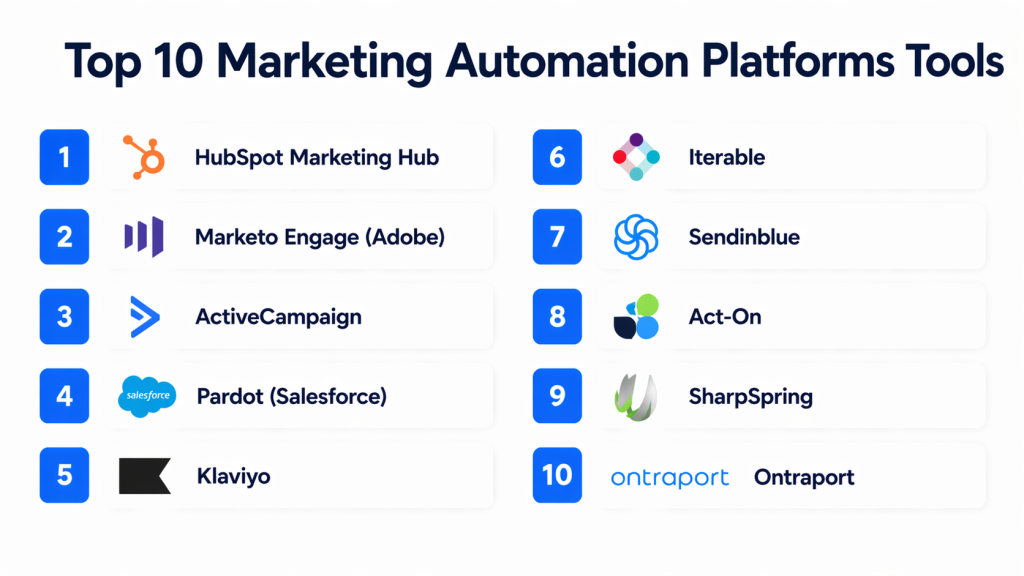
Top 10 Marketing Automation Platforms Tools
#1 — HubSpot Marketing Hub
Short description (2–3 lines): All-in-one marketing platform for inbound marketing, lead management, and automation. Ideal for SMBs to enterprise marketing teams.
Key Features
- Email marketing and automation workflows
- CRM integration and lead scoring
- Landing page and form builder
- Multi-channel campaign orchestration
- Analytics and reporting dashboards
- Social media management
- AI-powered content and personalization
Pros
- Easy-to-use interface for marketers
- Strong CRM integration
- Comprehensive inbound marketing features
Cons
- Premium features can be costly
- Some advanced reporting requires higher-tier plans
Platforms / Deployment
- Web, iOS, Android
- Cloud
Security & Compliance
- SSO, encryption, RBAC
- SOC 2, GDPR
Integrations & Ecosystem
- Integrates with CRMs, social platforms, analytics, and e-commerce systems
- HubSpot Marketplace apps
- REST APIs for custom integrations
Support & Community
- Extensive documentation and onboarding resources
- HubSpot Academy and active community
#2 — Marketo Engage (Adobe)
Short description (2–3 lines): Enterprise-grade marketing automation platform focused on B2B marketing and lead management.
Key Features
- Lead nurturing and scoring
- Email and campaign automation
- Predictive analytics and AI recommendations
- CRM integration (Salesforce, Microsoft Dynamics)
- Multi-channel campaign orchestration
- ROI and performance reporting
Pros
- Strong enterprise B2B capabilities
- Deep CRM integration
- Advanced analytics and reporting
Cons
- Steep learning curve
- Expensive for small businesses
Platforms / Deployment
- Web
- Cloud
Security & Compliance
- SOC 2, GDPR
Integrations & Ecosystem
- Salesforce, Microsoft Dynamics, SAP
- API for custom integrations
- Adobe Experience Cloud apps
Support & Community
- Enterprise support tiers
- Documentation and training resources
#3 — ActiveCampaign
Short description (2–3 lines): Marketing automation platform with CRM and sales automation, targeting SMBs and mid-market businesses.
Key Features
- Email automation and campaigns
- CRM and lead scoring
- SMS and site messaging
- Behavioral tracking and segmentation
- Multi-step workflow automation
- Predictive sending and AI insights
Pros
- User-friendly interface
- Affordable for SMBs
- Omnichannel automation capabilities
Cons
- Limited enterprise scalability
- Some advanced features require higher-tier plans
Platforms / Deployment
- Web, iOS, Android
- Cloud
Security & Compliance
- Not publicly stated
Integrations & Ecosystem
- Shopify, Salesforce, Zapier
- REST APIs for custom apps
Support & Community
- Documentation, webinars, email support
- Active community forum
#4 — Pardot (Salesforce)
Short description (2–3 lines): B2B marketing automation platform integrated with Salesforce CRM, enabling lead management and engagement tracking.
Key Features
- Lead nurturing and scoring
- Email marketing automation
- CRM integration and analytics
- Multi-channel campaigns
- AI-powered insights and recommendations
Pros
- Native Salesforce integration
- Advanced B2B marketing capabilities
- Real-time reporting
Cons
- Best suited for Salesforce users
- Can be expensive for smaller teams
Platforms / Deployment
- Web
- Cloud
Security & Compliance
- SOC 2, GDPR
Integrations & Ecosystem
- Salesforce CRM modules
- Marketing automation connectors
- APIs for custom workflows
Support & Community
- Salesforce support tiers
- Documentation and Trailhead resources
#5 — Klaviyo
Short description (2–3 lines): Email and SMS marketing automation platform primarily for e-commerce businesses.
Key Features
- Automated email campaigns
- SMS and push notifications
- Behavioral segmentation
- Advanced analytics and reporting
- Integration with e-commerce platforms
- Predictive recommendations
Pros
- Strong e-commerce focus
- User-friendly workflow builder
- Real-time engagement tracking
Cons
- Limited B2B marketing features
- Pricing scales with contacts and volume
Platforms / Deployment
- Web
- Cloud
Security & Compliance
- Not publicly stated
Integrations & Ecosystem
- Shopify, Magento, BigCommerce
- REST APIs for custom integration
Support & Community
- Documentation, tutorials, and email support
#6 — Iterable
Short description (2–3 lines): Cross-channel marketing automation platform for email, SMS, push, and in-app messaging.
Key Features
- Multi-channel campaigns
- Behavioral segmentation
- Marketing automation workflows
- Analytics dashboards and reporting
- AI-driven personalization
- Lifecycle management
Pros
- Omnichannel capabilities
- Flexible automation workflows
- Strong analytics and reporting
Cons
- Learning curve for advanced features
- Enterprise pricing
Platforms / Deployment
- Web
- Cloud
Security & Compliance
- Not publicly stated
Integrations & Ecosystem
- CRM, CDPs, e-commerce systems
- API-first for custom solutions
Support & Community
- Documentation and enterprise support
#7 — Sendinblue
Short description (2–3 lines): Affordable marketing automation platform with email, SMS, and chat capabilities for SMBs.
Key Features
- Email marketing automation
- SMS campaigns
- Chat integration
- Segmentation and personalization
- Workflow automation
Pros
- Cost-effective for SMBs
- Easy-to-use interface
- Multi-channel support
Cons
- Limited advanced analytics
- Less enterprise-ready
Platforms / Deployment
- Web
- Cloud
Security & Compliance
- Not publicly stated
Integrations & Ecosystem
- Shopify, WooCommerce, Zapier
- APIs for custom integrations
Support & Community
- Documentation, email support
#8 — Act-On
Short description (2–3 lines): B2B marketing automation platform offering lead management, email campaigns, and analytics.
Key Features
- Lead scoring and nurturing
- Email and multi-channel campaigns
- CRM integration
- Analytics and reporting dashboards
- Automated workflows
Pros
- Strong B2B marketing features
- Easy integration with CRMs
- Comprehensive reporting
Cons
- Limited SMB adoption
- UI may require training
Platforms / Deployment
- Web
- Cloud
Security & Compliance
- Not publicly stated
Integrations & Ecosystem
- Salesforce, Microsoft Dynamics
- APIs for custom workflows
Support & Community
- Enterprise support
- Documentation and onboarding
#9 — SharpSpring
Short description (2–3 lines): Marketing automation platform for agencies and SMBs with email, CRM, and campaign tracking.
Key Features
- Email marketing automation
- Lead scoring and CRM
- Behavioral tracking
- Campaign analytics
- Multi-channel workflows
Pros
- Affordable for agencies and SMBs
- User-friendly interface
- All-in-one marketing and CRM
Cons
- Limited advanced AI capabilities
- Enterprise-scale features are restricted
Platforms / Deployment
- Web
- Cloud
Security & Compliance
- Not publicly stated
Integrations & Ecosystem
- CRMs, e-commerce, analytics tools
- API access
Support & Community
- Documentation and email support
#10 — Ontraport
Short description (2–3 lines): Marketing automation and CRM platform aimed at SMBs and entrepreneurs.
Key Features
- Email and SMS automation
- CRM and contact management
- Campaign tracking
- Segmentation and personalization
- Workflow automation
Pros
- All-in-one SMB solution
- Easy workflow creation
- Affordable pricing
Cons
- Limited enterprise features
- Smaller integration ecosystem
Platforms / Deployment
- Web
- Cloud
Security & Compliance
- Not publicly stated
Integrations & Ecosystem
- Payment processors, CRMs, analytics
- API access for custom workflows
Support & Community
- Documentation, webinars, email support
Comparison Table (Top 10)
| Tool Name | Best For | Platform(s) Supported | Deployment | Standout Feature | Public Rating |
|---|---|---|---|---|---|
| HubSpot Marketing Hub | SMB to Enterprise | Web, iOS, Android | Cloud | All-in-one inbound automation | N/A |
| Marketo Engage | Enterprise B2B | Web | Cloud | Advanced lead management | N/A |
| ActiveCampaign | SMB / Mid-market | Web, iOS, Android | Cloud | Email + CRM automation | N/A |
| Pardot | Salesforce users | Web | Cloud | Native Salesforce integration | N/A |
| Klaviyo | E-commerce | Web | Cloud | Email + SMS personalization | N/A |
| Iterable | Omnichannel marketers | Web | Cloud | Cross-channel automation | N/A |
| Sendinblue | SMBs | Web | Cloud | Affordable multi-channel | N/A |
| Act-On | B2B marketers | Web | Cloud | Lead nurturing and analytics | N/A |
| SharpSpring | Agencies / SMBs | Web | Cloud | All-in-one marketing + CRM | N/A |
| Ontraport | SMB / Entrepreneurs | Web | Cloud | Integrated marketing + CRM | N/A |
Evaluation & Scoring of Marketing Automation Platforms
| Tool Name | Core (25%) | Ease (15%) | Integrations (15%) | Security (10%) | Performance (10%) | Support (10%) | Value (15%) | Weighted Total (0–10) |
|---|---|---|---|---|---|---|---|---|
| HubSpot Marketing Hub | 9 | 9 | 8 | 9 | 9 | 8 | 7 | 8.5 |
| Marketo Engage | 9 | 7 | 8 | 9 | 9 | 8 | 6 | 8.1 |
| ActiveCampaign | 8 | 9 | 8 | 7 | 8 | 7 | 8 | 7.9 |
| Pardot | 8 | 7 | 8 | 9 | 8 | 8 | 6 | 7.9 |
| Klaviyo | 7 | 9 | 7 | 7 | 8 | 7 | 8 | 7.7 |
| Iterable | 8 | 8 | 8 | 7 | 8 | 7 | 7 | 7.7 |
| Sendinblue | 7 | 9 | 7 | 7 | 7 | 7 | 8 | 7.5 |
| Act-On | 8 | 8 | 7 | 7 | 8 | 7 | 7 | 7.5 |
| SharpSpring | 7 | 8 | 7 | 7 | 7 | 7 | 7 | 7.2 |
| Ontraport | 7 | 8 | 7 | 7 | 7 | 7 | 7 | 7.2 |
Interpretation: Weighted totals highlight the relative strengths across core marketing automation features, ease of use, integrations, and value. Higher scores indicate stronger overall capabilities, but organizational context and budget should guide final selection.
Which Marketing Automation Platform Tool Is Right for You?
Solo / Freelancer
- Ontraport, Sendinblue, and ActiveCampaign offer affordable, easy-to-use automation for solo marketers and small teams.
SMB
- HubSpot Marketing Hub and Klaviyo provide prebuilt workflows and multi-channel automation for SMB marketing teams.
Mid-Market
- ActiveCampaign, Iterable, and SharpSpring offer scalable automation, AI insights, and CRM integration.
Enterprise
- Marketo Engage, Pardot, HubSpot Enterprise, and Iterable deliver advanced analytics, compliance, and omnichannel automation capabilities.
Budget vs Premium
- Smaller budgets benefit from Sendinblue and Ontraport; premium enterprise solutions like Marketo and Pardot offer advanced features, scalability, and support.
Feature Depth vs Ease of Use
- Enterprise platforms provide depth but may require training; SMB tools focus on usability at the cost of some advanced features.
Integrations & Scalability
- Evaluate CRM, CDP, analytics, and e-commerce integrations, and ensure the platform can scale with multi-channel campaigns.
Security & Compliance Needs
- Consider SOC 2, GDPR, and CCPA compliance, especially if handling sensitive customer data.
Frequently Asked Questions (FAQs)
1. What pricing models do Marketing Automation Platforms use?
Most operate on subscription or tiered pricing based on contacts, messages, or feature sets.
2. How long does implementation take?
Simple setups may take weeks, while enterprise deployments can take several months.
3. Can these platforms handle high-volume campaigns?
Yes, enterprise-grade platforms like Marketo and HubSpot can manage large-scale, multi-channel campaigns.
4. Are AI features standard?
Not always; some platforms offer predictive lead scoring, content recommendations, and workflow optimizations.
5. How do MAPs integrate with CRMs?
Most provide native integrations with Salesforce, HubSpot CRM, Microsoft Dynamics, or API-based connections.
6. Can small teams use these platforms effectively?
Yes, platforms like ActiveCampaign, Sendinblue, and Ontraport are designed for SMBs with intuitive interfaces.
7. Do MAPs comply with privacy regulations?
Enterprise platforms include GDPR, CCPA, and SOC 2 compliance features; SMB platforms may require configuration.
8. Are multi-channel campaigns supported?
Top platforms support email, SMS, social, push, and in-app messages, often within a single workflow.
9. Is training required?
Enterprise platforms often require onboarding, while SMB-focused solutions prioritize usability.
10. Can I switch MAPs easily?
Data migration and workflow reconfiguration are required, so planning and testing are recommended.
Conclusion
Marketing Automation Platforms are critical for organizations looking to streamline campaigns, enhance personalization, and drive measurable engagement. SMBs benefit from tools like ActiveCampaign, Sendinblue, and Ontraport, while enterprises rely on Marketo Engage, Pardot, and HubSpot Enterprise for complex, multi-channel campaigns. Selecting the right platform depends on team size, budget, integration needs, and campaign complexity. Organizations should shortlist 2–3 candidates, conduct pilot tests, and validate workflows and compliance before full-scale implementation.

Find Trusted Cardiac Hospitals
Compare heart hospitals by city and services — all in one place.
Explore Hospitals
This explains how document conversion tools help maintain file accuracy while changing formats like PDF, Word, or images.