Introduction
Reverse ETL tools enable organizations to operationalize data by moving it from centralized repositories like data warehouses or lakehouses into operational systems such as CRMs, marketing platforms, or support tools. Unlike traditional ETL, which focuses on centralizing data for analytics, reverse ETL ensures that clean, consolidated data is actionable in the systems where teams interact with customers and business processes.The need for reverse ETL has grown as companies invest in modern data stacks and seek to bridge analytics and operations. By automating data flows from warehouses into SaaS applications, teams can enrich customer experiences, improve targeting, and streamline decision-making.
Use cases include:
- Synchronizing customer segments from analytics platforms to marketing automation tools.
- Feeding product usage data from data warehouses to sales CRMs for personalized engagement.
- Enabling finance and billing teams to access operational metrics in real-time.
- Automating data updates in support platforms to reduce manual intervention.
- Operationalizing ML predictions in marketing, product, and sales workflows.
Evaluation criteria buyers should consider: connector coverage, real-time vs batch support, transformation capabilities, scalability, security and compliance, ease of use, pricing, monitoring and observability, cloud compatibility, and integration with analytics or AI tools.
Best for: analytics teams, marketing, sales, product operations, mid-market to enterprise organizations with complex data stacks. Not ideal for: teams with minimal SaaS adoption or small companies with limited operational systems.
Key Trends in Reverse ETL Tools
- Cloud-native, serverless architecture for scalability and ease of deployment.
- Real-time data synchronization and event-driven updates.
- AI-assisted mapping and transformations to simplify complex workflows.
- Expanding connectors for modern SaaS, APIs, and internal systems.
- Observability and logging for end-to-end data pipeline monitoring.
- Strong security and compliance, including SOC 2, ISO 27001, and GDPR readiness.
- Low-code/no-code interfaces for faster setup and adoption.
- Pricing models shifting to consumption-based and pay-as-you-go.
- Integration with predictive analytics and ML pipelines for operational insights.
How We Selected These Tools (Methodology)
- Evaluated market adoption and mindshare across sectors.
- Assessed connector library breadth and compatibility with common data stacks.
- Verified real-time and batch capabilities and pipeline reliability.
- Reviewed security posture, compliance standards, and RBAC features.
- Tested integrations with CRMs, marketing platforms, and operational systems.
- Considered scalability for small, mid-market, and enterprise organizations.
- Analyzed vendor support, onboarding, and community resources.
- Evaluated usability, AI/automation features, and transformation flexibility.
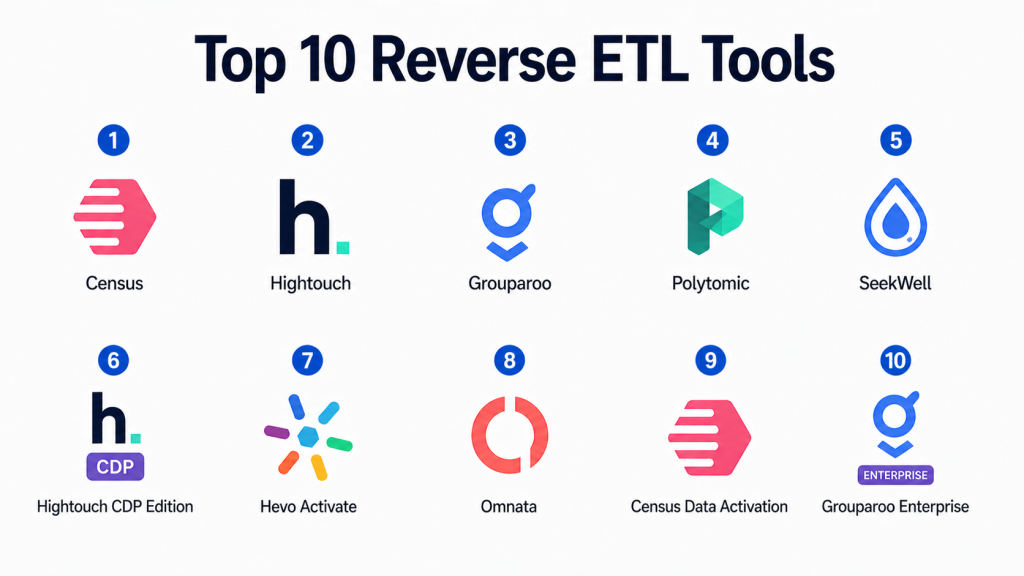
Top 10 Reverse ETL Tools
#1 — Census
Short description:
Census provides a reverse ETL platform to sync data from warehouses to operational systems. It helps teams operationalize analytics without engineering overhead and is ideal for mid-market and enterprise users.
Key Features
- Wide range of SaaS and database connectors
- Real-time and scheduled syncs
- Data transformation and mapping
- Customer segment activation
- Compliance-ready pipelines
- Monitoring and observability dashboards
Pros
- Low engineering requirements
- Strong automation and scheduling
- Supports multiple operational systems
Cons
- Limited custom transformation capabilities
- Pricing scales with volume
Platforms / Deployment
- Web
- Cloud
Security & Compliance
- SOC 2, GDPR, RBAC, encryption
Integrations & Ecosystem
Connects to Salesforce, HubSpot, Marketo, Zendesk, Snowflake, BigQuery
Support & Community
Vendor support, tutorials, and community forums
#2 — Hightouch
Short description:
Hightouch enables teams to move data from warehouses to operational apps with automated pipelines and prebuilt connectors, minimizing engineering efforts.
Key Features
- Prebuilt connectors for CRMs, advertising, and marketing platforms
- Real-time sync capabilities
- SQL-based transformations
- Versioning and rollback support
- Monitoring and alerting
- Multi-cloud compatibility
Pros
- Rapid deployment
- Easy to maintain workflows
- Strong monitoring features
Cons
- Some advanced transformations require SQL knowledge
- Cost increases with higher sync frequency
Platforms / Deployment
- Web
- Cloud
Security & Compliance
- SOC 2, GDPR, encryption, audit logs
Integrations & Ecosystem
Supports Salesforce, HubSpot, Intercom, Marketo, Snowflake, Redshift
Support & Community
Comprehensive vendor support and knowledge base
#3 — Grouparoo
Short description:
Grouparoo is an open-source reverse ETL tool allowing teams to sync data from warehouses to operational apps, with self-hosting options for flexibility.
Key Features
- Open-source flexibility
- Customizable connectors
- Event-driven and batch sync
- Data transformation with JavaScript
- Audit logging
- Self-hosted or cloud deployment
Pros
- Fully customizable
- Open-source community support
- Low operational cost for self-hosting
Cons
- Requires more technical expertise
- Limited prebuilt connectors compared to SaaS solutions
Platforms / Deployment
- Web / Linux / Windows
- Self-hosted / Cloud
Security & Compliance
- Not publicly stated
Integrations & Ecosystem
Connects to Salesforce, HubSpot, Intercom, Stripe, Snowflake
Support & Community
Active open-source community, documentation
#4 — Polytomic
Short description:
Polytomic enables automated data activation from warehouses into SaaS platforms with minimal setup, focusing on operational efficiency for revenue teams.
Key Features
- Wide SaaS connector library
- Real-time data syncing
- SQL-based transformations
- Monitoring dashboards
- Error handling and retry logic
Pros
- Simple, low-code interface
- Fast deployment
- Reliable sync with minimal maintenance
Cons
- Limited complex transformations
- Cloud-only deployment
Platforms / Deployment
- Web
- Cloud
Security & Compliance
- SOC 2, encryption, audit logging
Integrations & Ecosystem
Supports Salesforce, HubSpot, Marketo, Intercom, BigQuery
Support & Community
Vendor support, knowledge base, training resources
#5 — SeekWell
Short description:
SeekWell allows SQL queries from warehouses to be directly pushed into operational apps, ideal for analytics-driven teams with SQL expertise.
Key Features
- SQL-driven reverse ETL
- Scheduled and event-driven syncs
- Cloud-native
- Monitoring and alerting
- Supports multiple operational destinations
Pros
- High control via SQL
- Direct warehouse query integration
- Real-time updates
Cons
- Requires SQL knowledge
- Fewer prebuilt connectors
Platforms / Deployment
- Web
- Cloud
Security & Compliance
- SOC 2, encryption, RBAC
Integrations & Ecosystem
Connects to Salesforce, HubSpot, Marketo, Zendesk, Snowflake
Support & Community
Vendor documentation and community support
#6 — Hightouch CDP Edition
Short description:
This version of Hightouch focuses on customer data platform integration, syncing warehouse data directly to marketing and sales platforms.
Key Features
- Customer segmentation
- Real-time audience sync
- SaaS connector library
- Data quality validation
- Event-driven pipeline support
Pros
- Tailored for marketing teams
- Real-time activation
- Prebuilt CDP connectors
Cons
- Higher cost for small teams
- Limited flexibility for custom workflows
Platforms / Deployment
- Web
- Cloud
Security & Compliance
- SOC 2, GDPR, encryption
Integrations & Ecosystem
Supports Salesforce Marketing Cloud, HubSpot, Braze, Intercom
Support & Community
Vendor support, onboarding tutorials
#7 — Hevo Activate
Short description:
Hevo Activate brings warehouse data into operational tools with automation and prebuilt connectors for SaaS platforms.
Key Features
- Low-code pipeline builder
- Real-time data sync
- Multi-cloud support
- Data transformation
- Error handling
Pros
- Easy to set up
- Reliable syncing
- Minimal operational overhead
Cons
- Cloud-only deployment
- Limited complex transformations
Platforms / Deployment
- Web
- Cloud
Security & Compliance
- SOC 2, GDPR, encryption
Integrations & Ecosystem
Connects to Salesforce, HubSpot, Marketo, Intercom, BigQuery
Support & Community
Vendor support, documentation, tutorials
#8 — Omnata
Short description:
Omnata enables operationalizing warehouse data into SaaS apps with real-time workflows and automation for marketing and product teams.
Key Features
- Event-driven pipelines
- Real-time sync
- Prebuilt SaaS connectors
- Monitoring dashboards
- Data transformation tools
Pros
- Fast real-time sync
- Low-code setup
- Multiple SaaS connectors
Cons
- Limited on-prem options
- Higher volume costs
Platforms / Deployment
- Web
- Cloud
Security & Compliance
- SOC 2, encryption, audit logging
Integrations & Ecosystem
Supports Salesforce, HubSpot, Intercom, Marketo
Support & Community
Vendor support, documentation
#9 — Census Data Activation
Short description:
Census focuses on enabling analytics teams to operationalize warehouse data into marketing, sales, and support tools.
Key Features
- Real-time and batch pipelines
- Multi-cloud support
- Prebuilt connectors
- Monitoring and observability
- SQL transformations
Pros
- Easy for analytics teams
- Reliable syncs
- Supports multiple operational apps
Cons
- Limited advanced transformations
- Cloud-only
Platforms / Deployment
- Web
- Cloud
Security & Compliance
- SOC 2, encryption, audit logs
Integrations & Ecosystem
Supports Salesforce, HubSpot, Marketo, Intercom
Support & Community
Vendor support and community forums
#10 — Grouparoo Enterprise
Short description:
Enterprise edition of Grouparoo provides full-featured reverse ETL with support, SLA, and advanced enterprise connectors.
Key Features
- Open-source flexibility with enterprise support
- Multi-cloud support
- Real-time and batch syncs
- Advanced monitoring
- Custom connectors
Pros
- Enterprise-grade support
- Highly flexible
- Open-source transparency
Cons
- Technical setup required
- Higher learning curve
Platforms / Deployment
- Web / Linux / Windows
- Cloud / Self-hosted
Security & Compliance
- SOC 2, encryption, RBAC
Integrations & Ecosystem
Connects to Salesforce, HubSpot, Marketo, Intercom, Snowflake
Support & Community
Enterprise support, documentation, community
Comparison Table (Top 10)
| Tool Name | Best For | Platform(s) Supported | Deployment | Standout Feature | Public Rating |
|---|---|---|---|---|---|
| Census | Analytics to operations | Web | Cloud | Automated warehouse sync | N/A |
| Hightouch | SaaS activation | Web | Cloud | Low-code pipelines | N/A |
| Grouparoo | Open-source flexibility | Web/Linux/Windows | Self-hosted/Cloud | Custom connectors | N/A |
| Polytomic | Revenue ops | Web | Cloud | Fast activation | N/A |
| SeekWell | SQL-driven sync | Web | Cloud | Warehouse queries | N/A |
| Hightouch CDP | Marketing teams | Web | Cloud | Customer segment sync | N/A |
| Hevo Activate | Low-code activation | Web | Cloud | Multi-cloud support | N/A |
| Omnata | Real-time workflows | Web | Cloud | Event-driven pipelines | N/A |
| Census Data Activation | Analytics teams | Web | Cloud | Multi-app support | N/A |
| Grouparoo Enterprise | Enterprise flexibility | Web/Linux/Windows | Cloud/Self-hosted | Enterprise connectors | N/A |
Evaluation & Scoring of Reverse ETL Tools
| Tool Name | Core | Ease | Integrations | Security | Performance | Support | Value | Weighted Total |
|---|---|---|---|---|---|---|---|---|
| Census | 9 | 8 | 9 | 8 | 8 | 8 | 8 | 8.3 |
| Hightouch | 8 | 9 | 8 | 8 | 8 | 8 | 8 | 8.2 |
| Grouparoo | 8 | 7 | 8 | 7 | 8 | 7 | 7 | 7.6 |
| Polytomic | 8 | 8 | 8 | 8 | 8 | 7 | 7 | 7.8 |
| SeekWell | 8 | 7 | 8 | 7 | 8 | 7 | 7 | 7.6 |
| Hightouch CDP | 8 | 8 | 8 | 8 | 8 | 7 | 7 | 7.8 |
| Hevo Activate | 7 | 8 | 7 | 7 | 8 | 7 | 7 | 7.5 |
| Omnata | 7 | 8 | 7 | 7 | 8 | 7 | 7 | 7.5 |
| Census Data Activation | 8 | 8 | 8 | 8 | 8 | 7 | 7 | 7.8 |
| Grouparoo Enterprise | 8 | 7 | 8 | 8 | 8 | 8 | 7 | 7.8 |
Which Reverse ETL Tools Tool Is Right for You?
Solo / Freelancer
Open-source and low-code tools like Grouparoo and SeekWell enable small teams to operationalize data efficiently.
SMB
Fivetran, Hightouch, and Hevo Activate provide managed, automated pipelines with minimal overhead.
Mid-Market
Census, Polytomic, and Omnata support analytics-to-operations workflows with real-time capabilities.
Enterprise
Grouparoo Enterprise, Hightouch CDP, and Census Data Activation scale for multi-cloud, multi-team operations.
Budget vs Premium
Open-source reduces costs but requires setup; managed SaaS provides ease of use at higher price points.
Feature Depth vs Ease of Use
Census and Polytomic offer advanced features; Hightouch and Hevo Activate focus on speed and simplicity.
Integrations & Scalability
Enterprise-focused tools provide broad connectors, real-time pipelines, and multi-cloud support.
Security & Compliance Needs
SOC 2, GDPR, RBAC, and encryption should be verified for sensitive data movement.
Frequently Asked Questions (FAQs)
1. What is reverse ETL?
A process that operationalizes data by syncing it from warehouses or lakehouses to operational systems for actionable insights.
2. How is it different from traditional ETL?
ETL consolidates data into a warehouse for analysis; reverse ETL pushes warehouse data back into operational applications.
3. Which teams benefit most?
Marketing, sales, product, analytics, and revenue operations teams.
4. Are reverse ETL tools cloud-only?
Most are cloud-native, though some like Grouparoo provide self-hosted options.
5. What about real-time data?
Many tools support near real-time or event-driven syncs.
6. How is data security handled?
Encryption, RBAC, audit logging, and compliance with SOC 2 and GDPR are common standards.
7. Do they require technical expertise?
Low-code tools are user-friendly; open-source options require engineering skills.
8. Can they integrate with AI/ML pipelines?
Yes, they enable operationalization of predictive analytics and ML models.
9. How is pricing structured?
Most use subscription or consumption-based pricing, often tied to data volume or number of connectors.
10. Can reverse ETL replace traditional ETL?
No, reverse ETL complements ETL by operationalizing warehouse data into apps; ETL remains essential for analytics.
Conclusion
Reverse ETL tools bridge the gap between analytics and operations, enabling teams to act on warehouse data within operational systems. Selection depends on team size, technical expertise, real-time requirements, and system complexity. Organizations should shortlist tools, run pilot projects, and validate integrations and security before full adoption. The right reverse ETL platform enhances operational workflows, customer engagement, and data-driven decision-making.

Find Trusted Cardiac Hospitals
Compare heart hospitals by city and services — all in one place.
Explore Hospitals
Sometimes a sync may update some records but fail on others because of validation rules, API limits, or changed fields. Teams should be able to clearly see which records succeeded, which failed, and safely retry only the failed ones. This can prevent inconsistent data between the warehouse and operational systems.