Introduction
Data quality tools help organizations ensure that their data is accurate, complete, consistent, and reliable across various systems. These tools automate validation, cleansing, standardization, and monitoring processes to maintain high-quality data for decision-making, reporting, and analytics. As organizations increasingly rely on data-driven strategies, maintaining data quality is essential to prevent errors, improve operational efficiency, and reduce compliance risks.
Real-world use cases include preventing duplicate or inconsistent customer records, ensuring accurate financial reporting, enriching analytics dashboards with verified data, monitoring data pipelines for anomalies, and standardizing data for integrations across multiple systems.
Key evaluation criteria include data profiling and validation capabilities, real-time monitoring, ease of integration with existing systems, automation features, scalability, data governance support, usability, security and compliance, cost, and vendor support.
Best for: Data engineers, analysts, data governance teams, and mid-market to enterprise organizations that rely on large-scale, cross-system data operations. Not ideal for: Small organizations with limited data systems or teams where manual processes are sufficient.
Key Trends in Data Quality Tools
- Integration of AI/ML for anomaly detection and predictive cleansing
- Real-time data quality monitoring and alerts
- Automated data profiling and validation workflows
- Enhanced support for cloud-native and multi-cloud environments
- Low-code/no-code interfaces for broader team adoption
- Compliance-driven features for GDPR, CCPA, HIPAA, and SOC 2
- API-first approach for integration with modern data stacks
- Consumption-based pricing and scalable licensing models
- Data observability across ETL, warehouse, and operational systems
How We Selected These Tools (Methodology)
- Evaluated market adoption and customer mindshare
- Assessed breadth of features including cleansing, validation, and monitoring
- Tested reliability and performance in real-world scenarios
- Verified security and compliance posture, including audit and encryption support
- Checked integrations with popular databases, warehouses, and SaaS tools
- Considered scalability for mid-market and enterprise deployments
- Analyzed ease of use and automation capabilities
- Evaluated vendor support, documentation, and community engagement
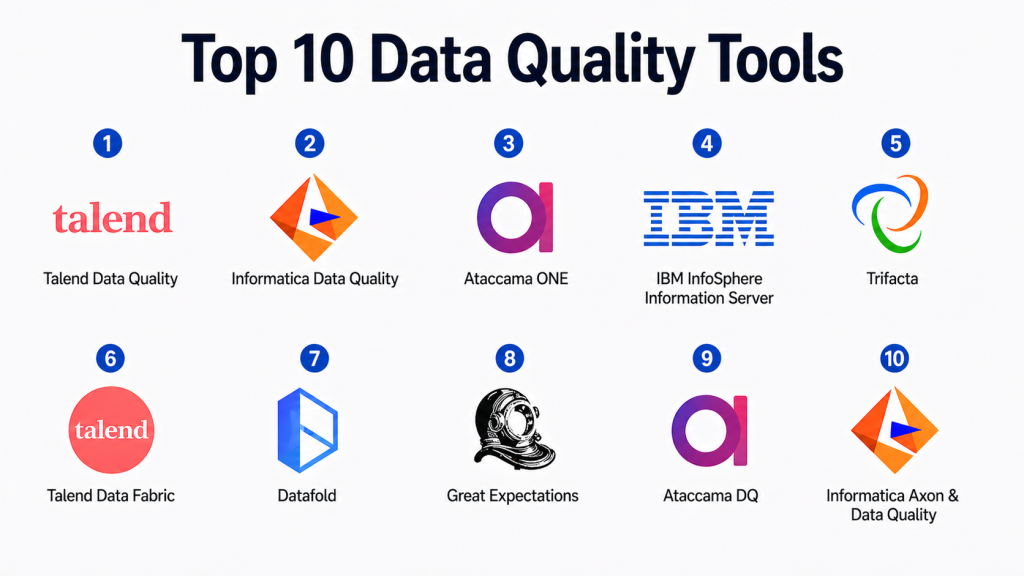
Top 10 Data Quality Tools
#1 — Talend Data Quality
Short description:
Talend Data Quality provides robust tools to profile, cleanse, and enrich data. It is suitable for enterprises needing advanced validation and monitoring workflows across multiple data sources.
Key Features
- Data profiling and anomaly detection
- Standardization and enrichment
- Duplicate detection and merging
- Real-time monitoring
- Prebuilt connectors for common databases and SaaS
- Data governance support
Pros
- Comprehensive functionality
- Strong enterprise integrations
- Scalable across large data environments
Cons
- Steeper learning curve
- Pricing can be high for smaller teams
Platforms / Deployment
- Windows / Linux / macOS
- Cloud / On-premises / Hybrid
Security & Compliance
- SOC 2, ISO 27001, GDPR, RBAC
Integrations & Ecosystem
Supports Snowflake, BigQuery, Salesforce, SAP, Oracle, APIs
Support & Community
Vendor support with training resources and active user community
#2 — Informatica Data Quality
Short description:
Informatica Data Quality enables organizations to standardize, cleanse, and monitor enterprise data with scalable pipelines and governance tools.
Key Features
- Automated data cleansing and enrichment
- Profiling and anomaly detection
- Address and entity resolution
- Rule-based validation
- Integration with Informatica platform ecosystem
Pros
- Enterprise-grade scalability
- Strong governance features
- Extensive connectors and templates
Cons
- Complex setup and configuration
- Cost may be prohibitive for smaller organizations
Platforms / Deployment
- Windows / Linux
- Cloud / On-premises / Hybrid
Security & Compliance
- SOC 2, ISO 27001, GDPR, audit logging
Integrations & Ecosystem
Supports Salesforce, SAP, Oracle, Snowflake, APIs, ETL platforms
Support & Community
Comprehensive documentation and global support
#3 — Ataccama ONE
Short description:
Ataccama ONE provides an AI-driven platform for data quality, profiling, and governance, suited for enterprises looking for automated insights and data stewardship.
Key Features
- AI-based anomaly detection
- Real-time monitoring dashboards
- Automated cleansing and standardization
- Duplicate detection and merging
- Data governance and stewardship tools
Pros
- AI-driven automation reduces manual work
- Strong governance and compliance features
- Scalable for enterprise data environments
Cons
- Requires onboarding to fully utilize AI features
- Cloud deployment preferred
Platforms / Deployment
- Web / Linux / Windows
- Cloud / Hybrid
Security & Compliance
- SOC 2, GDPR, ISO 27001
Integrations & Ecosystem
Supports Snowflake, Redshift, Salesforce, APIs, BI platforms
Support & Community
Vendor support, knowledge base, community forums
#4 — IBM InfoSphere Information Server
Short description:
IBM InfoSphere is an enterprise-grade platform for data integration and quality, providing profiling, cleansing, and governance for complex environments.
Key Features
- Data profiling and quality scorecards
- Cleansing, validation, and enrichment
- Duplicate detection and reconciliation
- Integration with ETL and data governance workflows
- Batch and real-time processing
Pros
- Highly scalable and reliable
- Integrated governance and compliance
- Suitable for complex enterprise data landscapes
Cons
- Expensive for mid-market organizations
- Requires specialized skills
Platforms / Deployment
- Windows / Linux
- Cloud / On-premises / Hybrid
Security & Compliance
- SOC 2, ISO 27001, GDPR, RBAC
Integrations & Ecosystem
Supports SAP, Oracle, Snowflake, Tableau, APIs
Support & Community
Enterprise-level support and consulting
#5 — Trifacta
Short description:
Trifacta provides data wrangling and preparation with quality checks and profiling for analytics and AI-ready datasets.
Key Features
- Visual data profiling and exploration
- Data cleansing and enrichment
- Pattern recognition and standardization
- Collaboration features for data teams
- Integration with cloud data platforms
Pros
- Intuitive visual interface
- Strong for self-service analytics
- Cloud-native and scalable
Cons
- Limited governance features compared to full enterprise suites
- Some transformations require learning the tool
Platforms / Deployment
- Web
- Cloud / On-premises
Security & Compliance
- SOC 2, encryption
Integrations & Ecosystem
Connects with Snowflake, BigQuery, Redshift, Tableau, APIs
Support & Community
Vendor support, tutorials, and community forums
#6 — Talend Data Fabric
Short description:
Talend Data Fabric combines ETL, integration, and data quality in one platform for comprehensive enterprise data management.
Key Features
- Data profiling, cleansing, and enrichment
- Real-time monitoring
- Governance and stewardship
- Prebuilt connectors for multiple systems
- Automation of workflows
Pros
- Full suite for enterprise data operations
- Scalable and reliable
- Strong support for governance
Cons
- Complexity for smaller teams
- Higher cost
Platforms / Deployment
- Web / Windows / Linux
- Cloud / On-premises / Hybrid
Security & Compliance
- SOC 2, ISO 27001, GDPR
Integrations & Ecosystem
Supports Salesforce, SAP, Oracle, Snowflake, APIs
Support & Community
Vendor support and active community
#7 — Datafold
Short description:
Datafold focuses on data quality monitoring and testing, offering automated validation and anomaly detection for modern data stacks.
Key Features
- Automated data validation
- Data regression testing
- Anomaly detection and monitoring
- Integration with version control and CI/CD
- Cloud-native support
Pros
- Strong observability and monitoring
- Automated testing reduces errors
- Easy integration with modern stacks
Cons
- Primarily cloud-only
- Smaller feature set compared to full enterprise suites
Platforms / Deployment
- Web
- Cloud
Security & Compliance
- SOC 2, GDPR
Integrations & Ecosystem
Supports Snowflake, BigQuery, Redshift, dbt, APIs
Support & Community
Documentation and support channels
#8 — Great Expectations
Short description:
Great Expectations is an open-source data quality framework providing automated testing and validation for pipelines and warehouses.
Key Features
- Open-source framework for validation
- Data profiling and expectations
- Integration with ETL and pipelines
- Testing and monitoring of datasets
- Reporting dashboards
Pros
- Open-source flexibility
- High customizability
- Integrates with CI/CD pipelines
Cons
- Requires technical expertise
- Limited out-of-the-box connectors
Platforms / Deployment
- Linux / Windows / macOS
- Self-hosted / Cloud
Security & Compliance
- Not publicly stated
Integrations & Ecosystem
Supports dbt, Airflow, Snowflake, Redshift, APIs
Support & Community
Active open-source community, documentation
#9 — Ataccama DQ
Short description:
Ataccama DQ offers data quality and governance capabilities for enterprise data environments with automation and AI support.
Key Features
- AI-based anomaly detection
- Cleansing and standardization
- Duplicate detection
- Data profiling and monitoring
- Integration with governance workflows
Pros
- AI-powered automation
- Comprehensive governance support
- Scalable for enterprises
Cons
- Requires setup and training
- Cost-intensive for small teams
Platforms / Deployment
- Web / Linux / Windows
- Cloud / Hybrid
Security & Compliance
- SOC 2, GDPR, ISO 27001
Integrations & Ecosystem
Supports Salesforce, Snowflake, Redshift, APIs
Support & Community
Vendor support and documentation
#10 — Informatica Axon & Data Quality
Short description:
Informatica’s combined platform delivers robust data quality, profiling, and governance for enterprise-scale data management.
Key Features
- Data profiling and cleansing
- Monitoring dashboards
- Governance and stewardship
- Integration with ETL and operational pipelines
- Anomaly detection
Pros
- Enterprise-grade reliability
- Strong governance and compliance
- Wide connector library
Cons
- Complexity and cost
- Learning curve for full feature set
Platforms / Deployment
- Web / Windows / Linux
- Cloud / On-premises / Hybrid
Security & Compliance
- SOC 2, ISO 27001, GDPR, audit logs
Integrations & Ecosystem
Supports Snowflake, Redshift, Salesforce, Tableau, APIs
Support & Community
Enterprise-level support and documentation
Comparison Table (Top 10)
| Tool Name | Best For | Platform(s) Supported | Deployment | Standout Feature | Public Rating |
|---|---|---|---|---|---|
| Talend Data Quality | Enterprise data cleansing | Windows/Linux/macOS | Cloud/On-prem/Hybrid | Comprehensive profiling & cleansing | N/A |
| Informatica Data Quality | Enterprise data governance | Windows/Linux | Cloud/On-prem/Hybrid | Governance & scalability | N/A |
| Ataccama ONE | AI-powered data quality | Web/Linux/Windows | Cloud/Hybrid | AI-driven anomaly detection | N/A |
| IBM InfoSphere | Complex enterprise pipelines | Windows/Linux | Cloud/On-prem/Hybrid | Enterprise integration & monitoring | N/A |
| Trifacta | Self-service analytics | Web | Cloud/On-prem | Visual data wrangling | N/A |
| Talend Data Fabric | Enterprise data operations | Windows/Linux/macOS | Cloud/On-prem/Hybrid | Integrated ETL & data quality | N/A |
| Datafold | Data observability & testing | Web | Cloud | Automated validation & monitoring | N/A |
| Great Expectations | Open-source framework | Linux/Windows/macOS | Self-hosted/Cloud | Pipeline validation & expectations | N/A |
| Ataccama DQ | Enterprise AI-driven quality | Web/Linux/Windows | Cloud/Hybrid | AI-powered automation | N/A |
| Informatica Axon | Enterprise governance & quality | Web/Windows/Linux | Cloud/On-prem/Hybrid | Combined governance & quality | N/A |
Evaluation & Scoring of Data Quality Tools
| Tool Name | Core | Ease | Integrations | Security | Performance | Support | Value | Weighted Total |
|---|---|---|---|---|---|---|---|---|
| Talend Data Quality | 9 | 7 | 8 | 8 | 8 | 8 | 7 | 8.0 |
| Informatica Data Quality | 9 | 7 | 8 | 8 | 8 | 8 | 7 | 8.0 |
| Ataccama ONE | 8 | 7 | 8 | 8 | 8 | 7 | 7 | 7.7 |
| IBM InfoSphere | 9 | 6 | 8 | 8 | 9 | 7 | 7 | 7.9 |
| Trifacta | 7 | 9 | 7 | 7 | 8 | 7 | 7 | 7.5 |
| Talend Data Fabric | 9 | 7 | 8 | 8 | 8 | 8 | 7 | 8.0 |
| Datafold | 8 | 8 | 7 | 7 | 8 | 7 | 7 | 7.5 |
| Great Expectations | 7 | 7 | 7 | 7 | 7 | 7 | 7 | 7.0 |
| Ataccama DQ | 8 | 7 | 8 | 8 | 8 | 7 | 7 | 7.7 |
| Informatica Axon | 9 | 6 | 8 | 8 | 8 | 7 | 7 | 7.7 |
Scores are comparative; higher totals indicate broader capabilities, ease of use, integrations, security, and value. Selection depends on organizational scale, technical expertise, and required governance features.
Which Data Quality Tools Tool Is Right for You?
Solo / Freelancer
Open-source tools like Great Expectations allow small teams to validate pipelines without heavy investment.
SMB
Low-code tools such as Trifacta or Datafold enable teams to clean and monitor data efficiently.
Mid-Market
Talend Data Quality and Ataccama ONE offer automation, monitoring, and governance suited for mid-sized organizations.
Enterprise
Informatica, IBM InfoSphere, and Ataccama DQ provide enterprise-grade governance, scalability, and integration across complex systems.
Budget vs Premium
Open-source or lightweight tools reduce cost; enterprise suites provide comprehensive features at higher price points.
Feature Depth vs Ease of Use
Enterprise tools deliver rich capabilities; low-code platforms prioritize speed and usability.
Integrations & Scalability
Enterprise and mid-market tools offer broad SaaS, database, and analytics integration, and can scale horizontally.
Security & Compliance Needs
SOC 2, ISO 27001, GDPR, and RBAC are critical for sensitive enterprise data pipelines.
Frequently Asked Questions (FAQs)
1. What are data quality tools?
Software that ensures data accuracy, completeness, consistency, and reliability across systems.
2. Why are they important?
Poor data quality can lead to incorrect insights, compliance risks, and operational inefficiencies.
3. How do these tools work?
They profile, cleanse, standardize, monitor, and validate data in pipelines and warehouses.
4. Who benefits most from them?
Data engineers, analysts, governance teams, and enterprise operations teams.
5. Are these tools cloud-only?
Most are cloud-native, but enterprise suites offer hybrid and on-premises deployment.
6. Can they integrate with ETL pipelines?
Yes, they often integrate with ETL, reverse ETL, and analytics tools.
7. Do they support real-time data?
Many platforms provide streaming or near real-time monitoring and validation.
8. Is technical expertise required?
Open-source tools require more technical knowledge; low-code platforms are easier for non-engineers.
9. What about compliance and security?
Enterprise tools support SOC 2, ISO 27001, GDPR, encryption, and RBAC.
10. Can small businesses use them?
Yes, lightweight or open-source solutions can be effective for smaller data stacks.
Conclusion
Data quality tools are essential for maintaining trust in enterprise data, enabling accurate analytics, and supporting compliance initiatives. The best tool depends on team size, technical expertise, real-time requirements, and integration needs. Organizations should shortlist tools, test in pilot projects, and validate integrations and security before full adoption. Implementing the right solution ensures reliable, actionable data across all business processes.

Find Trusted Cardiac Hospitals
Compare heart hospitals by city and services — all in one place.
Explore Hospitals
Not every missing or incorrect value needs the same level of attention. Teams should focus first on errors that can affect customers, financial reports, or important business decisions. This helps data teams spend their time on the problems that matter most.