Introduction
Master Data Management (MDM) Tools are software solutions that help organizations centralize, organize, and maintain their critical business data across multiple systems and applications. They provide a single source of truth for entities such as customers, products, suppliers, and accounts, ensuring that data is consistent, accurate, and trustworthy across the enterprise. With businesses increasingly relying on data-driven decision-making, MDM tools play a crucial role in eliminating duplicate records, enforcing data governance, and enhancing operational efficiency.
Organizations use MDM tools to streamline processes such as customer onboarding, regulatory compliance, supply chain management, and analytics. They allow teams to integrate disparate data sources, track changes in real time, and maintain high-quality data for operational and analytical purposes. Buyers evaluating MDM tools should consider factors such as integration capabilities, scalability, data governance features, AI-assisted data quality, security, ease of use, deployment models, compliance, and vendor support.
Best for: MDM tools benefit data teams, IT managers, business analysts, and compliance officers in medium to large enterprises across industries like finance, retail, healthcare, and manufacturing.
Not ideal for: Small businesses with limited data complexity or organizations that only require basic data management functionalities may find simpler data governance or spreadsheet-based solutions sufficient.
Key Trends in Master Data Management (MDM) Tools
- Increasing adoption of AI and machine learning to automate data cleansing, matching, and enrichment.
- Hybrid and cloud-native deployment models for flexible scalability and global accessibility.
- Integration with data catalogs, metadata management, and analytics platforms to ensure seamless workflows.
- Enhanced data governance frameworks to meet regulatory requirements like GDPR, CCPA, and HIPAA.
- Focus on customer data platforms (CDP) integration to unify customer profiles across marketing, sales, and support.
- Real-time data synchronization for operational intelligence and predictive analytics.
- Low-code/no-code interfaces for broader accessibility to business users.
- Subscription-based pricing models with tiered capabilities to cater to different enterprise sizes.
- Automated lineage and audit tracking for better compliance reporting.
- Ecosystem partnerships enabling interoperability with ERP, CRM, and BI systems.
How We Selected These Tools (Methodology)
- Market adoption and brand recognition across industries.
- Completeness of features including data cleansing, governance, and enrichment.
- Reliability and performance signals, including uptime, response times, and scaling capabilities.
- Security posture, encryption standards, and regulatory compliance support.
- Integration capabilities with modern cloud, on-premise, and SaaS platforms.
- Vendor support and community engagement for troubleshooting and knowledge sharing.
- Flexibility to serve multiple use cases like customer, product, or supplier data management.
- Ease of onboarding and deployment across technical and business teams.
- Vendor roadmap and innovation in AI-driven capabilities.
- Cost-effectiveness and licensing options for enterprises of varying sizes.
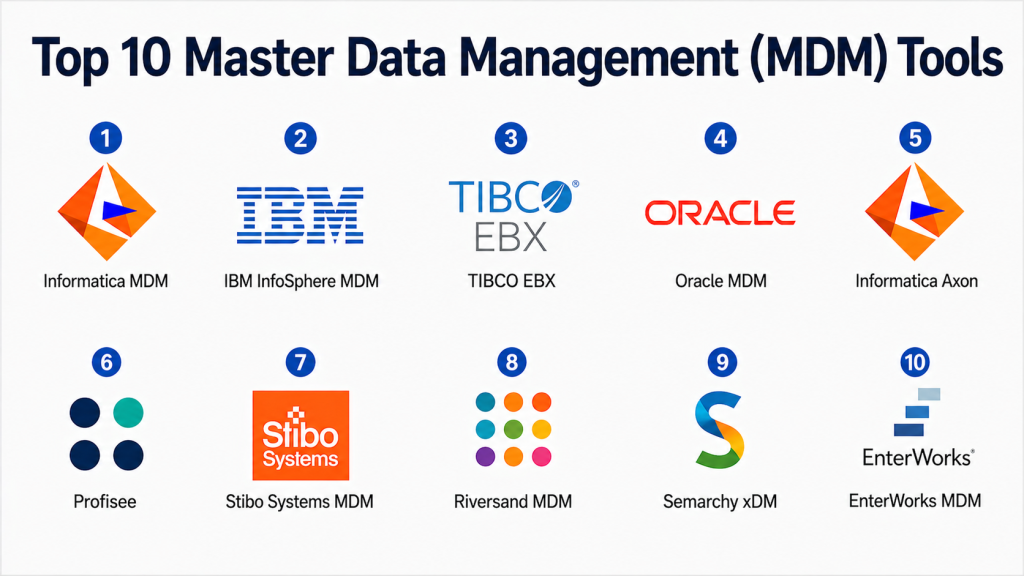
Top 10Master Data Management (MDM) Tools
#1 — Informatica MDM
Short description : Informatica MDM is an enterprise-grade platform that centralizes and manages master data across the organization. It provides robust data governance, AI-assisted matching, and real-time synchronization, making it suitable for complex multi-domain deployments.
Key Features
- Multi-domain MDM support (customer, product, supplier, finance).
- AI-driven data matching and merging.
- Real-time data integration with ETL and APIs.
- Built-in data quality and profiling tools.
- Workflow automation and stewardship dashboards.
- Compliance-ready with audit trails and lineage tracking.
- Flexible cloud and on-premises deployment.
Pros
- Highly scalable for large enterprise datasets.
- Strong integration ecosystem with popular BI and ERP systems.
Cons
- Can be complex to implement without expert support.
- Higher cost compared to simpler MDM solutions.
Platforms / Deployment
- Web / Windows / Linux
- Cloud / Self-hosted / Hybrid
Security & Compliance
- Supports SSO/SAML, MFA, encryption, audit logs
- SOC 2, ISO 27001, GDPR compliance
Integrations & Ecosystem
- Integrates with data warehouses, CRM, ERP
- Offers APIs for custom integrations
- Extensible with Informatica PowerCenter and iPaaS solutions
Support & Community
- Extensive documentation and onboarding programs
- Dedicated enterprise support tiers
- Active user community and professional training
#2 — IBM InfoSphere MDM
Short description : IBM InfoSphere MDM delivers a scalable and flexible platform to manage enterprise data across multiple domains. It emphasizes governance, security, and analytics-driven insights for consistent master data.
Key Features
- Multi-domain management including customer and product data.
- Role-based workflows and stewardship capabilities.
- Advanced matching and survivorship rules.
- Integration with IBM Cloud Pak and data governance tools.
- Real-time operational data hub for analytics.
- Extensive lineage tracking and reporting.
- AI-assisted data quality management.
Pros
- Strong enterprise-grade compliance and security features.
- Deep integration with IBM analytics ecosystem.
Cons
- Steep learning curve for new users.
- Requires significant resources for large-scale deployments.
Platforms / Deployment
- Web / Windows / Linux
- Cloud / Self-hosted / Hybrid
Security & Compliance
- SOC 2, ISO 27001, GDPR
- Encryption, audit logs, RBAC
Integrations & Ecosystem
- Integrates with ERP, BI, CRM
- Offers APIs and SDKs for customization
- Part of IBM’s larger data management suite
Support & Community
- Comprehensive documentation and tutorials
- Enterprise support contracts
- Active IBM user forums
#3 — TIBCO EBX
Short description : TIBCO EBX is a master data management platform designed for multi-domain governance. It supports business-friendly workflows and complex data stewardship, enabling organizations to unify, govern, and distribute data effectively.
Key Features
- Centralized repository for all master data domains.
- Business-friendly UI for stewardship and workflows.
- Hierarchical data modeling and validation.
- Integration with TIBCO’s analytics and integration stack.
- Versioning and history tracking for lineage.
- Rule-based matching and survivorship policies.
- Scalable cloud or on-premise deployments.
Pros
- Intuitive interface for non-technical users.
- Strong multi-domain governance capabilities.
Cons
- Higher license costs for smaller enterprises.
- Initial setup and modeling can be time-consuming.
Platforms / Deployment
- Web / Windows / Linux
- Cloud / Self-hosted / Hybrid
Security & Compliance
- Encryption and RBAC
- SOC 2 and GDPR alignment
Integrations & Ecosystem
- Connects with BI tools and ETL platforms
- API support for third-party integrations
- Part of TIBCO integration ecosystem
Support & Community
- Training and documentation available
- Enterprise support packages
- Active community of practitioners
#4 — Oracle MDM
Short description : Oracle MDM is a multi-domain solution for centralized management of master data. It emphasizes data quality, governance, and integration with Oracle’s enterprise applications.
Key Features
- Multi-domain master data consolidation.
- Integration with Oracle ERP and CX suite.
- Data quality and cleansing workflows.
- Hierarchical relationship management.
- Audit trails and lineage tracking.
- Cloud-native deployment options.
- AI-assisted matching and duplicate resolution.
Pros
- Seamless integration with Oracle ecosystem.
- Strong data governance capabilities.
Cons
- Complex configuration for multi-domain setups.
- Licensing can be expensive for SMBs.
Platforms / Deployment
- Web / Linux / Windows
- Cloud / Self-hosted / Hybrid
Security & Compliance
- SOC 2, ISO 27001
- MFA, encryption, audit logs
Integrations & Ecosystem
- Connects with Oracle ERP, CRM, BI
- API support for custom connectors
- Part of Oracle Cloud suite
Support & Community
- Comprehensive Oracle support programs
- Detailed documentation and training
- Large global community
#5 — Informatica Axon
Short description : Informatica Axon is a collaborative data governance and MDM platform that helps organizations manage the lifecycle of master data across all domains with strong stewardship and compliance focus.
Key Features
- Collaborative data governance workflows.
- Business glossary and stewardship dashboards.
- Integration with Informatica MDM and PowerCenter.
- Policy management and compliance reporting.
- AI-driven data quality insights.
- Lineage and impact analysis.
- Multi-cloud deployment support.
Pros
- Strong governance and compliance features.
- Intuitive collaboration and stewardship tools.
Cons
- May require additional Informatica modules for full MDM functionality.
- Initial setup can be resource-intensive.
Platforms / Deployment
- Web / Windows / Linux
- Cloud / Hybrid
Security & Compliance
- SOC 2, ISO 27001
- Encryption, RBAC, MFA
Integrations & Ecosystem
- Connects with BI, ETL, CRM systems
- REST APIs for custom integration
- Part of Informatica ecosystem
Support & Community
- Enterprise support tiers
- Training and certification programs
- Active user community
#6 — Profisee
Short description : Profisee is an MDM platform focused on ease of deployment and affordability. It offers multi-domain management with strong integration and governance features suitable for mid-market and enterprise organizations.
Key Features
- Multi-domain master data management.
- Cloud and hybrid deployment flexibility.
- Workflow automation and data stewardship.
- Integration with ETL and BI tools.
- Duplicate detection and merging.
- Lineage tracking and reporting.
- Low-code interface for faster adoption.
Pros
- Affordable and quick to deploy.
- User-friendly interface for business users.
Cons
- Less feature-rich than enterprise MDM suites.
- Limited analytics integration compared to larger vendors.
Platforms / Deployment
- Web / Windows / Linux
- Cloud / Self-hosted / Hybrid
Security & Compliance
- Not publicly stated
- Supports encryption and access controls
Integrations & Ecosystem
- Connects with Salesforce, Power BI, and other systems
- REST APIs available
- Extensible via connectors
Support & Community
- Standard and premium support packages
- Documentation and onboarding guides
- Growing user community
#7 — Stibo Systems MDM
Short description : Stibo Systems MDM offers a unified platform for product, customer, and supplier data. It focuses on business usability, global scalability, and compliance.
Key Features
- Multi-domain master data management.
- Product information management (PIM) capabilities.
- Workflow and stewardship automation.
- Data quality and validation rules.
- Integration with ERP, CRM, and analytics tools.
- Role-based access and audit trails.
- Cloud and on-premises deployment.
Pros
- Strong global scalability and multi-domain support.
- Business-friendly interface.
Cons
- Premium pricing for small businesses.
- Implementation can be complex.
Platforms / Deployment
- Web / Windows / Linux
- Cloud / Self-hosted / Hybrid
Security & Compliance
- SOC 2, GDPR
- RBAC, encryption, audit logs
Integrations & Ecosystem
- Connects with SAP, Salesforce, and analytics platforms
- API support for custom integrations
- Part of Stibo ecosystem
Support & Community
- Enterprise support packages
- Documentation and training programs
- Active professional community
#8 — Riversand MDM
Short description : Riversand MDM provides cloud-native master data and product information management, focusing on scalability, flexibility, and AI-driven data governance.
Key Features
- Multi-domain MDM and PIM.
- AI-powered data quality and matching.
- Cloud-native and scalable architecture.
- Workflow automation and stewardship dashboards.
- Integration with BI, CRM, and ERP systems.
- Lineage tracking and compliance reporting.
- Role-based access control.
Pros
- Cloud-native, highly scalable.
- Strong AI and automation features.
Cons
- Learning curve for complex configurations.
- Pricing can be higher for SMBs.
Platforms / Deployment
- Web / Linux / Windows
- Cloud / Hybrid
Security & Compliance
- SOC 2, ISO 27001
- MFA, encryption, audit logs
Integrations & Ecosystem
- APIs for custom integrations
- Connects with Salesforce, Power BI, ERP systems
- Part of Riversand ecosystem
Support & Community
- Dedicated support tiers
- Documentation and training
- Growing community
#9 — Semarchy xDM
Short description : Semarchy xDM is a unified data management platform for multi-domain MDM with strong governance, integration, and business-friendly workflows.
Key Features
- Multi-domain MDM support.
- Low-code configuration for business users.
- Integration with ETL and BI tools.
- Data quality and validation features.
- Stewardship and workflow automation.
- Cloud and hybrid deployment options.
- Lineage tracking for compliance.
Pros
- Easy adoption for business and IT users.
- Flexible deployment options.
Cons
- Smaller ecosystem compared to major vendors.
- Some advanced features require additional modules.
Platforms / Deployment
- Web / Windows / Linux
- Cloud / Hybrid
Security & Compliance
- Not publicly stated
- Supports RBAC, encryption, audit logs
Integrations & Ecosystem
- API and ETL connectors available
- Integrates with BI and CRM platforms
- Extensible via Semarchy ecosystem
Support & Community
- Enterprise support
- Training resources and documentation
- Active user community
#10 — EnterWorks MDM
Short description : EnterWorks MDM provides multi-domain master data and product information management with strong workflow and governance capabilities for enterprises.
Key Features
- Multi-domain data management.
- PIM and DAM integrations.
- Workflow automation and stewardship.
- Integration with ERP and analytics platforms.
- Data quality and validation rules.
- Role-based access and audit trails.
- Cloud or on-premise deployment.
Pros
- Comprehensive governance and workflow support.
- PIM capabilities included for product-centric organizations.
Cons
- Higher cost for smaller organizations.
- Implementation may require specialist support.
Platforms / Deployment
- Web / Windows / Linux
- Cloud / Self-hosted / Hybrid
Security & Compliance
- SOC 2, ISO 27001
- RBAC, encryption, audit logs
Integrations & Ecosystem
- Connects with Salesforce, ERP systems, BI platforms
- API support for custom integrations
- Part of EnterWorks ecosystem
Support & Community
- Enterprise support tiers
- Documentation and onboarding programs
- Active professional community
Comparison Table (Top 10)
| Tool Name | Best For | Platform(s) Supported | Deployment | Standout Feature | Public Rating |
|---|---|---|---|---|---|
| Informatica MDM | Enterprise | Web, Windows, Linux | Cloud / Self-hosted / Hybrid | AI-assisted matching | N/A |
| IBM InfoSphere MDM | Enterprise | Web, Windows, Linux | Cloud / Self-hosted / Hybrid | Operational hub & lineage | N/A |
| TIBCO EBX | Multi-domain | Web, Windows, Linux | Cloud / Self-hosted / Hybrid | Business-friendly stewardship | N/A |
| Oracle MDM | Enterprise | Web, Linux, Windows | Cloud / Self-hosted / Hybrid | Integration with Oracle apps | N/A |
| Informatica Axon | Multi-domain | Web, Windows, Linux | Cloud / Hybrid | Governance collaboration | N/A |
| Profisee | Mid-market | Web, Windows, Linux | Cloud / Self-hosted / Hybrid | Ease of deployment | N/A |
| Stibo Systems MDM | Enterprise | Web, Windows, Linux | Cloud / Self-hosted / Hybrid | Global scalability | N/A |
| Riversand MDM | Enterprise | Web, Linux, Windows | Cloud / Hybrid | AI-driven data quality | N/A |
| Semarchy xDM | Multi-domain | Web, Windows, Linux | Cloud / Hybrid | Low-code workflows | N/A |
| EnterWorks MDM | Enterprise | Web, Windows, Linux | Cloud / Self-hosted / Hybrid | PIM integration | N/A |
Evaluation & Scoring of Master Data Management (MDM) Tools
| Tool Name | Core (25%) | Ease (15%) | Integrations (15%) | Security (10%) | Performance (10%) | Support (10%) | Value (15%) | Weighted Total (0–10) |
|---|---|---|---|---|---|---|---|---|
| Informatica MDM | 9 | 7 | 9 | 9 | 9 | 8 | 7 | 8.7 |
| IBM InfoSphere MDM | 9 | 6 | 8 | 9 | 8 | 8 | 7 | 8.3 |
| TIBCO EBX | 8 | 8 | 7 | 8 | 8 | 7 | 8 | 7.9 |
| Oracle MDM | 9 | 6 | 8 | 9 | 8 | 7 | 7 | 8.2 |
| Informatica Axon | 8 | 8 | 8 | 8 | 7 | 7 | 8 | 7.9 |
| Profisee | 7 | 8 | 7 | 7 | 7 | 7 | 8 | 7.5 |
| Stibo Systems MDM | 8 | 7 | 8 | 8 | 8 | 7 | 7 | 7.8 |
| Riversand MDM | 8 | 7 | 8 | 8 | 8 | 7 | 7 | 7.8 |
| Semarchy xDM | 7 | 8 | 7 | 7 | 7 | 7 | 8 | 7.4 |
| EnterWorks MDM | 8 | 7 | 7 | 8 | 8 | 7 | 7 | 7.6 |
Scores are comparative and reflect a mix of functionality, usability, integration, compliance, performance, support, and value. Enterprises should weigh criteria based on their specific operational priorities and budgets.
Which Master Data Management (MDM) Tools Tool Is Right for You?
Solo / Freelancer
For individuals managing small datasets or proof-of-concept projects, Profisee or Semarchy xDM offer affordable, easy-to-deploy solutions with low learning curves.
SMB
Small to medium businesses benefit from Profisee and TIBCO EBX, providing multi-domain management without enterprise-level complexity.
Mid-Market
Mid-sized organizations with multiple departments can leverage Informatica Axon or Semarchy xDM for governance and integration while balancing cost and scalability.
Enterprise
Large enterprises with complex data environments require Informatica MDM, IBM InfoSphere, Oracle MDM, or Riversand MDM for comprehensive multi-domain support, compliance, and enterprise-grade security.
Budget vs Premium
Budget-conscious teams may prioritize Profisee and Semarchy xDM. Premium deployments requiring full integration, AI features, and scalability favor Informatica, IBM, and Oracle.
Feature Depth vs Ease of Use
If your team values deep governance, lineage, and analytics, Informatica MDM or IBM InfoSphere are ideal. For ease of use and quicker adoption, Profisee and TIBCO EBX are more suitable.
Integrations & Scalability
Enterprise-grade MDM tools like Informatica and Riversand offer robust APIs, cloud scalability, and compatibility with BI, CRM, and ERP systems.
Security & Compliance Needs
Organizations in regulated industries should prioritize tools with SOC 2, ISO 27001, GDPR, and HIPAA support, such as IBM InfoSphere, Oracle MDM, and Informatica MDM.
Frequently Asked Questions (FAQs)
1. What is the pricing model for MDM tools?
Pricing typically depends on deployment type (cloud vs self-hosted), number of domains, and data volume. Enterprise solutions often use subscription or perpetual licensing models.
2. How long does implementation take?
Implementation varies by complexity; small deployments can take a few weeks, while enterprise multi-domain MDM implementations may require several months.
3. Can MDM tools integrate with existing data sources?
Yes, all top MDM platforms support integration with ERP, CRM, BI, and ETL tools via APIs, connectors, or native integrations.
4. What is the difference between MDM and data governance?
MDM focuses on managing master records, whereas data governance encompasses policies, roles, and oversight for data quality, lineage, and compliance.
5. Are these tools suitable for cloud and on-premise environments?
Most leading MDM tools offer hybrid options, allowing deployment in cloud, on-premise, or both, depending on enterprise requirements.
6. How do MDM tools handle data quality?
MDM tools provide cleansing, deduplication, matching, and validation rules to ensure accurate and consistent master data.
7. Can small businesses use MDM tools effectively?
Yes, solutions like Profisee and Semarchy xDM are cost-effective and suitable for mid-market and SMBs with moderate data complexity.
8. How do these tools support regulatory compliance?
Enterprise MDM platforms include audit trails, lineage tracking, and policy enforcement to comply with GDPR, HIPAA, and other standards.
9. Can MDM tools integrate AI features?
Yes, modern MDM tools use AI for matching, enrichment, anomaly detection, and predictive data quality insights.
10. What happens if we switch MDM vendors?
Switching requires careful planning for data migration, mapping master data domains, and testing integration with dependent systems.
Conclusion
Master Data Management (MDM) tools are critical for organizations seeking consistent, accurate, and trusted master data across complex environments. By centralizing customer, product, and operational data, these tools enable better governance, compliance, analytics, and operational efficiency. Selecting the right MDM solution depends on organizational size, data complexity, governance requirements, and integration needs. Enterprises should assess vendor capabilities, run pilot programs, and validate security and compliance before full deployment. Investing in an effective MDM platform transforms fragmented data into a single source of truth, unlocking insights and improving decision-making across the business.

Find Trusted Cardiac Hospitals
Compare heart hospitals by city and services — all in one place.
Explore Hospitals
Sometimes the CRM, ERP, and other systems may have different values for the same customer or product. Teams should define which source is trusted for each type of data and what happens when the values do not match. This can make the MDM process much easier to manage and prevent incorrect data from spreading across systems.