Introduction
Data lineage tools provide visibility into the movement and transformation of data across systems, pipelines, and analytics platforms. They help organizations understand the origin, flow, and lifecycle of their data, ensuring accuracy, compliance, and trust. By mapping data lineage, organizations can trace errors, validate reports, and optimize data processes efficiently.
Real-world use cases include tracing data for regulatory compliance, debugging ETL workflows, understanding dependencies between data sources, auditing data for accuracy, and improving collaboration between data engineers and analysts. Buyers should evaluate automation capabilities, integration with existing systems, scalability, ease of use, real-time tracking, compliance features, AI-assisted analysis, visualization capabilities, governance support, and pricing.
Best for: Data engineers, analytics teams, governance teams, and large enterprises with complex data ecosystems. Not ideal for: Small teams with simple datasets or those without established data workflows.
Key Trends in Data Lineage Tools
- AI-assisted automatic lineage detection and metadata enrichment
- Real-time and dynamic data flow visualization
- Integration with ETL, ELT, and reverse ETL tools
- Cloud-native deployment with multi-cloud support
- Embedded compliance tracking for GDPR, SOC 2, and HIPAA
- Self-service lineage for analysts and business users
- Collaboration features for cross-team data governance
- Hybrid deployment models for on-prem and cloud data
- Automation in impact analysis and anomaly detection
- Subscription-based and consumption-based pricing
How We Selected These Tools (Methodology)
- Market adoption and mindshare across industries
- Completeness of lineage tracking, visualization, and governance features
- Reliability and performance across large datasets
- Security features including audit logs and encryption
- Extensibility and ecosystem integrations with ETL, BI, and analytics tools
- Customer fit across enterprise, mid-market, and SMB segments
- Ease of use, visualization capabilities, and automation features
- Support quality and active user community
- Scalability for complex, multi-source environments
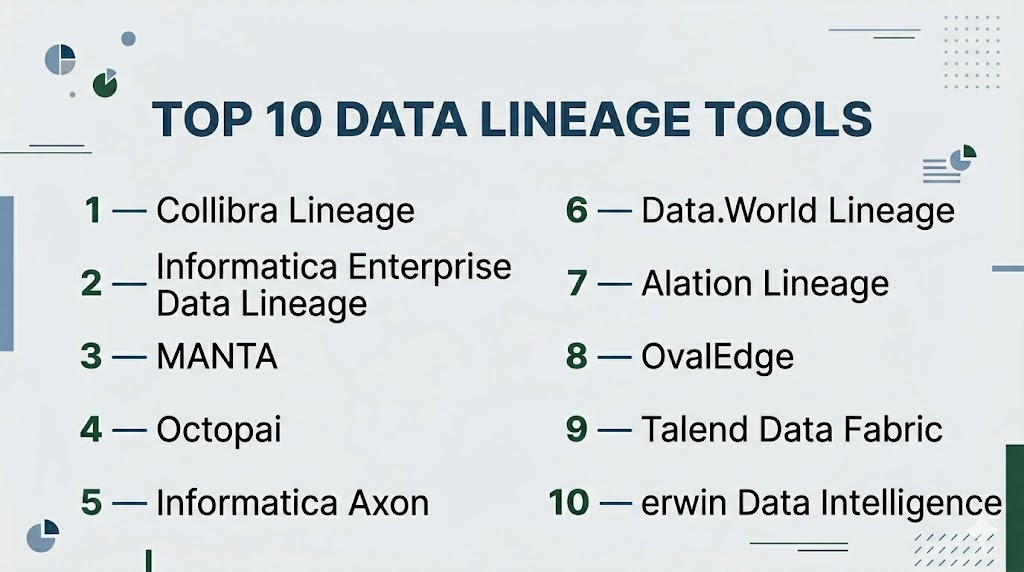
Top 10 Data Lineage Tools
#1 — Collibra Lineage
Short description:
Collibra Lineage provides enterprise-grade visibility into data flows and transformations. It is suited for organizations looking to enforce governance and trace data for compliance and operational efficiency.
Key Features
- Interactive lineage visualization
- Automated data discovery and mapping
- Integration with BI and ETL pipelines
- Data stewardship workflows
- Policy enforcement for compliance
- Collaboration features for teams
Pros
- Strong governance and audit capabilities
- Enterprise scalability
- Clear visualization of data flow
Cons
- Higher learning curve
- Premium pricing may be challenging for SMBs
Platforms / Deployment
- Web
- Cloud / On-prem / Hybrid
Security & Compliance
- SOC 2, ISO 27001, GDPR, RBAC
Integrations & Ecosystem
Integrates with Informatica, Snowflake, Tableau, Power BI, and ETL tools
Support & Community
Vendor support, knowledge base, and active enterprise community
#2 — Informatica Enterprise Data Lineage
Short description:
Informatica provides automated lineage tracking across complex ETL pipelines, offering AI-assisted metadata analysis and impact assessment for enterprise data.
Key Features
- AI-driven lineage discovery
- Data impact analysis
- Integration with Informatica suite and BI tools
- Metadata-driven governance workflows
- Collaboration and reporting capabilities
Pros
- Automated lineage reduces manual effort
- Scales for large enterprise environments
- Integrates well with ETL and data catalogs
Cons
- Requires Informatica ecosystem knowledge
- Implementation can be complex
Platforms / Deployment
- Web / Windows / Linux
- Cloud / On-prem / Hybrid
Security & Compliance
- SOC 2, ISO 27001, GDPR
Integrations & Ecosystem
Snowflake, Redshift, Tableau, Power BI, APIs
Support & Community
Enterprise support and documentation, active community
#3 — MANTA
Short description:
MANTA offers complete end-to-end data lineage visualization with automated extraction and real-time tracking. It is designed for compliance-heavy and data-intensive industries.
Key Features
- Automated ETL, SQL, and BI lineage extraction
- Data flow visualization
- Integration with data catalogs and quality tools
- Compliance and audit-ready reporting
- Collaboration and annotation features
Pros
- Full visibility into complex pipelines
- Supports multiple sources and formats
- Real-time impact analysis
Cons
- Premium cost for small teams
- Integration setup may require IT support
Platforms / Deployment
- Web / Windows / Linux
- Cloud / Hybrid
Security & Compliance
- SOC 2, GDPR, RBAC
Integrations & Ecosystem
Supports Snowflake, Redshift, Tableau, Power BI, APIs
Support & Community
Vendor support and knowledge base
#4 — Octopai
Short description:
Octopai automates metadata management and data lineage, providing self-service lineage for analytics and business users. It is suitable for mid-market to enterprise companies.
Key Features
- Automated data mapping and lineage
- Self-service discovery for analysts
- Integration with BI and ETL platforms
- Data impact and dependency analysis
- Collaboration and annotations
Pros
- Easy to use with minimal configuration
- Reduces manual lineage mapping
- Supports multi-cloud and hybrid environments
Cons
- Limited advanced governance features
- May need training for full adoption
Platforms / Deployment
- Web
- Cloud / Hybrid
Security & Compliance
- SOC 2, GDPR
Integrations & Ecosystem
Snowflake, Redshift, Tableau, Power BI, APIs
Support & Community
Vendor support, tutorials, and community forums
#5 — Informatica Axon
Short description:
Axon complements Informatica lineage by providing governance, stewardship, and policy enforcement across complex data ecosystems.
Key Features
- Centralized lineage and governance
- Stewardship workflows
- Data policy enforcement
- Collaboration and reporting
- Compliance tracking
Pros
- Enterprise-grade governance
- Integrates with Informatica suite
- Strong reporting and compliance
Cons
- Complexity for smaller teams
- Premium cost
Platforms / Deployment
- Web / Windows / Linux
- Cloud / On-prem / Hybrid
Security & Compliance
- SOC 2, ISO 27001, GDPR
Integrations & Ecosystem
Informatica EDC, Snowflake, Tableau, Power BI
Support & Community
Vendor support, documentation, and community
#6 — Data.World Lineage
Short description:
Data.World offers collaborative data lineage with social features, enabling business users to understand data dependencies easily.
Key Features
- Interactive lineage visualization
- Metadata and impact analysis
- Collaboration and annotation tools
- Integration with BI platforms
- Self-service discovery
Pros
- Easy adoption for analysts
- Collaborative interface
- Cloud-native and scalable
Cons
- Limited enterprise governance features
- Smaller scope for compliance reporting
Platforms / Deployment
- Web
- Cloud
Security & Compliance
- SOC 2, encryption
Integrations & Ecosystem
Snowflake, Redshift, Tableau, Power BI, APIs
Support & Community
Documentation, tutorials, and community forums
#7 — Alation Lineage
Short description:
Alation provides lineage mapping as part of its data catalog, enabling analytics teams to track data flow and transformations efficiently.
Key Features
- Data flow and transformation visualization
- Automated lineage capture
- Integration with catalogs and BI tools
- Policy enforcement
- Collaboration features
Pros
- Seamless integration with Alation catalog
- Strong governance support
- Visual and interactive lineage
Cons
- Works best with Alation ecosystem
- Premium pricing
Platforms / Deployment
- Web
- Cloud / Hybrid
Security & Compliance
- SOC 2, GDPR, RBAC
Integrations & Ecosystem
Snowflake, Redshift, Tableau, Power BI, APIs
Support & Community
Vendor support and training resources
#8 — OvalEdge
Short description:
OvalEdge automates lineage discovery and visualizes data dependencies, suitable for mid-market and enterprise companies.
Key Features
- Automated lineage extraction
- Impact analysis and dependency tracking
- Collaboration tools
- Integration with BI and ETL platforms
- Policy and governance support
Pros
- AI-assisted automation
- Scalable and user-friendly
- Real-time visualization
Cons
- Cloud-centric approach
- May require onboarding
Platforms / Deployment
- Web
- Cloud / Hybrid
Security & Compliance
- SOC 2, GDPR
Integrations & Ecosystem
Snowflake, Redshift, Tableau, Power BI, APIs
Support & Community
Vendor support, tutorials, and knowledge base
#9 — Talend Data Fabric
Short description:
Talend provides lineage as part of its data integration and governance platform, delivering visibility across ETL and pipelines.
Key Features
- ETL lineage tracking
- Metadata-driven governance
- Data impact analysis
- Collaboration features
- Compliance reporting
Pros
- Integrated with Talend platform
- Supports multiple sources
- Real-time lineage tracking
Cons
- Best for Talend users
- May require training
Platforms / Deployment
- Web / Windows / Linux
- Cloud / On-prem / Hybrid
Security & Compliance
- SOC 2, ISO 27001, GDPR
Integrations & Ecosystem
Talend Studio, Snowflake, Redshift, Tableau, APIs
Support & Community
Vendor support and community forums
#10 — erwin Data Intelligence
Short description:
erwin offers enterprise lineage visualization and governance, helping organizations maintain compliance and track data flow across complex pipelines.
Key Features
- Automated lineage discovery
- Data flow visualization
- Policy and compliance enforcement
- Integration with ETL and BI tools
- Collaboration features
Pros
- Enterprise-grade governance
- Detailed lineage visualization
- Compliance-ready
Cons
- Higher cost for small teams
- Complex onboarding
Platforms / Deployment
- Web
- Cloud / On-prem / Hybrid
Security & Compliance
- SOC 2, ISO 27001, GDPR, RBAC
Integrations & Ecosystem
Snowflake, Redshift, Tableau, Power BI, APIs
Support & Community
Enterprise support and documentation
Comparison Table (Top 10)
| Tool Name | Best For | Platform(s) Supported | Deployment | Standout Feature | Public Rating |
|---|---|---|---|---|---|
| Collibra Lineage | Enterprise governance | Web | Cloud / On-prem / Hybrid | Workflow automation | N/A |
| Informatica Enterprise Data Lineage | ETL pipelines | Web / Windows / Linux | Cloud / On-prem / Hybrid | AI-assisted metadata | N/A |
| MANTA | Compliance-heavy organizations | Web / Windows / Linux | Cloud / Hybrid | End-to-end lineage | N/A |
| Octopai | Mid-market / enterprise | Web | Cloud / Hybrid | Self-service lineage | N/A |
| Informatica Axon | Governance & stewardship | Web / Windows / Linux | Cloud / On-prem / Hybrid | Policy enforcement | N/A |
| Data.World Lineage | Analysts / collaborative teams | Web | Cloud | Social collaboration | N/A |
| Alation Lineage | Catalog users | Web | Cloud / Hybrid | Interactive visualization | N/A |
| OvalEdge | Mid-market | Web | Cloud / Hybrid | AI-assisted lineage | N/A |
| Talend Data Fabric | Talend users | Web / Windows / Linux | Cloud / On-prem / Hybrid | ETL lineage tracking | N/A |
| erwin Data Intelligence | Enterprise governance | Web | Cloud / On-prem / Hybrid | Compliance-ready visualization | N/A |
Evaluation & Scoring of Data Lineage Tools
| Tool Name | Core | Ease | Integrations | Security | Performance | Support | Value | Weighted Total |
|---|---|---|---|---|---|---|---|---|
| Collibra Lineage | 9 | 8 | 8 | 8 | 8 | 7 | 7 | 8.0 |
| Informatica Enterprise | 9 | 7 | 8 | 8 | 8 | 7 | 7 | 7.9 |
| MANTA | 8 | 7 | 8 | 8 | 8 | 7 | 7 | 7.7 |
| Octopai | 8 | 8 | 7 | 7 | 7 | 7 | 7 | 7.3 |
| Informatica Axon | 8 | 7 | 8 | 8 | 8 | 7 | 7 | 7.6 |
| Data.World Lineage | 7 | 8 | 7 | 7 | 7 | 7 | 7 | 7.1 |
| Alation Lineage | 8 | 8 | 7 | 7 | 7 | 7 | 7 | 7.3 |
| OvalEdge | 8 | 8 | 7 | 7 | 7 | 7 | 7 | 7.3 |
| Talend Data Fabric | 8 | 7 | 8 | 8 | 7 | 7 | 7 | 7.4 |
| erwin Data Intelligence | 8 | 7 | 8 | 8 | 8 | 7 | 7 | 7.6 |
Scores are comparative and highlight tools’ relative strengths in features, integrations, governance, and usability.
Which Data Lineage Tools Tool Is Right for You?
Solo / Freelancer
Cloud-native, lightweight options like Data.World allow lineage tracking without heavy investment.
SMB
Mid-market tools such as Octopai or OvalEdge provide self-service lineage and collaboration features.
Mid-Market
MANTA and Alation Lineage deliver AI-assisted discovery and governance for mid-sized organizations.
Enterprise
Collibra, Informatica, and erwin offer end-to-end lineage, governance, and compliance for complex environments.
Budget vs Premium
Cloud-native and mid-market tools reduce costs, while enterprise-grade platforms provide advanced lineage, governance, and compliance at higher pricing.
Feature Depth vs Ease of Use
Enterprise tools excel in depth and automation; mid-market tools focus on usability and collaboration.
Integrations & Scalability
Enterprise tools integrate broadly with ETL, BI, and analytics platforms, scaling for large datasets.
Security & Compliance Needs
SOC 2, ISO 27001, GDPR, RBAC, and audit logs are critical for regulated industries.
Frequently Asked Questions (FAQs)
1. What are data lineage tools?
Platforms to track the flow and transformations of data across pipelines and systems.
2. Why is data lineage important?
It ensures data quality, traceability, compliance, and operational transparency.
3. Who uses them?
Data engineers, analysts, governance teams, and compliance officers.
4. Can they handle real-time data?
Many platforms offer near real-time lineage tracking and impact analysis.
5. Are they cloud-only?
Most are cloud-native, with hybrid and on-prem options available.
6. Do they integrate with ETL tools?
Yes, they commonly integrate with Talend, Informatica, Alteryx, and others.
7. Are AI features available?
Some platforms use AI for automated lineage discovery, metadata enrichment, and anomaly detection.
8. How do they support compliance?
Enterprise tools provide audit-ready lineage, policy enforcement, and GDPR/SOC 2/HIPAA compliance.
9. Can small teams benefit?
Yes, cloud-native and lightweight platforms allow lineage tracking for smaller datasets.
10. How do they help analysts?
They provide visual flow, impact analysis, and self-service discovery to improve decision-making.
Conclusion
Data lineage tools are essential for understanding, governing, and trusting enterprise data. Choosing the right platform depends on organizational size, data complexity, and compliance requirements. Companies should shortlist tools, run pilots, and validate integrations, governance, and security features to ensure accurate lineage tracking and improved data-driven decisions.

Find Trusted Cardiac Hospitals
Compare heart hospitals by city and services — all in one place.
Explore Hospitals
A new pipeline, renamed table, or changed data source can make an old lineage map misleading. Teams should review lineage after major changes and flag areas that have not been updated. This can help people trust the lineage information when they need it for troubleshooting or impact analysis.