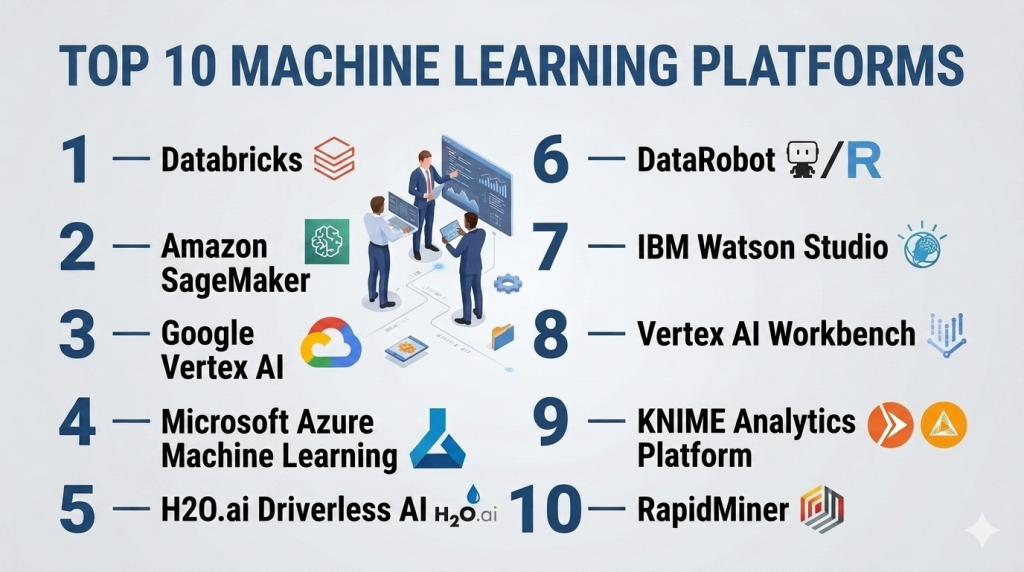
Introduction
Machine learning platforms are comprehensive software environments that enable organizations to build, train, deploy, and manage machine learning models efficiently. They provide tools for data preprocessing, model development, experiment tracking, and production deployment in a unified ecosystem. In these platforms are critical for businesses seeking to leverage AI and predictive analytics to gain competitive advantage, automate processes, and enhance decision-making.
Use cases for machine learning platforms include predictive maintenance for manufacturing equipment, recommendation engines for e-commerce, fraud detection in financial services, customer churn prediction in telecom, and image or video analysis in healthcare. Buyers evaluating platforms should focus on criteria such as:
- Model development and training capabilities
- Support for multiple ML frameworks and languages
- Scalability for large datasets and distributed compute
- Experiment tracking and reproducibility
- Deployment and MLOps support
- Collaboration features for teams
- Integration with data sources and enterprise systems
- Security and compliance controls
- Cost and pricing models
- Community and support resources
Best for: Data scientists, ML engineers, AI teams, and enterprises of all sizes seeking scalable and collaborative platforms.
Not ideal for: Small teams with minimal ML needs or teams requiring only simple scripting; alternatives like notebook environments or cloud APIs may suffice.
Key Trends in Machine Learning Platforms
- Increasing integration of generative AI and large language model support for automated feature engineering and model creation
- Shift towards end-to-end MLOps platforms integrating training, deployment, monitoring, and model governance
- Adoption of no-code and low-code ML tools for broader accessibility among business users
- Emphasis on cloud-native deployments and elastic compute for large-scale model training
- Improved experiment tracking, reproducibility, and versioning features
- Enhanced security and compliance including SOC 2, GDPR, and HIPAA certifications
- Interoperability with data warehouses, lakes, and orchestration tools
- Modular architecture with plug-ins for visualization, data preprocessing, and model monitoring
- Flexible pricing models, including subscription, pay-as-you-go, and enterprise licensing
- Focus on collaboration tools for distributed teams and hybrid workflows
How We Selected These Tools (Methodology)
- Evaluated market adoption, mindshare, and enterprise penetration globally
- Assessed completeness of ML features including data ingestion, model training, deployment, and monitoring
- Considered performance and reliability signals for large-scale datasets
- Analyzed security posture including authentication, encryption, and audit capabilities
- Examined ecosystem integrations, APIs, and framework support
- Reviewed customer fit across solo users, SMBs, mid-market, and enterprise segments
- Considered collaboration and team productivity features
- Prioritized active development, vendor support, and roadmap clarity
- Balanced open-source flexibility with enterprise-grade solutions
- Assessed community engagement, tutorials, and knowledge resources
Top 10 Machine Learning Platforms Tools
#1 — Databricks
Short description : Databricks is an enterprise-grade, cloud-native ML platform built on Apache Spark, designed to handle big data analytics and machine learning at scale. It targets data engineering, ML, and AI teams in large enterprises needing distributed computing capabilities.
Key Features
- Distributed training with Spark clusters
- Unified analytics and ML workflow
- MLflow integration for experiment tracking
- Real-time collaboration on notebooks
- Automated hyperparameter tuning
- Integration with cloud data sources
- Support for Python, R, SQL, Scala
Pros
- Handles massive datasets efficiently
- Strong collaboration and governance
- Comprehensive ML lifecycle support
Cons
- High cost for smaller teams
- Learning curve for Spark
- Cloud-only deployment
Platforms / Deployment
- Web / Windows / macOS / Linux
- Cloud
Security & Compliance
- SOC 2, ISO 27001, GDPR
- Encryption, RBAC, SSO
Integrations & Ecosystem
Databricks integrates with popular ML frameworks, data lakes, and BI tools.
- AWS, Azure, GCP
- TensorFlow, PyTorch, Scikit-learn
- MLflow, Delta Lake
- REST APIs
Support & Community
Enterprise support available; extensive documentation; active professional community.
#2 — Amazon SageMaker
Short description : Amazon SageMaker is a fully managed ML platform offering development, training, and deployment of machine learning models. It is ideal for enterprises leveraging AWS for cloud infrastructure and large-scale ML operations.
Key Features
- Built-in algorithms and frameworks
- AutoML capabilities
- Integrated MLOps pipelines
- Managed training and deployment
- Real-time inference endpoints
- Model monitoring and drift detection
- Python and R support
Pros
- Deep AWS ecosystem integration
- Scalable training and inference
- Comprehensive MLOps support
Cons
- AWS-dependent for full capabilities
- Complex pricing
- Requires cloud expertise
Platforms / Deployment
- Web
- Cloud
Security & Compliance
- SOC 2, ISO 27001, HIPAA, GDPR
- SSO, encryption, audit logs
Integrations & Ecosystem
- AWS services: S3, Lambda, Redshift
- ML frameworks: TensorFlow, PyTorch
- APIs and SDKs for automation
Support & Community
AWS support tiers; active forums; extensive documentation.
#3 — Google Vertex AI
Short description : Vertex AI is Google Cloud’s unified ML platform, designed for enterprises to build, deploy, and scale ML models efficiently. It supports end-to-end ML workflows with a focus on MLOps and AI integration.
Key Features
- Managed notebooks and pipelines
- AutoML and pre-built models
- Model monitoring and explanation
- Scalable training with TPUs/GPUs
- Support for TensorFlow, PyTorch, XGBoost
- Integrated data labeling services
Pros
- Tight Google Cloud integration
- Easy deployment of models to production
- Strong experiment tracking and monitoring
Cons
- Cloud-only platform
- Cost can be high for compute-intensive tasks
- Limited offline capabilities
Platforms / Deployment
- Web
- Cloud
Security & Compliance
- SOC 2, ISO 27001, GDPR, HIPAA
- Encryption, RBAC, audit logs
Integrations & Ecosystem
- BigQuery, Cloud Storage, AI APIs
- TensorFlow, PyTorch
- REST APIs
Support & Community
Google Cloud enterprise support; active user forums and tutorials.
#4 — Microsoft Azure Machine Learning
Short description : Azure Machine Learning is Microsoft’s cloud-based ML platform enabling model development, training, deployment, and MLOps. It is ideal for enterprises embedded in the Microsoft ecosystem.
Key Features
- Designer drag-and-drop interface
- Automated ML and hyperparameter tuning
- Model registry and deployment pipelines
- Support for Python, R, and ML frameworks
- Integration with Azure data services
- Compute clusters for training
Pros
- Enterprise-grade security and compliance
- Deep integration with Azure services
- Scalable model training and deployment
Cons
- Azure-focused; less flexible outside ecosystem
- Learning curve for advanced features
- Cost can escalate for large workloads
Platforms / Deployment
- Web
- Cloud
Security & Compliance
- SOC 2, ISO 27001, GDPR, HIPAA
- Encryption, RBAC, SSO
Integrations & Ecosystem
- Azure Data Lake, SQL Database
- TensorFlow, PyTorch, Scikit-learn
- REST APIs, SDKs
Support & Community
Microsoft support tiers; comprehensive documentation; strong enterprise adoption.
#5 — H2O.ai Driverless AI
Short description : H2O.ai Driverless AI is an automated ML platform designed for rapid model building, feature engineering, and deployment. It targets data science teams aiming to accelerate predictive analytics workflows.
Key Features
- AutoML for classification, regression, and time series
- Automatic feature engineering
- Interpretability tools and insights
- Deployment to production endpoints
- Python and R integration
- GPU acceleration for model training
Pros
- Fast model development
- Built-in explainability and interpretability
- Strong performance on tabular datasets
Cons
- Premium pricing for enterprise features
- Cloud and hardware requirements for large models
- Less flexible for custom workflows
Platforms / Deployment
- Windows / macOS / Linux
- Cloud / Self-hosted
Security & Compliance
- Not publicly stated
Integrations & Ecosystem
- REST APIs for deployment
- Integration with Spark, Hadoop, and data lakes
- Python/R SDKs
Support & Community
Enterprise support tiers; active community forums; documentation available.
#6 — DataRobot
Short description : DataRobot is an enterprise ML platform emphasizing automation, model governance, and MLOps. It is designed for enterprises requiring robust model deployment, monitoring, and compliance capabilities.
Key Features
- Automated ML with feature engineering
- Model explainability and monitoring
- End-to-end MLOps pipelines
- Python and R integration
- Deployment to cloud or on-prem
- Collaborative workspace for teams
Pros
- Strong governance and compliance tools
- Accelerates model delivery
- Enterprise-focused collaboration features
Cons
- Premium pricing
- Complexity for small teams
- Cloud-first model may require adaptation for on-prem users
Platforms / Deployment
- Web
- Cloud / Hybrid
Security & Compliance
- SOC 2, ISO 27001, GDPR
- Encryption, RBAC
Integrations & Ecosystem
- Cloud storage: AWS, GCP, Azure
- ML frameworks: TensorFlow, PyTorch
- REST APIs, monitoring tools
Support & Community
Enterprise support tiers; detailed documentation; active professional network.
#7 — IBM Watson Studio
Short description : Watson Studio is IBM’s cloud ML platform offering data prep, modeling, training, and deployment. Best suited for enterprises seeking AI-powered analytics and integration with IBM Cloud.
Key Features
- Automated model building and deployment
- Collaborative notebooks and dashboards
- Python, R, and SPSS support
- Integration with IBM Cloud and Watson APIs
- MLOps capabilities for production models
- Scalable compute and storage
Pros
- Strong enterprise AI ecosystem
- Collaborative features for teams
- Scalable infrastructure
Cons
- IBM ecosystem dependency
- Pricing can be high
- Complexity for small teams
Platforms / Deployment
- Web
- Cloud
Security & Compliance
- SOC 2, ISO 27001, GDPR
- Encryption, RBAC, audit logs
Integrations & Ecosystem
- IBM Cloud data services
- Watson AI APIs
- Python/R SDKs
Support & Community
IBM enterprise support; strong documentation; professional community.
#8 — Vertex AI Workbench
Short description : Vertex AI Workbench is Google Cloud’s integrated development environment for machine learning, providing unified tools for notebooks, pipelines, and deployment. It is suited for ML teams needing streamlined development workflows.
Key Features
- Managed notebooks with scalable compute
- Pipeline orchestration for MLOps
- AutoML and pre-trained model integration
- Python and TensorFlow support
- Model monitoring and explainability
Pros
- Integrated Google Cloud services
- Simplifies end-to-end ML workflows
- Supports collaborative projects
Cons
- Cloud-only
- Limited offline or on-prem support
- Cost scales with compute usage
Platforms / Deployment
- Web
- Cloud
Security & Compliance
- SOC 2, ISO 27001, GDPR, HIPAA
- SSO, encryption
Integrations & Ecosystem
- BigQuery, Cloud Storage
- TensorFlow, PyTorch
- REST APIs
Support & Community
Google Cloud support tiers; documentation extensive; active forums.
#9 — KNIME Analytics Platform
Short description : KNIME is an open-source ML and data analytics platform offering workflow-based automation, model training, and deployment. It is ideal for analysts, data engineers, and small to mid-sized teams.
Key Features
- Visual workflow design
- Integration with Python, R, and Java
- AutoML and model validation
- Data preprocessing and transformation nodes
- Scalable compute with server option
- Community extensions and plugins
Pros
- Open-source and cost-effective
- Strong data integration capabilities
- Easy to use for analysts
Cons
- Steeper learning curve for advanced ML
- GUI-centric may limit flexibility
- Cloud deployment requires KNIME Server
Platforms / Deployment
- Windows / macOS / Linux
- Self-hosted / Hybrid
Security & Compliance
- Not publicly stated
Integrations & Ecosystem
- Databases: SQL, NoSQL
- ML frameworks: TensorFlow, Scikit-learn
- APIs and community extensions
Support & Community
Community support; paid enterprise support available; active user forum.
#10 — RapidMiner
Short description : RapidMiner is a data science and ML platform offering automated model building, visual workflows, and deployment tools. It caters to businesses seeking rapid insights with minimal coding.
Key Features
- Visual workflow and drag-and-drop interface
- Automated ML with hyperparameter tuning
- Python and R integration
- Model deployment and monitoring
- Pre-built templates for common use cases
- Collaboration features for teams
Pros
- Reduces coding complexity
- Fast model deployment
- Enterprise features for governance
Cons
- GUI-focused limits advanced customization
- Licensing costs for enterprise tiers
- Cloud options may be limited compared to competitors
Platforms / Deployment
- Windows / macOS / Linux / Web
- Cloud / Self-hosted / Hybrid
Security & Compliance
- Not publicly stated
Integrations & Ecosystem
- Database connectors
- ML frameworks and Python/R integration
- REST APIs
Support & Community
Documentation and tutorials available; enterprise support options; active professional forums.
Comparison Table (Top 10)
| Tool Name | Best For | Platform(s) Supported | Deployment | Standout Feature | Public Rating |
|---|---|---|---|---|---|
| Databricks | Big data ML teams | Web/Windows/macOS/Linux | Cloud | Distributed Spark computing | N/A |
| Amazon SageMaker | AWS users, enterprise | Web | Cloud | Managed training and deployment | N/A |
| Google Vertex AI | End-to-end ML workflows | Web | Cloud | MLOps pipeline integration | N/A |
| Azure ML | Microsoft ecosystem | Web | Cloud | Automated ML and pipelines | N/A |
| H2O.ai Driverless AI | Automated ML, feature engineering | Windows/macOS/Linux | Cloud/Self-hosted | AutoML and interpretability | N/A |
| DataRobot | Enterprise ML automation | Web | Cloud/Hybrid | Governance and MLOps | N/A |
| IBM Watson Studio | Enterprise AI and analytics | Web | Cloud | AI integration with IBM Cloud | N/A |
| Vertex AI Workbench | Google Cloud ML teams | Web | Cloud | Managed notebooks and compute | N/A |
| KNIME Analytics | Open-source workflow ML | Windows/macOS/Linux | Self-hosted/Hybrid | Visual workflow automation | N/A |
| RapidMiner | Rapid ML insights | Windows/macOS/Linux/Web | Cloud/Self-hosted/Hybrid | GUI-based ML workflow | N/A |
Evaluation & Scoring of Machine Learning Platforms
| Tool Name | Core (25%) | Ease (15%) | Integrations (15%) | Security (10%) | Performance (10%) | Support (10%) | Value (15%) | Weighted Total (0–10) |
|---|---|---|---|---|---|---|---|---|
| Databricks | 9 | 7 | 9 | 9 | 9 | 8 | 6 | 8.3 |
| Amazon SageMaker | 8 | 7 | 8 | 9 | 8 | 7 | 7 | 7.9 |
| Google Vertex AI | 8 | 7 | 8 | 9 | 8 | 7 | 6 | 7.8 |
| Azure ML | 8 | 7 | 7 | 9 | 8 | 7 | 7 | 7.8 |
| H2O.ai Driverless AI | 8 | 7 | 7 | 6 | 8 | 7 | 7 | 7.4 |
| DataRobot | 8 | 7 | 8 | 8 | 8 | 7 | 6 | 7.6 |
| IBM Watson Studio | 8 | 7 | 7 | 9 | 8 | 7 | 6 | 7.5 |
| Vertex AI Workbench | 8 | 7 | 7 | 9 | 8 | 7 | 6 | 7.5 |
| KNIME Analytics | 7 | 7 | 7 | 6 | 7 | 6 | 8 | 7.0 |
| RapidMiner | 7 | 7 | 7 | 6 | 7 | 6 | 7 | 6.9 |
Scores are comparative and help organizations identify platforms that excel in core features, integration, security, performance, support, and value. Weighted totals allow for prioritization based on organizational needs.
Which Machine Learning Platforms Tool Is Right for You?
Solo / Freelancer
Google Vertex AI Workbench, KNIME, or H2O.ai offer free or entry-tier options with minimal setup, ideal for solo ML projects and experimentation.
SMB
RapidMiner, DataRobot, or Deepnote provide user-friendly automation and collaboration for small to mid-sized analytics teams.
Mid-Market
Databricks, Amazon SageMaker, and Vertex AI are suited for scaling ML workloads, enabling distributed computing and MLOps.
Enterprise
Azure ML, IBM Watson Studio, Databricks, and DataRobot cater to regulatory compliance, large-scale collaboration, and advanced deployment needs.
Budget vs Premium
Open-source options like KNIME and H2O.ai are cost-effective. Premium platforms provide scalability, enterprise support, and advanced MLOps features.
Feature Depth vs Ease of Use
Databricks, SageMaker, and DataRobot offer comprehensive feature sets; RapidMiner and KNIME emphasize ease-of-use with GUI workflows.
Integrations & Scalability
Cloud-native platforms such as Vertex AI, SageMaker, and Azure ML excel at integrating with cloud services and scaling training and inference.
Security & Compliance Needs
Enterprise-grade platforms (Databricks, IBM Watson Studio, Azure ML) provide certifications, encryption, and role-based access, while open-source tools require additional configuration.
Frequently Asked Questions (FAQs)
1. What is the pricing model for ML platforms?
Pricing varies: open-source tools are free, while cloud platforms use subscription or pay-as-you-go based on compute, storage, and team size.
2. How quickly can teams onboard?
Cloud platforms with managed services offer rapid onboarding; self-hosted platforms like KNIME require setup and training.
3. Can multiple users collaborate?
Yes, platforms like Databricks, Vertex AI, and DataRobot enable team collaboration and real-time workflow sharing.
4. Are these platforms secure for sensitive data?
Enterprise cloud platforms offer SOC 2, ISO 27001, HIPAA, and GDPR compliance; open-source deployments require custom security configurations.
5. Which ML frameworks are supported?
Most platforms support Python, R, TensorFlow, PyTorch, Scikit-learn, and XGBoost, depending on deployment.
6. How scalable are these platforms?
Cloud-native solutions (Databricks, Vertex AI, SageMaker) handle large datasets and distributed compute efficiently; GUI-based tools are better for smaller datasets.
7. Can I deploy models to production easily?
Yes, enterprise platforms provide MLOps pipelines for deployment, monitoring, and versioning, while open-source tools require additional configuration.
8. How easy is it to switch platforms?
Exporting models via standard formats (ONNX, PMML) ensures portability. Some platform-specific features may need adaptation.
9. Are there alternatives?
Yes, notebook environments, custom ML pipelines, or cloud APIs can serve small-scale or prototype use cases.
10. Do platforms support reproducibility?
Yes, enterprise tools provide versioning, experiment tracking, and environment management to ensure reproducible workflows.
Conclusion
Machine learning platforms are essential for enterprises seeking to implement AI and predictive analytics at scale. The “best” platform depends on team size, deployment preferences, budget, required frameworks, and compliance needs. Open-source tools like KNIME or H2O.ai are flexible and cost-effective for small to mid-sized teams, while cloud-native enterprise solutions such as Databricks, SageMaker, Azure ML, and Vertex AI provide scalability, MLOps pipelines, and collaboration for large organizations. Buyers should evaluate integration capabilities, performance, and security before committing. Running pilot projects or trials can help organizations determine the best platform fit, ensuring ML initiatives deliver maximum business impact

Find Trusted Cardiac Hospitals
Compare heart hospitals by city and services — all in one place.
Explore Hospitals
An ML project may depend on specific APIs, services, or platform features that are difficult to move later. Teams should keep important workflows as portable as possible and document platform-specific dependencies. This can make future migration or switching platforms much easier.