Introduction
Active learning tooling refers to software platforms and frameworks that enable machine learning models to iteratively improve by selecting the most informative data points for annotation or model training. Rather than labeling large datasets blindly, active learning prioritizes data that will yield the highest value for improving model accuracy. This approach reduces annotation costs, accelerates model development, and allows teams to focus resources strategically. active learning tools are more crucial than ever due to the explosion of data, the complexity of AI models, and the growing demand for domain-specific, high-quality labeled datasets. Businesses across industries from healthcare and finance to e-commerce and autonomous systems need smarter ways to train models with limited labeled data.
Real-world use cases include:
- Improving NLP models for customer support or chatbots using selective data labeling.
- Enhancing computer vision datasets in medical imaging, autonomous vehicles, or retail analytics.
- Prioritizing edge cases for fraud detection, anomaly detection, or cybersecurity models.
- Optimizing recommendation engines by selectively labeling ambiguous user interactions.
- Supporting domain adaptation when deploying models across regions or verticals with limited labeled data.
Evaluation criteria for buyers:
- Model compatibility and flexibility across ML frameworks
- Ease of integration with labeling platforms and pipelines
- Support for multiple data types (text, image, audio, video)
- Annotation workflow management and human-in-the-loop features
- Active learning strategy options (uncertainty sampling, diversity sampling, etc.)
- Scalability and performance on large datasets
- Security, compliance, and access control
- Cost efficiency and licensing flexibility
- Community support and documentation
Best for: Data scientists, ML engineers, AI teams, and organizations managing iterative labeling workflows across small to large-scale datasets.
Not ideal for: Teams with fully labeled datasets, low-volume ML projects, or scenarios where standard batch training suffices without iterative selection.
Key Trends in Active Learning Tooling
- Increasing integration of AI-assisted labeling to accelerate annotation workflows.
- Hybrid human-in-the-loop pipelines combining automated labeling with selective human review.
- Support for multi-modal data, including text, images, audio, and video.
- Enhanced interpretability and transparency in active learning decision-making.
- Cloud-native deployment with collaborative annotation platforms.
- Advanced uncertainty and diversity sampling strategies leveraging modern ML metrics.
- Security-focused platforms supporting enterprise access control and compliance (SOC 2, ISO 27001, GDPR).
- API-first architectures for seamless integration into MLOps pipelines.
- Subscription-based SaaS pricing models emphasizing scalability and elastic usage.
- Use of active learning in low-data regimes, domain adaptation, and transfer learning scenarios.
How We Selected These Tools (Methodology)
- Evaluated market adoption and industry mindshare for active learning tooling.
- Reviewed feature completeness, including data type support and active learning strategies.
- Assessed reliability and performance signals from customer use cases.
- Considered security posture, including authentication, encryption, and compliance standards.
- Examined integrations with labeling platforms, ML frameworks, and MLOps tools.
- Determined suitability across solo developers, SMBs, mid-market, and enterprise users.
- Reviewed community support, documentation, and onboarding experience.
- Considered pricing flexibility and cost efficiency for iterative labeling workflows.
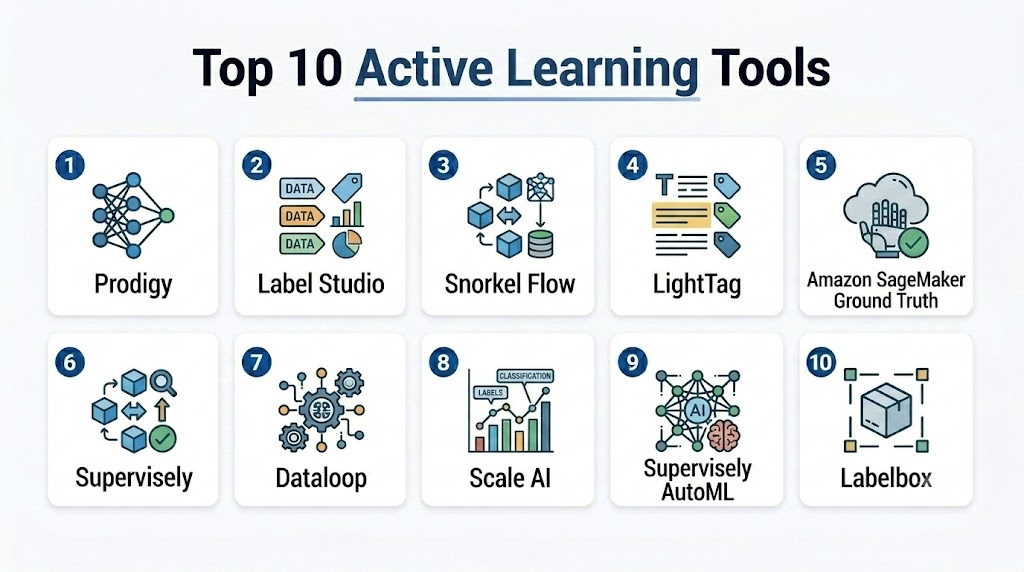
Top 10 Active Learning Tools
1- Prodigy
Short description: A Python-based annotation tool designed for active learning workflows, suitable for NLP and computer vision tasks.
Key Features
- Supports text, image, and multi-modal data annotation.
- Active learning loop with model-in-the-loop suggestions.
- Customizable workflows and scripts for domain-specific tasks.
- Integration with spaCy and PyTorch.
- Real-time annotation feedback and model updates.
- Efficient data management for iterative labeling.
Pros
- Highly flexible for developers familiar with Python.
- Speeds up labeling with intelligent pre-suggestions.
Cons
- Requires coding knowledge to unlock full potential.
- Not fully cloud-hosted; deployment is self-managed.
Platforms / Deployment
- Windows / macOS / Linux
- Self-hosted
Security & Compliance
Not publicly stated
Integrations & Ecosystem
Prodigy integrates easily with Python-based ML frameworks.
- spaCy
- PyTorch
- TensorFlow (via adapters)
- Custom Python scripts
Support & Community
Strong documentation, active community forums; onboarding support varies.
2- Label Studio
Short description: Open-source data labeling platform with active learning support for text, audio, image, and video.
Key Features
- Multi-modal annotation support.
- Active learning pipelines with uncertainty and diversity sampling.
- Extensible via REST API and SDK.
- Role-based access control and collaboration workflows.
- Supports cloud and on-prem deployment.
Pros
- Flexible, open-source, and widely adopted.
- Supports complex multi-user workflows.
Cons
- UI can be less polished for non-technical users.
- Performance may require tuning on large datasets.
Platforms / Deployment
- Web / Windows / macOS / Linux
- Cloud / Self-hosted
Security & Compliance
Not publicly stated
Integrations & Ecosystem
Supports integration with ML frameworks and workflow automation tools.
- Python SDK
- TensorFlow, PyTorch
- MLOps pipelines
Support & Community
Active open-source community; commercial support via provider.
3- Snorkel Flow
Short description: Enterprise-grade data-centric AI platform enabling programmatic labeling with active learning loops.
Key Features
- Programmatic labeling and weak supervision.
- Active learning with model-in-the-loop.
- Data quality monitoring and labeling analytics.
- Scales to large datasets with cloud-based infrastructure.
- Integration with MLOps pipelines.
Pros
- Reduces manual labeling via programmatic strategies.
- Strong enterprise features for governance and scaling.
Cons
- Steeper learning curve for beginners.
- Proprietary platform, not open-source.
Platforms / Deployment
- Web
- Cloud
Security & Compliance
Not publicly stated
Integrations & Ecosystem
- Python APIs
- Cloud ML platforms
- MLOps frameworks
Support & Community
Commercial support; growing community resources.
4- LightTag
Short description: Collaborative annotation platform for NLP with active learning suggestions.
Key Features
- Team-based text annotation with model suggestions.
- Active learning-driven sentence prioritization.
- Annotation consistency monitoring.
- Project management dashboards for labeling teams.
- API access for ML model integration.
Pros
- Streamlines team workflows and quality assurance.
- Reduces labeling time with intelligent suggestions.
Cons
- Focused mainly on NLP, less on multi-modal data.
- Subscription pricing can be high for small teams.
Platforms / Deployment
- Web
- Cloud
Security & Compliance
Not publicly stated
Integrations & Ecosystem
- REST API
- Python SDK
- Direct export to common ML frameworks
Support & Community
Documentation, onboarding support, and active user community.
5- Amazon SageMaker Ground Truth
Short description: Fully managed labeling service with active learning for images, text, video, and 3D data.
Key Features
- Human-in-the-loop labeling with ML pre-labeling.
- Automatic active learning for efficiency.
- Supports multi-modal datasets.
- Integrated with AWS ecosystem for deployment.
- Cost optimization via incremental labeling.
Pros
- Enterprise-grade scalability and reliability.
- Tight integration with AWS ML services.
Cons
- Cloud-only, vendor lock-in.
- Can be expensive for smaller teams.
Platforms / Deployment
- Web
- Cloud
Security & Compliance
SSO, encryption, IAM policies; AWS compliance standards (SOC 2, ISO 27001)
Integrations & Ecosystem
- AWS ML stack
- APIs for custom ML pipelines
- S3 and data lakes
Support & Community
AWS support tiers; active documentation and community forums.
6- Supervisely
Short description: Visual data labeling and active learning platform for computer vision projects.
Key Features
- Collaborative annotation for images and videos.
- Active learning loops with model-in-the-loop suggestions.
- Dataset versioning and project management.
- Pre-trained model integration for pre-annotations.
- Scalable cloud and on-prem deployment.
Pros
- Optimized for computer vision.
- Supports large datasets efficiently.
Cons
- Steeper learning curve for non-technical teams.
- Focused on CV; less NLP support.
Platforms / Deployment
- Web / Windows / macOS / Linux
- Cloud / Self-hosted / Hybrid
Security & Compliance
Not publicly stated
Integrations & Ecosystem
- Python SDK
- TensorFlow, PyTorch
- Cloud storage systems
Support & Community
Documentation, community forums; enterprise support available.
7- Dataloop
Short description: End-to-end active learning platform for AI pipelines, specializing in CV and sensor data.
Key Features
- Human-in-the-loop annotation workflows.
- Active learning prioritization for model retraining.
- Automated quality assurance and labeling pipelines.
- Multi-modal support (images, video, sensor).
- Cloud-based collaborative platform.
Pros
- Efficient for iterative model improvement.
- Enterprise-ready with workflow automation.
Cons
- Less focus on NLP.
- Subscription pricing may be high for SMBs.
Platforms / Deployment
- Web
- Cloud
Security & Compliance
Not publicly stated
Integrations & Ecosystem
- Python SDK
- REST APIs
- ML frameworks integration
Support & Community
Professional onboarding and support; documentation available.
8- Scale AI
Short description: Active learning-enabled labeling service for structured and unstructured data.
Key Features
- Human-in-the-loop annotation with AI suggestions.
- Active learning pipelines for efficient labeling.
- Multi-modal support including LiDAR, images, text.
- Quality control dashboards and analytics.
- Cloud-based platform with collaboration features.
Pros
- Highly scalable for enterprise data pipelines.
- Strong multi-modal support.
Cons
- Service cost can be significant for startups.
- Mostly cloud-based; limited self-hosting options.
Platforms / Deployment
- Web
- Cloud
Security & Compliance
Not publicly stated
Integrations & Ecosystem
- API-based access
- Integration with ML frameworks
- Export to MLOps pipelines
Support & Community
Commercial support with documentation; community limited.
9- Supervisely AutoML
Short description: Active learning-oriented AutoML tool for vision models, integrating labeling and model training.
Key Features
- End-to-end CV model development with labeling.
- Active learning feedback for dataset curation.
- Pre-trained models and fine-tuning pipelines.
- Collaborative annotation and model tracking.
- Cloud and on-prem deployment options.
Pros
- Simplifies CV model building with integrated active learning.
- Supports iterative data improvement loops.
Cons
- Primarily CV; not suitable for NLP or audio.
- Platform complexity may overwhelm small teams.
Platforms / Deployment
- Web / Windows / Linux
- Cloud / Hybrid
Security & Compliance
Not publicly stated
Integrations & Ecosystem
- TensorFlow, PyTorch
- Python SDK
- Cloud storage integration
Support & Community
Professional support, knowledge base, community forums.
10- Labelbox
Short description: Enterprise-grade data labeling and active learning platform for images, video, and text.
Key Features
- Active learning pipelines with model-in-the-loop.
- Collaborative labeling and workflow management.
- Dataset versioning and auditing.
- Multi-modal support.
- API and SDK for integration into ML pipelines.
Pros
- Scalable enterprise solution.
- Streamlines labeling and model feedback loops.
Cons
- Can be expensive for small teams.
- Steeper learning curve for complex pipelines.
Platforms / Deployment
- Web
- Cloud
Security & Compliance
Not publicly stated
Integrations & Ecosystem
- Python SDK
- ML framework integration
- MLOps pipeline connectivity
Support & Community
Documentation, enterprise support, active user forums.
Comparison Table (Top 10)
| Tool Name | Best For | Platform(s) Supported | Deployment | Standout Feature | Public Rating |
|---|---|---|---|---|---|
| Prodigy | NLP & CV developers | Windows, macOS, Linux | Self-hosted | Model-in-the-loop suggestions | N/A |
| Label Studio | Multi-modal labeling | Web, Windows, macOS, Linux | Cloud/Self-hosted | Open-source flexibility | N/A |
| Snorkel Flow | Programmatic labeling | Web | Cloud | Weak supervision pipelines | N/A |
| LightTag | Team-based NLP labeling | Web | Cloud | Collaborative annotation dashboards | N/A |
| Amazon SageMaker Ground Truth | Enterprise multi-modal | Web | Cloud | ML-assisted pre-labeling | N/A |
| Supervisely | Computer vision projects | Web, Windows, macOS, Linux | Cloud/Self-hosted/Hybrid | Collaborative CV annotation | N/A |
| Dataloop | AI pipelines for CV & sensors | Web | Cloud | Automated QA & active learning | N/A |
| Scale AI | Multi-modal enterprise labeling | Web | Cloud | Scalable labeling & active learning | N/A |
| Supervisely AutoML | CV AutoML & labeling | Web, Windows, Linux | Cloud/Hybrid | End-to-end CV workflow with active learning | N/A |
| Labelbox | Enterprise labeling & AI pipelines | Web | Cloud | Active learning with multi-modal support | N/A |
Evaluation & Scoring of Active Learning Tooling
| Tool Name | Core (25%) | Ease (15%) | Integrations (15%) | Security (10%) | Performance (10%) | Support (10%) | Value (15%) | Weighted Total (0–10) |
|---|---|---|---|---|---|---|---|---|
| Prodigy | 9 | 7 | 8 | 6 | 8 | 7 | 7 | 7.85 |
| Label Studio | 8 | 7 | 7 | 6 | 7 | 7 | 8 | 7.55 |
| Snorkel Flow | 9 | 6 | 8 | 7 | 8 | 7 | 6 | 7.65 |
| LightTag | 7 | 8 | 7 | 6 | 7 | 8 | 7 | 7.35 |
| Amazon SageMaker Ground Truth | 8 | 7 | 7 | 8 | 9 | 8 | 6 | 7.75 |
| Supervisely | 8 | 7 | 8 | 6 | 8 | 7 | 7 | 7.55 |
| Dataloop | 8 | 7 | 7 | 6 | 8 | 7 | 6 | 7.2 |
| Scale AI | 9 | 6 | 7 | 6 | 9 | 7 | 6 | 7.45 |
| Supervisely AutoML | 8 | 6 | 7 | 6 | 8 | 7 | 6 | 7.1 |
| Labelbox | 8 | 7 | 8 | 7 | 8 | 8 | 6 | 7.55 |
Which Active Learning Tool Is Right for You?
Solo / Freelancer
Prodigy and Label Studio are ideal due to low setup overhead and strong Python ecosystem integration. They allow rapid experimentation and selective labeling on small datasets.
SMB
LightTag or Label Studio provide collaborative workflows, active learning prioritization, and affordable deployment options. Teams benefit from pre-configured workflows without complex MLOps integration.
Mid-Market
Dataloop and Supervisely balance scalability and cost, enabling mid-sized teams to run multi-modal labeling with active learning loops efficiently.
Enterprise
Amazon SageMaker Ground Truth, Snorkel Flow, Scale AI, and Labelbox offer large-scale active learning pipelines, compliance, enterprise security, and multi-modal data support for complex deployments.
Budget vs Premium
Open-source options (Label Studio, Prodigy) are cost-efficient; commercial platforms offer SLA-backed support, enterprise-grade features, and scalable pipelines.
Feature Depth vs Ease of Use
Tools like Snorkel Flow and Scale AI offer deep feature sets but require more expertise; LightTag and Label Studio are easier for non-technical teams.
Integrations & Scalability
Cloud-native platforms (SageMaker Ground Truth, Dataloop) integrate seamlessly into MLOps pipelines and scale with dataset growth.
Security & Compliance Needs
Enterprise teams must prioritize platforms with robust access control, audit logs, encryption, and regulatory compliance, even if it comes at a higher cost.
Frequently Asked Questions (FAQs)
1- What is active learning in ML?
Active learning is a process where models identify the most informative data points for labeling, reducing overall annotation effort while maximizing model improvement.
2- Which data types do these tools support?
Most modern tools support text, images, video, audio, and sensor data. Some are specialized, like Supervisely for computer vision.
3- How do active learning strategies work?
Strategies include uncertainty sampling, diversity sampling, and hybrid approaches. Models select data points that are likely to improve learning efficiently.
4- Can I use these tools with my existing ML framework?
Yes, Python-based SDKs and APIs enable integration with frameworks like TensorFlow, PyTorch, and spaCy.
5- Are cloud deployments mandatory?
Not always. Tools like Prodigy and Label Studio allow self-hosted setups; enterprise tools often offer cloud options.
6- How does human-in-the-loop annotation help?
Human reviewers validate or correct model predictions, improving model accuracy and reducing label noise in active learning loops.
7- What security features should I consider?
SSO/SAML, MFA, encryption, audit logs, and role-based access control are critical for enterprise deployments handling sensitive data.
8- Can active learning reduce labeling costs?
Yes. By selecting the most informative examples, teams can achieve higher model performance with fewer annotated samples.
9- How steep is the learning curve for these tools?
Open-source platforms may require coding expertise; enterprise SaaS platforms offer more GUI-based workflows but may still need ML knowledge.
10- What are alternatives to active learning tooling?
Traditional batch annotation platforms, crowdsourcing services, or pre-labeled datasets are alternatives but may be less efficient for iterative model improvement.
Conclusion
Active learning tooling is a strategic investment for any team working with machine learning, especially when labeled data is limited or costly. These tools help prioritize the most informative examples, accelerating model training and improving accuracy with fewer resources. The landscape includes options for individual developers, growing teams, and large enterprises each with distinct strengths in workflow automation, collaboration, and scalability. Choosing the right solution depends on data types, integration needs, security requirements, and budget constraints. Modern active learning platforms increasingly unify automation with human‑in‑the‑loop intelligence, driving efficiency across ML lifecycles. Whether you need open‑source flexibility or enterprise‑grade governance, there’s a tool that can fit your active learning objectives. Start by shortlisting 2–3 options, pilot with your real data, and validate integrations before committing long‑term.

Find Trusted Cardiac Hospitals
Compare heart hospitals by city and services — all in one place.
Explore Hospitals
One important consideration is how active learning systems handle labeling bottlenecks at scale. As datasets grow, ensuring consistent annotation quality and managing human-in-the-loop workflows becomes critical for maintaining model performance over time.