Introduction
Deep learning frameworks are software libraries that provide tools and abstractions to build, train, and deploy neural networks efficiently. They handle tensor computations, automatic differentiation, GPU acceleration, and pre-built layers for faster AI model development. In these frameworks are essential for organizations seeking to leverage artificial intelligence in applications such as computer vision, natural language processing, and predictive analytics.
Real-world use cases include image recognition for medical diagnostics, autonomous vehicle navigation, recommendation engines in e-commerce, speech-to-text systems, and financial fraud detection. When evaluating frameworks, buyers should consider:
- Support for various neural network architectures (CNNs, RNNs, Transformers)
- GPU and TPU acceleration
- Multi-language support and integration with ML libraries
- Deployment flexibility (cloud, edge, on-prem)
- Experiment tracking and reproducibility
- Scalability for large datasets
- Model interpretability and debugging tools
- Ease of use and learning curve
- Community and ecosystem support
- Licensing, cost, and enterprise support options
Best for: AI researchers, data scientists, ML engineers, enterprises, and startups building production AI solutions.
Not ideal for: Teams only using classical ML, small-scale projects, or simple analytics where notebook environments or AutoML tools may suffice.
Key Trends in Deep Learning Frameworks
- Growing adoption of transformer-based models and large language models
- Native GPU/TPU acceleration and distributed multi-node training
- Integration with AutoML for automated feature engineering and model selection
- Enhanced experiment tracking and reproducibility tools
- Increased cloud, edge, and hybrid deployment capabilities
- Modular architectures with plugins for visualization, preprocessing, and MLOps
- Open-source community contributions and active research updates
- Support for low-latency inference on edge devices
- Enterprise security, compliance, and governance features
- Flexible licensing and subscription models
How We Selected These Tools (Methodology)
- Market adoption and mindshare among global AI teams
- Feature completeness including model building, training, deployment, and monitoring
- Performance and reliability for large-scale training workloads
- Security posture and enterprise compliance capabilities
- Integration with popular ML libraries, cloud platforms, and orchestration tools
- Suitability across solo users, SMBs, mid-market, and enterprise segments
- Collaboration and reproducibility features
- Active development and community engagement
- Scalability for GPU/TPU clusters and distributed training
- Balance between open-source flexibility and enterprise readiness
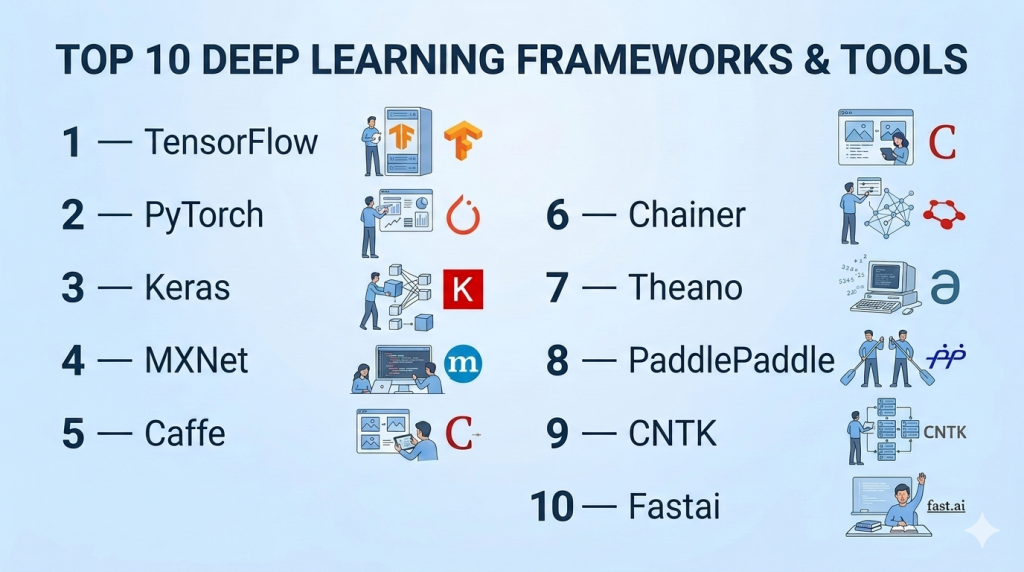
Top 10 Deep Learning Frameworks Tools
#1 — TensorFlow
Short description : TensorFlow is an open-source deep learning framework from Google, widely used for research and production AI systems. It enables building complex neural networks efficiently with GPU/TPU acceleration and has a robust ecosystem for deployment.
Key Features
- Support for CNNs, RNNs, Transformers, and custom architectures
- GPU and TPU acceleration
- TensorFlow Lite for edge deployment
- Model Hub with pre-trained models
- Integration with Keras for high-level APIs
- TensorBoard for visualization and monitoring
- Distributed training support
Pros
- Highly scalable for enterprise applications
- Large community and documentation
- Broad adoption in research and industry
Cons
- Steep learning curve
- Verbose syntax for complex models
- Frequent updates require adaptation
Platforms / Deployment
- Windows / macOS / Linux
- Cloud / Self-hosted / Hybrid
Security & Compliance
- Not publicly stated
Integrations & Ecosystem
- TensorFlow Extended (TFX) for MLOps
- Keras and TensorFlow Hub
- Cloud platforms: GCP, AWS, Azure
- Python, Java, C++ APIs
Support & Community
- Strong global community, forums, and tutorials; enterprise support via Google Cloud
#2 — PyTorch
Short description : PyTorch is a dynamic deep learning framework from Meta, preferred by researchers for its flexibility and Pythonic interface. It supports rapid prototyping and scalable production deployment.
Key Features
- Dynamic computation graphs
- GPU acceleration with CUDA
- TorchScript for deployment
- Torch Hub with pre-trained models
- CNN, RNN, and Transformer support
- Distributed training via PyTorch Lightning
- Integration with Python ecosystem
Pros
- Flexible and user-friendly
- Widely adopted in research
- Strong community support
Cons
- Deployment pipelines require extra tooling
- Slightly less enterprise adoption than TensorFlow
- Backend-dependent features
Platforms / Deployment
- Windows / macOS / Linux
- Cloud / Self-hosted / Hybrid
Security & Compliance
- Not publicly stated
Integrations & Ecosystem
- TorchVision, TorchText, TorchAudio
- MLflow and ONNX for MLOps
- Python ML libraries and APIs
Support & Community
- Active open-source community; tutorials, forums, and enterprise consulting
#3 — Keras
Short description : Keras is a high-level API for building neural networks quickly, often running on TensorFlow. It simplifies deep learning model creation and is popular for rapid experimentation and teaching.
Key Features
- High-level model abstraction
- Supports CNNs, RNNs, and hybrid networks
- TensorFlow backend
- Pre-trained models available
- Model export and deployment tools
- GPU support
- Visualization tools
Pros
- Beginner-friendly
- Rapid prototyping
- Integrates with TensorFlow ecosystem
Cons
- Limited low-level control
- Backend-dependent performance
- Less suitable for massive distributed training
Platforms / Deployment
- Windows / macOS / Linux
- Cloud / Self-hosted / Hybrid
Security & Compliance
- Not publicly stated
Integrations & Ecosystem
- TensorFlow, TensorFlow Lite
- Pre-trained models and datasets
- Python and R APIs
Support & Community
- Extensive tutorials, forums, and academic adoption
#4 — MXNet
Short description : MXNet is a scalable, flexible deep learning framework with multi-language support, designed for developers building production AI models in cloud environments.
Key Features
- Symbolic and imperative programming
- Multi-language support: Python, R, Scala, C++
- GPU acceleration
- Model zoo with pre-trained models
- Efficient memory management
- On-device deployment
Pros
- Scalable for distributed training
- Multi-language support
- Efficient resource usage
Cons
- Smaller community
- Documentation less extensive
- Less enterprise adoption
Platforms / Deployment
- Windows / macOS / Linux
- Cloud / Self-hosted / Hybrid
Security & Compliance
- Not publicly stated
Integrations & Ecosystem
- Cloud: AWS, Azure
- Libraries: GluonCV, NLP
- REST APIs
Support & Community
- Moderate community; official tutorials
#5 — Caffe
Short description : Caffe is a deep learning framework optimized for image processing tasks, popular in computer vision research and deployment.
Key Features
- CNN support
- Pre-trained models
- GPU acceleration
- Python and C++ interfaces
- Transfer learning support
- Visualization tools
Pros
- Fast and efficient
- Lightweight deployment
- Large collection of models
Cons
- Limited modern architecture support
- Smaller active community
- Minimal MLOps support
Platforms / Deployment
- Windows / macOS / Linux
- Cloud / Self-hosted
Security & Compliance
- Not publicly stated
Integrations & Ecosystem
- OpenCV integration
- Python bindings
- REST API wrappers
Support & Community
- Community-driven, legacy documentation available
#6 — Chainer
Short description : Chainer is a Python framework with dynamic computation graphs, ideal for research experimentation and custom architectures.
Key Features
- Define-by-run dynamic graphs
- GPU acceleration with CuPy
- CNN, RNN, LSTM support
- Integration with Python ecosystem
- Distributed training
Pros
- Highly flexible
- Pythonic API
- Efficient for research
Cons
- Smaller community
- Limited deployment tools
- Less popular than TensorFlow/PyTorch
Platforms / Deployment
- Windows / macOS / Linux
- Self-hosted / Hybrid
Security & Compliance
- Not publicly stated
Integrations & Ecosystem
- NumPy, SciPy, CuPy
- ONNX model export
- Python ML libraries
Support & Community
- Moderate open-source community; tutorials available
#7 — Theano
Short description : Theano is a symbolic computation library for deep learning, widely used in academia for model experimentation.
Key Features
- Symbolic graph optimization
- GPU acceleration
- Integration with Python numeric libraries
- CNN and RNN support
- Efficient computation
Pros
- Fast numerical computation
- Strong academic adoption
- Foundation for Keras
Cons
- No longer actively developed
- Limited community
- Minimal deployment features
Platforms / Deployment
- Windows / macOS / Linux
- Self-hosted
Security & Compliance
- Not publicly stated
Integrations & Ecosystem
- Python, NumPy, SciPy
- Keras backend
- Custom extensions
Support & Community
- Legacy academic forums; minimal active development
#8 — PaddlePaddle
Short description : PaddlePaddle is Baidu’s deep learning platform optimized for NLP and computer vision, supporting production-scale models.
Key Features
- GPU acceleration
- CNN, RNN, Transformer support
- Pre-trained model hub
- Distributed training
- Cloud and edge deployment
- Python API
Pros
- Production-ready
- Active research updates
- Pre-trained models available
Cons
- Smaller global adoption
- Limited English-language community
- Steeper learning curve
Platforms / Deployment
- Windows / macOS / Linux
- Cloud / Self-hosted / Hybrid
Security & Compliance
- Not publicly stated
Integrations & Ecosystem
- Python API
- Cloud deployment
- Pre-trained models
Support & Community
- Active Chinese community; tutorials available
#9 — CNTK
Short description : Microsoft’s CNTK framework offers efficient GPU-powered deep learning suitable for enterprise-scale projects.
Key Features
- High-performance computation
- CNN, RNN support
- Multi-GPU training
- Python and C++ APIs
- Visualization tools
Pros
- Efficient and scalable
- Supports multiple neural architectures
- Enterprise-focused
Cons
- Smaller community
- Limited recent updates
- Steeper learning curve
Platforms / Deployment
- Windows / macOS / Linux
- Self-hosted / Hybrid
Security & Compliance
- Not publicly stated
Integrations & Ecosystem
- Python/C++ APIs
- ONNX support
- Azure cloud deployment
Support & Community
- Microsoft documentation; moderate community
#10 — Fastai
Short description : Fastai is a high-level deep learning library built on PyTorch, simplifying model development and training. Ideal for educators and rapid prototyping.
Key Features
- High-level PyTorch abstractions
- Pre-trained models and transfer learning
- Simplified training loops
- CNN, RNN, tabular, audio, and vision support
- GPU acceleration
- Integration with Jupyter Notebooks
Pros
- Rapid prototyping
- User-friendly API
- Strong educational support
Cons
- Dependent on PyTorch
- Less flexible for low-level customization
- Limited enterprise features
Platforms / Deployment
- Windows / macOS / Linux
- Cloud / Self-hosted / Hybrid
Security & Compliance
- Not publicly stated
Integrations & Ecosystem
- PyTorch backend
- Jupyter integration
- Pre-trained models
Support & Community
- Active open-source community; tutorials and courses available
Comparison Table (Top 10)
| Tool Name | Best For | Platform(s) Supported | Deployment | Standout Feature | Public Rating |
|---|---|---|---|---|---|
| TensorFlow | Research & production | Windows/macOS/Linux | Cloud/Self-hosted/Hybrid | Scalable infrastructure | N/A |
| PyTorch | Research and prototyping | Windows/macOS/Linux | Cloud/Self-hosted/Hybrid | Dynamic computation graph | N/A |
| Keras | Rapid prototyping | Windows/macOS/Linux | Cloud/Self-hosted/Hybrid | High-level API | N/A |
| MXNet | Multi-language ML | Windows/macOS/Linux | Cloud/Self-hosted/Hybrid | Efficient distributed training | N/A |
| Caffe | Image processing | Windows/macOS/Linux | Cloud/Self-hosted | Fast CNN deployment | N/A |
| Chainer | Research flexibility | Windows/macOS/Linux | Self-hosted/Hybrid | Define-by-run dynamic graphs | N/A |
| Theano | Academic research | Windows/macOS/Linux | Self-hosted | Symbolic computation optimization | N/A |
| PaddlePaddle | NLP & vision | Windows/macOS/Linux | Cloud/Self-hosted/Hybrid | Pre-trained models & production-ready | N/A |
| CNTK | Enterprise GPU workloads | Windows/macOS/Linux | Self-hosted/Hybrid | High-performance computation | N/A |
| Fastai | Rapid model development | Windows/macOS/Linux | Cloud/Self-hosted/Hybrid | High-level PyTorch API | N/A |
Evaluation & Scoring of Deep Learning Frameworks
| Tool Name | Core (25%) | Ease (15%) | Integrations (15%) | Security (10%) | Performance (10%) | Support (10%) | Value (15%) | Weighted Total (0–10) |
|---|---|---|---|---|---|---|---|---|
| TensorFlow | 9 | 7 | 9 | 7 | 9 | 8 | 8 | 8.3 |
| PyTorch | 9 | 8 | 8 | 7 | 8 | 7 | 8 | 8.2 |
| Keras | 7 | 9 | 7 | 6 | 7 | 7 | 8 | 7.6 |
| MXNet | 8 | 7 | 8 | 6 | 8 | 7 | 7 | 7.6 |
| Caffe | 7 | 7 | 6 | 6 | 8 | 6 | 7 | 6.9 |
| Chainer | 8 | 7 | 7 | 6 | 7 | 6 | 7 | 7.2 |
| Theano | 7 | 6 | 6 | 5 | 7 | 5 | 6 | 6.2 |
| PaddlePaddle | 8 | 7 | 7 | 6 | 8 | 6 | 7 | 7.3 |
| CNTK | 8 | 6 | 7 | 6 | 8 | 6 | 7 | 7.1 |
| Fastai | 7 | 8 | 7 | 6 | 7 | 6 | 7 | 7.1 |
These scores allow organizations to compare frameworks for features, usability, integrations, performance, and enterprise value.
Which Deep Learning Frameworks Tool Is Right for You?
Solo / Freelancer
Fastai, Keras, or PyTorch offer accessible tools for experimentation and rapid model prototyping.
SMB
MXNet, PaddlePaddle, or TensorFlow provide scalability with reasonable resource requirements and cloud deployment.
Mid-Market
PyTorch, TensorFlow, or PaddlePaddle enable distributed training and moderate production deployment capabilities.
Enterprise
TensorFlow, CNTK, MXNet, and PaddlePaddle provide enterprise support, compliance, and GPU/TPU scalability for large AI workloads.
Budget vs Premium
Open-source frameworks (PyTorch, TensorFlow, Keras) are free; enterprise support or cloud-hosted solutions may require subscription fees.
Feature Depth vs Ease of Use
TensorFlow and MXNet offer extensive capabilities; Keras and Fastai prioritize ease of use and fast experimentation.
Integrations & Scalability
TensorFlow, PyTorch, and MXNet integrate well with cloud services, MLOps pipelines, and large-scale deployment systems.
Security & Compliance Needs
Enterprise deployments allow encryption, access control, and auditing, while open-source setups need custom security configuration.
Frequently Asked Questions (FAQs)
1. What is the pricing model for deep learning frameworks?
Most frameworks are open-source and free. Cloud-hosted or enterprise support options may have subscription fees.
2. How long does onboarding take?
Beginner-friendly frameworks like Keras or Fastai require minimal onboarding; TensorFlow or MXNet require more setup and training.
3. Can multiple users collaborate simultaneously?
Yes, frameworks like PyTorch and TensorFlow support collaborative cloud notebooks or MLOps pipelines for team projects.
4. Are these frameworks secure for sensitive data?
Enterprise deployments provide encryption and access control; open-source frameworks require additional configuration.
5. Which programming languages are supported?
Most support Python; MXNet also supports R, Scala, C++, and PaddlePaddle supports Python.
6. Can I deploy models to production easily?
Yes, via MLOps pipelines, ONNX model export, or cloud deployment options depending on framework.
7. Are there alternatives to deep learning frameworks?
Yes, AutoML tools or high-level notebook environments can be used for simpler use cases.
8. How scalable are these frameworks?
TensorFlow, MXNet, PyTorch, and PaddlePaddle are optimized for distributed GPU/TPU workloads.
9. How do I ensure model reproducibility?
Use experiment tracking, version control, and containerized environments supported by frameworks or integrated tools.
10. Can I switch between frameworks?
Exporting models via ONNX or standard formats allows portability, though some framework-specific features may require adjustments.
Conclusion
Deep learning frameworks are the foundation for building modern AI applications. Open-source frameworks like PyTorch, TensorFlow, and Keras provide flexibility and rapid prototyping capabilities, while enterprise-grade frameworks such as MXNet, PaddlePaddle, and CNTK enable scalable and secure production deployments. Selecting the right framework depends on team size, compute requirements, deployment environment, and enterprise compliance needs. Evaluating integrations, performance, and community support ensures the platform fits the organization’s AI strategy. Running pilot projects or experiments is recommended to validate suitability before committing to full-scale deployment.

Find Trusted Cardiac Hospitals
Compare heart hospitals by city and services — all in one place.
Explore Hospitals
A model that works today can break after a framework, GPU driver, or dependency update. Teams should keep fixed environments and test upgrades before using them in production. This can prevent unexpected failures and make old models much easier to maintain.