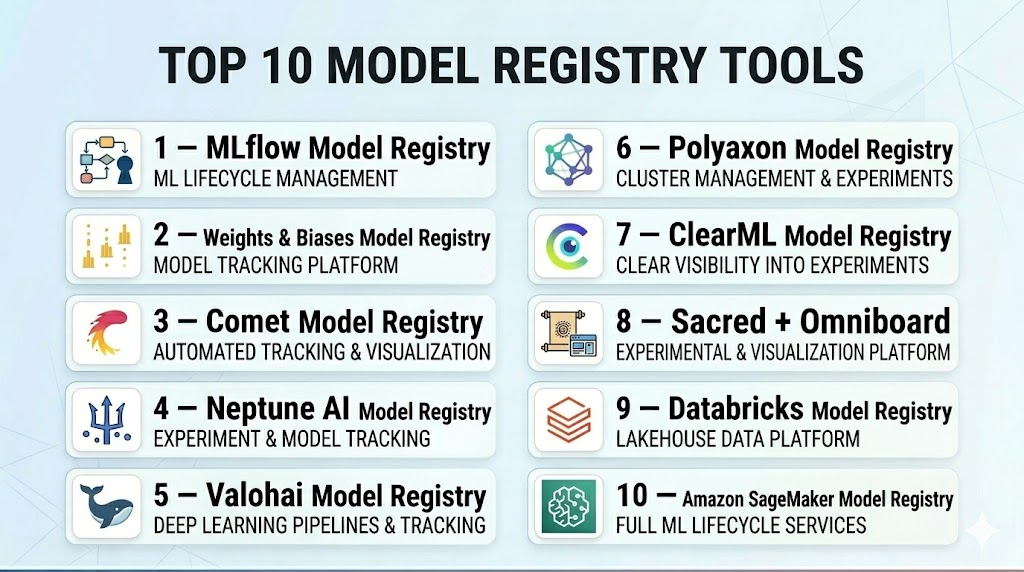
Introduction
Model Registry Tools are platforms designed to store, manage, and govern machine learning models throughout their lifecycle. They provide versioning, metadata tracking, and reproducibility, ensuring that teams can deploy, monitor, and audit models consistently across environments. In as AI adoption grows, model registries have become essential for production-grade machine learning operations, enabling teams to manage multiple models, track lineage, and maintain compliance.
Use cases include managing ML models for predictive analytics in finance, deploying recommendation systems in e-commerce, versioning fraud detection models in banking, monitoring production performance of NLP models, and maintaining reproducibility in healthcare AI pipelines. Buyers should evaluate:
- Model versioning and lifecycle management
- Integration with CI/CD and MLOps pipelines
- Artifact storage and reproducibility
- Deployment and rollback capabilities
- Security, access control, and compliance
- Scalability for multiple models and teams
- Metadata and lineage tracking
- Experiment integration and monitoring
- Ease of use and collaboration features
- Pricing and support options
Best for: ML engineers, data scientists, and MLOps teams in medium to large enterprises managing multiple production models.
Not ideal for: Teams with few ML models, experimental workflows only, or simple prototype deployment, where registries may add unnecessary complexity.
Key Trends in Model Registry Tools
- Integration with MLOps platforms for full lifecycle management
- Real-time model metadata tracking and versioning
- Support for multiple ML frameworks and formats
- Automated deployment and rollback for production pipelines
- Model lineage tracking and reproducibility
- Cloud-native and hybrid deployment options
- Governance, access control, and compliance (SOC 2, GDPR, HIPAA)
- Experiment integration for seamless ML pipeline management
- Collaboration features for distributed teams
- Subscription-based SaaS and open-source options
How We Selected These Tools (Methodology)
- Market adoption and enterprise usage
- Feature completeness, including versioning, metadata, and lineage
- Reliability, uptime, and production-readiness
- Security posture, access control, and compliance
- Integration with MLOps pipelines, CI/CD, and cloud platforms
- Customer fit across solo practitioners, SMBs, mid-market, and enterprise
- Collaboration, reporting, and experiment linkage
- Scalability for multiple models, teams, and data volumes
- Active community support and vendor responsiveness
- Ease of use, onboarding speed, and documentation quality
Top 10 Model Registry Tools
#1 — MLflow Model Registry
Short description : MLflow Model Registry provides a centralized repository for managing ML models, supporting versioning, lifecycle management, and deployment tracking. Ideal for teams using multiple ML frameworks.
Key Features
- Model versioning and lifecycle states
- Deployment tracking and rollback
- Integration with MLflow experiments
- API and Python SDK for automation
- Multi-framework support (TensorFlow, PyTorch, scikit-learn)
- Artifact storage and reproducibility
Pros
- Open-source and flexible
- Framework-agnostic
- Active community support
Cons
- Enterprise support requires Databricks
- GUI less intuitive than some commercial alternatives
- Setup can be technical for beginners
Platforms / Deployment
- Windows / macOS / Linux / Web
- Cloud / Self-hosted / Hybrid
Security & Compliance
- Not publicly stated
Integrations & Ecosystem
- Python SDK
- REST API
- Spark, TensorFlow, PyTorch integration
Support & Community
Open-source community; Databricks enterprise support available.
#2 — Weights & Biases Model Registry
Short description : A SaaS platform providing versioned model tracking, collaboration, and integration with experiment tracking. Suitable for teams emphasizing visualization and teamwork.
Key Features
- Model versioning with metadata
- Integration with experiment tracking dashboards
- Deployment history and lineage
- API and SDK support
- Collaboration features for teams
- Metrics and performance tracking
Pros
- Intuitive UI and dashboards
- Easy collaboration across teams
- Supports multiple frameworks
Cons
- Cloud subscription required
- Some advanced features have learning curve
- Limited on-prem deployment
Platforms / Deployment
- Windows / macOS / Linux / Web
- Cloud
Security & Compliance
- SOC 2, GDPR
- RBAC and encryption
Integrations & Ecosystem
- Python SDK
- TensorFlow, PyTorch, Scikit-learn
- REST APIs for pipelines
Support & Community
Enterprise support; extensive tutorials and documentation.
#3 — Comet Model Registry
Short description : Comet provides a centralized registry for models with versioning, performance tracking, and lineage. Ideal for multi-team collaboration.
Key Features
- Model versioning and lifecycle management
- Artifact and metadata storage
- Integration with experiments
- Dashboard visualization of performance metrics
- API and Python SDK
- Deployment tracking
Pros
- Centralized view of models
- Facilitates collaboration
- Supports multiple frameworks
Cons
- Premium subscription for full features
- Cloud-based for enterprise features
- Advanced setup required
Platforms / Deployment
- Windows / macOS / Linux / Web
- Cloud / Hybrid
Security & Compliance
- SOC 2, GDPR
- RBAC and encryption
Integrations & Ecosystem
- TensorFlow, PyTorch, Keras
- REST APIs
- CI/CD pipeline connectors
Support & Community
Documentation, enterprise support, community forums.
#4 — Neptune AI Model Registry
Short description : Neptune AI offers model versioning, tracking, and collaboration in a centralized platform. Suitable for teams managing multiple ML experiments and models.
Key Features
- Model versioning and metadata tracking
- Integration with experiments
- Team collaboration and access control
- API and Python SDK
- Multi-framework support
- Dashboard visualization
Pros
- User-friendly interface
- Scalable for multiple experiments
- Collaboration-focused
Cons
- Cloud subscription required
- Limited on-prem options
- Advanced features require setup
Platforms / Deployment
- Windows / macOS / Linux / Web
- Cloud
Security & Compliance
- SOC 2, GDPR
- RBAC and encryption
Integrations & Ecosystem
- Python SDK
- TensorFlow, PyTorch, Scikit-learn
- REST APIs
Support & Community
Enterprise support; active documentation and tutorials.
#5 — Valohai Model Registry
Short description : Valohai integrates model registry with MLOps pipelines, tracking versions, experiments, and deployment workflows. Ideal for enterprise-grade ML workflows.
Key Features
- Model versioning and artifact tracking
- Pipeline orchestration integration
- Deployment history and rollback
- API and SDK access
- Team collaboration
- Multi-cloud deployment support
Pros
- End-to-end ML lifecycle support
- Enterprise-ready
- Scalable for multiple teams
Cons
- Premium pricing
- Cloud-focused
- Setup complexity
Platforms / Deployment
- Web / Linux
- Cloud / Hybrid
Security & Compliance
- SOC 2, GDPR
- RBAC, encryption
Integrations & Ecosystem
- TensorFlow, PyTorch, Keras
- REST API
- CI/CD pipeline integration
Support & Community
Enterprise support; onboarding guides and documentation.
#6 — Polyaxon Model Registry
Short description : Polyaxon provides an open-source registry for ML models, supporting versioning, artifacts, and reproducibility. Suitable for teams with multiple frameworks.
Key Features
- Model versioning
- Artifact and dataset tracking
- Experiment integration
- Multi-framework support
- Pipeline orchestration
- Cloud and on-prem deployment
Pros
- Open-source and flexible
- Supports reproducible workflows
- Scalable
Cons
- Requires infrastructure setup
- Less polished UI
- Enterprise features need configuration
Platforms / Deployment
- Linux / Web
- Cloud / Self-hosted
Security & Compliance
- Not publicly stated
Integrations & Ecosystem
- TensorFlow, PyTorch, Scikit-learn
- Python SDK
- REST API
Support & Community
Active open-source community; documentation available.
#7 — ClearML Model Registry
Short description : ClearML offers open-source model tracking, versioning, and experiment linking, suitable for collaborative teams and production pipelines.
Key Features
- Model versioning and artifact tracking
- Integration with experiments and pipelines
- Multi-framework support
- API and Python SDK
- Cloud and on-prem deployment
- Dashboard for performance monitoring
Pros
- Free and open-source
- Scalable
- Easy integration with pipelines
Cons
- Less advanced UI
- Paid features for enterprise support
- Documentation can be technical
Platforms / Deployment
- Windows / macOS / Linux / Web
- Cloud / Self-hosted
Security & Compliance
- Not publicly stated
Integrations & Ecosystem
- Python SDK
- TensorFlow, PyTorch
- REST APIs
Support & Community
Open-source support; optional enterprise support.
#8 — Sacred + Omniboard
Short description : Sacred is a lightweight experiment and model tracking tool, paired with Omniboard dashboards for visualization. Ideal for researchers and small teams.
Key Features
- Model and experiment tracking
- Artifact logging
- Visualization via Omniboard
- Multi-framework support
- Lightweight setup
Pros
- Open-source and free
- Simple and flexible
- Lightweight and code-first
Cons
- Limited enterprise support
- Requires setup
- Smaller community
Platforms / Deployment
- Windows / macOS / Linux
- Self-hosted
Security & Compliance
- Not publicly stated
Integrations & Ecosystem
- Python SDK
- REST API
- CI/CD optional
Support & Community
Open-source community-driven support.
#9 — Databricks Model Registry
Short description : Databricks Model Registry integrates with MLflow and Databricks pipelines, offering centralized versioning, deployment, and collaboration.
Key Features
- Model versioning
- Deployment tracking and rollback
- Integration with MLflow
- Collaboration for teams
- Pipeline integration
- Cloud-native
Pros
- Enterprise-ready
- Seamless Databricks integration
- Scalable for multiple models
Cons
- Databricks subscription required
- Premium pricing
- Learning curve for new users
Platforms / Deployment
- Web / Linux
- Cloud / Hybrid
Security & Compliance
- SOC 2, GDPR
- RBAC, audit logs
Integrations & Ecosystem
- Python SDK
- Spark, MLflow integration
- REST APIs
Support & Community
Enterprise support; active documentation.
#10 — Amazon SageMaker Model Registry
Short description : SageMaker Model Registry centralizes model storage, versioning, and deployment in AWS, with CI/CD and MLOps integration.
Key Features
- Model versioning and lineage
- CI/CD integration
- Deployment tracking and rollback
- Artifact management
- Multi-model support
- AWS ecosystem integration
Pros
- Tight AWS integration
- Cloud-native
- Enterprise-ready
Cons
- AWS subscription required
- Cloud-only
- Pricing scales with usage
Platforms / Deployment
- Web
- Cloud
Security & Compliance
- SOC 2, GDPR, HIPAA
- Encryption, RBAC
Integrations & Ecosystem
- AWS services (S3, Lambda)
- TensorFlow, PyTorch
- REST API
Support & Community
AWS enterprise support; active community.
Comparison Table (Top 10)
| Tool Name | Best For | Platform(s) Supported | Deployment | Standout Feature | Public Rating |
|---|---|---|---|---|---|
| MLflow Model Registry | Framework-agnostic tracking | Windows/macOS/Linux/Web | Cloud / Self-hosted / Hybrid | Versioning & lifecycle management | N/A |
| Weights & Biases | Visualization & collaboration | Windows/macOS/Linux/Web | Cloud | Dashboards & team collaboration | N/A |
| Comet ML | Centralized logging | Windows/macOS/Linux/Web | Cloud / Hybrid | Centralized model management | N/A |
| Neptune AI | Multi-experiment dashboards | Windows/macOS/Linux/Web | Cloud | Team collaboration | N/A |
| Guild AI | Code-first lightweight tracking | Windows/macOS/Linux | Cloud / Self-hosted | Command-line & Python SDK | N/A |
| DVC | Data-centric versioning | Windows/macOS/Linux | Cloud / Self-hosted | Dataset & experiment tracking | N/A |
| Valohai | Pipeline orchestration | Web / Linux | Cloud / Hybrid | End-to-end ML lifecycle | N/A |
| Polyaxon | Open-source ML workflow | Linux / Web | Cloud / Self-hosted | Pipeline orchestration | N/A |
| ClearML | Free & open-source tracking | Windows/macOS/Linux/Web | Cloud / Self-hosted | Logging & orchestration | N/A |
| Sacred + Omniboard | Research-oriented tracking | Windows/macOS/Linux | Self-hosted | Lightweight & code-first tracking | N/A |
Evaluation & Scoring of Model Registry Tools
| Tool Name | Core (25%) | Ease (15%) | Integrations (15%) | Security (10%) | Performance (10%) | Support (10%) | Value (15%) | Weighted Total (0–10) |
|---|---|---|---|---|---|---|---|---|
| MLflow Model Registry | 9 | 7 | 8 | 6 | 8 | 7 | 8 | 7.8 |
| Weights & Biases | 9 | 8 | 8 | 7 | 8 | 8 | 7 | 8.0 |
| Comet ML | 8 | 8 | 7 | 7 | 8 | 7 | 7 | 7.5 |
| Neptune AI | 8 | 8 | 7 | 7 | 7 | 7 | 7 | 7.4 |
| Guild AI | 7 | 7 | 7 | 6 | 7 | 6 | 8 | 7.1 |
| DVC | 8 | 7 | 7 | 6 | 7 | 6 | 8 | 7.2 |
| Valohai | 9 | 7 | 8 | 7 | 8 | 7 | 7 | 7.8 |
| Polyaxon | 8 | 7 | 7 | 6 | 7 | 6 | 7 | 7.0 |
| ClearML | 8 | 8 | 7 | 6 | 7 | 6 | 8 | 7.3 |
| Sacred + Omniboard | 7 | 7 | 6 | 6 | 6 | 6 | 8 | 6.7 |
Which Model Registry Tools Tool Is Right for You?
Solo / Freelancer
Guild AI, MLflow, or Sacred for lightweight, flexible, open-source workflows.
SMB
Comet ML, Neptune AI, or ClearML for collaborative dashboards and multi-model management.
Mid-Market
Weights & Biases, Valohai, or Polyaxon for enterprise-level reproducibility, pipeline integration, and team collaboration.
Enterprise
MLflow (enterprise), Weights & Biases, Neptune AI, and Valohai for governance, scalability, and production-ready deployment.
Budget vs Premium
Open-source options are cost-effective; SaaS and enterprise solutions provide collaboration, dashboards, and compliance support.
Feature Depth vs Ease of Use
Weights & Biases and Neptune AI focus on ease of use and visualization; Valohai and MLflow enterprise provide advanced lifecycle management.
Integrations & Scalability
Cloud-native registries integrate with ML frameworks, CI/CD pipelines, and multi-model production workflows.
Security & Compliance Needs
Enterprise solutions offer encryption, RBAC, audit logs, and compliance with GDPR, SOC 2, and HIPAA.
Frequently Asked Questions (FAQs)
1. What are typical pricing models?
Open-source tools are free; SaaS platforms are subscription-based and scale with users, compute, and storage.
2. How quickly can teams onboard?
SaaS platforms offer guided onboarding; open-source tools require setup and configuration.
3. Can multiple users track models simultaneously?
Yes, enterprise platforms support role-based access and collaboration features.
4. Are these tools secure for sensitive models?
Enterprise platforms provide encryption, RBAC, and compliance; open-source requires custom security setup.
5. Can these tools track experiments alongside models?
Yes, most model registries integrate with experiment tracking tools or have built-in experiment logging.
6. Do they support multiple ML frameworks?
Yes, commonly supported frameworks include TensorFlow, PyTorch, scikit-learn, Keras, and XGBoost.
7. How scalable are these tools?
Cloud-native tools scale horizontally to manage multiple models, teams, and high-volume pipelines.
8. Can registries integrate with CI/CD pipelines?
Yes, they can trigger deployments, rollbacks, and model promotions across pipelines.
9. Are open-source options production-ready?
Yes, but they may require additional setup, monitoring, and security configuration.
10. Can I migrate between registry tools?
Migration is possible but may require exporting artifacts, metadata, and version history.
Conclusion
Model Registry Tools are essential for enterprises managing production-grade ML models. They ensure reproducibility, enable collaboration, provide version control, and support governance across ML workflows. Open-source options like MLflow, Guild AI, and DVC offer flexibility and cost savings, while enterprise tools like Weights & Biases, Neptune AI, and Valohai deliver dashboards, collaboration, and integration with MLOps pipelines. Choosing the right model registry depends on team size, workflow complexity, infrastructure, and compliance requirements. Pilot projects and trials are recommended to validate integration, usability, and scalability before full-scale deployment.

Find Trusted Cardiac Hospitals
Compare heart hospitals by city and services — all in one place.
Explore Hospitals
A model may be technically ready but still have problems with accuracy, data quality, or business requirements. Teams should define simple checks that a model must pass before deployment. This can prevent an untested model from reaching users by mistake.