Introduction
Order Management Systems (OMS) are software solutions that centralize and automate the processing of orders from receipt to fulfillment. OMS platforms provide visibility across sales channels, inventory, and warehouses, helping businesses streamline operations, reduce errors, and improve customer satisfaction. OMS is crucial for companies managing multi-channel sales, complex order flows, or high volumes of transactions.
Real-world use cases include automating order processing for e-commerce platforms, tracking inventory across multiple warehouses, synchronizing orders from online marketplaces, managing returns and refunds efficiently, and integrating with shipping and fulfillment partners to ensure timely delivery.
Key evaluation criteria for OMS buyers:
- Multi-channel order management
- Inventory visibility and tracking
- Automation of order workflows and approvals
- Integration with ERP, CRM, and e-commerce platforms
- Reporting and analytics capabilities
- Scalability for high-order volumes
- Returns and refund management
- Customer notifications and communication
- Security and compliance
- User interface and ease of use
Best for: E-commerce managers, retail operations teams, distributors, and enterprises with multi-channel sales requiring centralized order processing.
Not ideal for: Small businesses with minimal order volume or simple fulfillment processes, where a basic inventory or spreadsheet system may suffice.
Key Trends in Order Management Systems (OMS)
- AI-powered demand forecasting and inventory optimization
- Automation of order routing and fulfillment
- Real-time inventory tracking across multiple channels
- Integration with e-commerce, ERP, and logistics platforms
- Cloud-native OMS for scalability and remote access
- Enhanced returns management and reverse logistics
- Mobile access for warehouse and field teams
- Subscription and recurring order management
- API-first architectures for custom integrations
- Analytics dashboards for performance and fulfillment monitoring
How We Selected These Tools (Methodology)
- Market adoption and reputation across retail, e-commerce, and distribution
- Feature completeness covering order, inventory, and fulfillment workflows
- Reliability and performance signals from customer feedback
- Security posture and compliance standards
- Integration ecosystem with ERP, CRM, and logistics systems
- Customer fit across SMB, mid-market, and enterprise organizations
- Support quality, documentation, and community engagement
- Scalability to accommodate growing order volumes
- Pricing flexibility and ROI potential
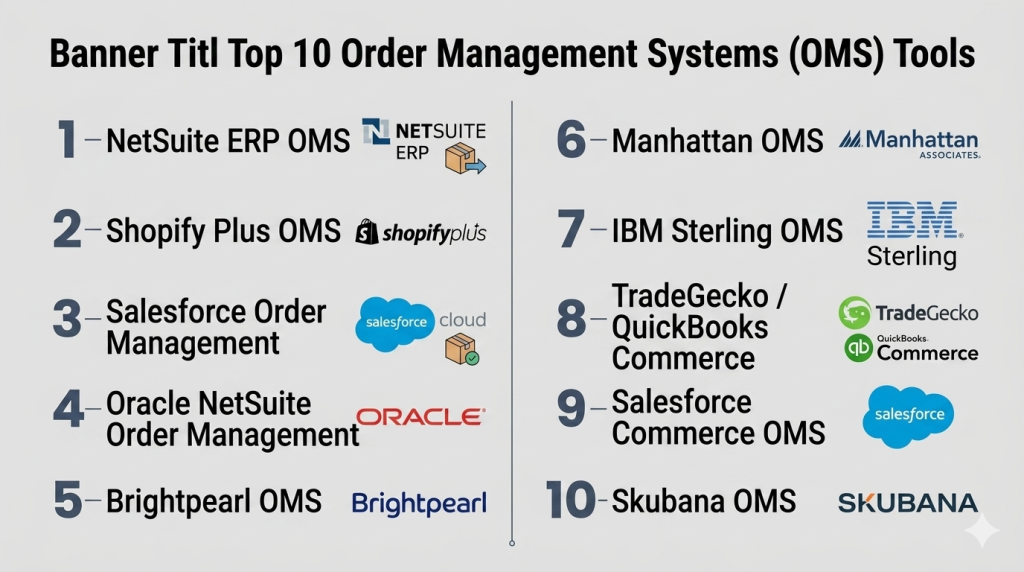
Top 10 Order Management Systems (OMS) Tools
#1 — NetSuite ERP OMS
Short description: NetSuite OMS is a cloud-based solution integrated with ERP for order processing, inventory management, and fulfillment. It is ideal for mid-market and enterprise companies managing multi-channel orders.
Key Features
- Centralized order and inventory management
- Automated order processing workflows
- Multi-channel integration for e-commerce, marketplaces, and POS
- Real-time inventory visibility
- Returns and refund management
- Analytics dashboards for order tracking
Pros
- Tight integration with NetSuite ERP
- Cloud-native with global scalability
Cons
- Premium pricing for smaller teams
- Requires ERP familiarity for full functionality
Platforms / Deployment
- Web / Cloud
Security & Compliance
- MFA, encryption, audit logs
- GDPR compliance
Integrations & Ecosystem
- ERP, CRM, e-commerce, shipping carriers
- API access for custom workflows
- Marketplace connectors
Support & Community
- Enterprise support tiers
- Training and documentation
- Active user community
#2 — Shopify Plus OMS
Short description: Shopify Plus OMS streamlines order processing for high-volume e-commerce merchants. It is ideal for businesses selling on multiple online channels and marketplaces.
Key Features
- Centralized order processing
- Multi-channel order routing
- Real-time inventory updates
- Returns and refunds management
- Analytics dashboards and reporting
Pros
- Easy integration with Shopify e-commerce ecosystem
- Scalable for growing online stores
Cons
- Limited to Shopify ecosystem
- Less customizable for enterprise workflows
Platforms / Deployment
- Web / Cloud
Security & Compliance
- MFA, encryption, audit logs
- GDPR compliance
Integrations & Ecosystem
- E-commerce platforms, payment gateways, shipping carriers
- API support for custom workflows
- Marketplace integrations
Support & Community
- Shopify Plus support packages
- Documentation and training
- Large merchant community
#3 — Salesforce Order Management
Short description: Salesforce OMS provides centralized order processing integrated with Salesforce CRM, ideal for organizations with multi-channel sales and subscription management.
Key Features
- Centralized order tracking
- Automated workflows and approvals
- Multi-channel order integration
- Inventory visibility across warehouses
- Returns and refunds management
- Reporting dashboards
Pros
- Native integration with Salesforce CRM
- Supports subscription-based products
Cons
- Works best within Salesforce ecosystem
- Higher cost for smaller organizations
Platforms / Deployment
- Web / Cloud
Security & Compliance
- SSO, MFA, encryption, audit logs
- GDPR compliance
Integrations & Ecosystem
- CRM, ERP, shipping carriers
- API for workflow extensions
- Marketplace connectors
Support & Community
- Enterprise support tiers
- Training resources and documentation
- Active Salesforce community
#4 — Oracle NetSuite Order Management
Short description: Oracle NetSuite OMS provides real-time order processing, inventory management, and multi-channel order fulfillment for mid-market and enterprise companies.
Key Features
- Centralized order lifecycle management
- Inventory and warehouse visibility
- Automated fulfillment and routing
- Returns management and reverse logistics
- Analytics and reporting
Pros
- Cloud-native with ERP integration
- Scalable for enterprise operations
Cons
- Complexity in setup and training
- Premium pricing for smaller teams
Platforms / Deployment
- Web / Cloud
Security & Compliance
- MFA, encryption, audit logs
- GDPR compliance
Integrations & Ecosystem
- ERP, CRM, e-commerce platforms
- API support for custom workflows
- Shipping and logistics integrations
Support & Community
- Enterprise support packages
- Knowledge base and training
- Professional services
#5 — Brightpearl OMS
Short description: Brightpearl OMS is designed for retail and wholesale businesses to manage orders, inventory, and fulfillment across multiple channels.
Key Features
- Centralized order management
- Real-time inventory tracking
- Automated workflows and routing
- Returns and refunds management
- Analytics dashboards
Pros
- Strong retail and wholesale focus
- Cloud-based with easy deployment
Cons
- Less suited for enterprise-scale customization
- Limited complex workflow support
Platforms / Deployment
- Web / Cloud
Security & Compliance
- MFA, audit logs, encryption
- GDPR compliance
Integrations & Ecosystem
- E-commerce platforms, ERP, shipping carriers
- API for workflow customization
- Third-party apps
Support & Community
- Standard support tiers
- Online documentation and training
- Moderate community
#6 — Manhattan OMS
Short description: Manhattan OMS provides enterprise-grade order management with multi-channel fulfillment, inventory visibility, and analytics. Ideal for large retailers and distributors.
Key Features
- Multi-channel order processing
- Inventory visibility and warehouse management
- Automated order routing
- Returns and refunds management
- Analytics and reporting dashboards
Pros
- Enterprise scalability
- Advanced workflow automation
Cons
- High implementation cost
- Requires expert configuration
Platforms / Deployment
- Web / Cloud / Hybrid
Security & Compliance
- MFA, encryption, audit logs
- GDPR compliance
Integrations & Ecosystem
- ERP, CRM, e-commerce, shipping carriers
- API support for integration
- Partner ecosystem
Support & Community
- Enterprise support tiers
- Documentation and training
- Professional services
#7 — IBM Sterling OMS
Short description: IBM Sterling OMS enables real-time order orchestration, inventory visibility, and fulfillment optimization for enterprise operations.
Key Features
- Order lifecycle management
- Inventory tracking and warehouse management
- Multi-channel integration
- Returns management
- Reporting and analytics
Pros
- Strong enterprise-grade features
- Cloud and hybrid deployment options
Cons
- Implementation complexity
- High cost for SMBs
Platforms / Deployment
- Web / Cloud / Hybrid
Security & Compliance
- MFA, audit logs, encryption
- GDPR compliance
Integrations & Ecosystem
- ERP, CRM, e-commerce platforms
- API-enabled integration
- Logistics and shipping connectors
Support & Community
- Enterprise support and professional services
- Documentation and training
- Global user community
#8 — TradeGecko / QuickBooks Commerce
Short description: TradeGecko OMS is a cloud-based solution for SMBs and mid-market companies managing multi-channel sales and inventory.
Key Features
- Centralized order and inventory management
- Multi-channel sales integration
- Automated workflows and fulfillment
- Returns management
- Analytics and reporting
Pros
- Affordable and user-friendly
- Good for SMBs with moderate sales volumes
Cons
- Limited enterprise features
- Customization options are restricted
Platforms / Deployment
- Web / Cloud
Security & Compliance
- MFA, encryption, audit logs
- GDPR compliance
Integrations & Ecosystem
- E-commerce platforms, ERP, payment gateways
- API access for integrations
- Partner marketplace
Support & Community
- Standard support tiers
- Documentation and training
- Active SMB community
#9 — Salesforce Commerce OMS
Short description: Salesforce Commerce OMS manages multi-channel e-commerce orders, inventory, and fulfillment within the Salesforce ecosystem.
Key Features
- Centralized order management
- Inventory visibility and fulfillment routing
- Returns and refund management
- Workflow automation
- Analytics and reporting dashboards
Pros
- Native Salesforce integration
- Cloud-native, scalable solution
Cons
- Best suited for Salesforce ecosystem users
- Premium pricing
Platforms / Deployment
- Web / Cloud
Security & Compliance
- SSO, MFA, encryption
- GDPR compliance
Integrations & Ecosystem
- Salesforce CRM, ERP, shipping platforms
- API-enabled extensions
- Partner apps
Support & Community
- Salesforce support tiers
- Training and documentation
- Active community
#10 — Skubana OMS
Short description: Skubana OMS centralizes order processing, inventory, and fulfillment for SMBs and mid-market e-commerce companies.
Key Features
- Multi-channel order management
- Inventory and warehouse visibility
- Automated workflows
- Returns and refunds management
- Analytics dashboards
Pros
- Cloud-native and easy to use
- Affordable for mid-market businesses
Cons
- Limited enterprise-scale customization
- Less advanced analytics
Platforms / Deployment
- Web / Cloud
Security & Compliance
- MFA, encryption, audit logs
- GDPR compliance
Integrations & Ecosystem
- E-commerce platforms, ERP, shipping carriers
- API-enabled integrations
- Partner apps
Support & Community
- Standard support tiers
- Documentation and training
- Active SMB community
Comparison Table (Top 10)
| Tool Name | Best For | Platforms Supported | Deployment | Standout Feature | Public Rating |
|---|---|---|---|---|---|
| NetSuite ERP OMS | Mid-market & enterprise | Web | Cloud | ERP integration | N/A |
| Shopify Plus OMS | E-commerce merchants | Web | Cloud | High-volume e-commerce | N/A |
| Salesforce OMS | Multi-channel sales | Web | Cloud | Salesforce integration | N/A |
| Oracle NetSuite OMS | Enterprise sales | Web | Cloud | Multi-channel fulfillment | N/A |
| Brightpearl OMS | Retail & wholesale | Web | Cloud | Multi-channel retail focus | N/A |
| Manhattan OMS | Large retailers | Web | Cloud / Hybrid | Enterprise scalability | N/A |
| IBM Sterling OMS | Enterprise logistics | Web | Cloud / Hybrid | Real-time orchestration | N/A |
| TradeGecko OMS | SMBs & mid-market | Web | Cloud | User-friendly SMB solution | N/A |
| Salesforce Commerce OMS | E-commerce & Salesforce | Web | Cloud | Multi-channel integration | N/A |
| Skubana OMS | Mid-market e-commerce | Web | Cloud | Cloud-native SMB solution | N/A |
Evaluation & Scoring of Order Management Systems (OMS)
| Tool Name | Core (25%) | Ease (15%) | Integrations (15%) | Security (10%) | Performance (10%) | Support (10%) | Value (15%) | Weighted Total (0–10) |
|---|---|---|---|---|---|---|---|---|
| NetSuite ERP OMS | 9 | 7 | 9 | 9 | 9 | 8 | 6 | 8.1 |
| Shopify Plus OMS | 8 | 9 | 8 | 8 | 8 | 7 | 7 | 7.9 |
| Salesforce OMS | 9 | 8 | 9 | 9 | 9 | 8 | 7 | 8.4 |
| Oracle NetSuite OMS | 9 | 7 | 9 | 9 | 9 | 8 | 6 | 8.1 |
| Brightpearl OMS | 8 | 8 | 8 | 8 | 8 | 7 | 7 | 7.8 |
| Manhattan OMS | 9 | 7 | 9 | 9 | 9 | 8 | 6 | 8.1 |
| IBM Sterling OMS | 9 | 7 | 9 | 9 | 9 | 8 | 6 | 8.1 |
| TradeGecko OMS | 7 | 9 | 7 | 8 | 8 | 7 | 7 | 7.5 |
| Salesforce Commerce OMS | 9 | 8 | 9 | 9 | 9 | 8 | 7 | 8.4 |
| Skubana OMS | 8 | 8 | 8 | 8 | 8 | 7 | 7 | 7.8 |
Interpretation: Higher weighted totals indicate stronger overall performance. Scores are comparative to help organizations evaluate based on core functionality, ease of use, integrations, and support.
Which Order Management Systems (OMS) Tool Is Right for You?
Solo / Freelancer
Cloud-native OMS like Skubana or TradeGecko can handle lower-volume orders with simple workflows efficiently.
SMB
Shopify Plus OMS, Brightpearl, or TradeGecko balance feature richness with affordability for growing teams.
Mid-Market
NetSuite ERP OMS, Salesforce OMS, and Oracle NetSuite OMS provide workflow automation, multi-channel fulfillment, and advanced inventory tracking.
Enterprise
Manhattan OMS, IBM Sterling OMS, and Salesforce Commerce OMS scale for global operations with complex order flows and multiple fulfillment centers.
Budget vs Premium
Budget-friendly OMS focus on essential order and inventory management, while premium platforms provide multi-channel orchestration, analytics, and complex workflow automation.
Feature Depth vs Ease of Use
Enterprise-grade OMS offer deeper features but require training; cloud-native OMS prioritize usability for mid-market and SMBs.
Integrations & Scalability
Tools integrating with ERP, CRM, e-commerce, and shipping systems reduce silos and improve operational scalability.
Security & Compliance Needs
Choose OMS with MFA, audit logs, encryption, and GDPR compliance to safeguard sensitive order and customer data.
Frequently Asked Questions (FAQs)
1. What is OMS software?
OMS software centralizes order processing, inventory tracking, and fulfillment to streamline operations and improve customer satisfaction.
2. How are OMS tools priced?
Pricing models include subscription-based SaaS, per-order, or enterprise licensing, often tiered based on transaction volume and features.
3. Do OMS tools integrate with ERP and CRM?
Yes, integration with ERP, CRM, and e-commerce platforms is common for seamless order processing and reporting.
4. Can OMS handle multi-channel orders?
Modern OMS platforms consolidate orders from online stores, marketplaces, POS, and B2B portals for unified processing.
5. Are OMS tools suitable for small businesses?
Yes, cloud-native OMS platforms like Skubana and TradeGecko provide affordable solutions for SMBs with lower-order volumes.
6. How does OMS improve operational efficiency?
Automated order routing, inventory tracking, and workflow management reduce errors, optimize fulfillment, and accelerate order completion.
7. Can OMS manage returns and refunds?
Yes, most OMS platforms include returns, exchanges, and refunds workflows to improve customer satisfaction.
8. What are common implementation challenges?
Data migration, integration with existing systems, and configuring multi-channel workflows can pose challenges during onboarding.
9. How scalable are OMS platforms?
Enterprise-grade OMS can handle high-volume orders across multiple warehouses, whereas SMB-focused solutions are optimized for smaller operations.
10. Are there alternatives to OMS software?
Manual processing, spreadsheets, or ERP modules can manage orders, but they lack automation, centralized visibility, and multi-channel integration.
Conclusion
Order Management Systems (OMS) are essential for businesses managing multi-channel orders, inventory, and fulfillment processes. From SMB-focused solutions to enterprise-grade platforms, OMS improves operational efficiency, reduces errors, and enhances customer satisfaction. Selecting the right tool depends on order volume, workflow complexity, integration requirements, and budget. Organizations should shortlist OMS solutions, test workflows, and validate integrations and security before full-scale implementation to maximize efficiency and ROI.

Find Trusted Cardiac Hospitals
Compare heart hospitals by city and services — all in one place.
Explore Hospitals
An OMS may show an item as available, but the warehouse or another sales channel may have already sold it. Teams should have a clear process for detecting these mismatches and deciding what happens to the order. This can help reduce cancellations, overselling, and customer complaints.