Introduction
Inventory Management Systems (IMS) are software platforms designed to help businesses track, manage, and optimize their stock levels, procurement processes, and supply chain operations. In simple terms, they ensure that the right products are in the right place, at the right time, reducing waste and improving profitability.
Organizations today face pressure to maintain lean inventories, respond quickly to customer demands, and adapt to global supply chain uncertainties. Modern IMS solutions incorporate AI-driven forecasting, real-time analytics, and seamless integrations with ERP, e-commerce, and warehouse systems.
Real-world use cases include:
- Retailers managing thousands of SKUs across multiple locations
- Manufacturing units monitoring raw materials and production schedules
- E-commerce businesses coordinating fulfillment and returns
- Healthcare organizations tracking medical supplies and expiry dates
- Distribution companies optimizing warehouse layouts and replenishment cycles
Key evaluation criteria for buyers:
- Accuracy and reliability of inventory tracking
- Forecasting and demand planning capabilities
- Ease of use and user interface
- Integration with ERP, POS, and e-commerce platforms
- Security and compliance features
- Scalability across locations and business sizes
- Automation and AI-driven insights
- Reporting and analytics
- Mobile accessibility
- Vendor support and ecosystem
Best for: Retail managers, supply chain analysts, warehouse operations, SMBs to enterprises, and e-commerce businesses
Not ideal for: Very small businesses with minimal inventory needs or companies preferring manual tracking spreadsheets
Key Trends in Inventory Management Systems
- Increased adoption of AI and machine learning for predictive inventory and demand forecasting
- Automation in warehouse operations, including robotics and real-time tracking
- Cloud-native IMS solutions for scalable, multi-location inventory management
- Real-time visibility and IoT-enabled stock monitoring
- Integration with e-commerce marketplaces and ERP systems for end-to-end inventory tracking
- Advanced analytics and reporting dashboards for decision-making
- Subscription-based pricing models replacing traditional licenses
- Compliance and regulatory tracking for healthcare, food, and pharmaceutical industries
- Enhanced security with role-based access, audit trails, and multi-factor authentication
- Cross-platform mobile apps for warehouse staff and field teams
How We Selected These Tools (Methodology)
- Evaluated market adoption, brand recognition, and mindshare
- Assessed feature completeness across stock tracking, reporting, and automation
- Verified reliability through performance signals and real-world implementation cases
- Reviewed security posture including encryption, authentication, and compliance
- Considered integrations and ecosystem support with ERP, e-commerce, and POS platforms
- Analyzed customer fit across company sizes, industry verticals, and global operations
- Factored in deployment flexibility (cloud, on-premises, hybrid)
- Reviewed support offerings, documentation, and user community
- Cross-checked scalability potential for multi-location and multi-warehouse operations
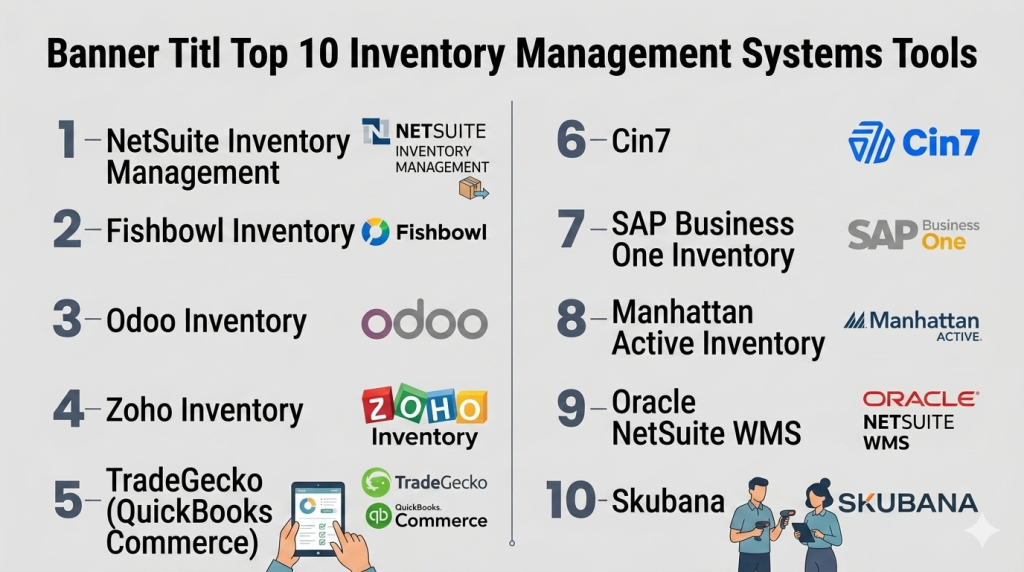
Top 10 Inventory Management Systems Tools
#1 — NetSuite Inventory Management
Short description: A cloud-based solution for enterprises looking to unify inventory, order management, and procurement processes. Suitable for mid-to-large scale organizations with complex supply chains.
Key Features
- Real-time inventory tracking across multiple locations
- Automated replenishment and demand planning
- Integrated order management and procurement
- Lot, serial number, and batch tracking
- Cloud-based dashboards and reporting
- Mobile app for on-the-go management
- AI-driven inventory forecasting
Pros
- Highly scalable for global operations
- Strong integration with other NetSuite ERP modules
Cons
- Higher price point may not suit SMBs
- Learning curve can be steep for new users
Platforms / Deployment
- Web, iOS, Android
- Cloud
Security & Compliance
- SSO/SAML, MFA, encryption
- SOC 2, GDPR
Integrations & Ecosystem
Supports ERP, POS, e-commerce platforms, shipping providers.
- APIs for custom integrations
- Prebuilt connectors for Shopify, Magento, Salesforce
- Vendor and supplier portals
Support & Community
- Tiered support options
- Comprehensive documentation and training resources
- Active user community forums
#2 — Fishbowl Inventory
Short description: Tailored for SMBs and manufacturing units, Fishbowl provides warehouse and order management capabilities integrated with QuickBooks and other accounting software.
Key Features
- Multi-location inventory management
- Barcode scanning and asset tracking
- Automated reorder points
- Manufacturing order management
- QuickBooks integration
- Reporting and analytics
- Mobile access for warehouse staff
Pros
- Cost-effective for SMBs
- Strong QuickBooks integration
Cons
- UI can feel dated
- Limited AI-driven forecasting features
Platforms / Deployment
- Windows, Web
- Cloud / On-premises
Security & Compliance
- Role-based access, audit logs
- Not publicly stated
Integrations & Ecosystem
Connects with accounting software, shipping platforms, e-commerce solutions.
- QuickBooks, Xero
- Shopify, WooCommerce
- REST API support
Support & Community
- Phone and email support
- Training webinars
- Moderate community forums
#3 — Odoo Inventory
Short description: Open-source ERP module suitable for SMBs and mid-market companies, combining inventory, warehouse, and e-commerce management in one platform.
Key Features
- Real-time inventory valuation
- Automated replenishment and procurement
- Barcode and RFID support
- Multi-warehouse management
- Integration with Odoo sales and e-commerce modules
- Reporting dashboards
- Mobile accessibility
Pros
- Flexible open-source platform
- Modular approach allows easy customization
Cons
- Setup can be complex
- Requires technical expertise for advanced customization
Platforms / Deployment
- Web, iOS, Android
- Cloud / On-premises
Security & Compliance
- SSL encryption, user permissions
- Not publicly stated
Integrations & Ecosystem
Odoo apps ecosystem, API access for custom integrations.
- E-commerce platforms
- POS systems
- Accounting and CRM modules
Support & Community
- Enterprise support plans available
- Extensive community resources and forums
#4 — Zoho Inventory
Short description: Cloud-based inventory system designed for small to mid-sized businesses, offering multi-channel selling and automated workflows.
Key Features
- Multi-channel inventory tracking
- Automated order fulfillment
- Shipping and logistics integration
- Serial number and batch tracking
- Real-time analytics and reporting
- Integration with Zoho suite and e-commerce
- Mobile application for inventory management
Pros
- Affordable and scalable for SMBs
- Strong e-commerce integrations
Cons
- Limited advanced manufacturing features
- May require add-ons for larger businesses
Platforms / Deployment
- Web, iOS, Android
- Cloud
Security & Compliance
- SSL, role-based access
- GDPR compliant
Integrations & Ecosystem
Supports Shopify, Amazon, eBay, QuickBooks, Zoho apps.
- REST APIs for custom workflows
- Multi-channel sales integrations
Support & Community
- Email and chat support
- Knowledge base and tutorials
- Moderate community presence
#5 — TradeGecko (QuickBooks Commerce)
Short description: Designed for SMBs and online retailers, TradeGecko simplifies inventory, orders, and sales operations with cloud-based tools.
Key Features
- Multi-channel inventory management
- Order and warehouse management
- Supplier and vendor management
- Analytics dashboards
- Pricing and discount management
- Integration with QuickBooks
- Mobile app support
Pros
- User-friendly interface
- Seamless QuickBooks integration
Cons
- Limited advanced manufacturing capabilities
- Cloud-only deployment
Platforms / Deployment
- Web, iOS, Android
- Cloud
Security & Compliance
- SSL encryption, RBAC
- Not publicly stated
Integrations & Ecosystem
- Shopify, Amazon, WooCommerce, QuickBooks
- API for custom integrations
Support & Community
- Email support and tutorials
- Active online user community
#6 — Cin7
Short description: Cloud-based IMS aimed at retail, wholesale, and e-commerce businesses for unified inventory and order management.
Key Features
- Inventory tracking across channels
- Point-of-sale integration
- Automated purchase orders
- Barcode scanning
- Multi-warehouse support
- Reporting and analytics dashboards
- Mobile application
Pros
- Strong multi-channel inventory features
- Cloud-first with good scalability
Cons
- Pricing may be high for smaller businesses
- Customization can be limited
Platforms / Deployment
- Web, iOS, Android
- Cloud
Security & Compliance
- SSL, RBAC
- SOC 2 Not publicly stated
Integrations & Ecosystem
- Shopify, Magento, QuickBooks, Xero
- REST API for custom workflows
- E-commerce marketplaces integration
Support & Community
- Email and phone support
- Online tutorials and knowledge base
#7 — SAP Business One Inventory
Short description: Enterprise-focused IMS integrated with SAP Business One ERP, designed for complex supply chains and global operations.
Key Features
- Multi-location inventory tracking
- Automated replenishment and alerts
- Batch and serial number tracking
- Forecasting and reporting
- Integration with finance, sales, and procurement
- Mobile access
- Barcode and RFID support
Pros
- Robust for enterprise supply chains
- Tight ERP integration
Cons
- High cost and complexity
- Implementation time can be lengthy
Platforms / Deployment
- Web, Windows, iOS, Android
- Cloud / On-premises / Hybrid
Security & Compliance
- Role-based access, audit logs
- GDPR, Not publicly stated
Integrations & Ecosystem
- SAP ecosystem and APIs
- E-commerce and POS connectors
- Supplier and logistics integrations
Support & Community
- Enterprise-level support tiers
- Extensive documentation and user community
#8 — Manhattan Active Inventory
Short description: Cloud-native IMS for large-scale retailers and distributors, offering real-time visibility and omnichannel fulfillment.
Key Features
- Omni-channel inventory management
- Warehouse optimization
- Automated replenishment
- Forecasting and analytics
- Integration with order management
- Mobile access for staff
- Barcode and RFID support
Pros
- Strong for complex retail operations
- Real-time visibility across channels
Cons
- Expensive for smaller businesses
- Learning curve for new users
Platforms / Deployment
- Web, iOS, Android
- Cloud
Security & Compliance
- SSO, encryption
- Not publicly stated
Integrations & Ecosystem
- ERP, POS, and e-commerce integrations
- API for custom workflows
- Logistics and shipping integrations
Support & Community
- Dedicated support teams
- Training and knowledge base
#9 — Oracle NetSuite WMS
Short description: Focused on warehouse management within the NetSuite ecosystem, supporting large enterprises with inventory optimization.
Key Features
- Warehouse and bin-level tracking
- Order fulfillment automation
- Real-time reporting
- Mobile barcode scanning
- Integration with NetSuite ERP
- Multi-location management
- Advanced forecasting
Pros
- Strong for large enterprise warehouses
- Seamless ERP integration
Cons
- Pricey and complex setup
- Less suited for SMBs
Platforms / Deployment
- Web, iOS, Android
- Cloud
Security & Compliance
- SSO, encryption, audit logs
- SOC 2, GDPR
Integrations & Ecosystem
- ERP modules, shipping, and logistics integrations
- REST API for custom extensions
Support & Community
- Enterprise support packages
- Extensive documentation
#10 — Skubana
Short description: IMS for e-commerce and omnichannel businesses, focusing on automation and analytics to streamline operations.
Key Features
- Multi-channel inventory management
- Automated order routing
- Analytics and reporting dashboards
- Supplier management
- Integration with e-commerce marketplaces
- Forecasting and demand planning
- Mobile access
Pros
- Excellent for e-commerce SMBs
- Strong automation capabilities
Cons
- Limited advanced manufacturing features
- Cloud-only deployment
Platforms / Deployment
- Web, iOS, Android
- Cloud
Security & Compliance
- SSL, RBAC
- Not publicly stated
Integrations & Ecosystem
- Shopify, Amazon, eBay, WooCommerce
- API for custom integration
- Shipping and logistics providers
Support & Community
- Email and chat support
- Knowledge base and tutorials
Comparison Table (Top 10)
| Tool Name | Best For | Platform(s) Supported | Deployment | Standout Feature | Public Rating |
|---|---|---|---|---|---|
| NetSuite Inventory Management | Enterprise | Web, iOS, Android | Cloud | AI-driven forecasting | N/A |
| Fishbowl Inventory | SMB, Manufacturing | Windows, Web | Cloud / On-prem | QuickBooks integration | N/A |
| Odoo Inventory | SMB / Mid-Market | Web, iOS, Android | Cloud / On-prem | Open-source flexibility | N/A |
| Zoho Inventory | SMB | Web, iOS, Android | Cloud | Multi-channel sales | N/A |
| TradeGecko | SMB / E-commerce | Web, iOS, Android | Cloud | Multi-channel inventory | N/A |
| Cin7 | Retail, E-commerce | Web, iOS, Android | Cloud | Omni-channel inventory | N/A |
| SAP Business One Inventory | Enterprise | Web, Windows, iOS, Android | Cloud / On-prem / Hybrid | ERP integration | N/A |
| Manhattan Active Inventory | Retail, Distribution | Web, iOS, Android | Cloud | Omni-channel visibility | N/A |
| Oracle NetSuite WMS | Large Enterprise | Web, iOS, Android | Cloud | Warehouse optimization | N/A |
| Skubana | E-commerce SMB | Web, iOS, Android | Cloud | Automation & analytics | N/A |
Evaluation & Scoring of Inventory Management Systems
| Tool Name | Core (25%) | Ease (15%) | Integrations (15%) | Security (10%) | Performance (10%) | Support (10%) | Value (15%) | Weighted Total (0–10) |
|---|---|---|---|---|---|---|---|---|
| NetSuite Inventory Management | 9 | 7 | 9 | 8 | 9 | 8 | 7 | 8.4 |
| Fishbowl Inventory | 7 | 8 | 7 | 7 | 8 | 7 | 8 | 7.5 |
| Odoo Inventory | 8 | 7 | 8 | 7 | 8 | 7 | 8 | 7.8 |
| Zoho Inventory | 7 | 8 | 7 | 7 | 7 | 7 | 8 | 7.4 |
| TradeGecko | 7 | 8 | 7 | 7 | 7 | 7 | 7 | 7.2 |
| Cin7 | 8 | 7 | 8 | 7 | 8 | 7 | 7 | 7.6 |
| SAP Business One Inventory | 9 | 6 | 9 | 8 | 9 | 8 | 6 | 8.1 |
| Manhattan Active Inventory | 8 | 7 | 8 | 7 | 8 | 7 | 6 | 7.5 |
| Oracle NetSuite WMS | 9 | 6 | 9 | 8 | 9 | 8 | 6 | 8.1 |
| Skubana | 7 | 8 | 7 | 7 | 7 | 7 | 7 | 7.2 |
Scores are comparative across tools. Weighted totals highlight overall suitability. Core features and integrations heavily influence the score for enterprise use, while ease and value are critical for SMBs.
Which Inventory Management Systems Tool Is Right for You?
Solo / Freelancer
Zoho Inventory or Skubana: affordable, simple interface, multi-channel support
SMB
Fishbowl Inventory or TradeGecko: strong QuickBooks/e-commerce integration, manageable costs
Mid-Market
Odoo Inventory or Cin7: flexible, modular platforms that scale with growth
Enterprise
NetSuite Inventory Management, SAP Business One Inventory, Oracle NetSuite WMS: robust features, ERP integration, global operations
Budget vs Premium
Budget: Zoho Inventory, Fishbowl, Skubana
Premium: NetSuite, SAP, Manhattan Active
Feature Depth vs Ease of Use
High-depth platforms may require training (NetSuite, SAP)
Simpler solutions prioritize ease and speed (Zoho, TradeGecko)
Integrations & Scalability
Ensure compatibility with ERP, e-commerce, POS, and logistics systems
Cloud platforms offer greater multi-location scalability
Security & Compliance Needs
Enterprises may require SOC 2, GDPR, audit logs, MFA
SMBs may prioritize basic role-based access and encryption
Frequently Asked Questions (FAQs)
1. What pricing models do Inventory Management Systems use?
Most IMS solutions use subscription-based pricing, often tiered by number of users, warehouses, or sales channels. Some enterprise platforms may have additional implementation and support fees.
2. How long does it take to implement an IMS?
Implementation varies by tool and business complexity. SMB cloud solutions can be operational in weeks, while enterprise platforms like SAP or NetSuite may require months of configuration and integration.
3. Can IMS integrate with my existing ERP or e-commerce platforms?
Yes, modern IMS solutions offer API-based integrations, prebuilt connectors for popular platforms, and support multi-channel operations. Ensure the vendor explicitly supports your systems before purchase.
4. Are there security risks with cloud-based IMS?
Cloud platforms typically provide encryption, role-based access, and audit logs. Enterprises should verify compliance standards such as SOC 2 or GDPR where relevant.
5. How does AI help in inventory management?
AI improves demand forecasting, identifies reorder points, predicts stockouts, and optimizes warehouse layouts, helping reduce carrying costs and increase service levels.
6. What are common mistakes when adopting an IMS?
- Failing to map workflows before implementation
- Choosing overly complex systems for small teams
- Ignoring integration needs
- Underestimating training and change management
7. Can I switch IMS tools easily?
Switching is possible but requires careful data migration, process alignment, and integration setup. Evaluate export/import capabilities and vendor support for transition.
8. How scalable are these systems?
Cloud-based solutions scale more easily across multiple warehouses, locations, and international markets, while on-premises systems may need additional hardware and licenses.
9. What industries benefit most from IMS?
Retail, e-commerce, manufacturing, distribution, and healthcare benefit most due to complex inventory needs, compliance requirements, and demand variability.
10. Are mobile apps important for inventory management?
Yes, mobile apps enable warehouse staff to scan barcodes, manage stock, and fulfill orders in real-time, reducing errors and improving efficiency.
Conclusion
Inventory Management Systems are essential for businesses aiming to streamline operations, optimize stock levels, and respond rapidly to market demand. Choosing the right tool depends on company size, industry, and operational complexity. SMBs may benefit from affordable, cloud-based solutions with strong e-commerce integrations, while enterprises require feature-rich, scalable platforms with comprehensive compliance and security features. Evaluating core functionality, integrations, security, performance, support, and value helps businesses create a shortlist, run pilots, and implement the system effectively. A well-selected IMS ensures operational efficiency, reduces waste, and enhances customer satisfaction.

Find Trusted Cardiac Hospitals
Compare heart hospitals by city and services — all in one place.
Explore Hospitals
Even with real-time tracking, differences can happen because of damaged items, returns, misplaced products, or manual errors. Regular cycle counts and simple checks can help find these issues early. This is important because good inventory decisions depend on the stock data being accurate.